Category Archives: Board Game
How Tall Is Your Spire?

I’m always curious to see how board games handle issues of scale. Is a desolate geographical region compressed, perhaps necessarily, in order to fit onto a map? Is a powerful monster larger than its weaker kin? Do oceans feel vast, or are they minor transitions between continents? Do stock markets plummet or gently slope?
And then there’s Gil Hova’s High Rise. Set on an island that could give Manhattan a run for its money, every addition makes its presence known. A size-six structure is twice as tall as a size-three structure. When somebody muscles into a district, the skyline is altered. When one of the taller edifices is constructed, it stands over the rest, unironically erect. Phallic comparisons? Isn’t that gauche? Not when it comes to corrupt billion-dollar enterprises stamping their mark on human endeavor. Scale is the point.
Oh, and it bears mentioning if but once: High Rise manages this without a single plastic miniature.
Viking Dice
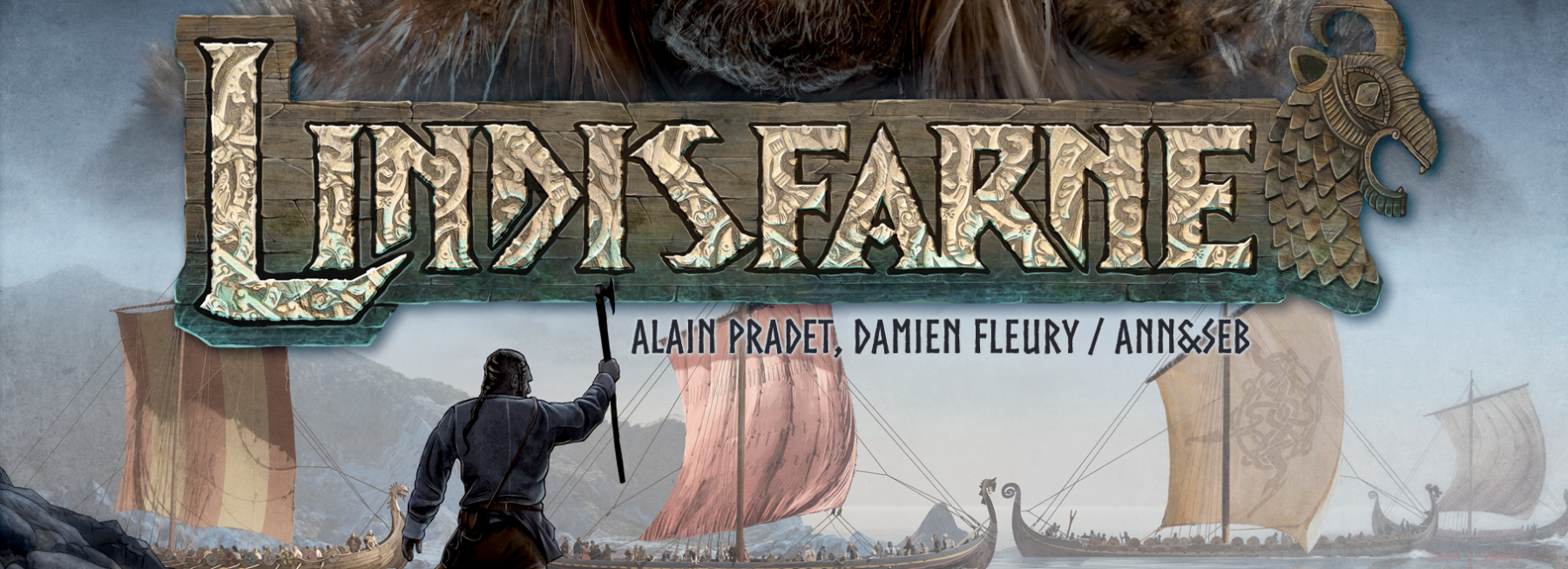
History is shot through with unintentional ironies. In response to political meddling in church affairs, English monasteries tended to be isolated on cliffs and islands, all the better for devoting time to God and avoiding the bickering of minor kings. In board game terms, they were located on the edge of the map. This solution worked — right up until June 793, when ships of Northmen made landfall and sacked the lightly-defended abbey on Lindisfarne before anybody from the mainland could respond. So much for keeping your back to the wall.
Alain Pradet and Damien Fleury’s Lindisfarne has nothing to do with that particular raid or its aftermath. It’s a dice game. A particularly clear-headed dice game that highlights both how to do dice properly and how to fail to generate much lasting interest.
Grant Rodiek Presents: Fart

What a difference a change of paint makes. Well, a change of paint plus a number of quality-of-life improvements, careful mechanical adjustments, and a near-total user interface overhaul.
Grant Rodiek’s SPQF was a treat, a Disney’s Robin Hood approach to deck-building and empire-building. Despite some jagged edges, it made a name for itself as one of the best games of 2018. But that’s old news. After some development with the folks at Leder Games, SPQF has been nipped, tucked, and fine-tuned into Fort. Quite the metamorphosis — and an improvement in nearly every regard.
Alone(ish) Against the Umayyads

The First Jihad is a shout of defiance — in more ways than one. Designed by Ben Madison and Wes Erni, it’s a long-in-the-making riff on the States of Siege formula, that old hallmark from Victory Point Games that saw lone players fending off encroachments along multiple lanes. Here, however, the concept is turned inside out. Rather than defending a central entity, you’re cast as up to fourteen different empires, city-states, tribes, and kingdoms as they weather the long century of Islam’s expansion under the direction of the Umayyad Dynasty. Less siege, more doomed containment.
Breezy stuff. Fortunately, Madison and Erni have a keen eye for how to capture the sweep of an era with a paper map and some chits.
Nojira: Tokyo Clash

Whenever I see a giant monster slap one of its peers with its tail or snap a skyscraper in half like a baby carrot, the question on my mind is anabolic. In the process of undertaking that action, how much energy was metabolized? The average elephant consumes 70,000 calories per day. Even cells altered by radiation must require fuel. Godzilla is at least twenty elephants in height. My back-of-the-napkin algebra reveals something horrific:
These monsters fight because they are the only source of food bounteous enough to sustain each other.
In a rare disappointment from Prospero Hall, Godzilla: Tokyo Clash gets one thing right — the caloric requirements of its creatures would leave them shuffling around with all the haste of chilled molasses. Scientific accuracy for the win! Compelling gameplay, not so much.
Ticket to Fly

Look, it isn’t that I don’t have the utmost faith in Seattle design collective Prospero Hall. I do. It’s just that their best games, titles like Horrified and Jaws, have been pitch-perfect distillations of licensed topics. Even How to Rob a Bank had its cartoony heist vibe going for it. Pan Am, on other hand? Since the airline’s bankruptcy in 1991, who’s passing out that license? I suppose there’s a solid probability that the answer is Disney. But why now? Is 2020 the year the Pan Am image needed a boost? Or has someone at the collective been holding onto their sweet Pan Am idea for decades?
Never mind. There are two main takeaways from this one. First, Pan Am is a graceful blend of worker placement, bidding, and stock hoarding. And second, it’s very nearly a commentary on the zombie-like nature of twentieth-century capitalism.
Talking About Games: Pax Pamirs and Framing

I appreciate any game that makes an argument. Even — perhaps especially — if I don’t agree with that argument. Even rarer is a game that makes multiple arguments for the price of one. All the better if some of those arguments are at odds with its other arguments, like a hydra snapping at its own throats.
Cole Wehrle’s Pax Pamir is one such game.
Across two editions and an expansion, Pax Pamir makes three distinct arguments from two separate authors. Those arguments have been both criticized and applauded, sometimes fairly and sometimes reflexively. Because this is the internet, both the critiques and the celebrations have often been painfully simplified. It would require an essay apiece just to deconstruct them fully. Rather than doing so, I want to touch upon all three so as to examine something tangential to their specific stances on the subject of the Great Game in 1823-1845 Afghanistan — namely, how differences of framing prompt divergent readings of Pax Pamir as a cultural artifact and historical argument.
The Review of the Field of the Cloth of Gold

Today marks the 500th anniversary of the conclusion of the 1520 summit between King Henry VIII of England and King Francis I of France. The purpose of this summit was nothing less than the leveraging of the scales of power in Europe. Long story short, Francis was the sovereign of one of two European superpowers — the other being Charles V of the Hapsburg Empire — and as such, he hoped to recruit the up-and-coming Henry VIII as an ally. Instead, they feasted and jousted and showed off fancy clothes for over two weeks, caused the site in Balingham to be named Camp du Drap d’Or, and, after frittering away unthinkable wealth, failed to produce an alliance when England hopped into bed with the Hapsburgs anyway.
Tom Russell’s The Field of the Cloth of Gold is an appropriate commemoration. Unlike the actual summit, this outing is a trifle, a game designed briskly and minimally. Yet its frivolousness is all the more fitting for the real event’s excesses, a chuckle at the peacocking its sovereigns would undertake in the name of an alliance that never materialized.
In other words, this is a wonderful send-up of the absurdities of Medieval gift-giving — and also point-salad game design. Different epochs, perfect bedfellows. And Russell has his tongue firmly embedded in his cheek as he officiates the marriage.
Pavement & Haze
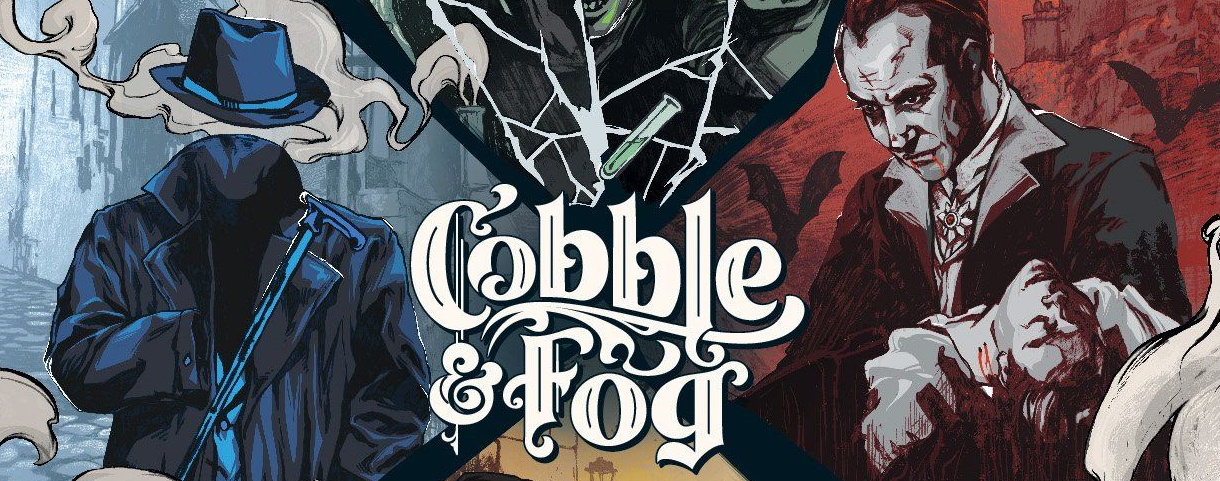
I love the gentle irony of Unmatched becoming the flagship property of Restoration Games. You know, the company dedicated to remaking older titles. Yes, yes, I’m aware that Unmatched is a quasi-remake of Star Wars: Epic Duels, but come on — that “quasi” is doing some world championship lifting.
Lest you assume I’m being sarcastic, I can assure you that my affection is genuine. The initiatory set, Unmatched: Battle of Legends, was one of the best games of 2019. My only complaint was that it was a mite too basic. With so many titles passing through every month, I wanted to see Daviau & Co. put their best foot forward. Show us the weird stuff! Go crazy with your characters! There’s no guarantee of any property surviving even a few weeks, let alone long enough to justify additional releases.
Well, I’m happy to eat my fedora, because Unmatched is still kicking. Better yet, Cobble & Fog is easily the most confident set in the series thus far.
Previewpalooza: Bullet, Intrepid, Pax Viking

Woe is me. I have let too many previews pile up, and now the reaper is coming to collect his due. What follows are three games that I’ve played only in limited fashion — digitally, in prototype, with unfinished components or rules — but certainly enough to get excited about. In other words, it’s fun to be enthusiastic, but be warned that the final game might be totally different from what I actually played.
Cool? Cool. Here we go.

 SPACE-BIFF!