Author Archives: Dan Thurot
Salmonella

In the United States, around four percent of all packaged chicken is contaminated with salmonella.
Just thought you might want to know that.
Anyway, Chicken! by the ever-prolific Scott Almes is all about backing out of a bad bet. You know, playing chicken. Supposedly.
Those Darn Kittens

Speaking as someone who regularly plays games filled with questionable content, I’m not sure I’ve ever witnessed stakes quite as high as those in Frank West’s Race to the Raft. The Isle of Cats has caught fire and it’s your task to herd these disoriented kittens to safety. Because they are cats, they are the opposite of ruly. My nine-year-old is invested. So invested, in fact, that I have been prohibited from playing it without her.
One Minute to Stationfall

I don’t remember how it came up. Andy Mesa, the principal developer on Matt Eklund’s Stationfall, mentioned that this was the logical endpoint of all those fancy patented techs in Pax Transhumanity. I can see it. All these advances, yet we still cut corners on the station’s construction codes. This is a place where heavily armed security bots brush elbows with sentient chimps and telepathic rats, where botanists and schizophrenic doctors chase patents of their own via research most unethical, where a billionaire has taken up residence across the corridor from the maintenance clones. And it’s falling out of the sky.
That billionaire, by the way, is the source of Stationfall’s least-subtle but best joke. But to understand it, you first need to onboard some basics. And what better way to do that than by hearing the tale of the time my best buddy was kidnapped?
Charmed!

Taiki Shinzawa has designed no fewer than three of my favorite trick-takers: American Bookshop, 9 Lives, and Ghosts of Christmas. Now two more of his designs are getting wider distribution thanks to New Mill Industries. There’s Inflation!, formerly known as Zimbabwe Trick, and Charms, née Dois. Both titles very much want to punish you for making grave counting errors.
Sounds Swedish

I’m one of those nerds who insists that board games “get Star Trek right.” Just ask my reviews of Star Trek: Ascendancy, which offers a longue durée telling of the series’ civilizations, or even Star Trek: Super-Skill Pinball, with its emphasis on weird situations and problem-solving.
But it matters. Star Trek was the formative science fiction of my childhood. It was never as polished as Star Wars. Maybe more importantly, its collectible card game wasn’t nearly as interesting. But it was a series that celebrated doubt and skepticism rather than positing that its in-universe religion was the font of truth. In Star Wars, success was a question of believing hard enough. In Star Trek, it was a question of breaking down the problem into its constituent pieces and then working through them. For a kid grappling with existential questions in a culture that offered too many glib answers, Star Trek was a promise.
So when three sets of Star Trek: Away Missions appeared unbidden on my doorstep, I was skeptical. Hey, that’s the Star Trek way. Maybe I shouldn’t have been. Although Away Missions has plenty of problems, getting Star Trek right isn’t one of them.
Rage Against the Artificial Machine
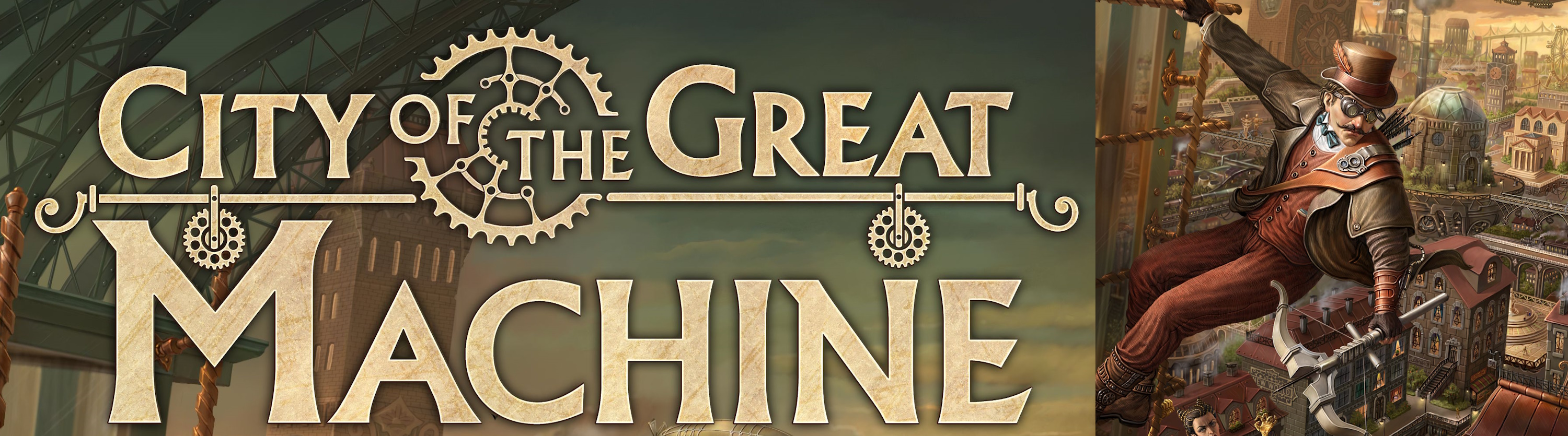
There are two cautionary tales in City of the Great Machine, the recent board game by German Tikhomirov. The first and more intentional of these tales is one we’ve read and watched and played many times. Decades ago, the citizens of this steampunk setting decided to automate the humdrum chores and maintenance tasks that were necessary for the operation of their floating city. Thanks to some serious feature creep, the great machine gradually took over more and more of the city’s labor. First it was factory work. Then sanitation. Next, security. Eventually, art. Tomorrow, perhaps, it will automate thinking altogether.
A resistance has formed. These brave men and women, armed only with stovepipe hats, corsets, and the occasional geared implement of war, intend to smash the great machine. Their one problem? Whenever they talk about the dang thing, everybody is too busy tinkering with its latest Midjourney ChatGPT steampunk app to pay attention.
The People Person’s People Power

Between its eleven volumes, two spinoffs, and a handful of spiritual successors, the COIN Series has covered a lot of ground over the past decade. It’s a series I’ve always appreciated for how it dusts the underappreciated corners of history for conflicts that are otherwise too unconventional for easy gamification. That said, it’s also a challenging series, both thematically and as player experiences, not least because of its unswerving dedication to force asymmetry. Perhaps that’s inevitable. It is, after all, dedicated to showing how small irregular forces can paralyze military juggernauts with their unpredictability and tendency to disappear into the countryside rather than trade blows with tanks and helicopters.
Somewhere along the way, the series morphed into a depiction of not only governments and insurgencies, but also popular movements. Kenneth Tee’s People Power: Insurgency in the Philippines, 1981-1986 leans into this more recent characterization. It’s also the simplest and most approachable the series has been since its second volume.
Space-Cast! #31. An Undaunting Conversation

As befits as large and ambitious a game as Undaunted: Stalingrad, today on the Space-Cast! we’re joined by Trevor Benjamin and David Thompson to discuss WWII, inclusions and omissions in historical games, and whether board games are art — or at least what it means for them to have authorial intent.
Listen here or download here. Timestamps can be found after the jump.
Emergence

It’s an easy thing to draw comparisons between one game and another when they share mechanical underpinnings, but I often prefer to dwell on those parallels that aren’t immediately clear. Take, for example, Adam DeYoung’s Emerge, the recent release from Pandasaurus that, for all intents and purposes, is another generic points-chaser. It’s a dice game at heart, and feels bland for precisely the same reason it feels rewarding in the moment, thanks to a core gameplay loop in which nearly every action awards roughly one point. It doesn’t immediately stand out from the pack.
But while playing Emerge, the strangest comparison kept springing to mind. That title was Jon Sudbury’s Ortus Regni.
In the Pale Blood Moon Light

Ryan Courtney is mostly known for games about pipes, but it seems I will forever prefer his less squiggly work. Bear Raid leaps to mind.
From now on, I expect it will be Spectral that leaves the strongest impression. Once every million years, give or take a thousand, the blood moon bathes a haunted house in its crimson light. On that night alone, spectral treasures can be found within. Also curses. Maybe look out for those.

 SPACE-BIFF!