All Things Go, All Things Go
Quinn Brander’s Rebuilding Chicago is one of the best polyomino-placement games I’ve ever played. That’s the lede, and I will not bury it. Even moreso than its predecessor, Rebuilding Seattle — not to be confused with Raising Chicago, which I do pretty much every time I say the game’s title aloud — this is a tight, smart, and addictive approach to city-building and competitive brinkmanship. The more I play it, the more I want to keep coming back.
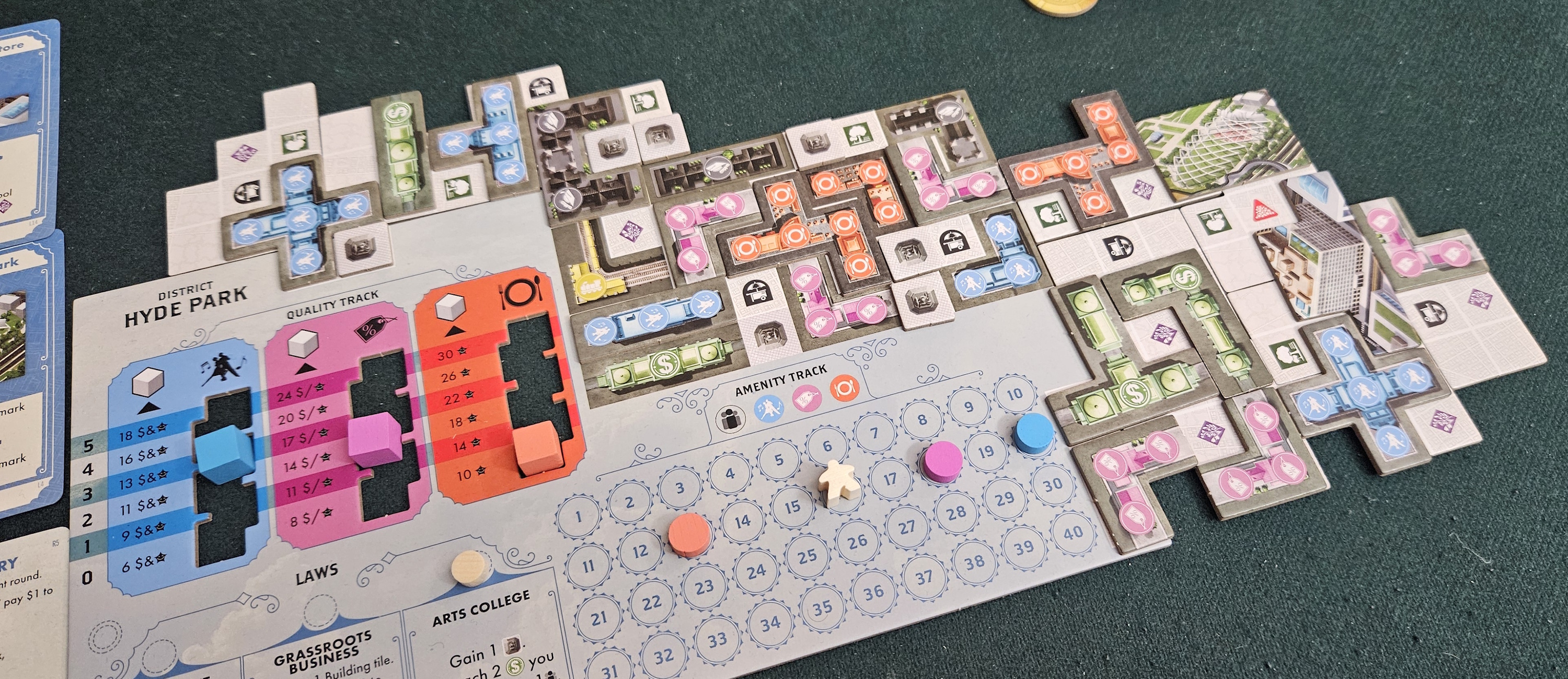
The player boards are also where you build your district.
Lest this become a comparison piece with Rebuilding Seattle, let’s nudge the parallels out of the way. Yes, this is more or less the same system. But where Seattle had some baggy Ozempic skin wrapped around its bones, Rebuilding Chicago sees Brander screwing down every edge and flap until all that remains is a taut cable that bears so much more weight than its predecessor.
We begin with the usual tale. Chicago has burned down. Cow in the shed, fire fire fire, a hot time in the old town tonight. Now it’s up to you to transform the rubble into not only into a place people can inhabit, but one they might visit from afar. A World’s Fair city. A city that stands for a thousand years. Or at least a little over a century, barring any further catastrophe.
Right away, there’s a confidence to the whole thing. Your player board, festooned with trackers and laws only you can pass, also shows the first portions of your city district. Cleverly, this district is fragmented. There’s the main area, filled with food carts and gardens and public parks — a lot of rubble, too — where you will place the structures that govern your city’s progress. But there are also two smaller areas, way off to the left and right. You’ll bridge to these areas eventually, but until you do so they’re unavailable, just collections of spun-off decay that must be reached eventually lest they produce an eyesore from afar.
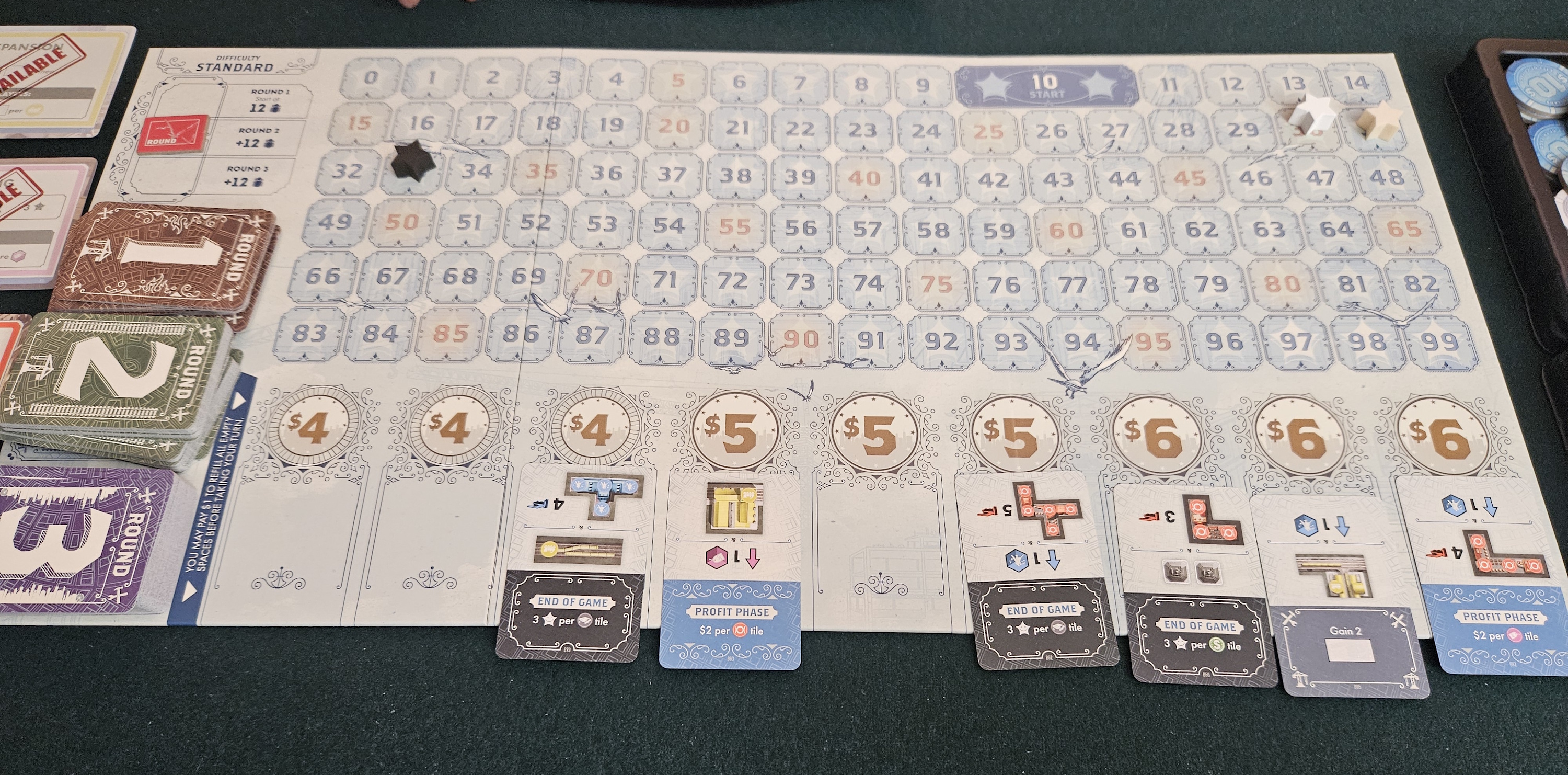
The card offer and scoring board is printed in base 17 for some reason.
Rebuilding Chicago, then, is a polyomino game in two layers. Underneath it all are suburbs, oddly shaped pieces that don’t always fit together easily, each providing the same icons that dominate your main board. Once adjoined to the rest of your city, these then provide the foundation for everything else.
It’s a little bit like building one jigsaw atop a different, mismatched jigsaw, with certain pieces you’d rather not cover because all those hot dog stands will provide income at regular intervals. But given how tight the game’s geography tends to be, sacrifices will have to be made. It isn’t uncommon, for instance, for your pitiless district councilperson to glean the benefit of those local hotspots, only to then immediately eminent domain them into new shopping centers.
There are seven types of structure in all, but three of them are given outsized attention: shopping, nightlife, and dining. These are your amenities, and unlike the banks and train stations and everything else, they’re given special trackers for both their quantity and quality. This is crucial, because at certain points someone, whether yourself or one of your rival district bosses, will trigger these amenities to score. When that happens, you check their position on your trackers against how many dissatisfied citizens are living in your district, subtract any shortfalls, and then earn victory points and hard-earned cash on the result.
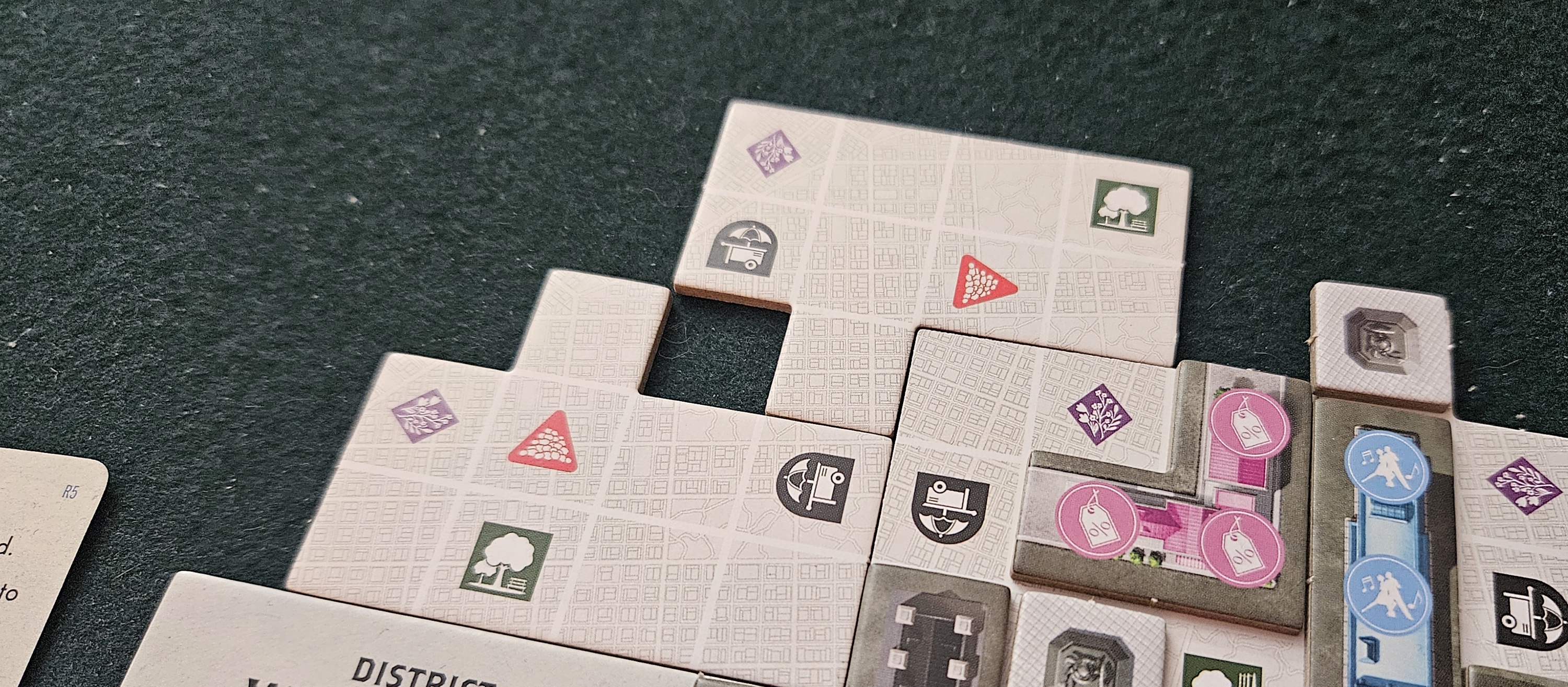
Those gaps in your city are entirely legal.
In addition to your ongoing construction projects, Rebuilding Chicago contains a whole series of interlocking systems, but never so many that the game becomes complicated to cluttered.
To start, there’s the drafting. You select buildings, bonuses, amenity perks, and everything else via a market draft. Each card offers both structures and some other bonus, forcing players to make hard decisions almost every turn. Meanwhile, the market doesn’t refresh unless you pay some cash to do it. This can feel restrictive at times, especially when you’re scraping the till for every last nickel, but also prevents the table from churning through the decks — of which there are three, one per era of the city — until they get precisely what they want.
Overlaid atop everything else is an event system that’s purposely frustrating in all the right ways. Claiming an event awards some minor bonus to the triggering player, while also applying a broader effect to everyone at the table. In many cases, though, the best outcome is to let some other rube trigger them so you can benefit without having to spend the turn.
These events run the gamut: new suburbs, cash for hot dog stands, scoring checks, even occasional bids to ensure your city is visible on the world stage. There are subtleties aplenty to consider, especially since events tend to be scattered among the usual card-drafting and city-building, producing little windfalls that punctuate the action. The result is a circadian rhythm that propels the game through both ups and downs. Sometimes players are flush with cash, other times events provide necessary infusions. It’s significantly more organic than the systems found in some tableau-builders, where everyone has resources until they don’t. Here, everybody is involved until the last event has been claimed. Then it’s time for the next round.
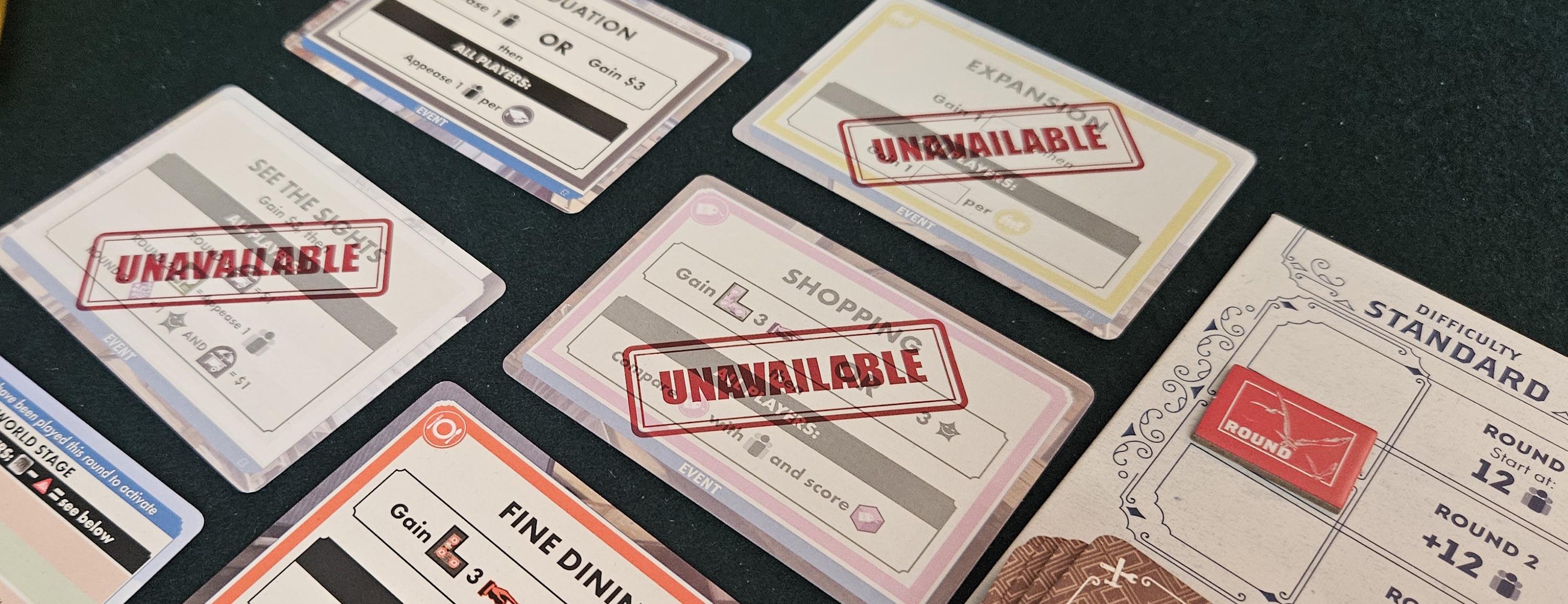
Events are powerful, and dictate the duration of the round.
Perhaps best of all, Brander’s vision of a city on the rise is pleasantly nuanced. The amenities are the clear show-stealers, with their periodic checks and windfalls. But every project receives its due in some manner. Trains allow access to distant suburbs, making expansion all the easier, although at times the additional responsibility can prove overwhelming, especially in the game’s early stages. Schools reduce the number of grumpy citizens, making it easier to appease your population via amenities. Financial institutions make money, special landmarks trigger sweeping bonuses that can alter your approach to scoring, and even single-square monuments serve to beautify your urban landscape and pave over unsightly messes.
It helps, too, that each player is given control over their own district, complete with its own starting benefits and unique laws, the game’s term for special abilities you can trigger once per round. The Loop, with its easy access to transportation, tends to expand rapidly, while River North feels a little more scrappy and Lincoln Park is thick with cash potential. There are six districts in all, and rather than settling for my usual three plays I couldn’t help but give them all a try, observing how Brander invests his system with distinct puzzles despite making only the barest of tweaks. My personal favorite, Hyde Park, leans into the education strategy to quell its citizen-grousers, but there are other approaches, all valid, with their own advantages and drawbacks.
Which is to say, it’s a stunningly rich system for so few rules. Perhaps that’s to do with how it always returns to its core considerations: the draft and how your rivals can steal precisely what you were looking for, the events that might occur one turn shy of their maximal benefit, and above all those wonderful skylines, all Tetris pieces and larger landmarks and monuments spackled into the cracks. This is one of those rare games that asks to be looked at for a moment, to be beheld, before everything gets sorted back into the box.
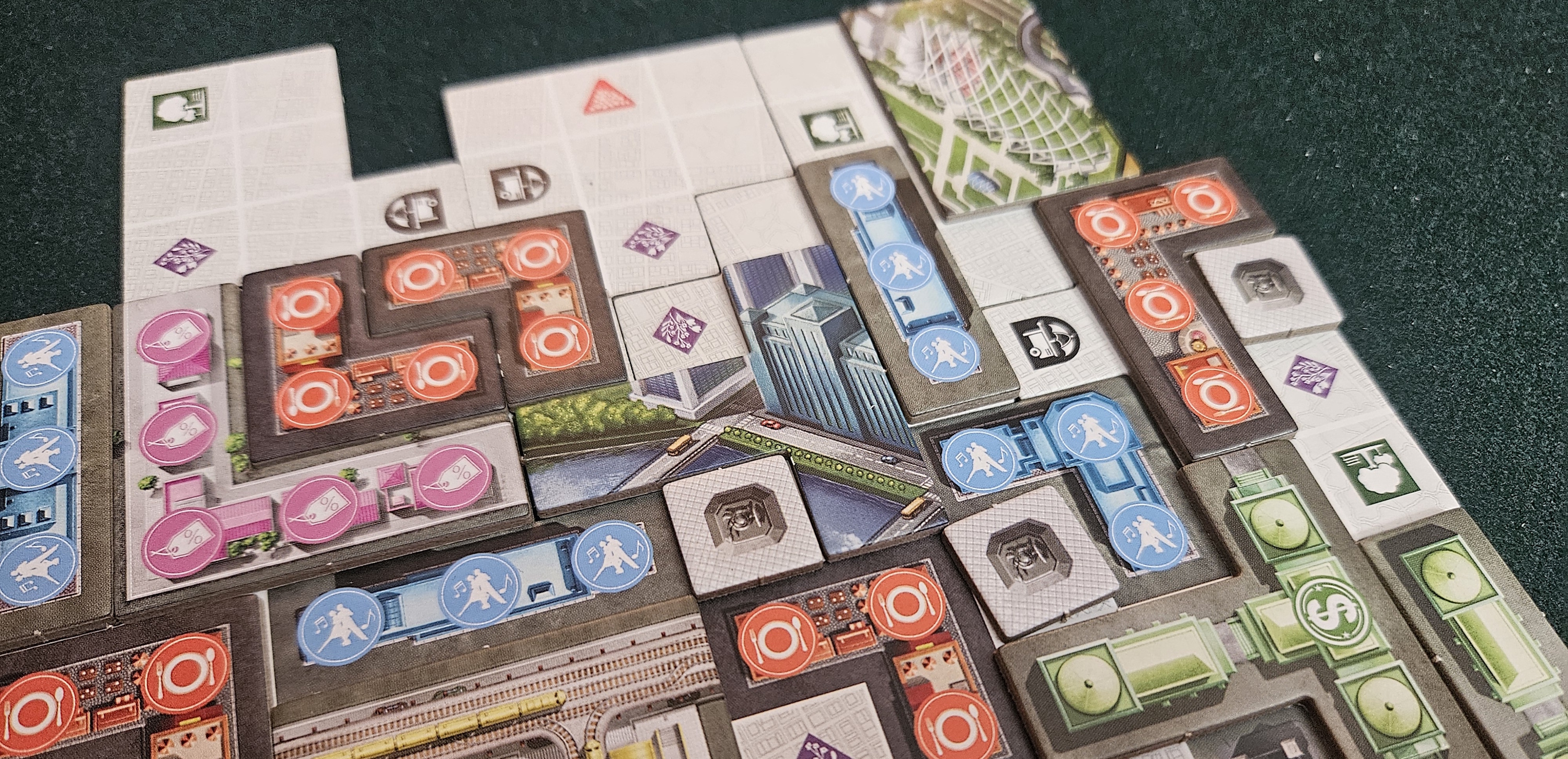
Hey, I’ve been to there.
In the end, Rebuilding Chicago realizes the promise of Rebuilding Seattle and then some. Where that game played it loose with every detail, this one cinches up its suspenders. The result is a mighty fine game in every regard. As a drafter, as a race, as a series of accidental or snitty thefts between players, as a positional puzzle to use every last acre of a city in metamorphosis. Here’s to a second round with each of those half-dozen districts.
A complimentary copy of Rebuilding Chicago was provided by the publisher.
(If what I’m doing at Space-Biff! is valuable to you in some way, please consider dropping by my Patreon campaign or Ko-fi. Right now, supporters can read my first-quarter update of 2026: the best board games, movies, books, and more!)
Posted on May 14, 2026, in Board Game and tagged Board Games, Rebuilding Chicago, WizKids. Bookmark the permalink. Leave a comment.

 SPACE-BIFF!
Leave a comment
Comments 0