High O’er the Billows We Are Wafted Along
Let it not be said that I don’t take requests. A number of readers have pointed out that it’s been a long time since I’ve covered any print-and-play games. Too true. But there’s a reason for that. Voyages, the six-map design by Rory Muldoon and Matthew Dunstan and the launchpad title from Postmark Games, is both an illustration of my reticence and a roundhouse kick to that same reticence’s noggin.
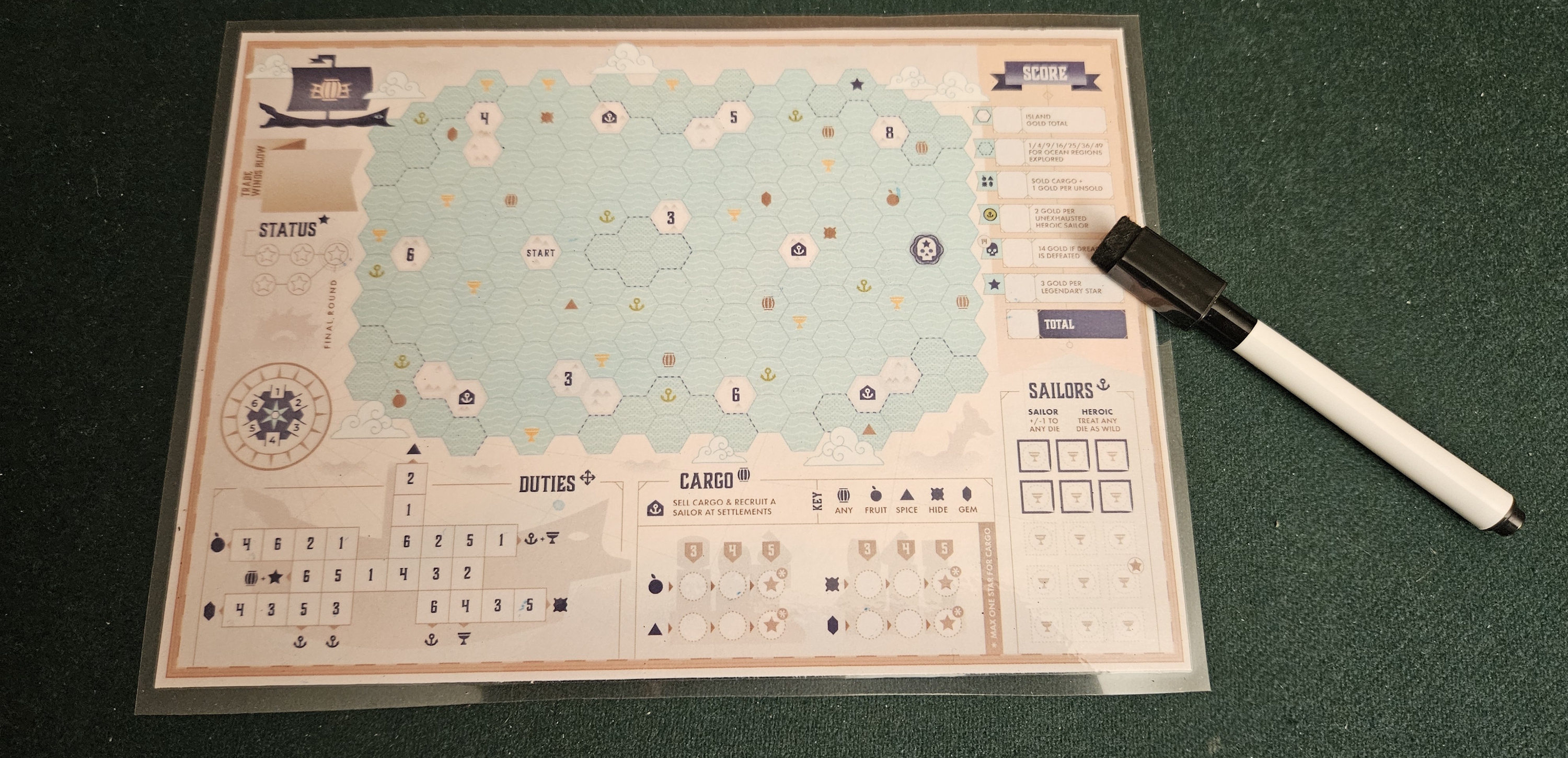
How Voyages really ought to look.
This is how Voyages is supposed to look. Soft hues, perfect for covering with pencil marks. (Or, if you’re a consummate professional, a dry-erase marker.) Weathered at the edges, giving it the feel of a brine-worn map. Crisp, with sharply defined edges, all the better for making out the proper boundaries of everything, from the sea’s hexes to the spaces for tracking the depletion of your sailors.
And this is how my version of Voyages looks:
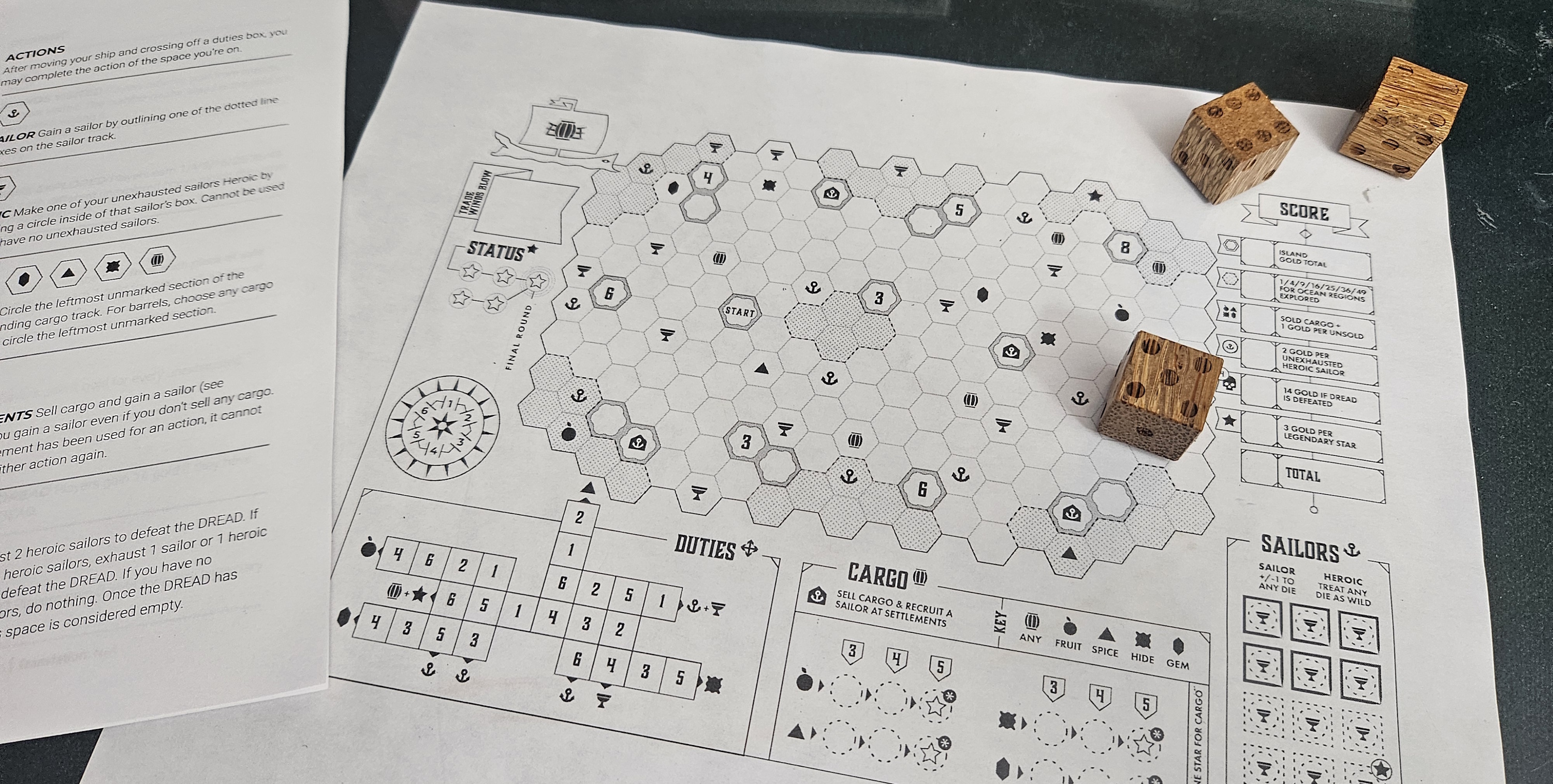
In my hands, how it actually looks.
Gray. Somewhat dull. Concealed beneath a much-abused plexiglass. Dice not included.
This is a very good thing. Because my main hangup with print-and-play games is that I only own a black-and-white printer. It works roughly a quarter of the time. The ink is sold at a premium by a cartel with armed enforcers and semi-legal firmware updates that mark my bootleg cartridges as empty until I bend a plastic doohickey, perform a hard reset, and offer three Our Emperors to the Omnissiah.
Discussing business practices isn’t very sexy. There’s a reason I don’t talk much about the publishers or marketing schemes behind the games I feature here. But in the case of Postmark Games, the business practice is the format. Buying a game gives you access to a Dropbox folder. That folder includes assets for both high- and low-ink printers. It’s as indie as it gets. A little fly-by-night. Shabby, if you’re the sort of person who demands a custom link to everything.
But the beauty of this format is that it’s also easy to use. Even with my wonky printer, I was able to get everything working in about two minutes. After another hard reset, I even had the rules sheet and a few warm maps ready to go.
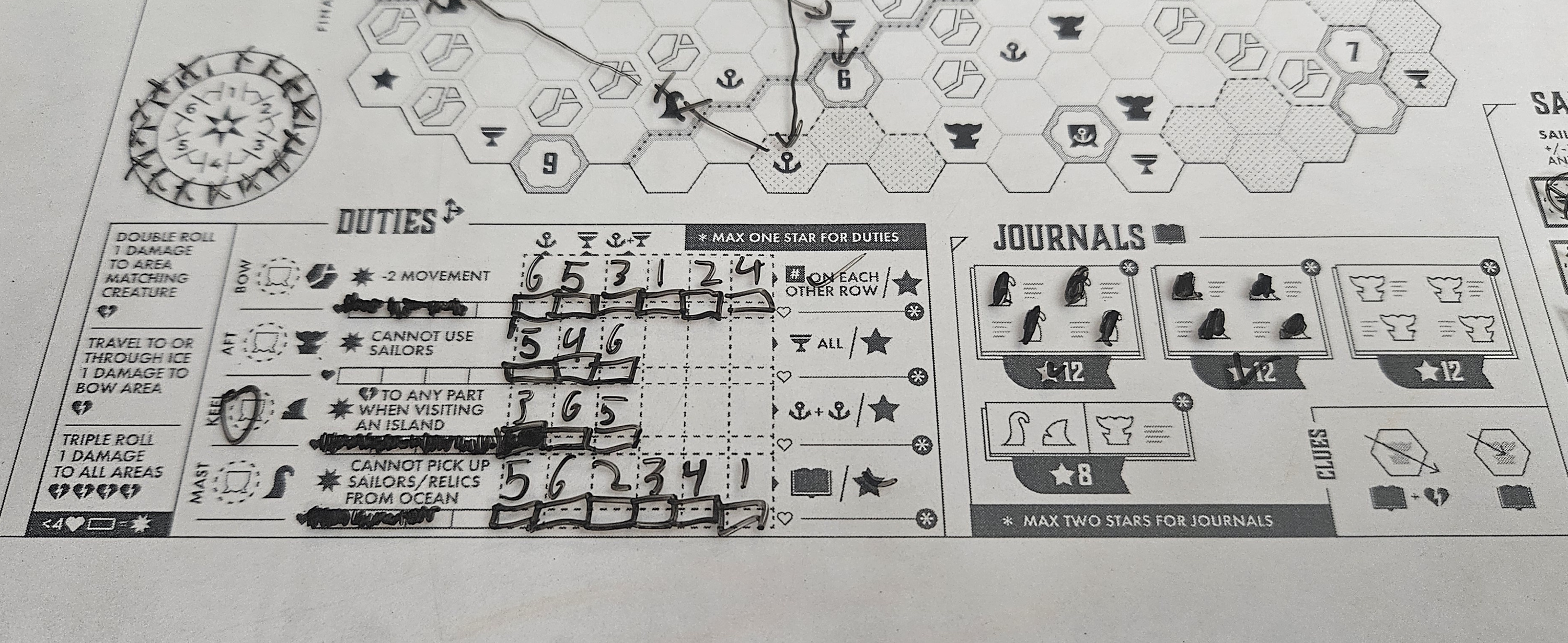
Sometimes your crew’s duties are tough, such as when you keep plowing into icebergs.
The gameplay, as befits a one-sheet roll-and-write game, is elegantly simple. You roll three dice and then assign them to three roles. One is your ship’s heading, which of six compass directions it will travel. The second is your speed, how far you’ll travel. You know, provided you don’t run aground on an island, hit a reef, or smack into the map’s edge. Between these two assigned dice, you’ll steer around the map to… well, it depends on the map.
Which brings us to that third die. This one governs your crew’s duties. But those duties differ from map to map. In the first map, this is a simple number-crossing game. If your third die shows a 3, you scratch off a 3 on your sheet. If this happens to finish a row or column, you earn a bonus. Easy.
But as the maps progress, the rules grow increasingly tricky. Not hard, exactly. Just tricky. Frankly, it’s impressive how much territory Muldoon and Dunstan are able to cover. Where one map sees your vessel racing to ignite beacons on lonely islands, another becomes a hard-bitten game of survival in arctic waters. The first map has some simple pick-up-and-deliver gameplay. Basic stuff. But another is all about catching the wind to drift between coral arches.
More often than not, these extra rules are handled by the die you assign to your ship duties. Repairing your vessel when it rams into icebergs or gets swatted by a whale. Tacking into the wind. Diving for treasure. Scavenging artifacts.
It’s a lovely system, surprisingly open-ended despite the stark limitation of three dice, and while there’s obviously a great deal of luck involved, it’s open to manipulation thanks to sailors who can be exhausted to ensure you don’t drift endlessly back and forth. More than once, I found myself thinking back to The Guild of Merchant Explorers, another flux-and-write game that threaded the needle between limitation and expression. That’s not exactly a coincidence, given that Dunstan co-designed that one with Brett Gilbert, but it’s notable how Voyages manages to produce an entirely different tale under similar constraints. To sail these waters is to be both buffeted by the winds and master of your own fate. It’s a wonderful paradox.
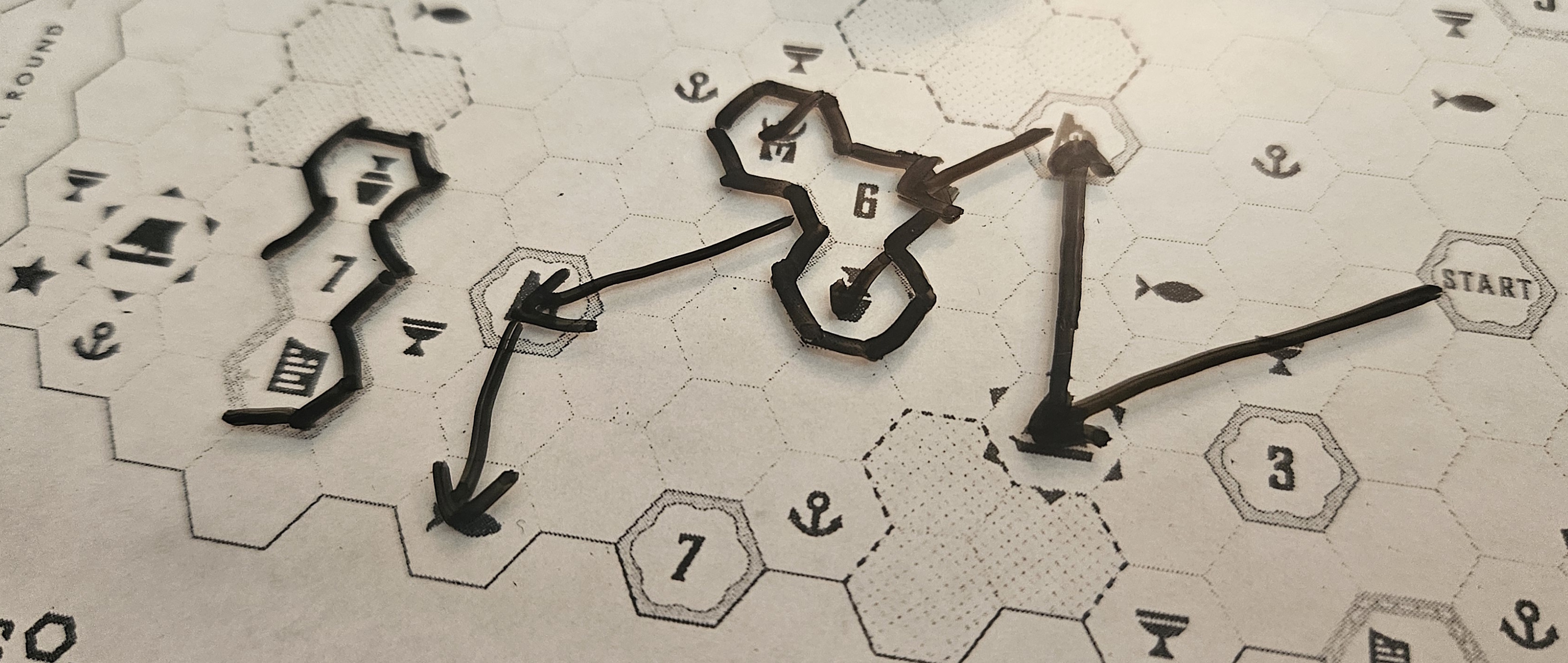
Charting invisible islands.
At first, my assumption was that Voyages would be a solitaire game. Because that’s what print-and-play games are for, right? And it is. A solitaire game, I mean.
But the solo mode is merely okay, a race to unlock three objectives (out of five) before sixteen turns have expired. Personally, I found that goal not only achievable, but usually laughable, barring a series of becalmed rolls. Anyway, what’s the fun of rushing all the time? The seas are full of things to discover. I’d rather take the time to poke around a corner before darting off to the next objective-indicating star.
Where Voyages shines is in multiplayer. The race element is still present, with those aforementioned objectives triggering the conclusion of the session, but the emphasis on scoring feels more natural to both the format and the setting. In this mode, there’s room to explore some more, everybody keeping one eye on their own heading and another on their opponents’ progress toward those objective stars. There’s also the pleasure of seeing what someone else did with the same rolls that caused you so much trouble. I was delighted by how quickly Summer picked up those first couple of maps, sailing gracefully from one isle to the next, scooping up sailors from their rafts and weaving between hazards. Compared to my bumbling from one island to the next, it was quite the sight. Also, her dry-erase lines are really sharp. Apparently I smush the felt into the plexiglass like some sort of ape.
If Voyages shines with multiple hands, it really glows when strung together in a campaign. This adds a little bit of everything. There are moonshot objectives to pursue, like visiting every single special zone on a single map or ensuring a half-dozen members of your crew upgrade to elite status. Stars can now be exchanged for upgrades, adding new ways to score points or mitigate a bad roll. And these newfound abilities are offset with the presence of a nemesis that adds increasingly difficult restrictions to the rules.
In the case of our campaign, our nemesis was Scar. Early on, he threatened to snipe any sailors we rescued from the water. Not too bad, given his shoddy marksmanship. But in the campaign’s later stages, he sent us sailing straight through islands rather than stopping automatically and eventually turned our three dice into a measly pair plus a duplicate. At the apex of our power, we found ourselves forced to wring every advantage from our abilities just to make a pit stop or sail the proper currents. The result was another careful dance between limitation and permissibility, stretching the system but never so far that it snapped.
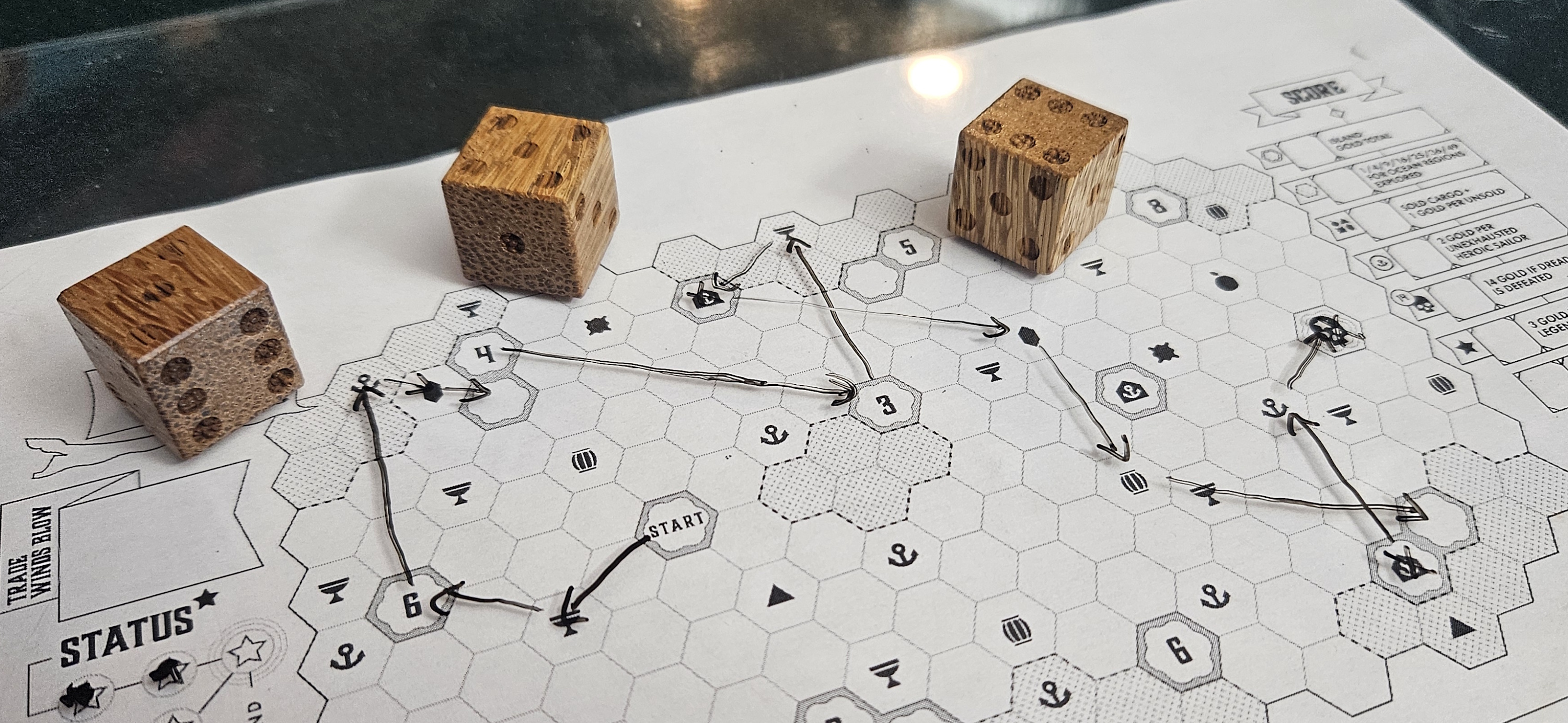
These are my “thematic” dice.
On the whole, I came away deeply impressed. With the business model, with the design, with the way the game actually came out okay on my cartel-operated printer. Crud, even with the way Voyages manages to be a roll-and-write that isn’t just sums and filling in test-sheet bubbles. As much as I enjoy some of those titles, free-ranging movement has its own organic appeal. I’ll go where I want, winds be damned.
Or tacked into, anyway. As I’ve noted before, Voyages is a masterclass in the way board games excel when they lean into the limitations of their medium rather than trying to escape them altogether. Voyages is something special. It seems I’ll be getting back into print-and-play games.
Access to the files to print Voyages was provided by the publisher/designer.
(If what I’m doing at Space-Biff! is valuable to you in some way, please consider dropping by my Patreon campaign or Ko-fi. Right now, supporters can read my first-quarter update of 2026: the best board games, movies, books, and more!)
Posted on May 4, 2026, in Board Game and tagged Alone Time, Board Games, Postmark Games, Print and Play, Voyages. Bookmark the permalink. 4 Comments.

 SPACE-BIFF!
I love Voyages, Dan! I have my students play it in my game design class (they love the competitive aspect), and then have then iterate off it for a design project. It’s just great for what it is.
That’s super cool! It seems like it would be a fantastic leaping-off point for a school project. There’s so much you could do with it.
I’m a fan of Postmark Games model… and I enjoy Voyages. For my money, though, their hiking/exploration game Waypoints is the most wildly creative roll’n’write I own and an utter delight to play.
I agree. Of the roll-and-move trio, Waypoints is the best of the group. I was originally going to “batch review” them, but then I figured they were different enough to warrant their own separate pieces. I’ll probably do one a week for a while.