Maybe Check Under the Mountain?

The old king has disappeared. Inconvenient. We were barely holding the place together as it was. Now four claimants are scrambling to seat their bums on the royal pillow. The pillow is on the throne, you understand. But it’s a sublime pillow. Too bad it’s no good for sharing.
Longtime readers will be well aware that one of my favorite types of game is the lane battler, whether we’re talking about classic Battle Line and Schotten Totten or something newer like Omen: A Reign of War, Haven, RiftForce, or Air, Land, & Sea. Even Marvel Snap qualifies.
The Old King’s Crown is a lavish addition to the genre. Designed and illustrated by Pablo Clark, this forthcoming title is certainly one of the handsomest games I’ve played in a long time. I mean, just look at the thing. Mwah.
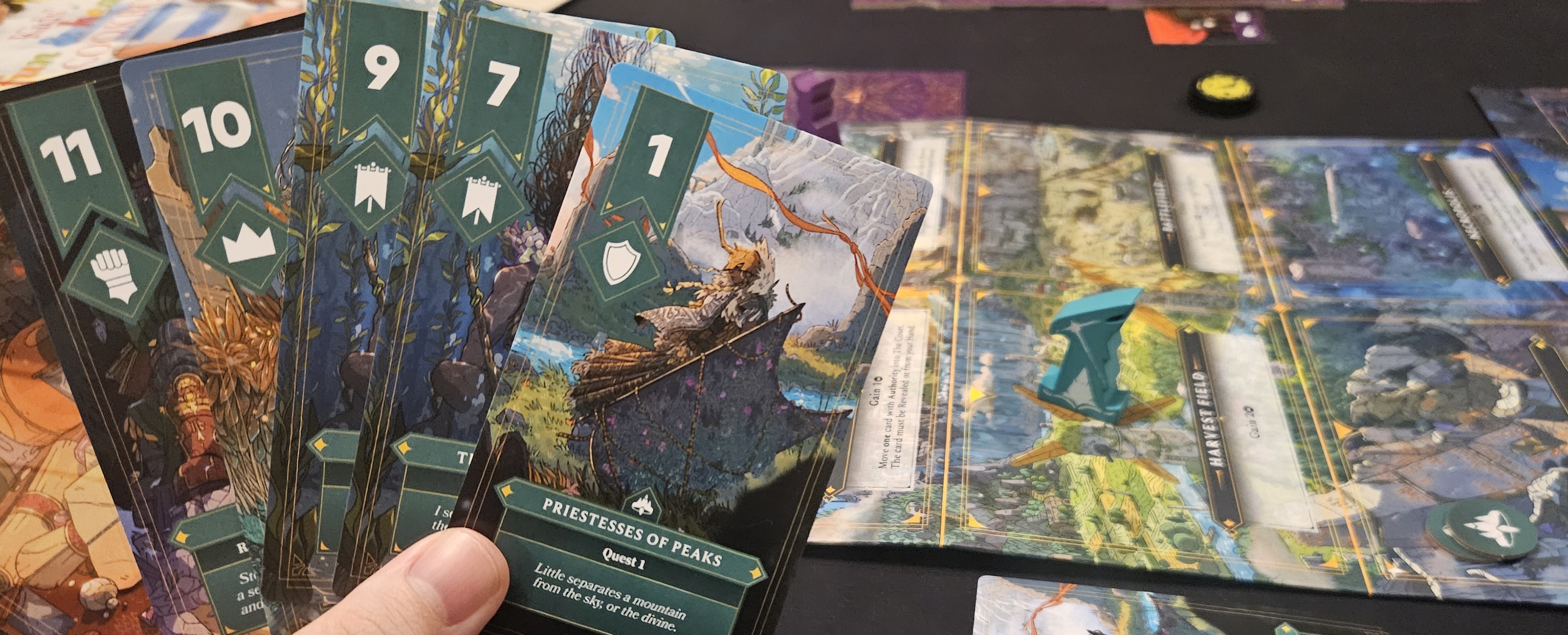
As with most lane battlers, the cards demand consideration.
Now let’s ask the follow-up question: Behind the good looks, why should we play this thing?
Thankfully, The Old King’s Crown’s beauty isn’t skin-deep. It’s down in the guts. Unlike most lane battlers, which trend toward sparseness, Clark seems more interested in going the other way. The Old King’s Crown is big and bombastic. It journeys in unexpected directions, taking detours that turn out to be an entire quest unto themselves. Yet it does so without feeling like it’s taken a third swing past the buffet.
Everything comes back to those core conflicts. There are four “lanes” for its factions to contest. What immediately sets them apart is that each is distinct, offering its own combination of advantages. They’re so different, in fact, that each lane comprises two separate locations. When the round begins, everybody places their herald at one such destination. It’s a small movement, but one loaded with import, like sliding your first pawn forward in chess or placing a bid in a high-stakes game of chance. Winning where your herald is located earns an extra point. Even cooler, if you place your herald atop that of another faction and win in that spot, you’ll also steal a point from them. Of course, you’re also chasing those location bonuses. There’s a lot to consider even from that single placement.
And what locations they are. I don’t want to keep drumming up Clark’s illustrative work, but the panoramic scene of the kingdom immediately sets the tone for what’s to come. The lowlands, for instance, are shadowed and chilly, as befits the locations that make up that lane. These locales are for deck management: the Shrine tweaks the order of your deck while the Necropolis restores stuff from your discard. In a game where shuffling through your deck permanently downgrades your hand size, these are both a big deal.
Meanwhile, the plateau in the middle tends to score raw points via the Harvest Field. The other option is the Battlefield, which either lets you strip a player of their own hard-fought points or pick up a special token called the collaborator. This is the first hint that The Old King’s Crown has a few tricks up its sleeve. Each of the game’s four factions boasts its own collaborator ability, but these aren’t available unless you hold this token. The collaborator therefore tends to bounce between players, enabling a powerful effect but only if you can hold onto his loyalty. The guy is a veritable Alcibiades.
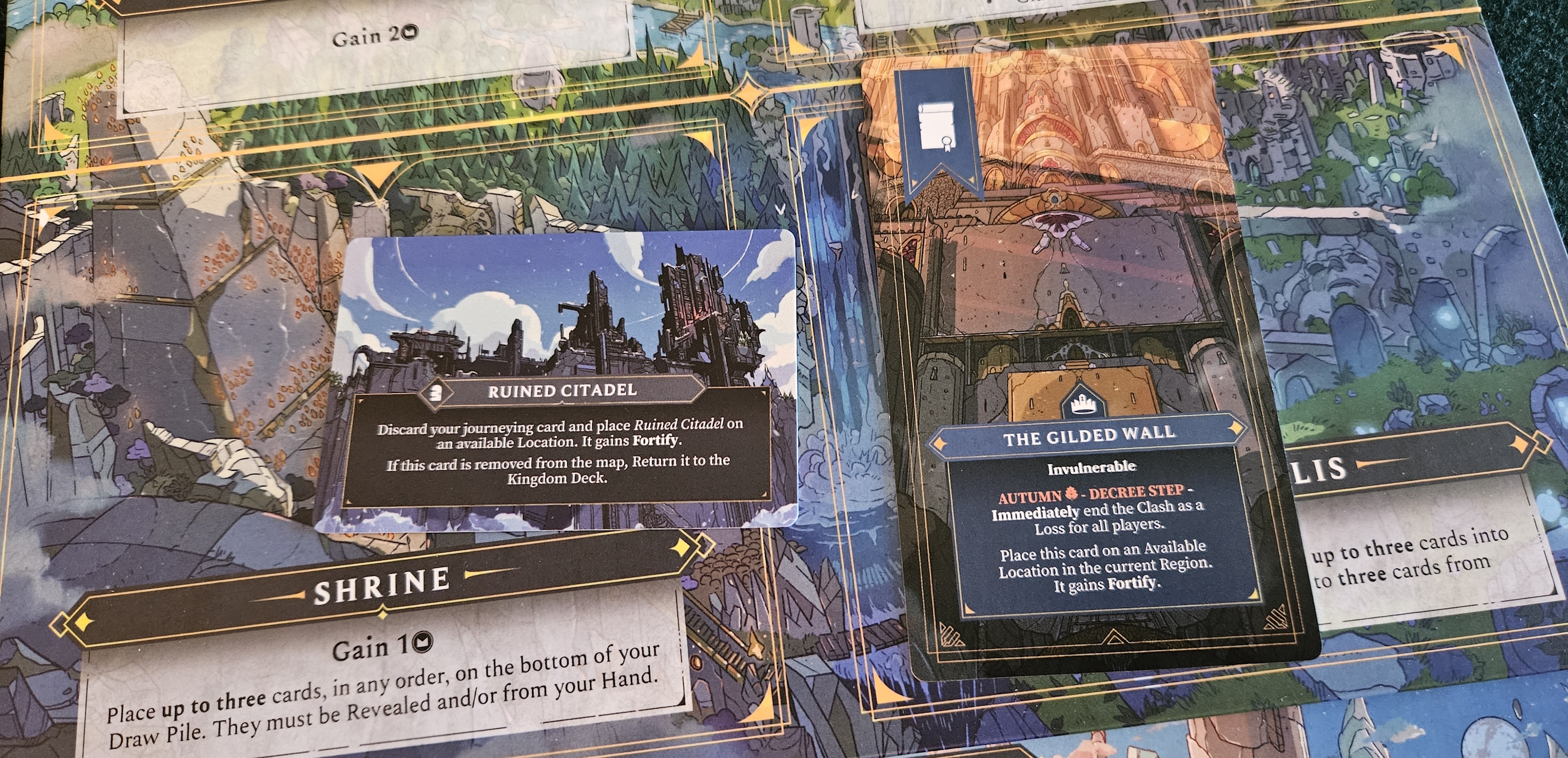
The battlefields are not only contested, but potentially upended by card effects.
The last two lanes are the most impactful in terms of disruption to the game state. There’s the Great Road, which doles out ability-modifying kingdom cards. These are powerful, tweaking or breaking the normal rules, but you also need to protect them lest your opponents steal them away. Finally there’s the highlands, with its Castle and Wilderness for sending your supporters off on adventures. In the former case, your supporters can petition at court, earning a trickle of points but almost certainly losing their favored status within a round or two. The Wilderness is even more exciting, deploying followers on quests to unlock more powerful cards or reactivate any special abilities you’ve deployed.
Okay, so that’s a lot of information. Here’s the protein. Rather than winning in any old place, your goal is to win strategically. If your deck is getting thin, it’s time to visit the lowlands. If you’re trying to build out your faction’s unique combos, you’ll likely head northward. Or maybe you’re just chasing points, in which case you can chase your opponent’s herald. Plenty of lane battlers give context to their various contests. The Old King’s Crown doubles down. Every little beat matters, and not always in the ways you expect.
If that sounds like a lot, it absolutely is. Right away, Clark constructs a rather formidable breastwork compared to other genre staples. We haven’t even discussed the cards yet, but they’re similarly disruptive. Those contested lanes, for instance, might be blocked by fortifications or raided by pillaging bands or reinforced by armed companies, while the tarot-sized cards offload the burden of a solid dozen keywords onto the players.
That same heft goes for the game’s phases. There are four seasons in each round, plus “start of year” and “end of year” effects, along with sub-phases that are either simultaneous or turn-based. A particular icon might designate an action as only useful in summer, except it’s talking about a particular step during that season. Some of this will likely be streamlined in the game’s final release, but it’s worth noting that even a streamlined version of this game is going to be heftier than its genre peers. Keep those reference sheets handy, because it’s a lot to take in.
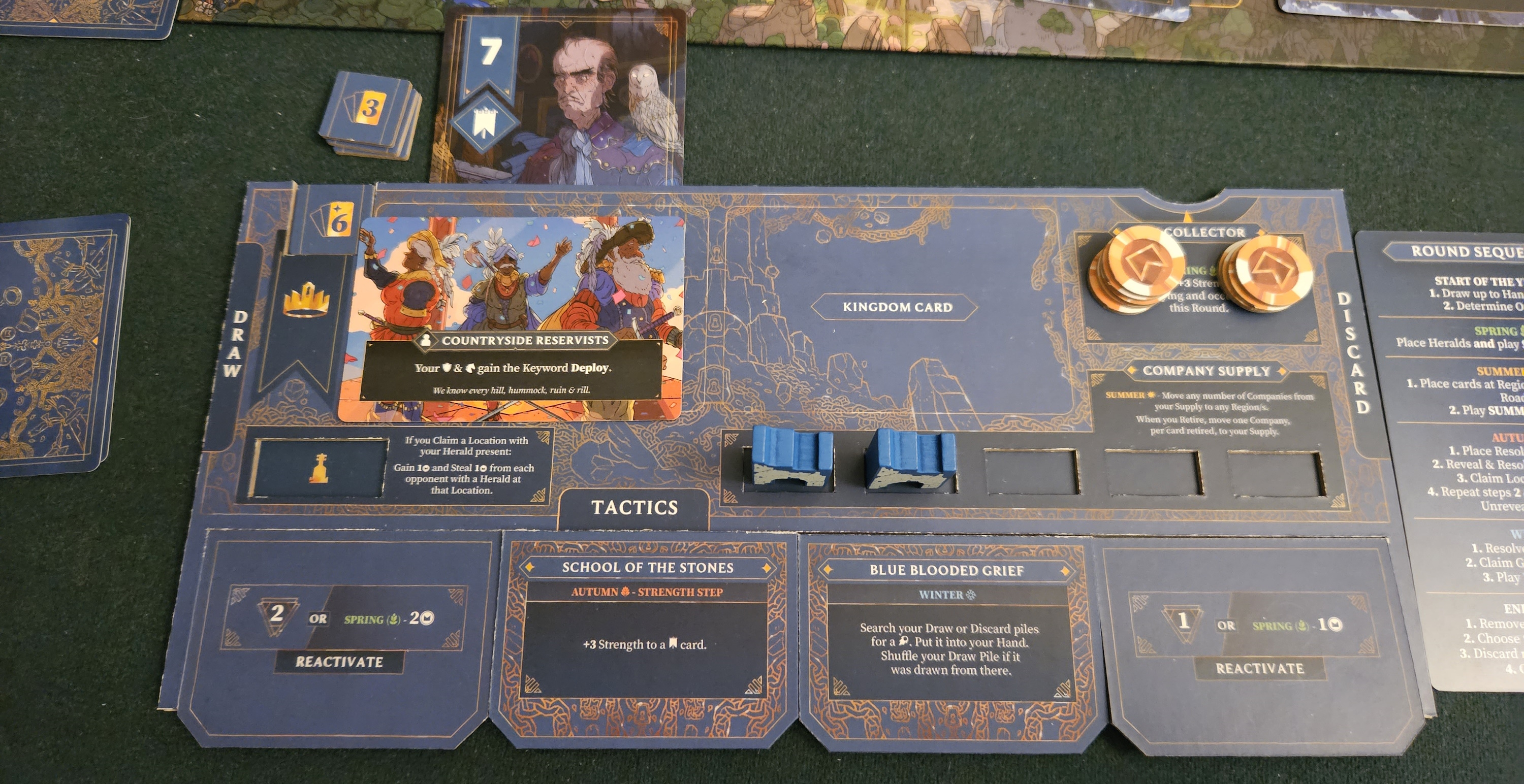
Building up my strength.
But… well, the “but” is found in even more complexity. That said, it’s a form of complexity that enriches the game rather than overburdening it. Beyond the keywords and phases, The Old King’s Crown puts its factional intrigues front and center. This highlights both the game’s tendency toward kitchen sink design and the advantages of allowing a design’s imagination to run wild. I’ve mentioned the presence of four factions. These are the stars of the show, and they’re unlike anything found in any other lane battler.
They’re also a joy to explore. Consider the Nobility. These are the rightful heirs of the vanished king, so they say, and they have an array of fairly traditional tools to prove it. Knights and cannons define their field strategy, making a solid showing and then boosting their strength from afar. But their more interesting tool is a clique of crusty old barnacles who know their way around court. These guys tend to dominate the Castle. Unlike other factions, the Nobility can pack the court with a whole retinue. This earns them a steady trickle of points per turn. If nobody bothers to disrupt it — and it’s very easy to neglect that sort of thing when there are objectives to pursue elsewhere — that trickle soon becomes a torrent.
That’s probably the most straightforward faction, although none of these people are quite as simple as they first seem. The Clans, for instance, behave like the barbarians they are, throwing down high-strength cards all over the place. But that’s only their day job. Surprise surprise, they also enjoy raiding. These special cards bounce between locations, gunking up the usual lane-based contests and bringing home spoils for their overlords. Other factions would do well to confront these pillaging parties. But when they try, the Clans can be unusually crafty, deliberately getting into ties and then resolving them in their favor. They’re real jerks like that.
The Uprising is subtle by comparison, using agents to murder their foes outright. Every faction has access to at least one assassin archetype, a card that can kill almost anybody but wilts in the face of certain icons. The Uprising makes the most extensive use of such backhanded killers, even peeking at rival deployments to ensure the blade catches its mark. Their Black Powder Ploy is my personal favorite card, blowing would-be kings to smithereens and winning the battle outright if they succeed in regicide.

Kingdom cards add new approaches as the game progresses.
Finally, the Gathering gives off serious cult vibes. Don’t worry, they would take that as a compliment. They’re the skulkiest faction of all, even going out of their way to lose as many battles as possible. They function like the opposite of a game timer, dragging at the leading player’s heels until they can unlock some cards that put their rivals’ tools to shame. In a game packed full of unexpected twists, it’s saying something that these are the folks most likely to kink the whole thing into a pretzel.
Those unanticipated twists are precisely what make The Old King’s Crown so thrilling. As you might expect, this is the sort of game that thrives on repeat plays. When you know what your opponents might accomplish, which little avenues they’re likely to pursue with their cards and abilities, that’s when it sparks to life. Knowing that the Nobility will try to enter the court, say, or that ceding a minor victory to the Gathering could throw their schemes into disarray, that’s the good stuff. Played well, The Old King’s Crown is about denial as much as anything. What your opponents want. How to stop them from getting it.
I say “opponents” because of one unique departure from the genre at large. Rather than capping at two players, it’s possible to play at any count between one and four. Each mode has its own feel, from the neck-and-neck contest between two peers to the clown-show rodeo that occurs when all four factions try to outguess one another’s plots at the same time. I prefer a session with three: that’s just enough to permit some testy handshake deals between trailing players without turning the box upside down. Even the solitaire is worthwhile. In an age when solo modes are often tacked-on marketing ploys, Ricky Royal’s Simulacrum faction is a highly moddable mechanized army of death. The Simulacrum isn’t reactive the way a human opponent would be, but it pursues its own interests with a dogged determination. Is it something I would play instead of a dedicated solitaire game? Well, no. But neither do I begrudge my couple of sessions with it, which is the normal state of affairs.

At four, The Old King’s Crown gets a little too wild for my tastes.
Regardless of the player count, I’ve had a tremendous time with The Old King’s Crown. It’s dense and sprawling where most lane battlers are pruned to a cutting edge, but sometimes a mace suits a task better than a blade — and anyway, this mace happens to include plenty of sharpened prongs of its own. What it sheds in aerodynamics it replaces with an epic feel that’s all too rare in this genre.
Best of all, that sweep, that sensation of belonging to something large and barely controlled, that’s what makes it worthwhile. One could describe it as Arthurian; perhaps the old king merely slumbers beneath the nearby mountain. In those moments of sweeping anticipation, everything clarifies. The cards have been learnt, the rules internalized. Everyone at the table has a session or two under their belts. All those errant notes resolve into a whole that’s at once thunderous and subtle. The game becomes a dance of competing interests and exchanged counters. That’s when The Old King’s Crown is at its best. There’s nothing like it. It has entered the pantheon of worthwhile lane battlers.
The Old King’s Crown launches on Kickstarter tomorrow.
(If what I’m doing at Space-Biff! is valuable to you in some way, please consider dropping by my Patreon campaign or Ko-fi.)
A prototype copy was provided.
Posted on October 23, 2023, in Board Game and tagged Board Games, Eerie Idol Games, The Old King's Crown. Bookmark the permalink. 16 Comments.

 SPACE-BIFF!
I had no idea this was a lane battler. From the casual glances at the imagery and some loose comments here and there, I assumed it was going to be in a similar vein to Oath.
It’s unsurprising that with 4p it gets wild given the game type but I’m glad to hear it works well with 3p. It seems a little sprawling for my typical 2p interests.
Going to do some more research now!
I was surprised at first when everybody was asking about how it compared to Oath, maybe because I always knew it was a lane battler! I had to zoom out a bit to see the comparison. Because, yeah, it does sorta look like Oath, doesn’t it?
The only thing that makes sense is that there are some thematic similarities and both have lovely, vivid art. I really don’t see any connection to Oath mechanically. Which is good, I bounced off of Oath particularly hard and am quite interested in The Old King’s Crown.
Yeah, no comparison mechanically. It’s all appearance. The herald/companies on the lanes in The Old King’s Crown look a lot like the guy/armies (I forget their names) on the shared tableau in Oath. At least that’s my guess.
I wish more people would talk about board games the way you do. You often manage to verbalize the reasons why board games appeal to me so much even though I might not take the time (or be too lazy) to figure it out on my own. Thank you.
You’ve also managed a second feat and that is that I’ve now backed my first ever Kickstarter. It was a temptation I had resisted for years but the invitation in your review this time was just too good to pass up.
That’s a big responsibility! I very much hope you love it when it finally arrives.
If I may be so bold, if you love what Dan does and want to support more critical discourse of board games as art, consider becoming a patreon like me 😁. There are not many who do what Dan does, but if people can make a living it at, there will be more discussions like this one.
Thanks for the plug, Jason!
Love your work as always Dan. Out of curiosity, how did you and Cole get involved in this game?
I’m not sure I could speak to the details there, unfortunately, as it’s been a couple of years now. I think Pablo reached out and asked if I would like to take a look via TTS. I play an unhealthy number of prototypes on TTS, and of course The Old King’s Crown was unusually handsome, so I was happy to give it a try. The system wasn’t wholly finished; it was more simultaneous, but this presented a few issues because players might base their placements on how their opponents played, which resulted in some weird timing bagginess. I don’t know when Pablo reached out to Cole — maybe he was pitching it to Leder? — but my understanding is that Cole suggested some changes and also that Pablo publish it himself. Fast forward some more months and Pablo showed it to me again on TTS. I agreed to write about the prototype. It took a while for the physical proto to be completed, but, well, here we are!
How very organic! Thanks for the info.
This is the most gorgeous art I’ve looked at for a while. I’m tempted to get the game only to be able to take a look at it whenever I want. The funny thing is that I sometimes do that with the cards from Omen…
Thanks for the write-up Dan, I hesitated to have a look at the rulebook but now I will do it for sure. The game seems to be a lot to take on upfront, but does the rules stick to mind after a few plays?
I played Ettin a few months ago, which is so far the heaviest lane-battler I’ve played, and was pleasantly surprised to see how easy it was to remember everything after the first Age thanks to the turn breakdown and the fact that every card is its own cheat sheet. In fact, taking a look at another faction’s deck after the first play, I could see how it would play, which says a lot about the clarity of the design, even if it might look messy at first.
Yeah, it sticks in the mind after a couple of plays. Like Ettin, it also comes with a very handy cheat sheet that breaks down all those little trigger words.
Pingback: Dudes on a Board | SPACE-BIFF!
Pingback: Sinking Buckets | SPACE-BIFF!
Pingback: All for Freedom and for Pleasure | SPACE-BIFF!