Blog Archives
Hot Alien-on-Alien Action
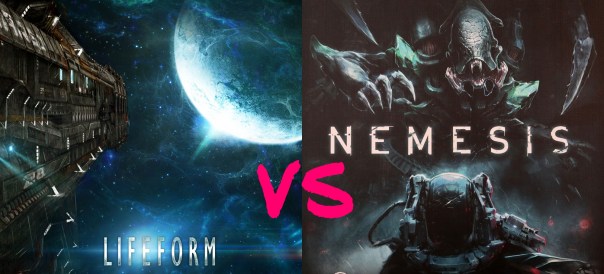
I didn’t actually watch Alien as a kid. Worse: my friends described it to me on the playground. It has been said that nothing is more terrifying than the unknown. That’s preposterous. It’s the half-known that’ll keep you up at night. To grub-form Dan, nothing was more terrifying than the prospect of Alien. Not even, when I finally got up the nerve to view it, the film itself.
Over the past month, I’ve played two separate releases that attempt to adapt the breathless horror that was initially brought to life by Ridley Scott and given an uncomfortable phallic pulse by H.R. Giger. And even though they’re remarkably similar in some ways, one of these games is among the year’s best while the other is merely fine.
Housing Crash: A Look at Magnate

It’s both accurate and misleading to say that James Naylor’s Magnate: The First City is a good version of Monopoly. Accurate because it’s a satirical take on unbridled capitalism that would do Lizzie Magie proud. Misleading because the two really don’t have much in common, aside from paper money, city development, plastic houses, and dice. Okay, saying that out loud makes them sound really quite similar. They’re not.
Seriously, they aren’t alike at all. You should keep reading. I promise.
Inspiration Plus Knowledge Is Wisdom
![A computer would read this as "VINDICATI[onevictorypoint]N"](https://spacebiff.com/wp-content/uploads/2019/11/1.-vindiheadercation.jpg?w=604&h=117 "A computer would read this as \"VINDICATI[onevictorypoint]N\"")
Sometimes — not often, but sometimes — it can feel as though I’ve seen all this hobby has to offer. The cause of such ennui is usually related to a deck-builder set in a licensed property. Event Horizon: The Card Game. Play the gravity drive card to trash your eyes cards. Yawn. Been there, winnowed that.
Every so often, however, something comes along that I haven’t heard before. Marc Neidlinger’s Vindication, for example. Its pitch starts out slow. “It’s an adventure game,” Vindication begins. Already my jaw is unhinging for the father of all yawns. Then Vindication finishes. “By way of resource conversion.”
By all rights, that shouldn’t be enough. I’ve been converting resources since my kids were in diapers, including the one that’s graduated to undies. But somehow, Vindication manages to not only make this idea work, but soar. It’s a strange world where tired plus tired equals really damn good.
Clodspire
Right up front, Cloudspire wasn’t made for me. Even with gobs of ways to play, ranging from a solo mode to cooperative scenarios, plus the regular competitive slugfest that goes all the way up to four factions, I can’t see the appeal. Maybe it’s because I have no history with the MOBA genre. Maybe it’s because I have a thing (a buried, unconscious thing) against poker chips.
Or maybe it’s because I like games that aren’t the board game equivalent of a chocolate syrup truck tipping over in slow motion. You know, a plodding mess.
The North Goes South

It’s been two years since we saw a proper Small Box Games release from John Clowdus. Unless we’re counting Kolossal’s printing of Omen: A Reign of War. Which I’m not, in case you were wondering. A professional printing may be glossy, but there’s nothing quite like the home-packaged feel of Clowdus’s limited runs, right down to its too-tight box and ribbon for prying the cards loose.
Thankfully, Clowdus hasn’t lost a step. The North is, at the absolute least, one stylish set of cards, with Aaron Nakahara’s chilly artwork raising the occasional goosebump. It also happens to be a deck-builder. Of course, Clowdus being Clowdus, that doesn’t make it like any deck-builder you’ve ever played before.
The Critic and the Card Game

If I’m being honest, I know nothing about The Girl and the Robot. The action-adventure video game, I mean. Initially I assumed it was an anime, another topic about which I know very little. But no, The Girl and the Robot was a video game years before it morphed into a card game. Don’t expect a blow-by-blow comparison. The card game is all I know.
And hey, it’s cute. Along with everything that word entails.
Captain Doomsday Laser

Looking back over Tim Fowers’ ludography, one encounters titles like Burgle Bros, Paperback, Hardback, and Fugitive. Small games that defy their size by yielding plenty of play. Bite-sized experiences that mingle with your saliva to swell into a wadded sock that leaves your jaw unhinged and your throat blocked. Except in a good way.
And then there’s… this. If not for the distinctive artwork from Ryan Goldsberry, the large unfolding box, plentiful miniatures, and over-the-top production of Sabotage would feel like a symptom of a minimalist recently disabused of his convictions. This is what happens when the Church of Portable collapses into schism, with Fowers playing Luther and Jeff Krause as that little Oecolampadius fellow.
How strange, then, that Sabotage might also be the best game we’ve seen from this little studio thus far.
Barker Placement: A Look at The Grand Carnival

Back in March I wrote about the seven best prototypes of SaltCon, including my personal favorite, The Grand Museum by Rob Cramer. You might remember Rob as the designer of the very silly wallet game Turbo Drift. Or maybe you don’t, because wallet games are tiny and often overlooked among the slew of big releases that clog up the headlines every month.
Well, fate is a strange thing, and not only because it doesn’t exist. After some retooling and a whole lot of development, The Grand Museum is back as The Grand Carnival, it’s better in nearly every way, and I’m here to tell you about it.
Hollow Is Right

As much as I appreciate asymmetry, not every game needs its sides to adhere to different rules. But as long as you’re going for it, there are worse pitches than Skulk Hollow. Basically, it’s man versus monster — except the men are foxes and the monsters are ten-story behemoths reminiscent of Shadow of the Colossus, including the “clamber up their short hairs to stab them in the soft spots” part.
I’ll say this for Skulk Hollow: ambition isn’t its problem.
More Vaster, Less Vastish

What I most appreciated about Vast: The Crystal Caverns was its improbable intermarriage of two ideas. The first was its dungeon, generated in roguelike fashion from a generous stack of tiles, producing a sprawling cavern filled with perils and plunder. The other idea was deep, even idolatrous asymmetry. Far more than the possibility of the multiple heroes offered by so many other dungeon crawls. Rather, it was an all-inclusive medley of characters and play styles. The knight versus the dragon, but also the sneaky thief, a pack of suicidal goblins, and even the haunted cavern itself, all working at cross-purposes.
Just as Vast beget Root, Cole Wehrle’s more approachable take on rabid asymmetry, so too does Patrick Leder’s Vast: The Mysterious Manor emerge from a paradigm established by Root. Which is really just a fancy-pants way of saying that this is a kinder, friendlier Vast — when it comes to learning the rules, at least.

 SPACE-BIFF!