Blog Archives
Back to the Burgle
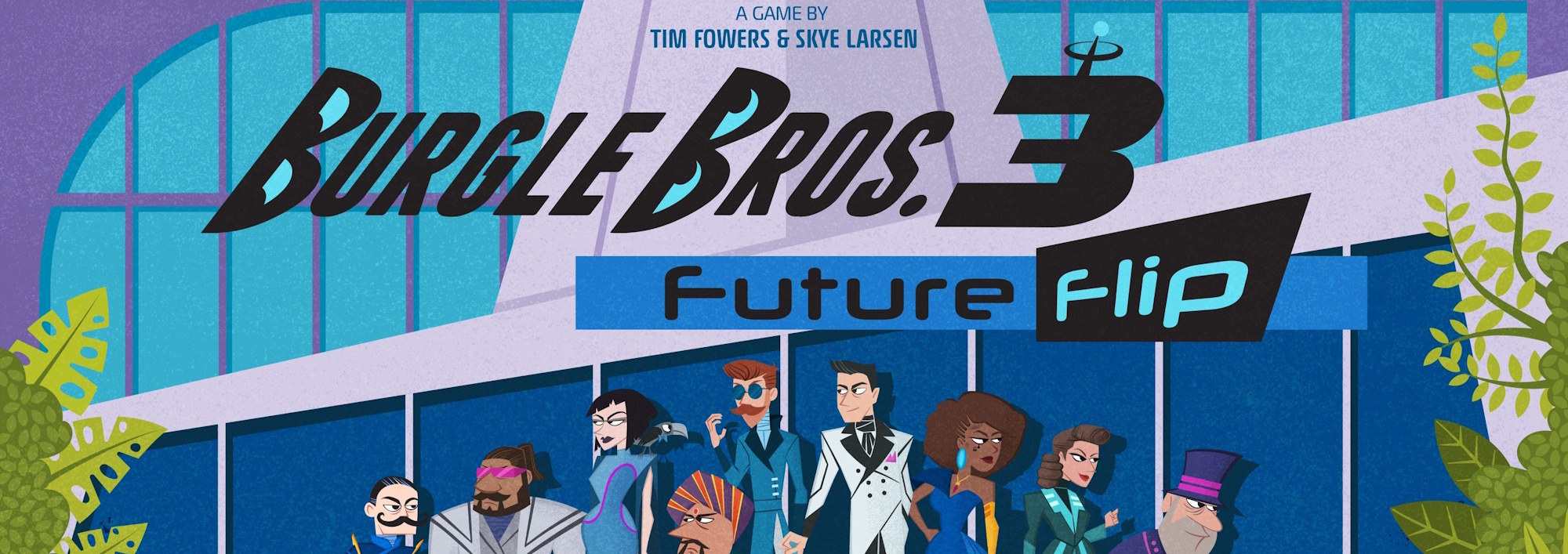
Have these bros had enough burgling? Apparently not. After two full Burgle Bros, not to mention at least three other wacky stealth games, I think it’s fair to confess to some fatigue. Burgle Bros 3: Future Flip moves the action into the not-too-distant future, where soulless megacorps run the world, intrusive surveillance is ubiquitous, and onesies are the height of fashion.
Apart from the onesies, that could be right now.
A Triphthong of Word Games

One of my favorite things about playing and critiquing board games is seeing the way designers can push the same mechanism in different directions. It’s not unlike a creative writing exercise in which everybody begins with a single prompt yet still produces their own individual perspective.
Here’s my latest example: I’ve been playing three word games that all revolve around pulling letters, chit-style, from a container. From that sliver of overlap, three distinct titles emerge, each with their own sensibilities and tics. Rather than spreading them across multiple reviews, I figured we might as well see how they fare in the grammar arena, my totally made-up word game deathmatch.
AMBLE
I own a pocket watch from Stratford-upon-Avon, a trinket I picked up to commemorate viewing Macbeth at the Royal Shakespeare Theater. It’s a gorgeous little thing, clasped in silver, its open face and back revealing the clockwork precision within. Everything has a purpose: the hairspring that stores tension, the jagged teeth of the escapement wheel that tick out the seconds, the gems that cap the gears to minimize friction. Sometimes I wind it up just to set all those pieces in motion.
RUN, a hidden movement game by Moritz Dressler, reminds me of that pocket watch. As an object of mechanical fascination, there’s nothing quite like it. Everything has its proper place. It ticks smoothly.
But it’s also pointless. An artifact, a curiosity, rather than something I’m going to actually carry around.
Running Shoes Unlocked

You’ve heard the story. Boy meet girl. Girl chases boy. Boy leaps off building, evades federal marshals with the help of a nightclub’s smoke machine, wades through the sewer, and boards a plane to a non-extradition nation.
It’s been a hot minute since I wrote about Fugitive, Tim Fowers’ highwire hidden movement game. There’s now a second edition out. I wasn’t anticipating that I would play it, let alone write about it, but it’s stolen my heart all over again.
If Books Could Kill

It’s hard to go even one minute in the presence of Paperback Adventures, the latest word game by Skye Larsen and Tim Fowers, without drawing comparisons to Slay the Spire — specifically, the original digital game by Anthony Giovannetti and Casey Yano, not the forthcoming cardboard adaptation by Gary Dworetsky. At this point, a Mormon genealogy project would struggle to detangle its heritage. Slay the Spire spawned entire crowds of imitators, but it was also a successor in its own right, drawing on both roguelikes and the tabletop deck-building craze. It’s been almost a decade since Fowers’ original Paperback, itself a deck-builder. Now it’s back after some liberal cribbing from Slay the Spire. Trace that lineage and you get a time paradox.
Here’s the crazy part: Paperback Adventures is possibly the finest title Fowers has produced. It might even be superior to Slay the Spire. Hear me out.
Burgle’s Four

I had a love/hate thing with Burgle Bros. It was so frustrating that I eventually gave it to my pal Brock. Later, I missed it enough to ask if he was done with it, whereupon “Brock brought back Burgle Bros” became our game night tongue-twister of choice. Naturally, I never played it again.
So it’s a thrill that Burgle Bros 2: The Casino Capers is more than a sequel. It’s everything the original game wasn’t.
Captain Doomsday Laser

Looking back over Tim Fowers’ ludography, one encounters titles like Burgle Bros, Paperback, Hardback, and Fugitive. Small games that defy their size by yielding plenty of play. Bite-sized experiences that mingle with your saliva to swell into a wadded sock that leaves your jaw unhinged and your throat blocked. Except in a good way.
And then there’s… this. If not for the distinctive artwork from Ryan Goldsberry, the large unfolding box, plentiful miniatures, and over-the-top production of Sabotage would feel like a symptom of a minimalist recently disabused of his convictions. This is what happens when the Church of Portable collapses into schism, with Fowers playing Luther and Jeff Krause as that little Oecolampadius fellow.
How strange, then, that Sabotage might also be the best game we’ve seen from this little studio thus far.
The Enburgling: A Look at Burgle Bros 2

I enjoyed Burgle Bros despite some caveats, even though my fondness dimmed somewhat with time and repetition. Still, there weren’t many moments as memorable as when Brock brought back Burgle Bros after keeping hold of it for a few months. Say that five times fast: Brock brought back Burgle Bros.
Well, this time he won’t need to. Last week, I sat down with Tim Fowers for a look at his and Jeff Krause’s sequel, Burgle Bros 2: The Casino Capers, on Kickstarter now. And while anything and everything is subject to change — the perils of a preview, unfortunately — here are the three things that rekindled my affection for this heist simulator.
Passenger 56
Ever wanted to run your own airline? An airline in a universe where scheduling computers and aviation engineers don’t exist, so you’re in charge of designing planes and booking flights mid-route? On a fifteen-second timer?
Yeah, me neither. But at least Now Boarding makes it better than it sounds.
Make a Million for You Overnight
Despite its staid outward appearance, Hardback is the byproduct of word game inbreeding. Its daddy is Tim Fowers, the same fella who brought us Paperback a couple years back, while its father is Jeff Beck, creator of last year’s Word Domination. Even a description of its particular playstyle feels like dendrochronology performed on a family tree: what Paperback was to Dominion, Hardback is to Star Realms.
Fortunately, that word-jumble statement is actually pretty easy to explain.

 SPACE-BIFF!