Blog Archives
Draculas, Frankensteins, Woofmans
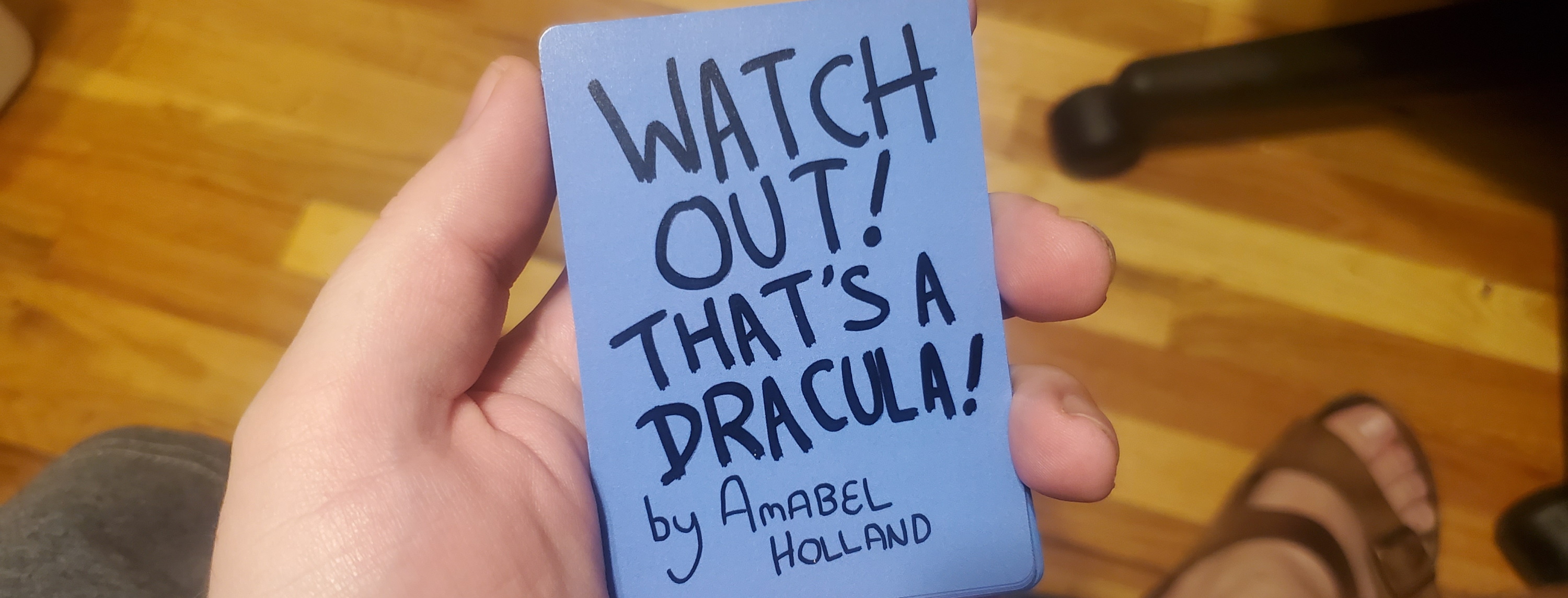
Every year, Amabel Holland designs a freebie game for Hollandspiele’s Hollandays sale. In the past, certain of these freebies have even been among the year’s best.
Watch Out! That’s a Dracula! might be my favorite yet. And not only because it treats Dracula like an absolute doofus.
A Deodorant for Excessively Hairy Men

“Northgard” sounds like a deodorant brand. Probably one that smells of pine needles and draugr leather. Northgard: Uncharted Lands, on the other hand, is the latest adaptation of a video game that happens to be considerably more competent than its bastard offspring. Based on Norse mythology in the loosest sense, players are tasked with leading a clan to preeminence. Mostly this consists of exploring terrain, fighting monsters, fighting other Vikings, fighting the winter, and never once setting foot on a boat.
At times, bits of flint shine through the muck. The rest of the time, it’s gone to mud.
Two Minds About Final Girl
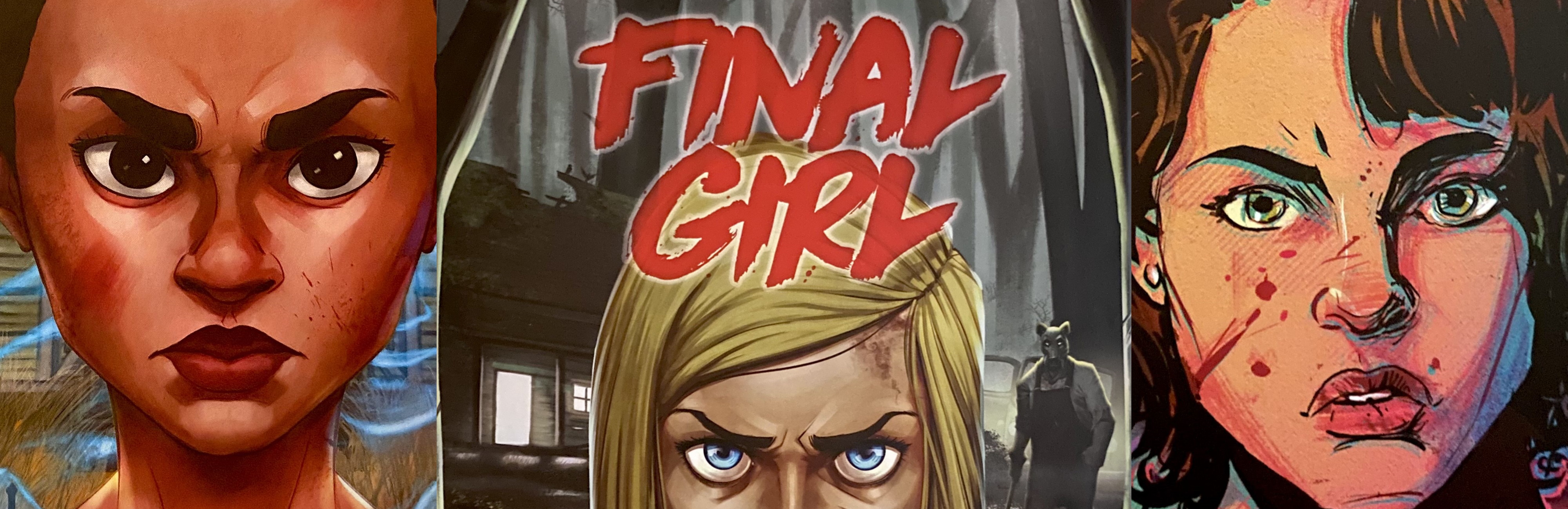
Brock: Can horror exist outside a movie, or a book, or a gaggle of costumed teenagers in a problematic haunted asylum? Does it require one or more draculas?
This time around, Dan and I put on our Two Minds lederhosen to tackle Van Ryder Games’ Final Girl. We wanted to discover just how well a horror movie could be translated to cardboard and dice, and just how small wooden cylinders in a board game could get. Will we make it out alive?
Dan: And I even own real lederhosen!
Aroo!

Ashwin Kamath and Clarence Simpson’s The Wolves comes with a soundtrack. Not on CD or MP3, and certainly nothing officially composed. It’s the compulsive “aroo!” that players belt whenever their pack of noble wolves takes the howl action. I have yet to play a game without somebody launching into that enthusiastic howl.
What about the game? Yeah, that’s pretty good too.
Twilight Iconographies

When we talk about “roll-and-writes,” the genre that’s going through a minor renaissance, we’re really talking about two slightly different things. Roll-and-writes, in which you roll dice, and flip-and-writes, in which you flip a card. Generally, both see everybody at the table using those identical inputs on their own board. It’s easy to see the appeal. The action is simultaneous, fast-playing, and highlights why “input luck” doesn’t feel unfair the way “output luck” does. Here’s a random number: put it to good use. (Unlike output luck, which says, Take your action: now here’s the roll to determine its outcome.) As a bonus, everybody gets the same number.
The biggest distinction between the two has everything to do with how that random input is curated. In a roll-and-write, you’re using dice. There’s more wiggle room to its randomness. In theory, an entire game could pass without a certain roll ever appearing. In a flip-and-write, drawing from a deck means you’ll eventually see a selection of possibilities. That’s less randomness, but more predictability. Yes, that can be a weakness. Neither system is inherently better than the other; they just have different ideas about how to best generate their inputs.
James Kniffen’s Twilight Inscription is both a roll-and-write and a flip-and-write. On one level, that isn’t surprising; it’s an adaptation of Twilight Imperium, that famously gargantuan game of stellar conquest. On another, it creatures a leviathan of its own, one that’s spread across four interconnected games.
Going to Bed Angry
I occasionally think back on the mudslide of advice I received when Somerset and I got married. There was so much, and we were so inexperienced, that at the time it was impossible to sort into good or bad. Hindsight helps. Some of it has proved apt (“Keep making the choice to love each other”). Other tidbits were stale even at the time (“Always listen to your wife, but as the man of the house you’re the tiebreaker”). And then there were the lines that sounded good until we realized they were soul-crushing (“Never go to bed angry”).
Xoe Allred’s Persuasion is about a brand of holy matrimony not all that far off from the partnership Summer and I entered into — young, rapid, religious, and oh so very Victorian. But where other recent games about the courtship rituals of yestercentury have been drier than hardtack, Allred’s take is viciously seductive. Not because it’s particularly spicy. Oh no. Because it’s so toxic it could break a Geiger counter.
Divide and Redivide
Yesterday, two to five oligarchs divided the planet to make space for their surplus mansion greens and car elevators. After World Splitters, World Exchangers, designed by Romain Caterdjian and Smoox Chen, jumps forward a generation. With humanity under thumb, what’s left for the ultra-rich?
They’re doing it all over again. This time, the stakes couldn’t be higher: for funsies.
Divide and Tally
At first glance, Tony Chen and Romain Caterdjian’s World Splitters, the latest of two titles from Taiwanese publisher EmperorS4 about the antics of the future uber-rich, looks like a riff on Dots & Boxes. Some have even asked if it might be kin to Android: Mainframe. Now there’s a game that feels much older than six years.
To some degree, yes, World Splitters is Dots & Boxes. That is, if Dots & Boxes featured clever auctions and a horrific tiebreaker system.
Strangling on Bootstraps

There’s this adage our mission mom used to tell us. This was prior to 2019, when a mission president’s wife finally became an official calling rather than one inequality among countless others. She didn’t have an official role despite fulfilling numberless functions, among them an ambiguous blend of cheerleader, guilt tripper, and motivational speaker. Every couple of months, dozens of nineteen-year-old Mormon missionaries would crowd into a tiny room to be scolded and encouraged, sometimes in the same breath.
“According to scientists,” she would say, in a voice that made one suspicious she hadn’t conferred with a scientist on the matter, “the bumblebee is so heavy and un-aerodynamic that it’s incapable of flight. But nobody ever told the bumblebee that. Whether you’re a bumblebee, a person out of a job, or a missionary hoping to bring others to Christ, all you need to do is pull yourself up by the bootstraps.”
Steve Dee’s The Rent is an autobiographical microgame about pulling oneself up by the bootstraps. It has a somewhat dimmer outlook on letting the ignorance of bumblebees stand in for economic theory.
No County for Old Men

After I declared Mind MGMT my favorite game of 2021, the pressure must have been unbearable for Off the Page Games. All right, all right, I doubt they noticed. Still, Jay Cormier and Sen-Foong Lim’s adaptation of Matt Kindt’s comic series was such a zinger that any follow-up would be swimming upriver.
Case in point, Harrow County: The Game of Gothic Conflict, co-designed by Cormier and Shad Miller as an adaptation of the comic series by Cullen Bunn and Tyler Crook, which is on Kickstarter for the next two days — yes, I’m running behind — carries itself with an exerted air. It does so many things in a short span of time. Maybe it should have doubled down on two or three.

 SPACE-BIFF!