Blog Archives
Hot Cross4 Buns
Back when I was in the dating pool — the late Pleistocene, oh ho ho — I would sometimes tell women that my only qualification for a life partner was somebody I could “play boggle in bed” with. This was, of course, a euphemism for playing Bill Cooke and Allan Turoff’s 1972 word-making board game Boggle. While atop a bed. Because beds are cozy. And let me tell you, that joke goes so much harder among people who don’t play so many board games that they immediately assume that’s what I meant by “Boggle” in the first place.
Amabel Holland’s cross4 falls into the category of retro word games. Like Boggle, I suppose. Frankly, I would rather play Boggle. Which perhaps isn’t a ding against cross4 so much as it is a statement about how great Boggle is.
Space-Cast! #50. City of Six Amabels

Not many board games are as mysterious as City of Six Moons. Is it a puzzle? A working board game? A grift? To answer those questions and many more, today we’re joined by Amabel Holland to discuss her oddest title yet, the joys and perils of translation, and her recent efforts to preserve board games that have fallen out of fashion.
Listen over here or download here. Timestamps can be found after the jump.
Three Phases of Six Moons

The past is not a foreign country but an act of imagination, one that can have greater or lesser fidelity to something that once happened, but one that also remains forever out of reach. The best we can do is stretch and maybe, just maybe, graze fingers with the unnameable.
Like true history or old starlight, City of Six Moons is an unrecoverable thing. Created by Amabel Holland, this is a radical design from a designer known for pushing boundaries. By now you may have heard of the game’s conceit: in a medium defined by its attempts to crystallize authorial intent as perfectly as possible, City of Six Moons is instead presented in a foreign language, offered to Holland by alien visitors and then transmitted to us as a signal garbled over the airwaves. Somewhere underneath the static is a playable game. On our plane, the designer refuses to clarify any rules or offer correction.
Over the past four months, I have grappled with City of Six Moons. I have studied its rulebook by lamplight and fallen asleep with its symbols dancing under my eyelids. This is the story of how I translated the game — or, perhaps, how I didn’t.
A Triphthong of Word Games

One of my favorite things about playing and critiquing board games is seeing the way designers can push the same mechanism in different directions. It’s not unlike a creative writing exercise in which everybody begins with a single prompt yet still produces their own individual perspective.
Here’s my latest example: I’ve been playing three word games that all revolve around pulling letters, chit-style, from a container. From that sliver of overlap, three distinct titles emerge, each with their own sensibilities and tics. Rather than spreading them across multiple reviews, I figured we might as well see how they fare in the grammar arena, my totally made-up word game deathmatch.
Space-Cast! #35. But Then She Spilled Tea
For this month’s episode, we’re unexpectedly joined by Amabel Holland to discuss board games — except this time, we cover three titles in total, ranging from Kaiju Table Battles to Doubt Is Our Product and But Then She Came Back. Along the way, we dive into the advantages of board games over other artistic mediums, that New Yorker article, and Amabel’s birthday orgy. Be warned: there’s a chance that this episode should not be played at work, in the presence of impressionable children, or at church. That is, unless your church is the fun kind.
Listen here or download here. Timestamps can be found after the jump.
Name Your Zombies
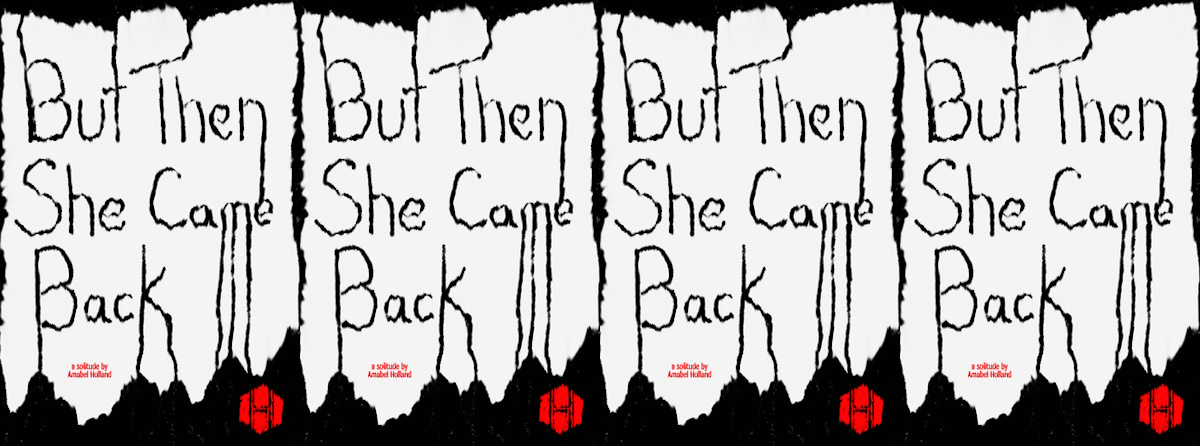
I’ve never been satisfied with the concept of the tone poem. If anything, it feels like a descriptor we resort to when there isn’t anything better at hand. When it comes to But Then She Came Back, the horror board game by Amabel Holland, well, there isn’t anything better at hand. Unlike most of Holland’s oeuvre, it’s an impressionistic lament to the toxic relationships we left behind, probably well after we should have. Very much like some of her work, it’s also a game that gives back what you bring to it.
The Banalities of Yesterday

Growing up Mormon, disdainful opinions about smoking were in plentiful supply. I recall a mother proudly recounting her answer to her daughter’s question about why people smoked. “Some people are on Satan’s side,” she declared.
She was half right. But the wicked were not the smokers — the victims, to use Amabel Holland’s parlance in Doubt Is Our Product. They were the profiteers who killed hundreds of millions for market share. Who peddled tobacco to children and obfuscated the deadliness of cigarettes. Who flooded the zone with bullshit so that ordinary people couldn’t make informed decisions. Who continue to do so, to the tune of eight million dead per year, one million of whom die from secondhand smoke. Textual critics have long held that hell and the devil were invented as a form of cognitive easing, a way to reassure ordinary people who couldn’t square why some of their peers, leaders, and oppressors were so predatory. Surely they were being influenced by a malevolent, otherworldly agent; surely they would receive a fiery judgement at the end of time.
If there’s anybody who makes hell and the devil seem necessary, it’s tobacco executives.
Antiantidisestablishmentarianism

This might shock you, but I don’t actually love big words. Rather than elbowing pneumonoultramicroscopicsilicovolcanoconiosis into a conversation, I prefer short, evocative slashes to anything my readers might need to sound out. Let’s be real for a second: Did you actually say the word in the previous sentence, or did you blip over it like one more nickname for Raskolnikov in Dostoevsky’s Crime and Punishment? Exactly.
Five-Dollar Words, then, is a game that I am unexpectedly terrible at. Designed by Amabel and Mary Holland as the freebie for this year’s Hollandays Sale, it peddles itself as a game for sesquipedalianists and pedants. Better yet, it has a rule that prevents anybody from dragging out antidisestablishmentarianism as their word of choice.
You End Up Becoming Yourself

Kaiju Table Battles is one of the most intensely personal games I have ever played. It’s like stumbling across a friend’s open diary and reading a few fervid paragraphs before recognizing the artifact for what it is. The impulse in that moment, in our culture, is to clasp the diary shut, and likewise clasp shut the memory. We shy away from earnestness so readily. How, then, do we respond when the earnestness stands on a stool and demands to be seen?
Amabel Holland has always been a designer who stretches and strains the medium to its absolute boundaries. Kaiju Table Battles takes both to their limit. Maybe beyond the limit. This is a legacy game, envelopes and all, which peels itself apart layer by layer, revealing new diary lines and rubber-suited monsters alike. Along the way, it questions the very foundations of play.
Fossil Industries

It would be a lie to say I love cube rails, but there is a handful I’ve enjoyed more or less, and it’s no coincidence that three of them were designed by Amabel Holland. Dinosaur Gauge, co-designed between Amabel and Mary Holland, is, I hate to break it to you, the least historical of the set. Despite some messiness, that might also mark it as my favorite of the bunch.

 SPACE-BIFF!