Planet Trashpocalypse
When I call Sandy Petersen’s Planet Apocalypse “trash,” please don’t take it as an insult. I mean it in the same way as when I call Petersen’s previous game Cthulhu Wars “trash,” or the 2001 action-adventure film The Musketeer “trash.” These things, these artifacts of culture, they were never going to escape the dumpster. So instead, they leaned into it. They wrapped their feet in banana peels and armored themselves with spent diapers. They forced Tim Roth to swagger around in leathers and feathers, wearing that eye patch, speaking those lines. That’s their whole appeal. To be so bad that they circle around on themselves, like the fathomless plains of hell, venturing not quite into the territory of good, but perhaps into worth a laugh.
I may have tipped my hand there. Oh well. At least I have some serviceable pictures of the game’s miniatures.
Babbling for Babylonia

I’m under no illusion that Babylonia is a perfect game. Far from it. The map has too much detail. Don’t mistake this for a nitpick. The only thing more frustrating than thinking you have one more hex with which to surround a city only to realize the hex in question is beyond the edge of the map is when you realize you’ve misapprehended whether you were looking into the waters of the Tigris and Euphrates or a patch of shadow on the riverbank. In a tile-laying game, these things matter. I might even go as far as to say the map would look better had it been barely illustrated at all, except that would make me sound like Don Draper mooning over a Hershey’s bar.
Everything else, though? Perfection. I’d even call it Reiner Knizia’s finest work. Let me tell you why.
European Cleavage

Here’s something that will sound like an obvious truism to some and opaque to others: the decision space of a board game is derived from its restrictions, not its permissiveness.
Hold up, Morpheus, what do you mean by that? Well, I mean that nothing is permitted until the rules explicitly announce that something is possible. Anything else would be require a ten-volume rulebook, because unless somebody spelled out instructions to the contrary, you could do anything you wanted at any time — which, incidentally, is pretty much how my friend Geoff plays board games. Since that’s untenable for anybody who hasn’t resigned themselves to repeatedly explaining that, no, you cannot teleport across the map and demolish all my armies with one action, the clearest rules start from scratch. Here are the phases. Here’s what it means to move. Here are the steps you follow every time you undertake an action. Nothing exists beyond that framework.
Europe Divided, designed by David Thompson and Chris Marling, is a fascinating look at what happens when you break the rules until they hardly matter.
Absentee Civilizations of the Inner Sea

Ancient Civilizations of the Inner Sea reads like a list of things that should appeal to me. Civilizations, check. Ancient civilizations, even bigger check. But abstract! Checkity-checkmate. Interactive, chaotic, punitive, not obsessed with technology as the sole motivator of human progress. That isn’t the distant rattle of a machine gun you hear. That’s me saying “check” so fast my jaw aches.
So why is this one of my least-favorite civilization games? I’ve narrowed it down to three reasons.
Arrakis—Dune—Deck-Builder.

Paul Dennen gets deck-building games. More importantly, he gets that deck-building is an under-leveraged mechanism. Wait, you might be saying, aren’t there one billion deck-building games? Yes. More deck-building games than there are grains of sand in the sea. But not all of them are slick hybrid titles like Clank!, which mixed deck-building with just enough beyond-the-deck considerations to make it worthwhile. While the rest of the hobby lags behind Martin Wallace’s multiple experiments in hybrid deck–building, Dennen has been doing one better by taking those lessons and turning them into games you’re actually likely to play.
Dune: Imperium is the best of his offerings yet. Although not necessarily because of the systems Dennen is mixing together.
Talking About Games: Subjecting Subjectivity

You’ve heard the refrain before. “Stay objective.” “Keep politics out of it.” “I just want to hear how the game works.”
Fine, you caught me! Nothing gets past you. Those are three refrains, not one. Except… aren’t they the same thing? All three complaints ultimately come down to a single expectation, that game reviews should conform to some sort of master code, a Strunk & White’s Elements of Style to gather all forms of criticism, bring them together, and in the darkness bind them. Objectivity all over again.
I know what you’re thinking. Haven’t we been here before? True, a few installments back I talked about objectivity and subjectivity. But that was principally about defining those two terms and examining how they sometimes bleed into each other thanks to some complicated linguistic history. Today, I want to travel in a different direction by talking about some of the advantages of subjectivity. Namely, why is it better for everyone when our game critiques are as subjective as possible?
Foo-d for Thought

Maxime Rambourg and Théo Rivière’s The Loop has a great sense of humor. It just isn’t my type of humor. Take the name of its time-traveling villain, Dr. Foo, and spitball the easiest jokes that come to mind. Lots of puns? Naturally. Foo Fighters? Certainly. Mr. T references? So many. Super underpants? That has nothing to do with “foo,” but sure.
Don’t take this as a slam. If anything, The Loop is so committed to its Saturday morning cartoon wackiness that it wins me over. A little bit. Not all the way. But enough to get past the candy colors and invest in the game’s quickly deteriorating timelines. Poo on you, Dr. Foo.
Faza vs. Faction Zeta
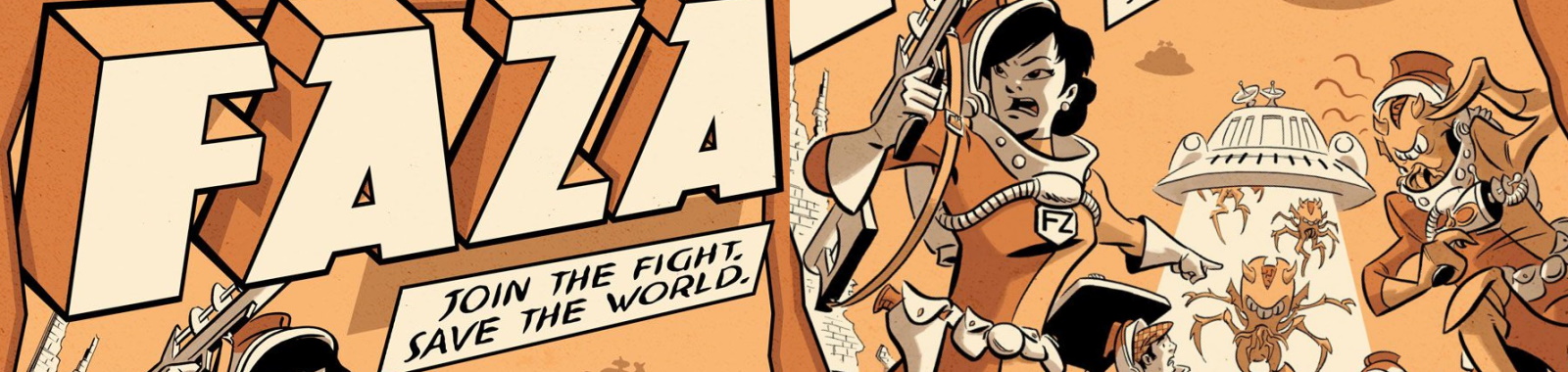
There’s a familiar formula to cooperative board games. Call it the Pandemic Formula. Every turn, four problems are added to the board. Your character can easily remove one or two of these problems, perhaps three with great effort. Because you’re always adding more problems than you can subtract, the game has a built-in tipping point, a cascade from which recovery is impossible. Fortunately, there’s a solution somewhere. A cure. When acquired, this will nullify the cascade before it ever happens. So the game becomes a balancing act. Chase the solution while delaying the inevitable.
What Benjamin Farahmand’s Faza asks is, what if instead of adding only four problems, each turn adds ten, chases you with a murder-ship, and irreversibly terraforms a patch of the planet?
Alone in the Dark Sector

The door swings open to reveal a board game critic. Slovenly, pretentious, angry at the world for none of the right reasons. He turns his wild eyes on you. “Hey. Wanna hear my theory about how the important but muted role of Catan’s robber pawn represents the erasure of Narragansett Algonquins from New Englander awareness after King Philip’s War?”
You must choose one option…
Agree: You acquiesce and sit across from the critic. Roll seven Vigor in three attempts to stay awake or lose 2HP.
Evade: Ask if the critic has heard of Monopoly. Begin Close Combat…
Then turn the next chapter card to read on.
Long Live The King Is Dead

Peer Sylvester’s The King Is Dead has some history to it. First appearing as König von Siam, then as an Arthurian version in The King Is Dead, and now as a second edition with a more historical flair, it’s been reprinted often enough to be considered a modern classic. Perhaps more importantly, traces of its DNA can be found in other games’ genealogy.
And it’s easy to see why.

 SPACE-BIFF!