Worldbreakers: The Gathering
Those of us who lived through the collectible card game boom of the 1990s approach our CCG derivatives with due suspicion.
Consider Worldbreakers: Advent of the Khanate, Elli Emir’s take on the genre. From one perspective, it’s the bastard child of Magic: The Gathering and Android: Netrunner, right down to the compulsive inclusion of a colon in its title. There’s nary a novel bone in the game’s body. Teaching it is as easy as confirming that your pupil also constructed decks in middle school. If anything, its slight differences from Magic — say, in the way attacks are resolved — are a sticking point for no other reason than because they’re so minor that they never wholly escape their daddy’s shadow.
On the other side of the coin, Worldbreakers is appealing for much the same reason. Amir has refined that august parentage into far more approachable offspring. It’s intuitive to teach, riffs on a few familiar chords, and crosses vivid new horizons. The result is that playing Worldbreakers is like exploring a hobby from adolescence for the first time.
Bloodsucking Techbros

It’s been a while since we’ve seen such a thorough explication of why setting matters than J.B. Howell’s SiliconVania. Set in a future Transylvania where vampires have gone public and decided to transform their ancestral homeland into the next Silicon Valley, Howell has crafted a game that riffs on blood-boy slurping techbros and venture capital excess, all without necessarily cluing its players in on the satire. It surprises with some devious bidding and tile-laying. If only the setting weren’t such a damp spitball to the ear.
Carcassonne-by-the-Sea

It would be easy to label Beacon Patrol, the tile-layer designed and illustrated by Torben Ratzlaff, as a toothless Carcassonne-by-the-Sea. Like Klaus-Jürgen Wrede’s masterpiece, it’s preoccupied with the matching of corners and edges, the apprehension of gaps yet to be filled, and landmasses that come together at jutting intersections. Despite those similarities, Beacon Patrol is unhurried, a wholly cooperative or solitaire game that proceeds at leisurely pace and doesn’t conclude so much as it goes to sleep.
That’s exactly what it’s meant to do. It may lack bite, but the better descriptor would be to say it never breaks skin.
When Fire Met Stone
From Troy to Stalingrad, there’s nothing quite as gripping as the stakes and drama of a good siege. Sieges seem like the perfect setting for a board game, with their limited parameters and clear-cut victory conditions. Yet we don’t often see them given their due. In many cases, board game sieges are little more than countdown timers while armies elsewhere rush to reinforce besieged allies or outmaneuver their foes.
In stark contrast with other efforts, Fire & Stone: Siege of Vienna is possibly the best siege game I’ve played. We’ve seen the work of Robert DeLeskie before, first with The Wars of Marcus Aurelius and later Stilicho: Last of the Romans. But where those were sweeping epics, covering decades of zoomed-out politics, Fire & Stone covers two months of intense fighting between the Ottoman and Holy Roman Empires.
Lacuna Matata

The older I get, the more I appreciate cozy games, those with simple rules and an intent to generate sensations of warmth and ease. Lacuna, designed by Mark Gerrits, is one such game. I came very close to overlooking it.
Fighters in Spaaaaace

There are so many things in Jordan Nichols and Michael Dunsmore’s Star Fighters: Rapid Fire that ought to be my jam. This is a real-time game (check) about chucking dice (check) and assigning them to a starship’s dashboard (check) in order to blast your opponent out of the sky (check check check). That’s a lot of checks. An entire preflight checklist’s worth of checks.
Upon takeoff, however, the flight was turbulent. Or perhaps it wasn’t turbulent enough. There’s no turbulence in outer space. What I’m saying is that it didn’t go as I’d hoped. After giving it some thought, there are two reasons for Star Fighter’s failure to launch. Now there’s the right metaphor! One, this game doesn’t seem to know what to do with its dice. And two, it’s been done before with far greater panache.
The First Shall Be First
There’s an account in the Gospel of Mark that stands out, not only as an expression of Jesus’s idealism, but also as an indictment of the Christian project at large. Jesus walks in on his disciples arguing over which of them is foremost among the entourage. His answer is succinct: Whoever wants to be first must instead be last. The symbol of greatness to Jesus is the servant, the child, the helpless. I have yet to find a church that takes Jesus at his word.
Pardon the religious talk. It’s impossible to discuss Ierusalem: Anno Domini without slipping into the territory. Designed by Carmen García Jiménez, this is the most devotionally charged board game I’ve played in recent memory, and that’s counting titles like The Acts of the Evangelists, Nicaea, and The Mission. The rulebook is glossed with statements from the Gospels. Resources include stones, loaves, fishes, and the Holy Spirit. Final scoring is an outpouring of points based on your proximity to the big man himself.
Speaking as a lifelong student of early Christianity — and surely not projecting any of my own hangups and traumas — it’s a very weird game indeed.
Class Warfaire

Hegemony: Lead Your Class to Victory, brought to us by veteran designer Vangelis Bagiartakis and newcomer Varnavas Timotheou, is the sort of game that invites criticism right out of the gate. As a medium, board games have a knack for modeling complex situations and structures. Those models, however, are only as sturdy as a designer’s understanding of the topic under reconstruction. And there aren’t many topics as complicated — or as prone to disagreement, even by very educated people — as class conflict.
This Trick-Taking Life: The Triumphs
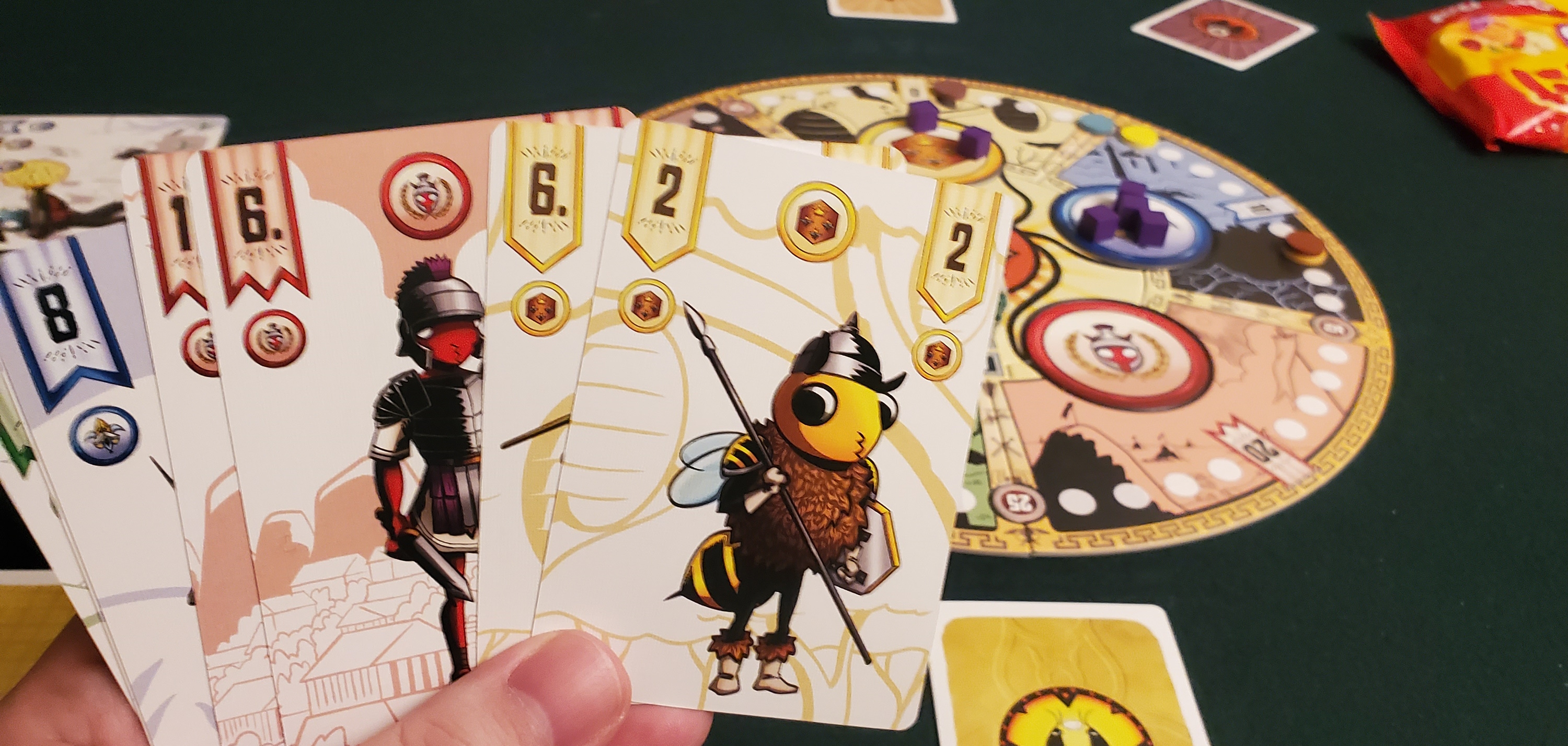
Why are trick-taking games having such a moment? Last time in this series about my personal journey with trick-takers, I proposed an answer: because the things are so dang simple that learning the rules to one immediately opens the door to a hundred more. But that’s not all! Far from being simplistic time-wasters, there are untold depths and ranges to the system. In fact, one of the best things about cracking open a new trick-taker is that you’re almost certain to discover an approach you haven’t seen before.
Today, though, we’re tackling an aspect of trick-taking that initially put me off the genre altogether. I’m talking about the triumph, also known as the trump, also known to my friend Rob as the “super-suit.”
Space-Cast! #29. Enduring Snake-Eyes
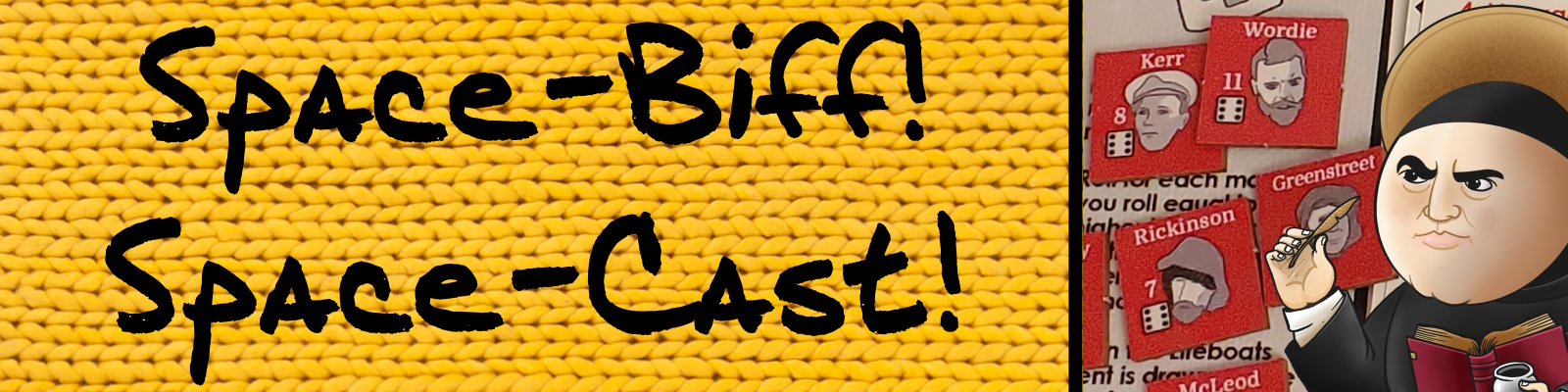
What’s the commonality between Shackleton’s voyage to the Antarctic, brain hemorrhages, and the virtue of watching R-rated movies? Today, it’s Amabel Holland’s Endurance, a board game about the strength of the human spirit in the face of abject misery. Join Dan and Amabel as we chat about this game’s difficult development, throwing out historical determinism, and why not every game should have a victory condition.
Listen here or download here. Timestamps can be found after the jump.

 SPACE-BIFF!