Author Archives: Dan Thurot
You Merely Adopted the Mist

Remember when Mistborn: House War made the uncomfortable decision to cast its players as the eugenicist oppressors of Brandon Sanderson’s much-loved fantasy series?
Oh, you don’t. Well, I do, and that’s the first thing John D. Clair’s Mistborn: The Deckbuilding Game has going for it. This time around, you’re an actual mistborn, a metal-guzzling, glass-dagger-stabbing, high-flying superhero in a goofy tassled cape. That’s all good stuff, but the real draw is the way Clair turns the deck-building formula on its head and even remediates one of its long-standing deficiencies, once again proving himself one of the hobby’s most overlooked innovators.
Welcome to Middle-Earf
I realize it represents critical malpractice at this point, but I still haven’t tried Antoine Bauza and Bruno Cathala’s Seven Wonders Duel. Then again, maybe that’s a good thing, since I’m effectively immune to any questions about how much The Lord of the Rings: Duel for Middle-earth shakes up the format.
Catapults, Mostly
Between Tales to Amaze and Return to Dark Tower, I’ve reached the phase of my life where Restoration Games ranks among my most anticipated playthings — not for my own sake, but because I know my ten-year-old is going to gush over each new release. Crossbows & Catapults: Fortress War is a remake of Henri Sala’s 1983 original, minus the decaying rubber bands and plus, well, a whole range of things. Better tempo. Action cards. Special ammunition. Mercenaries.
Look, there’s a critical quandary here, but it isn’t a tough circle to square. At thirty-eight, this isn’t my favored way to pass an hour. For my kiddo, it’s the most revolutionary construct in existence. Take one stab at who wins that tiebreaker.
Talking About Games: To Talk or Not
Three months ago, I encountered perhaps the worst board game I’ve ever played. This thing was truly non-functional, less coherent than almost any prototype that gets sent my way, a misbegotten experiment in game timers and open-ended negotiation. Worse, it was supposedly a game “about” something, the passage of time and the rise and fall of civilizations, the way societies are imprinted by their leaders. Surprise surprise, even those concepts were fumbled.
I’m never going to write about it.
Maybe that isn’t what you expected. Space-Biff! features a number of negative reviews. Some of them are scathing. Quite often, I’ve been told that it’s the inclusion of negative coverage that makes my site come across as trustworthy. So why wouldn’t I take this particular game down a peg?
In the interests of transparency, but also hopefully some good old-fashioned uncommon sense, today I’m going to talk about my thought process for what gets covered — and what doesn’t.
Space-Cast! #42. The Twilight Cardboard

On today’s Space-Cast!, we’re joined by Pako Gradaille to discuss his recent board game Onoda, about the Imperial Japanese officer who continued to wage the Second World War for nearly thirty years on the island of Lubang. Along the way we discuss why Gradaille was drawn to Hiroo Onoda, how board games can express alienation and discomfort, and both the necessity and perils of ambiguity in art.
Listen here or download here. Timestamps can be found after the jump.
The Gooey Decimal System
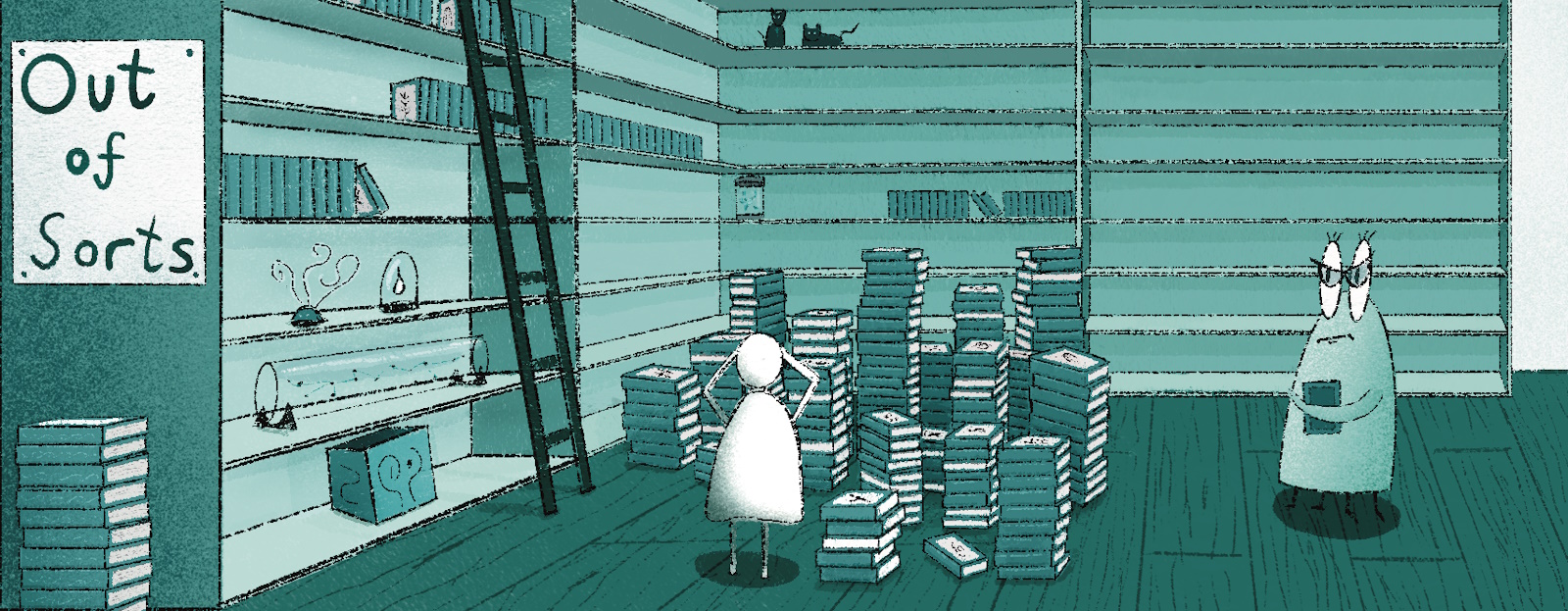
Surprising absolutely nobody, this inveterate library-hopper actually knows and utilizes the Dewey Decimal System. Unfortunately for everybody else in the human race, especially those with a far more vibrant social life than myself, the existence of Melvil Dewey’s sorting method is the one thing our galaxy’s extraterrestrials have learned about us. Now a gang of disparate humans has been abducted to sort an alien library. Eep.
2024 has been an excellent year for memory games, if only thanks to the stupendous Wilmot’s Warehouse. Connor Wake’s Out of Sorts, which like Marceline Leiman’s High Tide will be available at next month’s Indie Games Market at PAX Unplugged, is proof that the genre still has a few unswept corners to explore.
Smurf-Hopping

I only recently got the memo that we’re now calling the entire shared-input genre, roll-and-writes and draw-and-writes alike, “smurf-and-writes.” Which… look, I’m not the king of taxonomy around here, but at a certain point we linguistic descriptivists really ought to consider putting our foot down.
Anyway. Rivages, designed by Joachim Thôme, is an island-hopping smurf-and-write (hurk) that isn’t nearly as smurfy as most of its peers. By which I mean it’s less about those shared inputs than you might gather from its laminated maps and dry-erase pens.
Where a Million Diamonds Shine

If Imperial Miners used one of those home DNA kits, it would swiftly find itself on the front page of Reddit as yet another story about one’s parentage being thrown into dispute. Despite being named to capitalize on the success of Imperial Settlers, itself a descendant of 51st State — but also a parent to the other 51st State — Tim Armstrong’s design doesn’t actually display all that many of its predecessors’ hereditary traits. Why do I look so much like your college sweetheart, MOM?
But maybe this is a good thing. Freshly doubtful of its pedigree, perhaps Imperial Miners can forge its identity anew, free of the family’s medical history of clutter, obsessive hoarding, and frustrating expansions that require players to sort through multiple decks of cards.
Well. At least Imperial Miners escapes the first two fates.
Girder Up

Tower Up is one of those titles that proves a board game doesn’t need to be complex to conceal untold depths. Designed by Frank Crittin, Grégoire Largey, and Sébastien Pauchon, this another game about real estate developers doing their thing and earning big bucks, with faint but clear brushstrokes from Sid Sackson’s Metropolis or Klaus Zoch’s The Estates. But in spite of its vertical development and intersecting player interests, perhaps its biggest departure from those predecessors is found in its dead simple internal arithmetic.
That’s No Shadow Moon
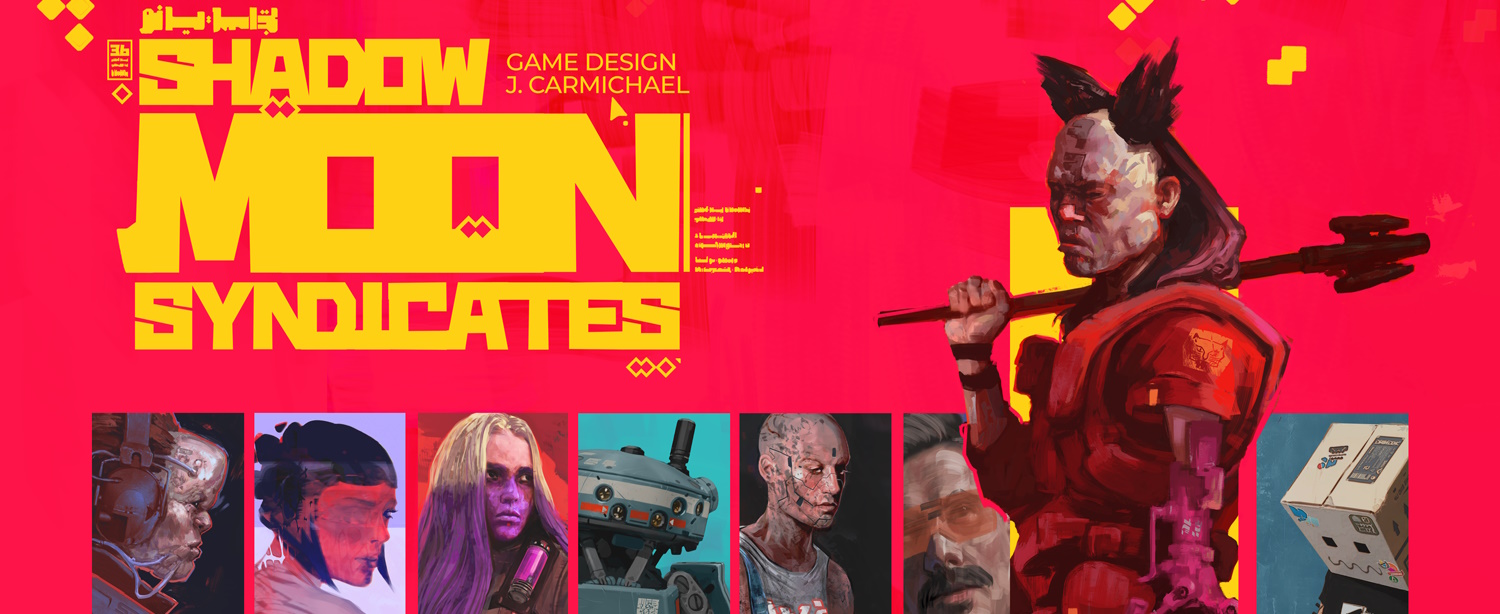
Shadow Moon Syndicates, the second design by Jarrod Carmichael, brings out my inner cynic. It might have something to do with the setting, all grungy piping and colorful gangs grappling over the guts of a husked-out asteroid. Or it might be the particular blend of chip-stacking, hand-building, and shifting objectives, which feels like somebody played Paolo Mori’s Ethnos and wondered why it wasn’t more complicated.
But then I come back to the star of this particular showdown: the cards. Oh, those cards! What marvelous little bastards!

 SPACE-BIFF!