That’s Not Two Minds!
Brock: The long anticipated return of a feature that’s maybe mostly forgotten… We are simply giddy with delight to bring you yet another installment of Two Minds About! How have you spent the two years since last we sparred, Dan?
Dan: Drugs. Also… no, it’s mostly drugs.
Brock: Me? I’ve been bench pressing bloated Kickstarter games and eating bowl after bowl of meeples. I knew this day would come, and I knew I would have to be ready. This time around, we’re looking at a tiny box that gives me some very big feelings: That’s Not a Hat!, designed by Kasper Lapp.
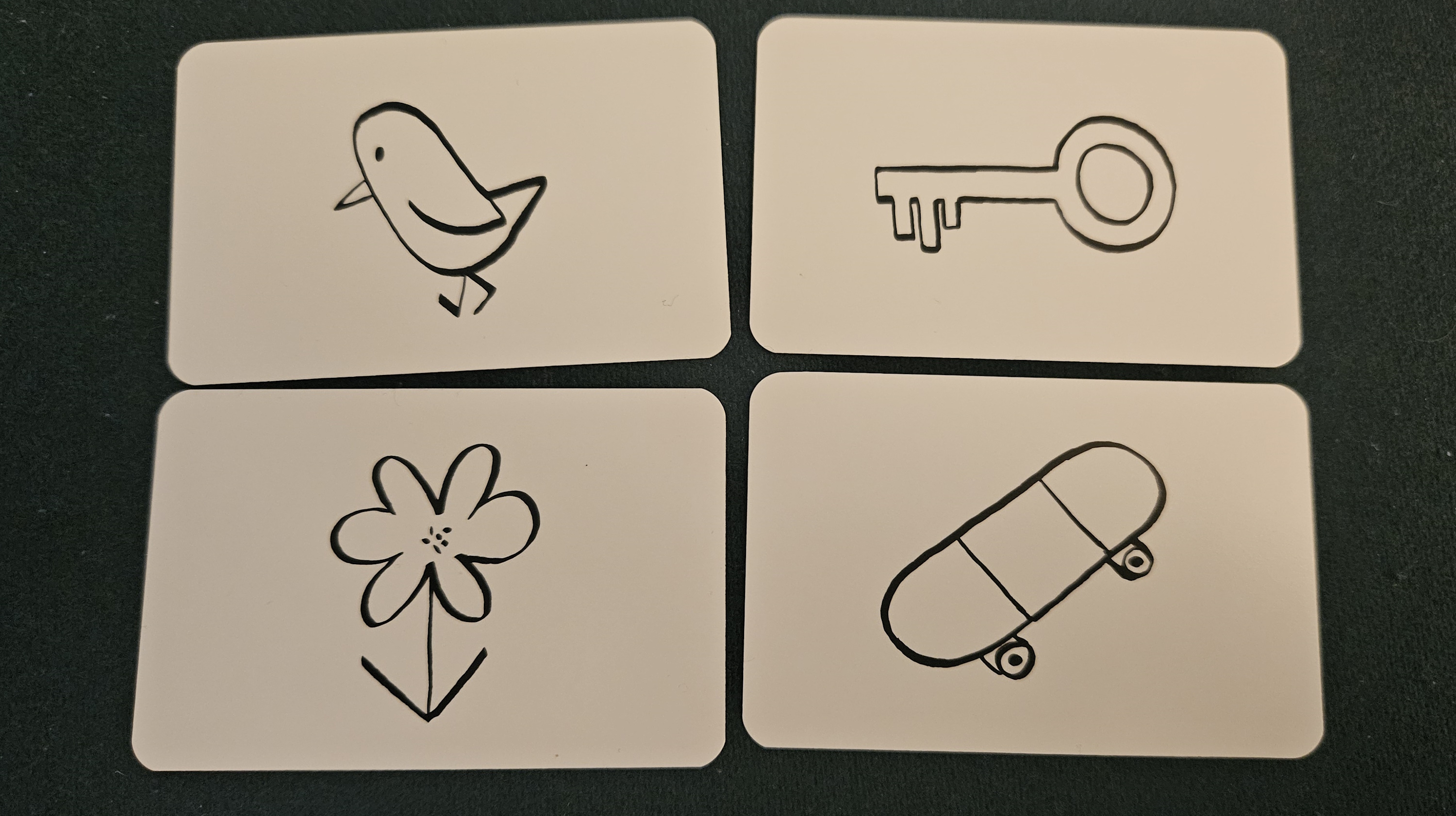
Look closely. You will forget these objects.
Dan: Have you played any of Lapp’s stuff before, Brock? Magic Maze, maybe? Gods Love Dinosaurs, perchance? Last year’s bop [checks BGG], Gardeners?
Brock: I did check on Lapp’s bona fides, but I’m ill-prepared to assess if he’s learned any lessons from previous designs. Magic Maze is the only one I’m familiar with at all, but not in a meaningful way. It seems like you enjoyed Gods Love Dinosaurs well enough, but by any measure That’s Not a Hat! looks to be a departure from the complexity we’ve seen from Lapp in past designs.
It could scarcely be simpler, in fact. Each player is dealt a card from a deck of pictures: hand drawn objects, crude depictions of fans or tubes of lipstick. The goal is simply to remember what objects are on the table as they get passed between players.
How is it even a game?! We can remember five or six objects, right? We’re adults. We have college degrees and mortgages.
Dan: I don’t have a mortgage. But yes, your point is well taken. That’s Not a Hat — which doesn’t actually include an exclamation mark, although I struggle to conceptualize it without one — is a shell game. Somehow, as those objects are passed around the table, you will forget about them. It’s not quite a magic trick. More like a curse.
Brock: I don’t get nervous about board games. The idea of it seems silly. When we talked about Final Girl, a game about horrible murderers, we agreed that it wasn’t scary in any way. We wondered if board games were even capable of such a thing.
I’m ready to eat my words, because I do feel a genuine anxiety at the prospect of putting this game on the table. Granted, it’s a mild anxiety. An uneasiness that likely has more to do with how cushy the rest of my existence is. But when those first cards start to be passed around, when I see those looks of doubt on other faces, my heart rate quickens.
It’s like that meme about how “That thing scares me.” But the “thing” in question is a little pink box of cards.
Am I alone here? Does That’s Not a Hat challenge your psyche like it does mine?
Dan: Maybe? I think I get where you’re coming from. One of the things that I very much dislike about That’s Not a Hat is the way it weaponizes our failing memory. It feels like an Alzheimer’s simulator.
Let me put it another way. One of this year’s biggest developments, hobby-wise, has been a pair of games that revolutionized the way I think about memory games, Wilmot’s Warehouse and Out of Sorts. Every time I introduce them to new players, the sell line is pretty much “They’re memory games… but good!”
That’s Not a Hat is a memory game… but not good. At best, you will hurt your head to remember something inconsequential. At worst, you’ll come away feeling stupid. I played it with my mother-in-law and she started talking about dementia. I’m quieter about my own fears, but when I can’t remember what’s on the card in front of me, I start thinking about all the old people in my life who forget themselves a full decade before they finally kicked the bucket.
And it’s such a contrast to those other games, which are these big celebrations of memory and story-telling and our human capacity to categorize information. Because, look, here’s the thing: the card I forgot, it was a baguette. I remember it now. I’ll probably remember it until they plant me. But I remember it because of my failure to remember it the first time. That’s a bummer, you know?
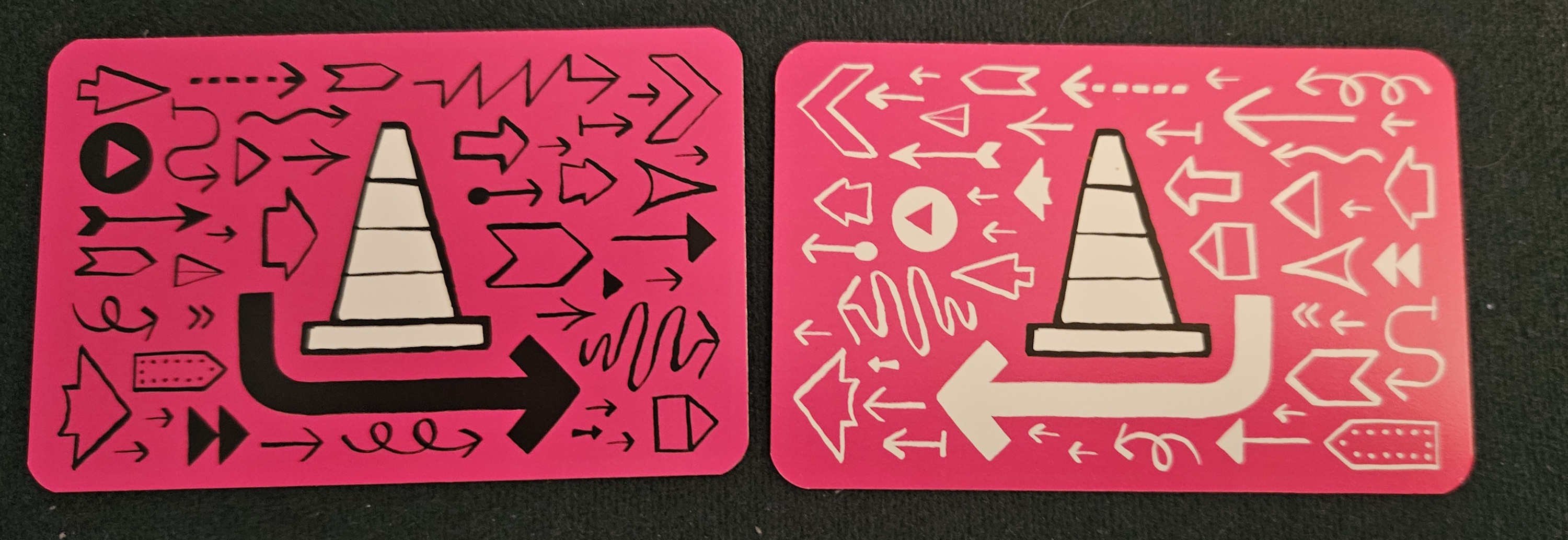
Cards are passed face-down. Do you remember what you’re re-gifting?
Brock: The topic of dementia and memory loss hasn’t come up with my group, but I imagine it’s on the horizon. And maybe that’s the origins of my own reticence. I try not to think too hard about my own loved ones who went through real memory failure toward the end of their lives, and this game possibly skews too close to that.
In my own experience, though, the memory loss being simulated here is more akin to attention disorders and a failure to prioritize information. Topics that are already my reality. And so maybe what I’m seeing – and the reason I love this game – is a leveling of the playing field. My fellow players are subjected to the same cognitive chaos that I’ve been fighting with for my whole life. Is it schadenfreude? Very possibly. Is it also hilarious? Yes, consistently.
Every session of That’s Not a Hat I’ve played in, I resolve to focus, to dial in, to apply any of the countless memory techniques that have bounced off of my brain over years of education. And I’m invariably left clueless, without even a convincing lie. Why can’t I remember any of the five household objects that I just saw? Why can’t I think of any single household object to bluff with?
I suspect your sessions went a little different. Did you find tricks that were helpful with this game, as you have in other memory games? Did that make the game feel “solved” for you?
Dan: If I pay enough attention, yes, to some degree. I wrote about my teenage obsession with ars memoriae, the art of memory, in my review of Wilmot’s Warehouse, and those principles do make the game significantly easier. Things like mind palaces, object ties, whatever. They also feel like cheating. Then again, I’m rusty enough that I’d probably have to really re-invest in those techniques to solve the game. And what would be the point of that? It’s like when people try to solve Wolfgang Warsch’s The Mind by setting a tempo and counting to 100. That’s how you dispel the magic. Something like That’s Not a Hat doesn’t exist to be played well. It exists to be played badly.
And there’s nothing wrong with that. Some of my favorite games are best played badly! But I think that’s still the source of my dissatisfaction. I love seeing how people react to Wilmot’s Warehouse. It’s such a process, their skepticism blooming into this wonder. That game makes me feel marvelous and good. This one makes me feel dumpy. That’s the dirty secret of all criticism: game make Dan dumpy, game bad.
For you, though, it sounds like a lot of the appeal is found in the way the game breeds a certain degree of… what, empathy? I hope it isn’t only schadenfreude. As an aphantasic and ADHDer, what do you mean when you say the game levels the playing field?
Brock: You know I can’t resist the urge for a cumbersome German term, but empathy or commiseration are probably more apt. That’s Not a Hat feels in some ways like an exercise meant specifically to emphasize my failings.
Most memory tricks out there lean heavily on visualization, for example, a mental feat that I find impossible. Aphantasia is a lack of a mind’s eye, meaning I can’t conjure up images at will. There’s no memory palace when I close my eyes; nowhere to sort the record players and socks for future perusal.
Coupled with ADHD, my memory is a strangely porous thing, letting some memories slip away while holding tight to others. It’s like a chunk of pumice that splits open to reveal a fossil. No, I don’t know why I can remember my childhood phone number but not the date of my next dentist appointment.
So I think part of my affection for That’s Not a Hat is the way its panicked pace inflicts these kinds of losses on others. We are united in cluelessness. My shortcomings become part of a shared experience, and what’s more, we’re sharing in it happily. We reveal a picture of a fork that seems to have arisen from the ether, forgotten by all, and the reaction is explosive and joyous.
I can also see how this could be a terrible experience for some people. It relies on the building pressure of limited information, and when the spotlight comes to you, the pressure may be too much. It fosters a similar feeling to word game Anomia, which expects constant vigilance should you be suddenly called on to name a US President or a variety of fruit. In my game group, that pressure valve has reliably produced laughter, but I can see it just as easily provoking frustration.
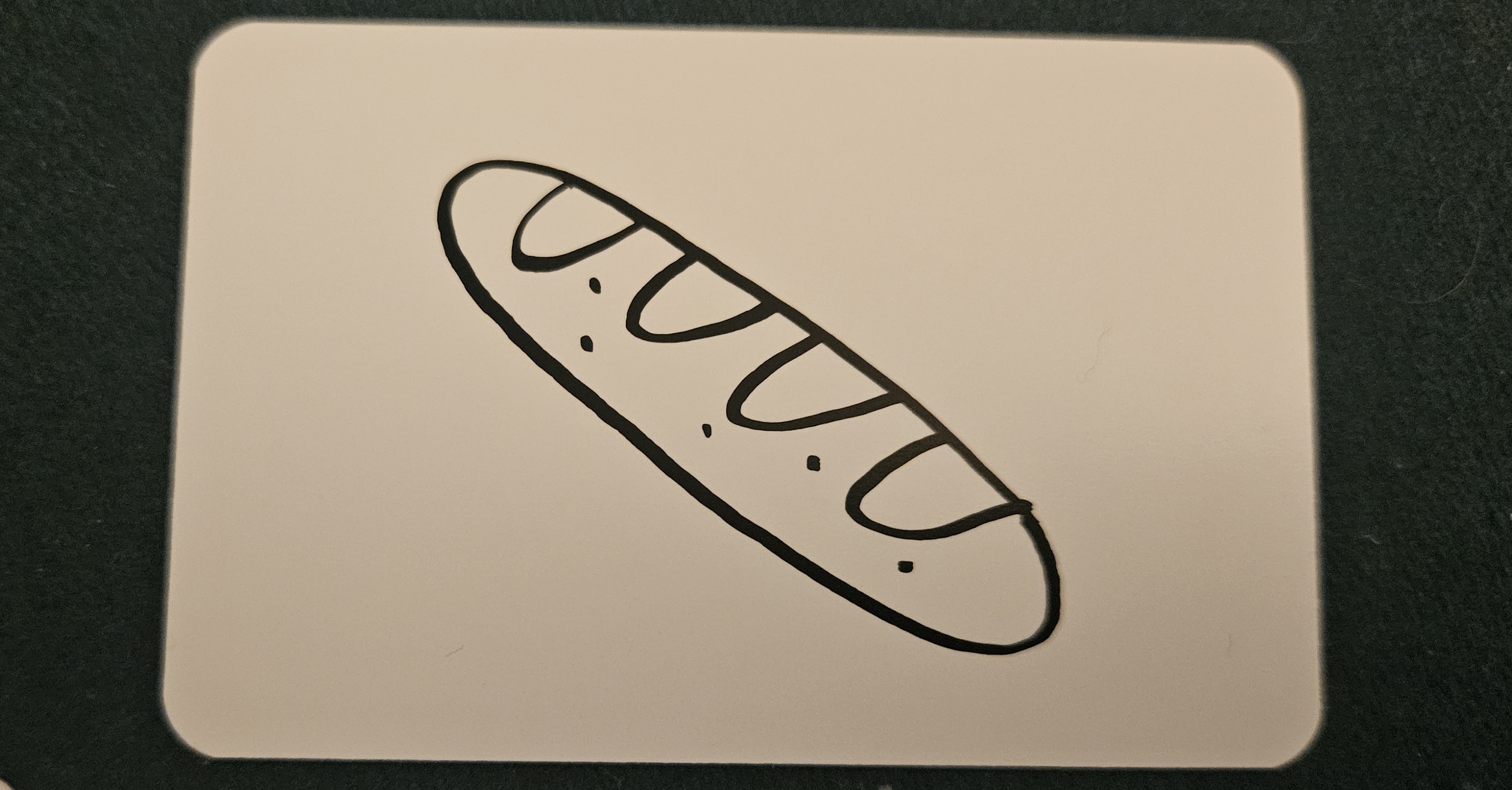
I am giving you a nice baguette. (My Nemesis)
So we diverged on this, more than I think we have on other games. But, as it happens, I think that we’re both right. It’s funny how that worked out, isn’t it?
Dan: No. Me right. Dan dumpy. Game bad.
(If what I’m doing at Space-Biff! is valuable to you in some way, please consider dropping by my Patreon campaign or Ko-fi.)
Posted on December 11, 2024, in Board Game and tagged Board Games, Ravensburger, That's Not a Hat, Two Minds About.... Bookmark the permalink. 3 Comments.

 SPACE-BIFF!
I really enjoy this format, and the contrasting opinions make a very interesting point about how games can hit people differently.
I feel like simpler games tend to be much more group dependent. Agricola is Agricola no matter who you play it with, for the most part.
I think it’s less about simple vs complex, and more just how much of the experience is based on group interactions. And yeah, simpler games tend to focus on interaction more often (player whims are a rules-lite source of variance!), but like… I think Can’t Stop is basically the same no matter who you play it with, and Sidereal Confluence really requires players in the right mindset. For example.
I guess I was trying to parse simple to complex without considering social level within the game, which I guess isn’t quite fair.