New Year, Old Year: 2021 Revisited

The wheel has turned again. And again. Although this installment of New Year, Old Year is a full year late, I’ve already explained my growing reservations with this recurring retrospective, so there’s no reason to belabor the point. Instead, here we are, on the precipice of revisiting the titles I considered the best of 2021. What did I get right? What did I get wrong? The answers may surprise you.
Or they may not. Who can tell. Not me. Either way, we’re doing things a little differently now. Rather than dividing everything into binary right/wrong categories, it seems more helpful to look back on each title in turn. Because sometimes I got things right and wrong at the same time. Nuance, y’all.
Day One! Make Something!
Best Week 2021 followed on the heels of a two-year global pandemic. A global pandemic that has not, in fact, been resolved, but apparently we have decided to collectively forget about all that. The underlying theme of my lists was survival advice, and the mere act of looking back at the trappings of the whole thing — the daily titles, the snippets of internal dialogue, the sheer desperation in my voice — speak to a frayed mental state. Nice.
Day One was about the games that let us build something. An acceptable enough framing after so many of us learned how to bake sourdough.
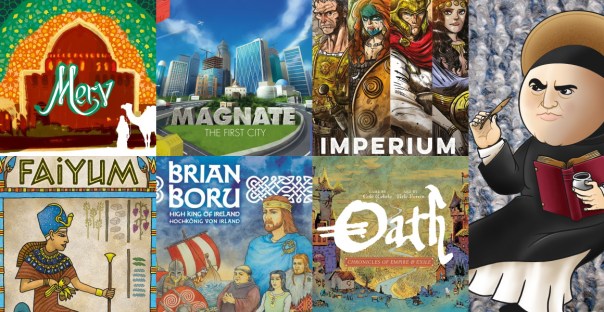
The biggest misstep in that framing, however, was Magnate: The First City. Not because it didn’t let us build something — it did — but because of the (deliberate) cynicism of the enterprise. Magnate has carved out an odd space in my mind. Despite the overall quality of its gameplay, it remains burdened by a few niggles. It’s overproduced, and my feelings have only curdled further on stacks of plastic miniatures. It’s also rather mathy, with all those stacking bonuses that aren’t always readily visible. As a rule of thumb, if a game requires a calculator, I’d better be punching numbers that get me to the moon. Magnate is still a good game, but it neither fits the intended tone of the day’s list nor leaves me fully satisfied that its immense production is quite as harsh a critique of capitalistic excess as it would like to believe.
Another title that leaves me somewhat fuzzy is Merv: The Heart of the Silk Road, albeit for reasons that are perhaps more meta than they ought to be. This, for me, remains the high-water mark for Fabio Lopiano. Both of his later titles that I’ve played, Autobahn and Merv’s more explicit successor Sankoré: The Pride of Mansa Musa, lean more into the systems complexity, resulting in puzzle boxes that see players wrestling against the game rather than with it. Merv stands out as an unfulfilled promise, a halfway point between interesting action selection and sense of place that Lopiano’s followups simply haven’t made good on.
Want more mixed feelings? I’m also waffling on Imperium Classics/Legends. Years back, I chatted with a young game designer about the possibility of assembling a large-scale 4X civilization game behind the mechanical veneer of a deck-builder. Imperium pretty much does that, and a few of its touches are downright insightful. Shuffling unrest into your deck? Perfect. At the same time, Imperium sure knows how to overburden itself. Multiple decks, an overcomplicated market, lots of downtime between turns… there’s a reason I’m not going to play the sequel, Imperium: Horizons, with more than two players. To some degree, Horizons is the stress test for the system. Will it hold up? Stay tuned.
Here are the easy ones: Faiyum and Brian Boru remain incredible. I would call them overlooked, but it would be more accurate to say they’ve been buried beneath an avalanche of new releases. Revisiting them is like catching up with an old friend over brunch. Faiyum in particular is a strong contender. If I had to do it all over again, it would have been the number-one pick on this list.
Which, of course, tips my hand on Oath somewhat. Last month I hauled it out again to teach to a friend. Unlike most titles, which stick in my head well enough that a quick skim of a cheat sheet will refresh my memory, Oath necessitated a full reread. Once internalized, the experience still grazed the sublime. Minus the irritating combat rules, that is. Those would benefit from some reworking, and seem emblematic of the design as a whole. Whatever the reason, Oath stands in contrast with other Wehrle gigs like Root, Pax Pamir, and even John Company, which boast thematic integrations that makes them run far more smoothly than their complex rules would indicate. They’re intuitive. Oath is many things: fascinating, thrilling, aggravating, three or four thesis statements on historiography. Intuitive it is not. I think it would still qualify for this list. But it should be knocked back a few pegs.
Whew. That’s enough for a whole article. But we’re only one-fifth finished! On the next page, we’re talking about survival.
Posted on March 14, 2024, in Board Game, Retrospective and tagged Best Week!, Board Games, Retrospective. Bookmark the permalink. 26 Comments.

 SPACE-BIFF!
Ugh. How did Mind MGMT fall so flat with me and hit so well for everyone else? After my third game spent playing it for the purposes of comparison, my friend (equally unimpressed) told me that it sounded like I was trying to talk myself into liking it. He was right: I knew about the current love for it and I knew what the Internet’s reaction would be.
Got lots of complaints about leaving it off my hidden movement list. City of the Great Machine was much more agreeable to me.
I suspect that City is the title you’re alluding to, and that just means we are looking for very different things in hidden movement.
City gives you control over the terrain and some more strategy. Mind MGMT feels like it’s trying to compensate for a lack of terrain with a lot of tacked-on systems, sub-systems, and rather bland asymmetry. My experience with most legacy games seems a lot like my experience with novelty pizzas, which try to spice up the basic ingredients with a lot of random, eclectic garbage dumped on top. MGMT was no exception in this regard.
Well, I think I’m just going to have to carry this one. MGMT’s here to stay.
Nah, wasn’t City of the Great Machine. I disliked that one so much that it doesn’t even register in my mind.
I am sad that Cryo didn’t fare better. Such a beautiful game! Friends of mine consider it too light, but there are enough 3-hour-games in that genre.
Agreed. Maybe it would have stuck around if I’d played it again.
Sad to hear your apprehension of Oath, I still find it absolutely sublime. We have played two “campaigns” of it with my group and are planning on the third one. Notably, over time we cut down the play time to less than ninety minutes for 4p, which I feel is a very brisk pace
I did not find the comment apprehensive. Rather, I agree about the unintuitive ruleset, especially regarding the campaign action. I’ve come to believe the reason for this is that Oath has an emerging narrative, rather than like, War of the Ring, where you tell your own version of the story, but within the confines of the books. I am not sure if everyone would agree with me, but despite its thick rulebook, I’ve found a lot of rules in War of the Ring intuitive. Teaching Oath, on the other hand, does not allow you to say “it’s just like in the books, the Chancellor has the upper hand!” Sure, it improves with replays as you’ve said, but in recent Leder studio chats, Wehrle himself admitted he’s working on an expansion that trims the rules a bit. I love Oath as it is, but that does not mean I am left scratching my head sometimes. What is fascinating, though, is how smoothly the card effects are understood by anyone and how much story they carry.
It occupies a weird space. I love Oath. I also think it’s a little too burdened with oddball rules, especially since it’s already asking players to inhabit an uncommon headspace. I dunno. I plan to revisit it as it gets expanded and reworked, plus when Arcs necessitates some comparisons.
What I’ll say about Oath is that this game has probably given me more than any other game. More enjoyment, more surprises, more food for thought – and simply an uncommonly large amount of plays (> 100). But I also recognize that to get it to fully release its nuance and complexity, a whole lot of stuff needs to be in place. The rules are indeed often not very intuitive and you want a group that knows how to lean into the game’s trickster mentality and make its many eccentricities work. And even then the game can be uneven – occasionally, things just don’t line up and it doesn’t work. Really I consider it a small price to pay given what the game yields, still it’s there.
Faiyum!!! Yes, still one of my favorite games of all time. It holds up well for me, too.
Faiyum crew!
I’m also a big fan of Free Ride, also by Friedemann Friese. It has a small problem in that it’s very hard to quickly determine the start/end points for the routes, so I took some unused gaming pieces that were left over from upgrading other games and we use them to identify the start and end points. Works really well and makes the game a lot more playable and fast. My wife and I really like that game.
Thanks for the recommendation.
“Wehrle gigs”
=)
I couldn’t help myself.
Great retrospective! I think the two year wait made it even better. Thanks for taking the time to write it.
Thanks for the kind words, Jepp! Your comment is making me question whether I should wait another year before tackling 2022…
nor leaves me fully satisfied that its immense production is quite as harsh a critique of capitalistic excess as it would like to believe.
Can anything made in China be a critique of capitalistic excess?
I would call them overlooked, but it would be more accurate to say they’ve been buried beneath an avalanche of new releases.
I tend to be years late with engagement. Film. Litterature. Music. Telly. I wait until the dust has settled and see what is still standing after the mobs have gone off to chase after some other shiny bauble. But. I wonder if that is going to get harder and harder to do due to these avalanches. Will anything get up from the trample to stand tall?
Of course, this also has a lot to do with what I want from a game play experience (which took me the last decade or so to figure out). And the question then becomes, is what I want from play compatible with new anything? Am I still buying new games because of some kind of social pressure to consume, rather than because it is compatible with what I want?
Hopefully this new format better captures the intended spirit of looking back at all these games.
While, I would happily read your lookbacks every year of every prior year to see what has changed… I do wonder if this feels different to me as the reader. While I value playing a game an Nth time (where N > 1) more than a 1st time (which means I would always prefer to play a known beloved game than a new to me game), I never took your previous commentary as something more than a snapshot. Not a predictor. And quite frankly, its on me if I chose to play a game you enjoyed, for whom replayability is less important, only to discover the game was not going to offer me what I wanted.
In my field, people are questioning the value of suicide evaluations as they are poor predictors of the future. Which is missing the point of them. They are supposed to provide a snapshot (will this person commit suicide now) and give you data to give you targets as you aim to augment the factors of protection keeping the person alive. If you want to know if they’ll kill themselves tomorrow, you have to redo the evaluation tomorrow.
Similarly, I read texts like these as a snapshot of the day they are written. With no real bearing on tomorrow.
1. Yes, things manufactured in China can be critiques of capitalistic excess. Of course they can.
2. Yeah, I also tend to assume that the value of any piece of writing is rooted in the momentary.
Hey, where can I find that Pax Viking Variant?
Thanks
It’s “the Danish variant,” which can apparently be found in the first promo pack.
The rules are simple, though. During setup, place one random victory card of each difficulty. These should be placed face-down. When you play an event, you will flip one of the victory cards face-up. However — and this is crucial — you must reveal the hardest victory condition still available. This replicates the Porfirio Diaz Senility Variant of Pax Porfiriana, with objectives becoming easier (and thus the multiplayer situation becoming more fraught) as the game progresses.
Dan, thank you this! I really appreciate both the “best week” and your reflective re-evaluations. It’s fascinating to see what a year or two of aging does to opinions, even if those same opinions were themselves distillate of an entire year of playing.
I wish more critics would take the time to do the same.
It’s an excellent reminder of how some games burn bright and fade to memories, fond or otherwise, while others continue to demand attention despite the cavalcade of newness.
Thanks for the kind words, Carl!
Love this series. The reading of your writing is very satisfying, and brings joy the all the toying with ideas. At the end of the day is another game with words, and I appreciate this retrospective as part of that longer game. On another note, hope to play Mind MGMT with my kids when they grow up… indeed, I am creating quite the collection and that would be another way of getting to know their old guy… or their old guy at a certain point in his life.
Thanks for the kind words, Juan! And yes, having a kid who’s old enough to enjoy and appreciate games is quite the turning point. I love it.
Pingback: 5 on Friday 15/03/24 – No Rerolls