Age of Blunders

In 2019, a video game named Age of Wonders: Planetfall came out. It was the fifth entry in the Age of Wonders series, a crossbreed of Civilization and Heroes of Might and Magic, and the only non-magical entry thus far. It has since been supplanted by Age of Wonders 4, the sixth entry in this increasingly inaccurately-numbered series.
Now there’s a board game adaptation of this four-year-old video game.
Why? Why is there a board game? I couldn’t tell you. Nor could I tell you why Stepan Opalev, the game’s designer, chose to adapt a series famous for its 4X openness by designing a tableau-builder. Apart from the in-game models that have been ported over as illustrations, Age of Wonders: Planetfall doesn’t capture the first thing about Age of Wonders: Planetfall.
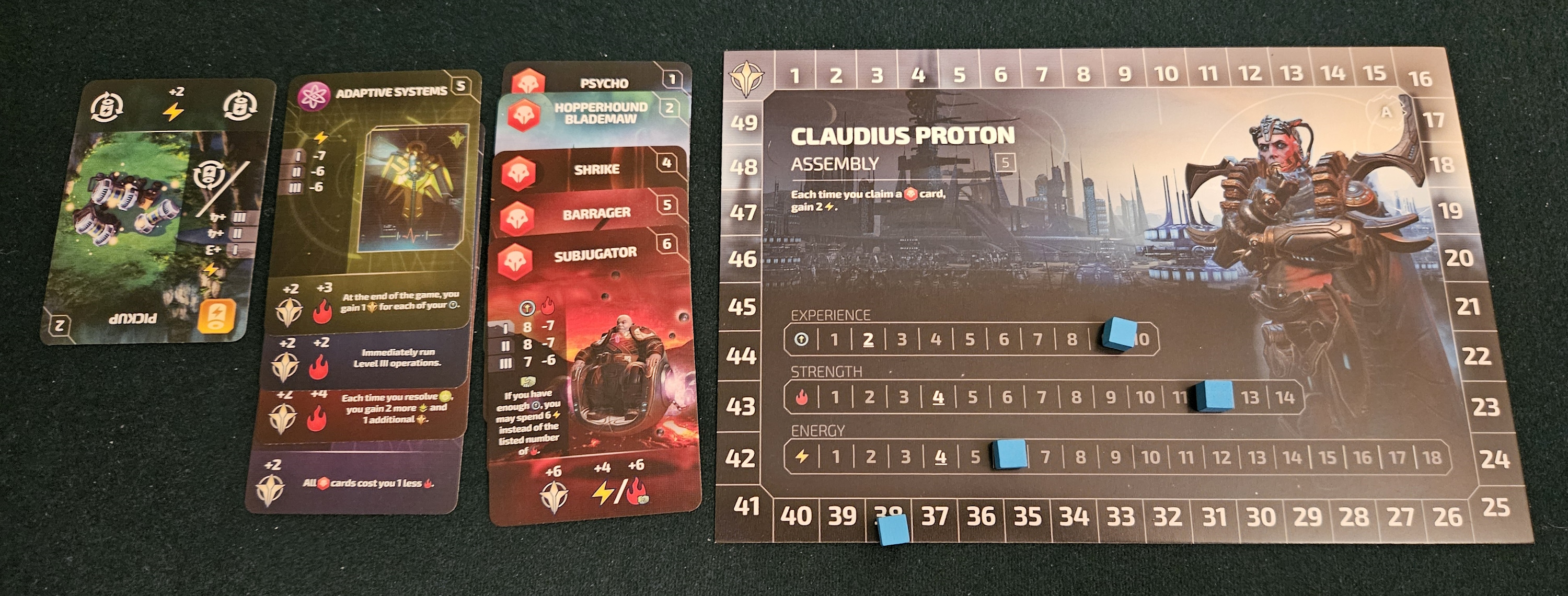
His name is Kenny Proton.
So what does Age of Wonders: Planetfall capture? Mostly an arithmetical awareness of every single action. This is a game about picking up cards worth various amounts of victory points. Nearly everything you do will yield a few of the buggers. In spite of this, every session seems to result in at least one tie. This is a sign that the game may have been over-balanced or too carelessly made or both. It’s like we’re all pedaling different bicycles in an ostensible race, only we all seem to be tethered together by a long pole.
Anyway, the cards. Here the cards are divided into four archetypes. There are enemies, some of whom can be parlayed with, but who mostly serve as ornaments to be impaled on stakes. These are a reliable source of points, but tend to require both great gobs of strength, your first resource, and experience, a secondary pool that functions to ensure you don’t have to spend too much of the former. Next are structures, energy-expensive edifices that are also worth points, and worth even more if you can pair them with a match later in the game. Advances function as perks, adding little advantages to their owner. Also, they award points. Last come pickups. These are worth resources. Sometimes you can turn them into a source of passive income rather than cashing them out immediately.
Pickups are the oddest inclusion of the bunch, though they also resemble the board game’s video game roots most closely. On the screen, Age of Wonders is a series about founding an empire and researching technologies, but also about sending heroes and armies into the wild to find the treasures and loot necessary to keep pace with your purchases. In the board game, these pickups become, well, pickups. They are things you pick up. Not caches, or troves, or whatever. Pickups. The veneer is membrane-thin. You might as well call enemies “points piñatas” and buildings “points piñatas that cost a different resource.”
So you gather these cards. You spend strength and energy. You accrue victory points. It’s all as boilerplate as rolled steel.
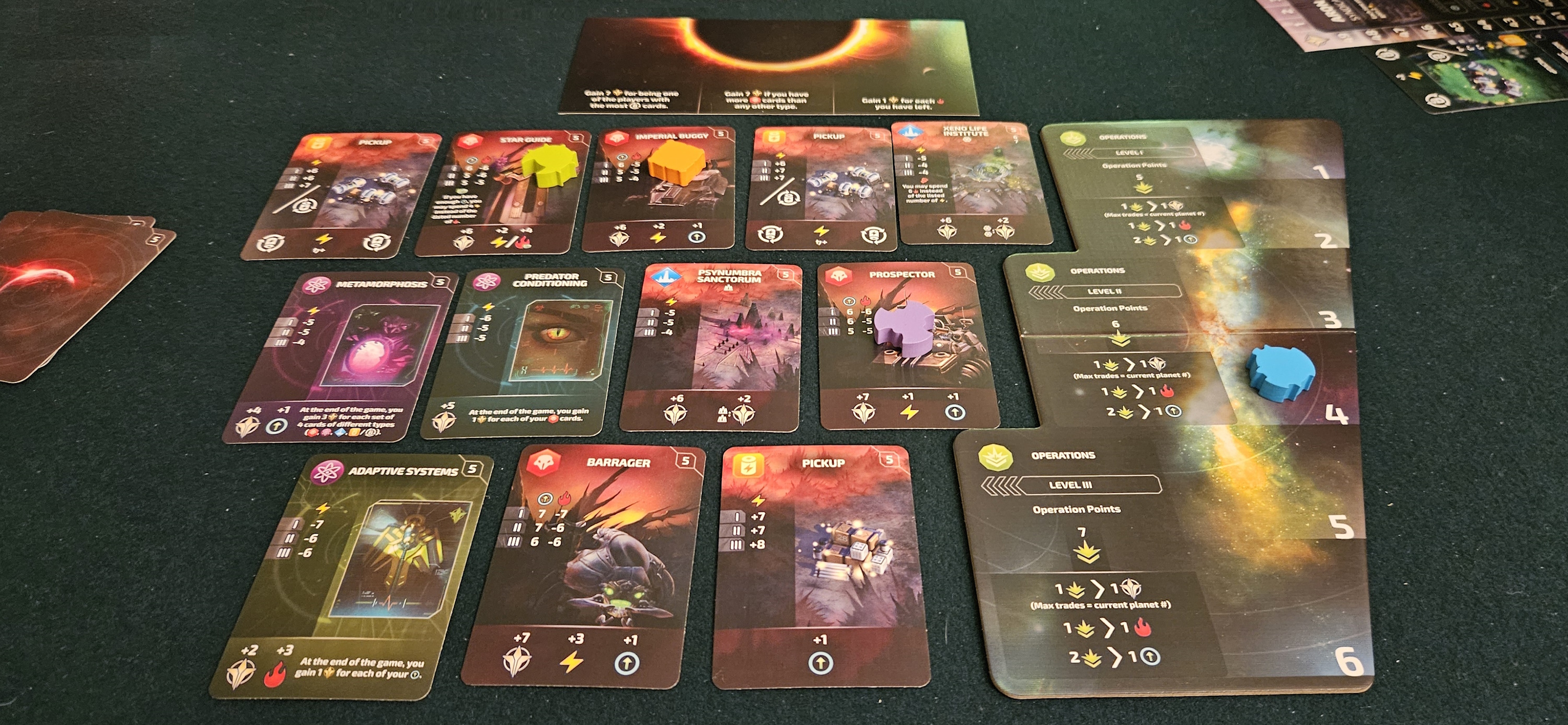
The card market is pretty solid, actually.
The one exception is the market. Planetfall is structured around seven planets, each played in sequence. You roll up to the first planet — a deck, really — deal it out as three rows onto the table, claim two cards per player, and then whisk away the remainder and bring out the next planet. After seven planets, the game ends, and none too soon.
But, again, the market is the exception, because claiming cards requires some degree of careful timing. As players select cards, their position determines everybody’s initiative for the next round of selection. At the same time, the higher the initiative of the card, the more expensive it is, or the tougher its thugs are, or the less valuable its pickup. Ugh. Pickup.
Anyway, the market is a clever system. It encourages players to think a little harder about what they grab, whether because of how a card’s position modifies its cost and/or yield, or because they’re hoping to follow it up with another card or get a jump on the next planet. If only it had been paired with a more arresting set of cards. As is, it’s far too clever to be slumming it up with pickups.
All told, Planetfall does so very little to explain itself. It’s an adaptation of a four-year-old video game, but one that doesn’t exhibit any sign of wanting to replicate what made its source material worth playing. Here’s the closest explanation I could figure. Sometime after its initial release, Age of Wonders: Planetfall (the video game) was updated with Galactic Empire Mode. Basically, this was a wrapper for the countless worlds you would conquer. Rather than playing only a single mission at a time, going through the process of expanding across and subjugating this brand new world (and in all likelihood giving up around the three-quarters mark because victory was inevitable), and then starting a new world, you would now hop from planet to planet, playing a full game apiece, with little sub-missions and unlockable perks. Think of it as a campaign mode, but with customization and dynamic objectives.

Hm.
Planetfall (the board game) doesn’t adapt Planetfall (the video game) so much as its Galactic Empire Mode. It goes without saying that this is a rather peculiar thing to adapt. It’s like designing a BioShock board game and making it about, I dunno, hydraulic hacking or the graphics settings.
Please note, this isn’t me saying that an adaptation needs to strive for faithfulness. For one thing, there was a BioShock board game! It was called BioShock Infinite: The Siege of Columbia, and it didn’t have all that much to do with its source material’s first-person shooter core. There’s nothing wrong with creating a game that hearkens to its source material without slavishly reproducing it. Geoff Engelstein did the same thing with The Expanse, decoupling the solar system’s biggest idiot and his plucky crew from the factional politics that surrounded them.
But in both cases, at least their designers strove to craft something that worked on the table. Sure, they emphasized, to various degrees, the things people liked about BioShock and The Expanse. But they also understood the language and possibilities of board games. Apart from its barest rudiments, Age of Wonders: Planetfall does no such thing. It’s serviceable rather than invigorating, bland with its imported models. Even its best idea is buried. This is one perplexing artifact. It doesn’t warrant a pickup.
(If what I’m doing at Space-Biff! is valuable to you in some way, please consider dropping by my Patreon campaign or Ko-fi.)
A complimentary copy was provided.
Posted on December 18, 2023, in Board Game and tagged Age of Wonders: Planetside, Arcane Wonders, Board Games, Hobby World. Bookmark the permalink. 5 Comments.

 SPACE-BIFF!
I’m curious, what led you to review this game? I know your time is limited, and this does not seem like a game that would fit within your interests.
I feel it’s important to try things that wouldn’t normally appeal to us. That’s how we discover new things.
Age of Wonders was a spiritual successor to Master of Magic, essentially Civilization but fantasy. Based on that pedigree I was interested in checking this out at PAX Unplugged, but as soon as I saw it I knew they had dropped the ball. Something closer to Civilization: A New Dawn but fantasy would have been very welcome – this, less so.
Yeah. There are so many directions they could have taken it. I would love to see them attempt something like A New Dawn!
Well, that looks underwhelming…