Messy and Tame

Dmitry Belyayev’s fox experiment is well known today. Launched in 1952 in Novosibirsk with 130 silver foxes rescued from fur farms, the objective was to determine whether the animals could be domesticated. Forty breeding generations later, the project had produced a cohort that was fully tame, if rather messy. But while tameness was the principal objective, other traits had also become evident: floppier ears, spotted faces, and a curiosity for sniffing and licking humans, among others.
Designed by Elizabeth Hargrave (of Wingspan fame) and Jeff Fraser, The Fox Experiment replicates Belyayev’s domestication project. It’s about as tame — and as messy — as that experiment’s descendants.
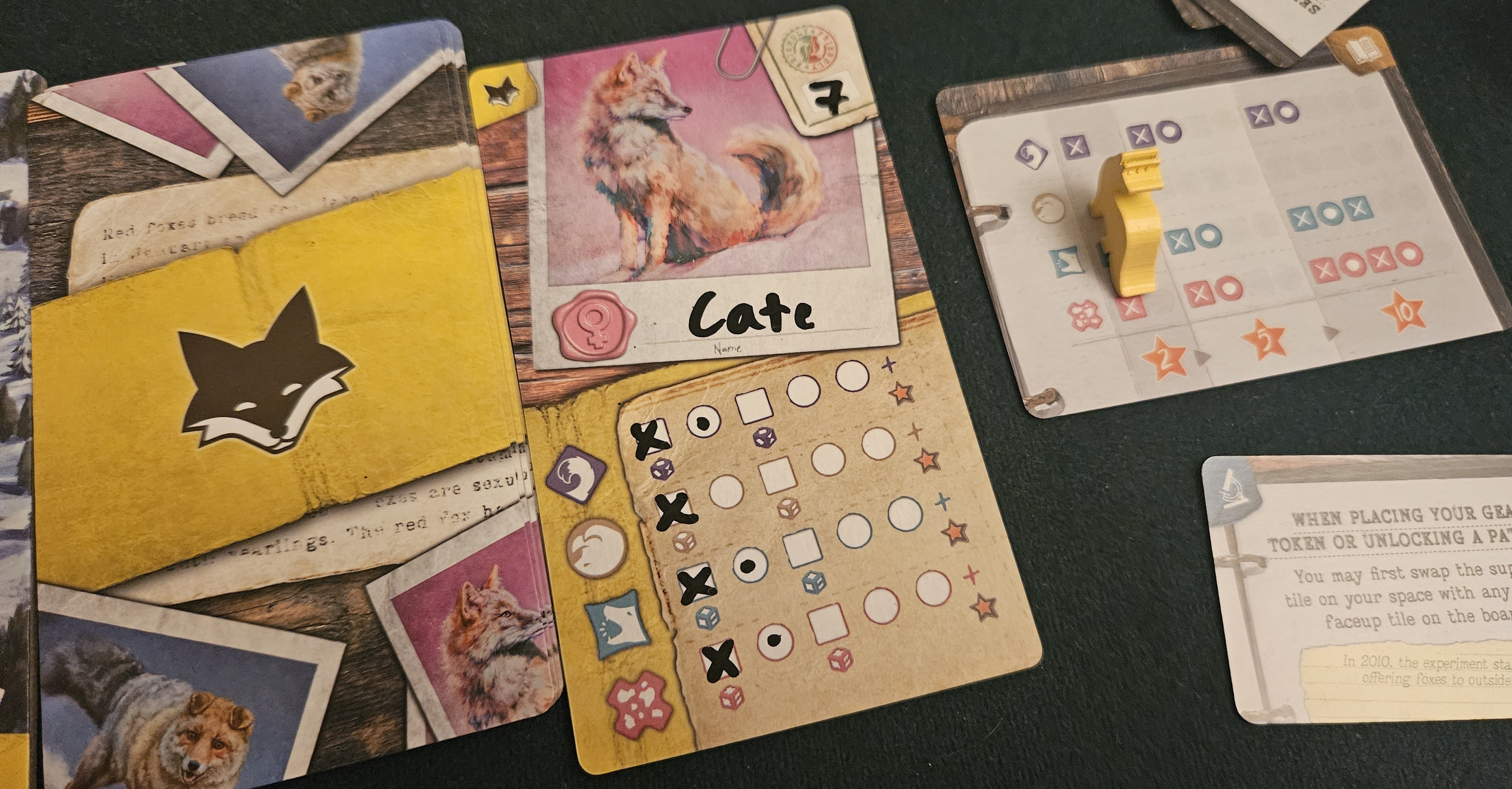
The second generation of fox.
It begins with a breeding pair. There are only five rounds in The Fox Experiment, each mapped to a single generation of foxes and their offspring. Which is why each round begins with a simple pair, male and female, selected from a pool of four or five options. Because this is a board game and players are locked in competition, this is pitched as a draft. My scientists might be hoping to produce offspring that are especially spotted and bark to get attention, so I’ll grab parents that have those traits. Then again, maybe I’ll select a suitable male only for the best matching female to get nabbed by a rival team. So it goes. In board games, anyway. I’m not so sure about in scientific research.
From there, we roll dice. By the back half of the game, probably a whole lot of dice. Each of our breeding pair’s offspring is generated based on those results, often with some interesting wiggle room around wild dice and matching half-dice and so forth. Okay, let’s go with it. We mark those traits on fox cards, which are handily dry-erase. And then, in the game’s best twist, after scoring and earning bonuses and all the other little instances of bookkeeping we’re required to undertake, these foxes become the next generation’s pool of parents.
In other words, from the second round onward, you’re now selecting custom-bred foxes. Custom-named, too, since The Fox Experiment defies easy characterization as a game about animal experimentation. It’s easy to get attached. So easy that there’s an optional rule for inbreeding. This nudges players into acquiring at least one mating fox that they didn’t produce last round, lest they incur a penalty. It’s a good inclusion, if only to make the selection process a little more interesting.
Now repeat the whole thing a few more times. Successive generations gain greater bonuses and handfuls of dice that are harder to wrap your fists around. There are rule-breaking research cards, and others that represent research benchmarks, and multiple ways to score points, and the faintest musky whiff of danger that never fully materializes.
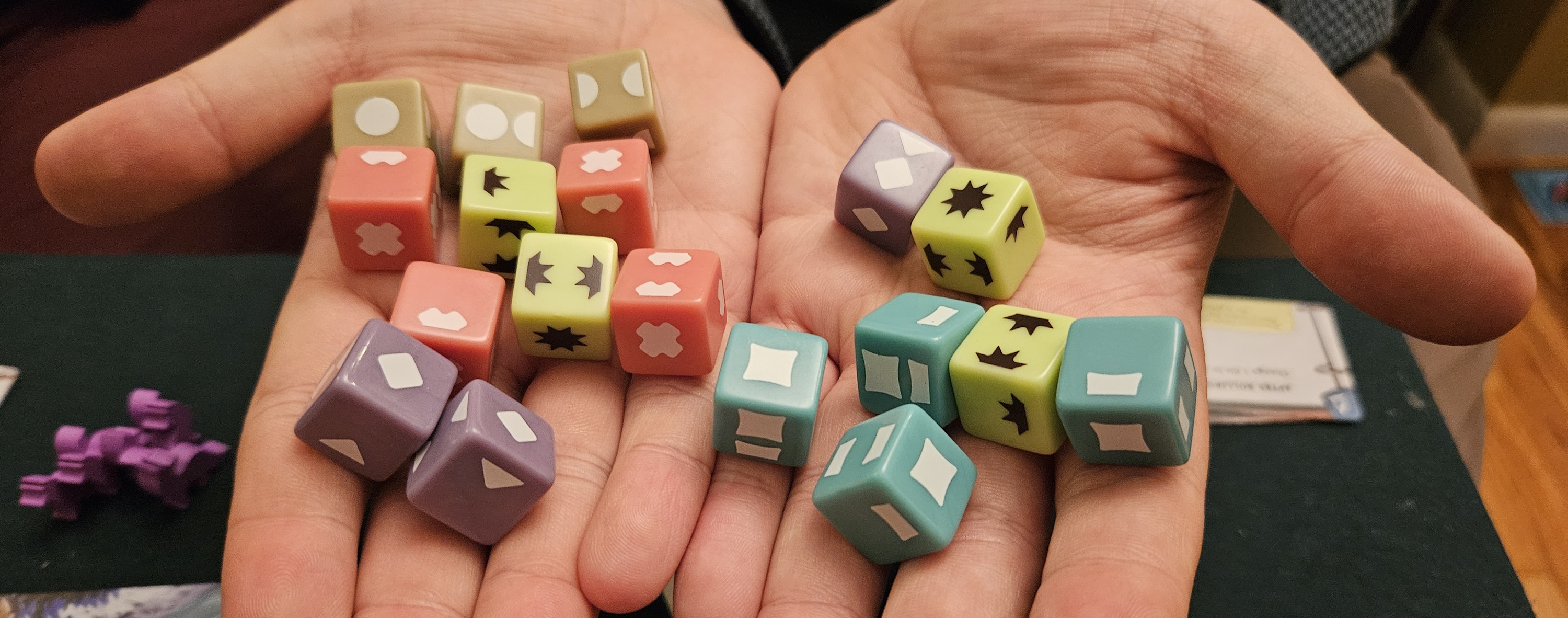
These dice get out of hand.
That danger is perhaps the least utilized of The Fox Experiment’s captivating backstory. The historical experiment posed certain dangers to its researchers, challenging as it was to the scientific doctrine of its place and time. Science and doctrine don’t often commingle; here they made strange bedfellows.
The Soviet Union of the 1950s had adopted the evolutionary theories of Jean-Baptiste Lamarck, which argued that an organism passed along the traits it had developed during its lifetime. This was more appealing to Joseph Stalin’s brand of Marxism, which preferred a model that was orderly — and readily manipulable — as opposed to the probabilities of random mutations and natural selection as posited by Gregor Johann Mendel. In its zeal to purge itself of every disagreeable element, the Soviet Union imprisoned and even executed scientists who promoted the “bourgeois nonsense” of Mendelian inheritance. This turned out to be a bad call when Trofim Lysenko, the main proponent of Lamarckism in the Soviet Union, used its principals in various crop hybridization programs. Instead of producing greater yields, these resulted in famines.
This tension is hinted at in The Fox Experiment but never capitalized on. To be sure, your fledgling program requires some assistance getting aloft. As your foxes develop traits, you earn tokens that can be spent to unlock upgrades. Some of these feed back into your research, adding wild dice or letting you produce a second or even third offspring per generation. Another upgrade lets you appeal to sponsors, earning immediate rewards and unlocking endgame bonuses. This is the game’s sole nod to the danger of challenging scientific orthodoxy. Like everything else in The Fox Experiment, it’s more airy than perhaps it could have been.
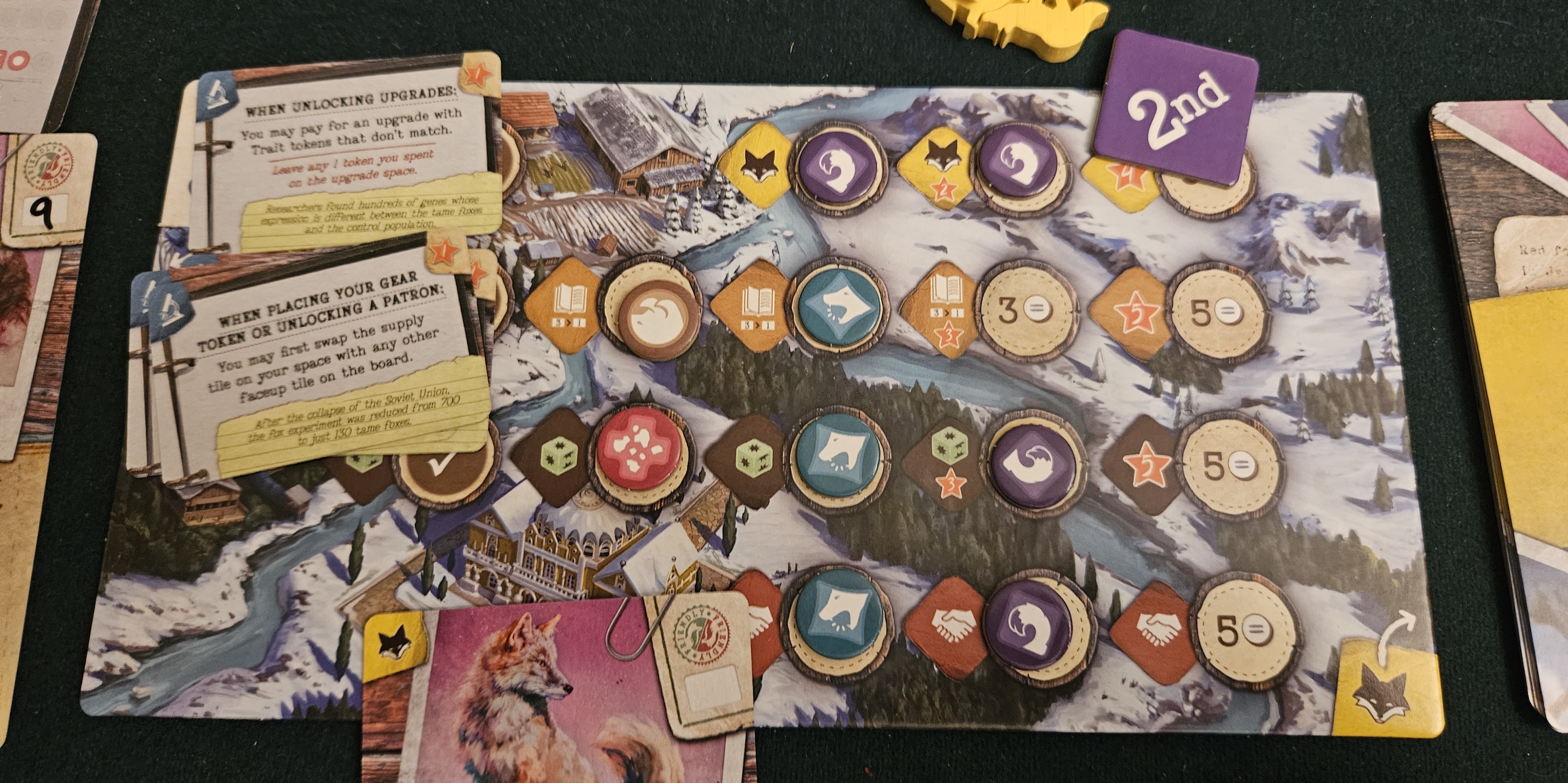
Do these upgrades occur within your lifetime or only between generations?
It would be wrong to expect The Fox Experiment to be too dense. This is a broad-appeal game, and it ticks so many bullet points that it puts an apparatchik to shame. Every step is full of clutter but not especially long on decisions. The bulkiest step, in which you roll those dice and mark traits on the next generation of foxes, takes longer than you might expect. The dice need to be carefully matched, and before long there are enough wild dice in the pool to begin prioritizing the right traits to fulfill research grants or chase other objectives.
The dice, however, are handled clumsily. To maximize how many traits your foxes will inherit, they need to be matched side by side to produce new icons. Their integers range from 0.5 to 1.5 trait pairs, so there’s a distinction between a good roll and a bad roll, but not by so much that the rolls ever become exciting. In many cases, especially as further foxes are bred and successive generations enter the gene pool, the results begin to flatten. Rather than producing distinct creatures, every player is conducting a lot of work in order to result in very similar foxes, give or take a pip. Early on, the hereditary traits of your foxes matter a whole lot. Later, not so much.
But here’s the thing. While The Fox Experiment is far too messy and far too tame to hold my interest, it does see success under the right circumstances. With my usual group, their tastes leathered by a hundred new titles a year, it was almost impossible not to tut at its mess, its sprawl, its lengthy processes that produced little of import. But when I introduced it to my nine-year-old, she was smitten. She labored not only over her foxes’ traits, but also their names. She commented on their coats, their poses, laughed in delight when one of her prize offspring was picked first for the next round. She loved it.
Mind you, the game still doesn’t quite fit her age. She pursued her research goals, but could make neither head nor tails of the sponsors. She struggled to recall the meaning behind all the symbols placed before her, and never worried too hard about chasing matches. Also, she drew all over her player board with her dry-erase pen, necessitating an emergency alcohol swab. It’s hardly her fault; the boards look like they should be scribbled on. If anything, the board upgrades would have functioned better with pens than tokens. With so many dice tumbling around, they’re far too easy to scatter.
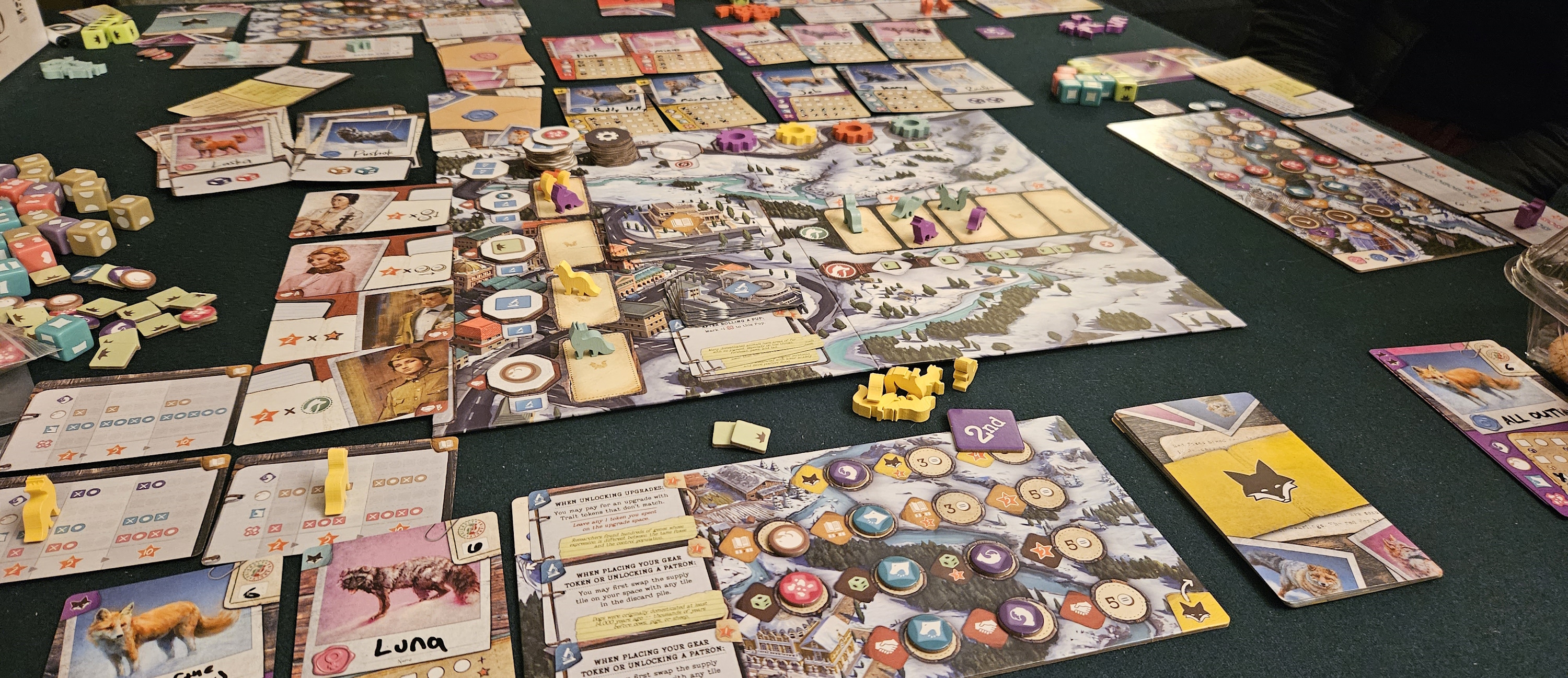
The Fox Experiment is rather cluttered.
But despite those hiccups, The Fox Experiment holds a certain appeal, one that’s full of wonder and less interested in good gaming than in pretty pictures and the novelty of naming your spotted fox Spotsy. I wish it had done more, or maybe less. Oh well. It’s messy and tame, for better and for worse.
(If what I’m doing at Space-Biff! is valuable to you in some way, please consider dropping by my Patreon campaign or Ko-fi.)
A complimentary copy was provided.
Posted on October 12, 2023, in Board Game and tagged Board Games, Pandasaurus Games, The Fox Experiment. Bookmark the permalink. 5 Comments.

 SPACE-BIFF!
This review really gives me an idea of The Fox Experiment’s strengths and weaknesses! I appreciate the contextualization of the game’s subject matter as well. And, as always, it’s beautifully written.
Thank you!
I could see my 8 year old reacting similarly! Too bad the game was more workable for that age group. What other games tickle your daughter or would she call her favs?
“wasn’t” more workable, I meant.
She likes Lacuna a whole bunch. Also chess, Men at Work, and Rhino Hero Super Battle. For the most part, though, she likes to try new things.