Blog Archives
All Shiver, No Timber

Michal Vitkovsky’s Shiver Me Timbers is a sandbox pirate game. To answer your question, yes, it’s similar to Christian Marcussen’s sandbox pirate game Merchants & Marauders. In more ways than one. Both see you helming your very own pirate ship, unashamedly trace their genealogy back to Sid Meier’s Pirates!, and, since Board Game Geek is basically a dating app for board games, they both catfish you into expecting a two-hour playtime when really you’ll be stuck at the table for four. Tsk tsk.
But even though the parallels are difficult to avoid, this isn’t a comparative review. Shiver Me Timbers is more interesting for the ways it stands apart.
That Magnate Moment

James Naylor’s Magnate: The First City is an ambitious opening act, a fact only made more appropriate by its wicked irony. In my preview, I compared it to Monopoly. Plastic buildings, paper money, rents, dice. They even share a setting, focused as they are on unregulated property development. It’s almost as though the entire real estate industry is so shot through with corruption and profiteering that its only natural gamification is get-rich-quick fantasies.
Unlike Monopoly, though, Magnate’s satirical perspective hasn’t been neutered by corporate plagiarism. Instead, it rushes toward a single inexorable conclusion. This will undoubtedly be the game’s most controversial aspect, but to strip it away would be to remove the whole reason Magnate works, both as a plaything and as a statement.
I’m speaking, of course, about that game-ending housing crash.
Interior Design for Ghouls

What’s a dungeon without a rack of swords? The odd pile of bones? A tasteful corridor-obstructing sheet of cobwebs? In Jeff LaFlam’s Dungeon Decorators, probably not very many points. Depending on which scoring card you’ve drawn, that is.
Off with Your Head
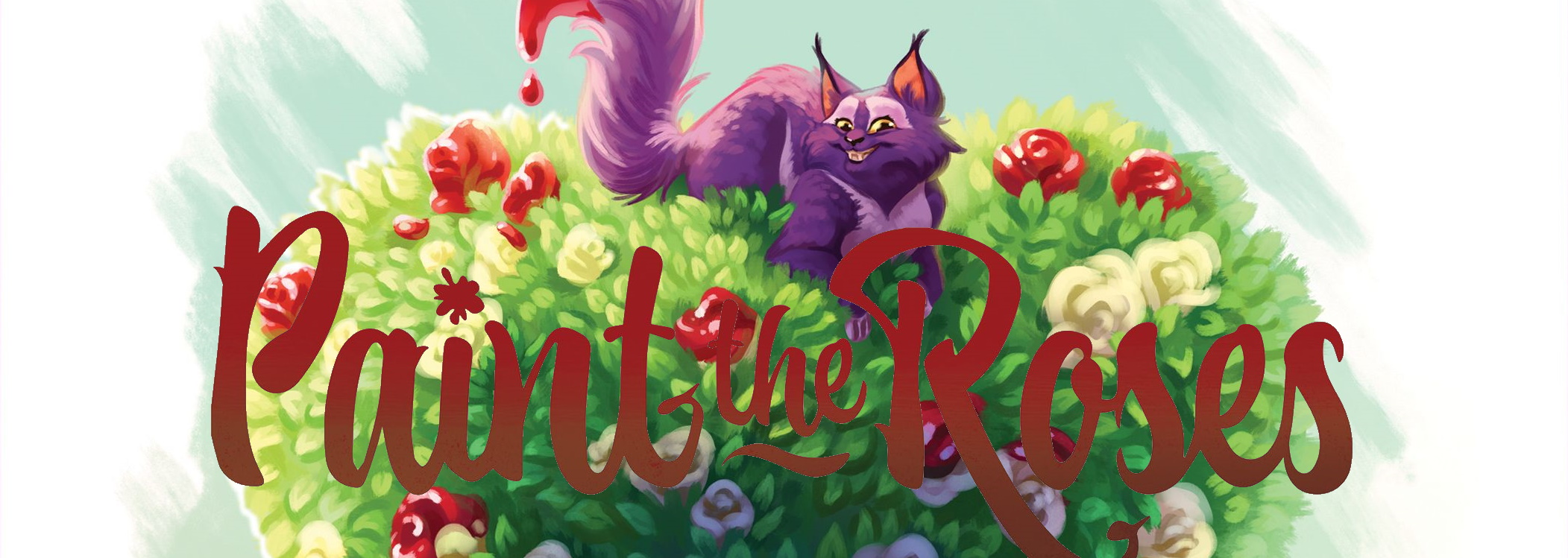
The latest trend in puzzle games is to tinker with communication. More properly, limitations on communication. The Mind, The Shipwreck Arcana, Codenames — the last few years have offered plenty of supernal examples. Have the player identify an island in a sea of noise, give them a way to provide limited glimpses of that island to their fellows, and then tell them to shut up. There you go. Puzzle game.
Ben Goldman’s Paint the Roses works in that same space, but according to a rhythm that feels more naturalistic and less constrained than its peers. Behind its pleasing Alice in Wonderland veneer, it just might be one of the finest limited communication games I’ve played.
Ruination Rumination
Everything about Ruination, the post-apocalyptic game of feuding post-apocalyptic maniacs by Travis R. Chance, screams in neon color squiggles that it would be the perfect eccoprotic for a trashy mood. Vibrant colors, thick miniatures, dice. Dice for days. Dice for miles of dusty motorbike trails. This is what the warboys play when Max Rockatansky isn’t helping Imperator Furiosa steal their rigs and breeders.
So why has Ruination left me colder than the wasteland after dark? Witness me as I try to explain.
Bug Wrasslin’

Ask my seven-year-old daughter what she wants to be when she grows up, she’ll say “an entomologist.” Also a robot artist. Still. An entomologist. That probably has something to do with why she shrieked in delight when I showed her the bug cards in Kabuto Sumo. And why she kept insisting we play again and again. Or maybe it’s that she loved shoving things around.
Tony Miller and Kwanchai Moriya, you made my daughter very happy tonight.
Elegy: The Oxidation Struggle

One of the oft-unacknowledged talents of designer John Clowdus is his ability to evoke a complete world in the most compact format possible. I’m not only talking about Omen: A Reign of War, although my affection for that card game has been documented and documented again. Clowdus is also responsible for the messy prehistory of Neolithic, the undying carnival that is Hemloch, the collapsing Bronze Age, and, more recently, the chilly The North. His games are transportations in miniature, showing a cross-section of a world that stretches far beyond the limitations of the small boxes he crams them into.
The same is true of Dirge: The Rust Wars. Returning to Aaron Nakahara’s dilapidated style from The North — with additional contributions by Liz Lahner of Bronze Age — Dirge evokes biomechanical vultures picking over the last scraps of bone in a world that’s fallen apart and won’t be put back together again.
There’s No Board Games Like Show Board Games

I’ll confess, I agreed to play Roll Camera! on the strength of its title pun alone. Because it’s about filmmaking, you see, and also it’s a dice game. Brilliant. Now you know the secret. Hook me with a next-level pun and your foot is already in the door.
Thank goodness Malachi Ray Rempen didn’t stop there. He also happens to have created a game that on more than one occasion made me exclaim with delight at its subtle moments of clever design.
Ceci n’est pas un Jeu de Société

It says so right there on the side of the box for Mind MGMT: “The Game of Calm and Relaxation. Where everyone wins.” Given the portrait that adorns the cover, of a woman partially shrouded by flames and implements of murder, one gets the sense that maybe this game isn’t being entirely forthright with its advertising.
The evidence keeps piling on. Hidden messages. Sinister warnings. Visual references to René Magritte’s La Trahison des Images. Much like the reality- and expectation-bending comic book series by Matt Kindt, Jay Cormier and Sen-Foong Lim’s version of Mind MGMT appears to be one thing only to soon reveal itself as something else. Before long, this state of constant metamorphosis proves to be the rule. You can barely hold it in place for all its writhing.
Criminal Capers: Hot Lead

Another day, another entry in Reiner Knizia’s Criminal Capers trilogy. After enjoying Soda Smugglers and Pumafiosi — both with caveats — it’s time to ask the big questions about Hot Lead.
Question one: Why is this the best title in the whole trilogy?
Question two: Is it “hot lead” like bullets? Or “hot lead” like a tangent you pursue? Or both?

 SPACE-BIFF!