Blog Archives
Alone on a Dark Night
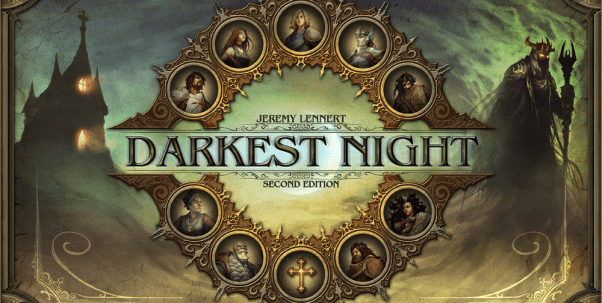
Darkest Night was one of the first games I ever played solo. It arrived with a tiny board with jigsaw-puzzle connectors, smoky laser-charred wooden standees, and a napkin for wiping the soot off your fingers when you were done punching everything out. For months it retained that campfire reek, like summers up the canyon, like burning villages, like a necromancer’s grip tightening around a fantasy kingdom’s throat.
It got its grip around my throat as well. With its thickly despairing gameplay, religion-gone-literal subtext, and smoke filling my nostrils, I defeated the necromancer time after time. More often, it was him who did the defeating.
Sadly, Darkest Night was a flawed game, and it fizzled from my table as abruptly as it had flickered to life in the first place. Its central notion — that your heroes were waging a guerrilla resistance and would spend more time hiding than fighting — was undercut by the fact that it was relatively easy to defend a single hero chilling in the corner. This hero could spend every turn searching for keys, which would unlock relics, which in turn would slay evil once and for all. A to B to C to Dead Necromancer, all without leaving the comfort of a single space. So much for guerrilla warriors. More like renegade metal detectorists.
Two Minds About One Deck Dungeon
Today on Two Minds About…, Dan Thurot and Brock Poulsen are here to dissect the claim that One Deck Dungeon only contains one deck. Because it totally doesn’t.
Dan: You heard the invisible man. So what’s your take, Brock? One deck or not?
Brock: Is this one of those Zen kōans? Are we going to have some kind of pseudo-intellectual discussion, like when those people argued about whether you can shuffle a single card?
Dan: Well, can’t you? (faint whiffling noise) Never mind, let’s move on.
Haze of Love

Look, whether or not we agree with it, we’ve all heard the refrain: why are so many games about war and violence? Why not love? Why not relationships?
Fog of Love is why. This isn’t a ding on Fog of Love, per se — there will be time for that later — so much as it is a statement on just how difficult this love stuff can be. All’s fair in love and war? Baby, war ain’t got nothing on love.
One Raven Two Raven Three Raven Four

While Grant Rodiek is possibly best known for Cry Havoc, it’s his smaller games that stand out as the purest expression of his design ethos. With offerings like Hocus and Solstice — the latter of which was one of the most devious games of last year — Rodiek seems determined to present slick, carefully tested, and, perhaps most importantly, interesting games, often with a footprint smaller than an actual footprint.
Enter Five Ravens. This is Rodiek’s newest game, and it’s easily one of his best yet.

Going Full Medieval
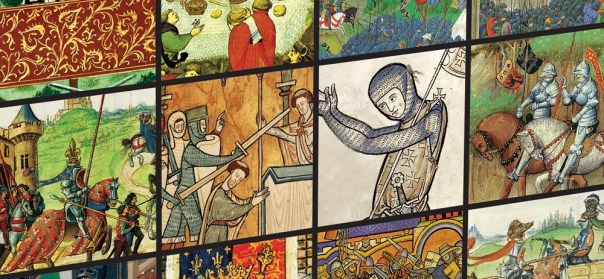
There are about a hundred reasons why Ortus Regni is such a fascinating artifact of board gaming. There’s the historical appeal, for one. Rather than merely establishing itself as a medieval card game, complete with all the modern idiosyncrasies and anachronisms anyone with a knowledge of the Middle Ages has come to expect, it’s a layered thing, descending through multiple eras like peeling back the layers of a dream. It’s today’s imagining of a Late Middle Ages game romanticizing the Anglo-Saxon Period. Twenty-first-century design sensibilities, fourteenth-century culture, ninth-century romance and nostalgia.
“Woah,” says Smart Neo.
Swallowing Hemloch

Here we are at last, taking a look at the final installment of John Clowdus’s second-latest trilogy of Small Box Games games. This time it’s Hemloch: Dark Promenade, and it’s by far the most interesting of the three.
Daimyo Seii, Daimyo Do

Another day, another Small Box Game by John Clowdus. This time it’s Seii Daimyo, where much like every other game about Feudal Japan, your goal is to unite the country’s warring clans under a single Shogun.
Fortunately, the execution is more interesting than the setup.
Not Sure What a Cartouche Has to Do With It

Another year, another trio of small box games from small box games king John Clowdus, proprietor of Small Box Games. Except this time I’m so far behind that he has some other games out, which pretty much makes me a filthy truant, and—
Deep breath. One thing at a time. First up, Cartouche Dynasties. This is a single-deck ditty about building a kingdom in Ancient Egypt. It has nothing to do with either cartouches or dynasties.
Now let’s uncover what else it’s been lying about.
Fate of the Public Domain Monsters
When it comes to board game settings, I’m about as energized by the appearance of H.P. Lovecraft’s Cthulhu as by anything featuring zombies — as in, yeah, they’re overdone, but at least they’re easy to design around. Just as zombies provide baked-in behavior (walk and bite, walk and bite), the presence of Cthulhu & Co. means you know what you’re getting yourself into. Hooded cultists, the coastal hamlets of New England, encroaching madness, and the Arkham that isn’t associated with Batman. It’s thematic shorthand for “watch your health and sanity meters.”
It might be possible to say that Fate of the Elder Gods does the setting a service by letting you don the robes of the cultists themselves as you strive to summon your chosen mind-flaying monster, but it’s hardly the first to do so. Instead, we’ll have to settle for celebrating the fact that it’s a surprisingly good screw-your-buddies affair.

 SPACE-BIFF!