Blog Archives
Simps All the Way Down

Gastby. You know Gatsby, right? Throws fancy parties. In love with a woman who couldn’t care less whether he lives or dies. Always staring at that green light.
When it was announced that Bruno Cathala and Ludovic Maublanc were doing a board game version of F. Scott Fitzgerald’s The Great Gatsby, the response was mostly derisive. I get it. We’re tired of this multiverse crap. And who are these new characters anyway? Everybody knows you can’t go disrupting fans’ headcanon by adding characters to a century-old book.
In this case, though, it works. What’s a better homage to Jay Gatsby than inventing two new characters who were presumably hovering in the wings the entire time, only he never noticed? Unsuccessfully simping for somebody’s attention is as Gatsby as it gets.
Too bad about the rest of the game, though.
The Year of Living Boringly

Ever wanted to make a year seem as long and tedious as possible? Boy, have I got the game for you! Meet 365 Adventures: Cthulhu 1926: 2026, a title filled with too many damn numbers. Designed by Lee Ju-Hwa, this is the sequel to this year’s 365 Adventures: The Dungeon. Some have called the idea of letting you play a microgame every day “innovative.” That’s a heck of a thing to say when daily peel-off crossword and sudoku calendars have existed since Ancient Roman times. But, sure, let’s go with it. 365 Adventures is innovative for anyone who wants to make their year seem as long and tedious as possible.
Oops. I already wrote that. My bad. Forced repetition is more of this game’s shtick.
That Wizard Came from the Moon

Fabio! Lopiano! Truly, he has the most pronounceable name in the entire hobby. I’m something of a provisional fan, after being impressed with Merv but mixed on Autobahn and Sankoré, both of which proved too overwrought for their own good. Shackleton Base, which Lopiano co-designed with Nestore Mangone, finds the pair back in stride. It’s complex but not too tangled, indulges in the occasional digression but never loses focus, and above all takes us to a semi-plausible moon colony that feels absolutely great to bang into working shape.
Smurf-Hopping

I only recently got the memo that we’re now calling the entire shared-input genre, roll-and-writes and draw-and-writes alike, “smurf-and-writes.” Which… look, I’m not the king of taxonomy around here, but at a certain point we linguistic descriptivists really ought to consider putting our foot down.
Anyway. Rivages, designed by Joachim Thôme, is an island-hopping smurf-and-write (hurk) that isn’t nearly as smurfy as most of its peers. By which I mean it’s less about those shared inputs than you might gather from its laminated maps and dry-erase pens.
Upscale Court Officiants
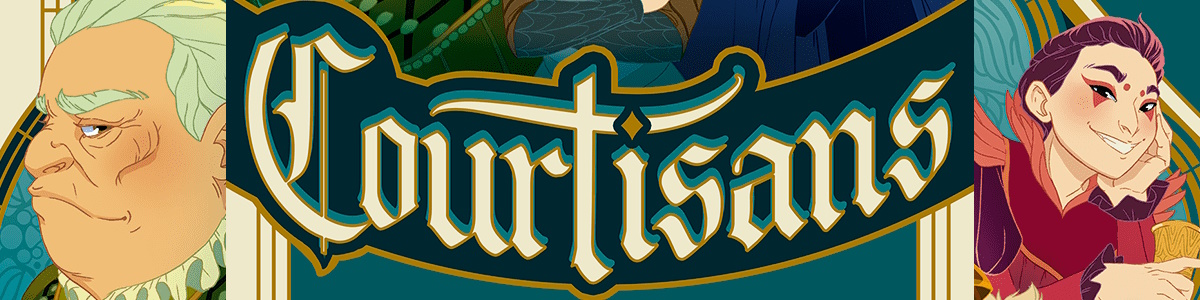
Let’s get this out of the way up front: yes, Courtisans is a funny title for a card game. Designed by Romaric Galonnier and Anthony Perone, one presumes the title’s French meaning hasn’t gone the way of the English word “courtesans” to imply upscale prostitutes. Or maybe it has. I really couldn’t tell you.
Look, it doesn’t matter. Whether it’s about upscale prostitutes, upscale courtiers, or upscale court officiants, Courtisans is a shockingly good game with almost zero rules overhead.
Messy and Tame

Dmitry Belyayev’s fox experiment is well known today. Launched in 1952 in Novosibirsk with 130 silver foxes rescued from fur farms, the objective was to determine whether the animals could be domesticated. Forty breeding generations later, the project had produced a cohort that was fully tame, if rather messy. But while tameness was the principal objective, other traits had also become evident: floppier ears, spotted faces, and a curiosity for sniffing and licking humans, among others.
Designed by Elizabeth Hargrave (of Wingspan fame) and Jeff Fraser, The Fox Experiment replicates Belyayev’s domestication project. It’s about as tame — and as messy — as that experiment’s descendants.
Join in the Restivities

Let’s see if I can do this correctly: Real men are always thinking about smashing the state. Have I gone viral?
The 35 cards in Brendan Hansen’s Unrest edge it out from being considered a microgame, but it’s about as short and tidy a game as I’ve seen. With one player controlling a dystopian empire and the other seeking to overthrow it, a full session last maybe ten minutes. The rules are similarly light, taking all of a minute to explain. Even so, it feels like it’s wasting the time of one of its players.
Emergence

It’s an easy thing to draw comparisons between one game and another when they share mechanical underpinnings, but I often prefer to dwell on those parallels that aren’t immediately clear. Take, for example, Adam DeYoung’s Emerge, the recent release from Pandasaurus that, for all intents and purposes, is another generic points-chaser. It’s a dice game at heart, and feels bland for precisely the same reason it feels rewarding in the moment, thanks to a core gameplay loop in which nearly every action awards roughly one point. It doesn’t immediately stand out from the pack.
But while playing Emerge, the strangest comparison kept springing to mind. That title was Jon Sudbury’s Ortus Regni.
Monkey See, Monkey Doze
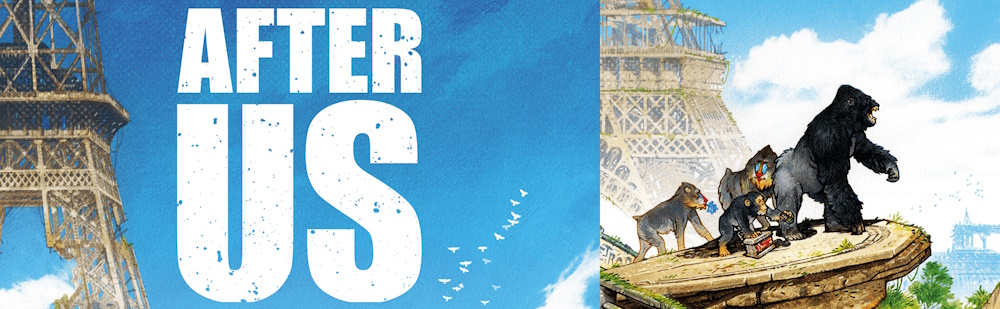
After Us is a tranquilizer. And not the gentle soporific kind that lets you slip little by little into drowsiness. It’s a knockout drug in a pressurized dart that’s been fired straight into your artery and dragged you kicking into a coma. I suspect that wasn’t what Florian Sirieix was designing for, but here we are.
All That Glitters Is Not Aurum

All I play anymore is trick-taking games.
I’m not being all the way serious. But it is a rare game night that doesn’t see at least a few tricks being taken. As I wrote in the first part of my open letter to my younger self about the value of trick-takers, these things are just so dang easy to learn that they offer the perfect digestif to a full-course gaming session. Only yesterday, Shreesh Bhat’s Aurum provided a literal digestif, enabling a pleasant half-hour after dinner with the in-laws. It helps that Aurum is mostly a team game. That way, my mother-and-law and I can tear up the table.

 SPACE-BIFF!