Blog Archives
Hot Cross4 Buns
Back when I was in the dating pool — the late Pleistocene, oh ho ho — I would sometimes tell women that my only qualification for a life partner was somebody I could “play boggle in bed” with. This was, of course, a euphemism for playing Bill Cooke and Allan Turoff’s 1972 word-making board game Boggle. While atop a bed. Because beds are cozy. And let me tell you, that joke goes so much harder among people who don’t play so many board games that they immediately assume that’s what I meant by “Boggle” in the first place.
Amabel Holland’s cross4 falls into the category of retro word games. Like Boggle, I suppose. Frankly, I would rather play Boggle. Which perhaps isn’t a ding against cross4 so much as it is a statement about how great Boggle is.
Lovers’ Quarrels
Who was it that said that every tale is a tragedy, it’s only a question of when the story ends. I bet that person was a real hoot at noon tea. Personally, I think every story is a comedy, provided the punchline is a trillion years of black holes and fading background radiation. (I, too, am fun at teatime.)
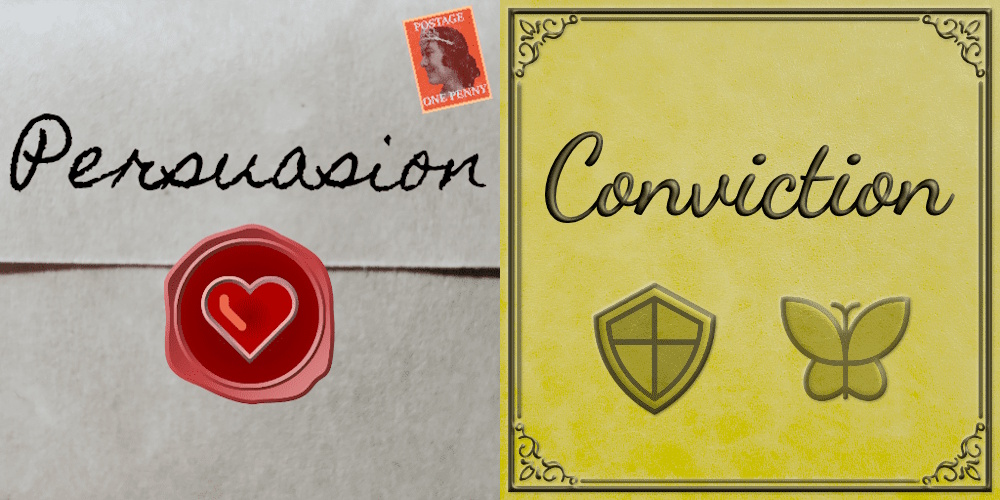
It’s been three years since we took at look at Persuasion, the relationship game by Xoe Allred. In the time since, Allred has given us Velocirapture and Vibes, imperfect little games that peel into our assumptions about victory conditions. Now it has two new games out: the Hollandspiele version of Persuasion and the self-published Conviction. Put together, we’re offered a two-act tale about the beginning and (potential) end of a relationship. I couldn’t speak to their suitability over tea, but together they offer contrasting — and sometimes all too familiar — perspectives on what it’s like to chase one’s Happily Ever After.
Space-Cast! #50. City of Six Amabels

Not many board games are as mysterious as City of Six Moons. Is it a puzzle? A working board game? A grift? To answer those questions and many more, today we’re joined by Amabel Holland to discuss her oddest title yet, the joys and perils of translation, and her recent efforts to preserve board games that have fallen out of fashion.
Listen over here or download here. Timestamps can be found after the jump.
Syke!
In 1916, at the height of WWI, two diplomats met in secret to outline the future partitioning of the Ottoman Empire. Those diplomats, the United Kingdom’s Mark Sykes and France’s François Georges-Picot, approached this undertaking with all due gravity and diligence.
Jokes! Nah, they more or less scribbled on a map with crayons, dividing the region between the U.K., France, Russia, and Italy. Their proposed boundaries split local polities — in some cases, they seem to have used the letters on their map as landmarks — and showed no intention of honoring their agreements with their Arab allies. Shrouded in secrecy, the agreement only came to light when post-revolution Bolsheviks published the whole thing, proving to the world that the Triple Entente had returned to their bad habit of cutting backroom deals.
This ignominious treaty is the topic of Sykes-Picot, the trick-taking, dry-erase, area control game by Brooks Barber and Hollandspiele. This one is angry, polemical, slapdash, and wholly on-point.
Three Phases of Six Moons

The past is not a foreign country but an act of imagination, one that can have greater or lesser fidelity to something that once happened, but one that also remains forever out of reach. The best we can do is stretch and maybe, just maybe, graze fingers with the unnameable.
Like true history or old starlight, City of Six Moons is an unrecoverable thing. Created by Amabel Holland, this is a radical design from a designer known for pushing boundaries. By now you may have heard of the game’s conceit: in a medium defined by its attempts to crystallize authorial intent as perfectly as possible, City of Six Moons is instead presented in a foreign language, offered to Holland by alien visitors and then transmitted to us as a signal garbled over the airwaves. Somewhere underneath the static is a playable game. On our plane, the designer refuses to clarify any rules or offer correction.
Over the past four months, I have grappled with City of Six Moons. I have studied its rulebook by lamplight and fallen asleep with its symbols dancing under my eyelids. This is the story of how I translated the game — or, perhaps, how I didn’t.
A Triphthong of Word Games

One of my favorite things about playing and critiquing board games is seeing the way designers can push the same mechanism in different directions. It’s not unlike a creative writing exercise in which everybody begins with a single prompt yet still produces their own individual perspective.
Here’s my latest example: I’ve been playing three word games that all revolve around pulling letters, chit-style, from a container. From that sliver of overlap, three distinct titles emerge, each with their own sensibilities and tics. Rather than spreading them across multiple reviews, I figured we might as well see how they fare in the grammar arena, my totally made-up word game deathmatch.
Space-Cast! #40. Heading Flint

Politics! There’s no avoiding them. In today’s space-cast, we’re joined by John du Bois to talk about two of his designs that encourage political awareness and human empathy: Heading Forward, about recovering from a traumatic head injury, and Striking Flint, focused on the 1936 General Motors sit-down strike. Along the way, we cover topics ranging from triggers and spoons to the banning of Matteo Menapace from the Spiel des Jahres.
Listen here or download here. Timestamps can be found after the jump.
Pugna Quin Percutias
One of my favorite things about board games is their ability to shine a spotlight on the undusted corners of history. Take Brad Smith’s Comet, a solitaire game about the titular resistance group and underground escape route that crossed from Belgium to Spain and helped over 700 Allied airmen escape back to Britain over the course of the war. It’s one of those tidbits I had an inkling of, but hadn’t given much consideration until I sat down at a table to reenact the smallest fraction of the hazards they faced.
Make no mistake, these were monumental acts of heroism, performed by civilian safe-house keepers and trail guides, under threat of arrest and execution, and conducted without firing a shot. Indeed, that was the Comet Line’s motto: Pugna Quin Percutias. To fight without arms. In many respects, an even more courageous proposition than taking up the rifle.
Stand Up by Sitting Down!

We all feel it. Told to work faster, work harder, produce more, keep that line flying till it’s near vertical. Shown the lives we could lead if we earned enough, big houses that overlook smaller houses, seats at the foot of the owner’s table, whining for scraps. Threatened with losing everything — our roofs, our kids, our health — if we don’t keep our heads down and play along.
In 1934, the CEO of General Motors, Alfred P. Sloan, Jr., took home one hundred times the average American wage. That’s one of many tidbits written into the margins of Striking Flint, John du Bois’s latest title and spiritual partner to Heading Forward. Like that earlier game, which pitted the player’s recovery from a traumatic brain injury against the deadlines of a health insurance company, Striking Flint offers an empathetic glimpse into an overlooked reality of American livelihood. It begins with the 1936-7 General Motors sit-down strike of Flint, Michigan.
Space-Cast! #35. But Then She Spilled Tea
For this month’s episode, we’re unexpectedly joined by Amabel Holland to discuss board games — except this time, we cover three titles in total, ranging from Kaiju Table Battles to Doubt Is Our Product and But Then She Came Back. Along the way, we dive into the advantages of board games over other artistic mediums, that New Yorker article, and Amabel’s birthday orgy. Be warned: there’s a chance that this episode should not be played at work, in the presence of impressionable children, or at church. That is, unless your church is the fun kind.
Listen here or download here. Timestamps can be found after the jump.

 SPACE-BIFF!