Blog Archives
Best Week 2025! Beatrixmania!

I don’t believe I’ve ever seen a publisher have more of a bottle rocket year than DVC Games. Home to the design collective Jasper Beatrix — which thankfully avoids the pitfalls of the now-defunct Prospero Hall by offering actual attribution — DVC Games has established itself as a cradle of innovation. Even when their individual titles riff on the familiar, they’re undoubtedly riffs, jazzy little grace notes that bring their own interpretation to the genre.
Which is to say, this is the tightest focus ever featured in Best Week. These folks deserve the plaudits. Just take a look.
Best Week 2025! Heart of Darkness!
This will surprise absolutely nobody, but I am sometimes accused of being a big old bummer. A downer. A morose feel-bad baby. Nietzsche said that if you stare into the abyss it’ll gaze back, and I’ve found that to be true, but in locking eyes with the abyss I also find we come to an understanding. We’re poorer in spirit if we don’t lock eyes with the void now and again.
There were a number of void-locking titles this year. Today is a celebration of the best of them. Take my hand, abyss. It’ll be all right.
Best Week 2025! Picture Perfect!
What a year. Best of times, worst of times, that’s what we’re supposed to say. For board games, though, 2025 was a banner year, full of tremendous titles both big and small.
As ever, Best Week is a celebration of the board games that struck me the most roundly, and today I’d like to cover the games that won me over thanks to their beauty, at least in part. These are the games that transported me to new places, that showed me wondrous sights, or that used their visual design in such a way that I found an old topic illuminated in a manner I hadn’t considered before.
Space-Cast! #52. Fellowship of the Trick

Transforming a work of literature into a trick-taking game is no mean feat, especially when that work is as influential as The Lord of the Rings. Today, we’re joined by Bryan Bornmueller, creator of the trick-taking versions of both The Fellowship of the Ring and The Two Towers. Listen in as we discuss our background with both Tolkien and trick-taking, the difficulties of adaptation, and what’s coming next.
Listen here or download here. Timestamps can be found after the jump.
Yoink: The Gathering

It occurs to me that I’ve never written about Mindbug. Co-designed by Richard Garfield, a fact the box prominently advertises, along with Skaff Elias, Marvin Hegen, and Christian Kudahl, there are a bunch of these things out in the world. Six core sets and well over a dozen promos, I think. It’s the sort of game some folks decry as “lucky” and “random” and “vacillating.” And it is those things. But it’s also clever in a way that feels like a remediation of Garfield’s past work, especially titles like Magic: The Gathering and its many collectible descendants.
I Don’t Wanna Do Your Dirty Work
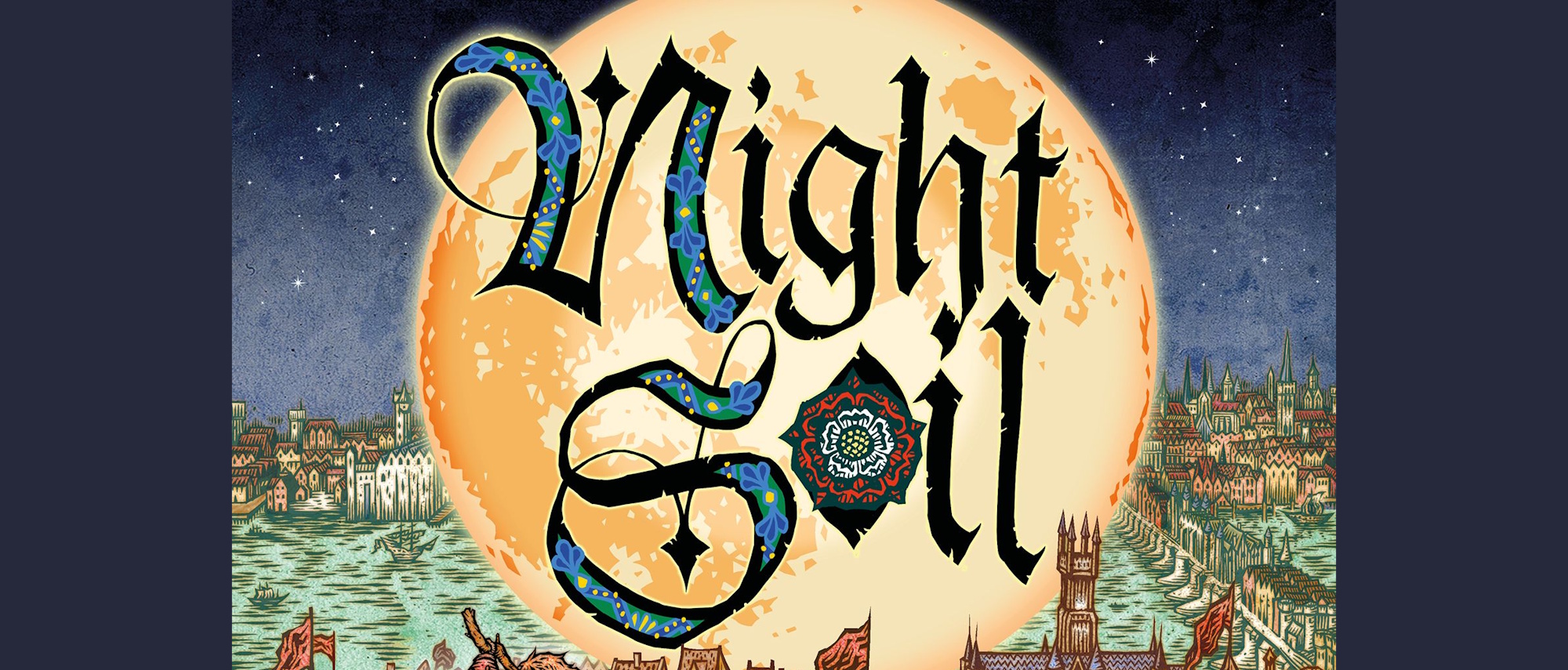
Whenever someone gets rosy-eyed about “the good old days,” it’s a surefire sign they’ve never cracked a history book. Ahh, the good old days, back when men were men, their eyesight obscured by forty thanks to sun damage. When women were women, dead at thirty from childbearing. When children were dropping like flies from preventable diseases, when ninety percent of jobs consisted of picking stones from dusty fields, when the nights were so cold that one curled about their steaming chamber pot for warmth.
At the same time, there are certain myths about human misery that simply won’t kick the bucket. Medieval people, for example, were not shabby peasants sitting around in their own filth. Even the poor bathed regularly, wore colorful clothes, and liked to attend dances and festivals. Reality occupies a strange middle ground. In the past, most folks were sicker, fed more poorly, and struggled daily against decay, but still strove to fill their lives with good and pleasant things.
Night Soil is not about most folks. Taken on its own, one might come away thinking that everybody padded their clogs with their own BMs. That’s because it’s about the dirty task of clearing Tudor London of human waste. Gathering poop, transporting poop, shoveling poop into the river — these are the game’s occupation. It’s a greasy, brown-hued business. I adore it.
A Prickle of Trickers

Say it with me now: All I play anymore is trick-taking games.
Every so often, one comes along that makes me perk up and take note. Which is an exciting (if unfair) way of setting these three Indie Games Night Market games against one another. Three trickers enter. All three leave. But one of them leaves with its head held a little higher than the others.
Queen of Lies
I’ve said before that Salt & Pepper Games is doing some of the finest work in the industry, especially when it comes to historical titles that draw in newer and veteran players alike. Queen of Spies pairs Liz Davidson with David Thompson, who produce a handsome, if uneven, solitaire perspective on resistance and spycraft in the Great War.
All for Freedom and for Pleasure

The more I play The Old King’s Crown, the more I become enamored with it. Which is saying something, given that I’ve been playing it for something like five years, beginning with Pablo Clark’s rough digital prototype, then a more polished physical prototype, and now the finished thing. It’s a hard title to describe, not quite a lane-battler, not quite a bluffing game, not quite an auction. It isn’t quite like anything because there’s nothing quite like it.
It begins with the disappearance of the king and the four factions who immediately vie to don the proverbial circlet. The contest that follows will be suitably nasty for a war of regicides, unusually vicious for a board game, and gorgeous from start to finish.
Lovers’ Quarrels
Who was it that said that every tale is a tragedy, it’s only a question of when the story ends. I bet that person was a real hoot at noon tea. Personally, I think every story is a comedy, provided the punchline is a trillion years of black holes and fading background radiation. (I, too, am fun at teatime.)
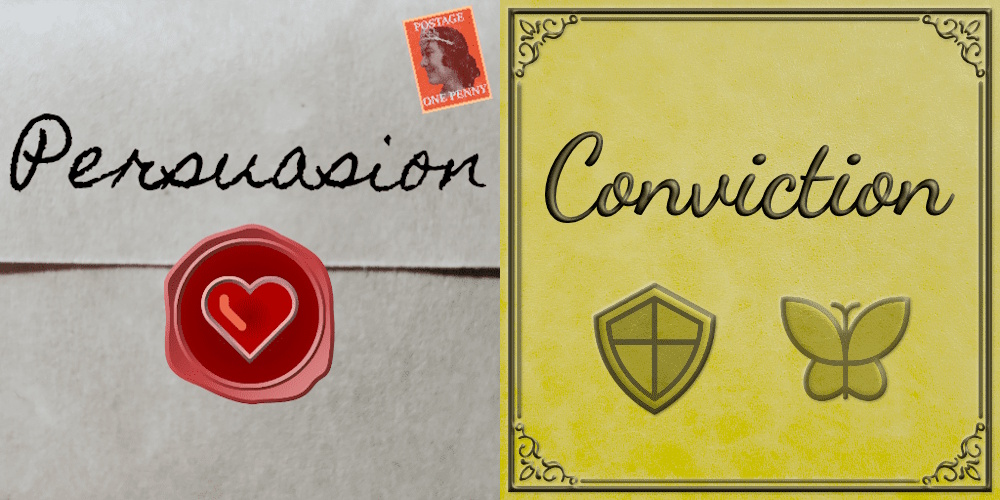
It’s been three years since we took at look at Persuasion, the relationship game by Xoe Allred. In the time since, Allred has given us Velocirapture and Vibes, imperfect little games that peel into our assumptions about victory conditions. Now it has two new games out: the Hollandspiele version of Persuasion and the self-published Conviction. Put together, we’re offered a two-act tale about the beginning and (potential) end of a relationship. I couldn’t speak to their suitability over tea, but together they offer contrasting — and sometimes all too familiar — perspectives on what it’s like to chase one’s Happily Ever After.

 SPACE-BIFF!