Yub Nub

Yubibo exists to reveal which member of your group has selfish proprioception, a sentence I never could have conceptualized until I experienced a friend, with a dozen sticks poised between his fingers and those of four peers, suddenly rotating his wrist all the way around to arrive at a more comfortable position. Six other players were sent lurching in response, doing everything in their power to maintain the pressure on those sticks. It didn’t work. Foam balls and wooden sticks clattered to the table. Everyone laughed.
Movin’ Up an’ Down Again

For all that board games thrive on taking us to new places, exploration is surprisingly hard to do well. Explorers of Navoria, designed by Meng Chunlin, is a prime example. Set in a colorful world redolent of Root’s woodland or Oath’s turbulent empire, and populated by critters who wouldn’t draw much side-eye in either setting, Explorers of Navoria is nominally about pushing the frontier ever outward, but more accurately about shifting one’s position on a number of slightly differentiated tracks. In the proper mode — a persnickety combination of player count, expansion, and headspace — it’s a tasty and visually appealing course that feels good going down even as it leaves the stomach rumbling minutes later.
Best Week 2025! The Index!
Another turn of the Wheel. 2025 was a banner year for board games, which by extension means it was a banner year for Best Week. Down below, you’ll find an index of the year’s picks. Click on any of the images to be whisked to the corresponding article. To the old year! To the new year!
Best Week 2025! All My Children!
In those now-unreachable years before my daughters came along, I remember balking at certain statements. “Some things you simply can’t understand until you have children,” someone would say. Now that I’ve had kids, I’m adult enough to admit they were right… but still juvenile enough to believe they were drafting their offspring into props to prove a point.
And what, exactly, have my daughters taught me? The unnamed emotion of putting an infant to sleep on my stomach. The mind-blanking terror of sitting beside a hospital bed. The way even the simplest of board games can become profound shared experiences. What follows is a list I never thought I would write: the games that transformed my year not because they were innovative or philosophical, but rather because they let me pass a few meaningful minutes with my girls.
Best Week 2025! The D.T.R.!
Do people still D.T.R.? When I was a youngling, the acronym stood for Define The Relationship, that belly-clenching moment when two people would sit across from one another, lock eyes, and hold a serious discussion about whether to go steady. Nowadays it probably stands for Do The Rhombus. What is the Rhombus? I couldn’t tell you. Too old, me.
Something was in the air this year. Love, sex, breakups, and awkward situationships, to be specific. Weird, I know! For whatever reason, 2025 was the year we decided to actually get squishy for once. What follows are the year’s strongest exemplars.
Best Week 2025! Beatrixmania!
I don’t believe I’ve ever seen a publisher have more of a bottle rocket year than DVC Games. Home to the design collective Jasper Beatrix — which thankfully avoids the pitfalls of the now-defunct Prospero Hall by offering actual attribution — DVC Games has established itself as a cradle of innovation. Even when their individual titles riff on the familiar, they’re undoubtedly riffs, jazzy little grace notes that bring their own interpretation to the genre.
Which is to say, this is the tightest focus ever featured in Best Week. These folks deserve the plaudits. Just take a look.
Best Week 2025! Heart of Darkness!
This will surprise absolutely nobody, but I am sometimes accused of being a big old bummer. A downer. A morose feel-bad baby. Nietzsche said that if you stare into the abyss it’ll gaze back, and I’ve found that to be true, but in locking eyes with the abyss I also find we come to an understanding. We’re poorer in spirit if we don’t lock eyes with the void now and again.
There were a number of void-locking titles this year. Today is a celebration of the best of them. Take my hand, abyss. It’ll be all right.
Best Week 2025! Picture Perfect!
What a year. Best of times, worst of times, that’s what we’re supposed to say. For board games, though, 2025 was a banner year, full of tremendous titles both big and small.
As ever, Best Week is a celebration of the board games that struck me the most roundly, and today I’d like to cover the games that won me over thanks to their beauty, at least in part. These are the games that transported me to new places, that showed me wondrous sights, or that used their visual design in such a way that I found an old topic illuminated in a manner I hadn’t considered before.
Space-Cast! #52. Fellowship of the Trick
Transforming a work of literature into a trick-taking game is no mean feat, especially when that work is as influential as The Lord of the Rings. Today, we’re joined by Bryan Bornmueller, creator of the trick-taking versions of both The Fellowship of the Ring and The Two Towers. Listen in as we discuss our background with both Tolkien and trick-taking, the difficulties of adaptation, and what’s coming next.
Listen here or download here. Timestamps can be found after the jump.
Yoink: The Gathering
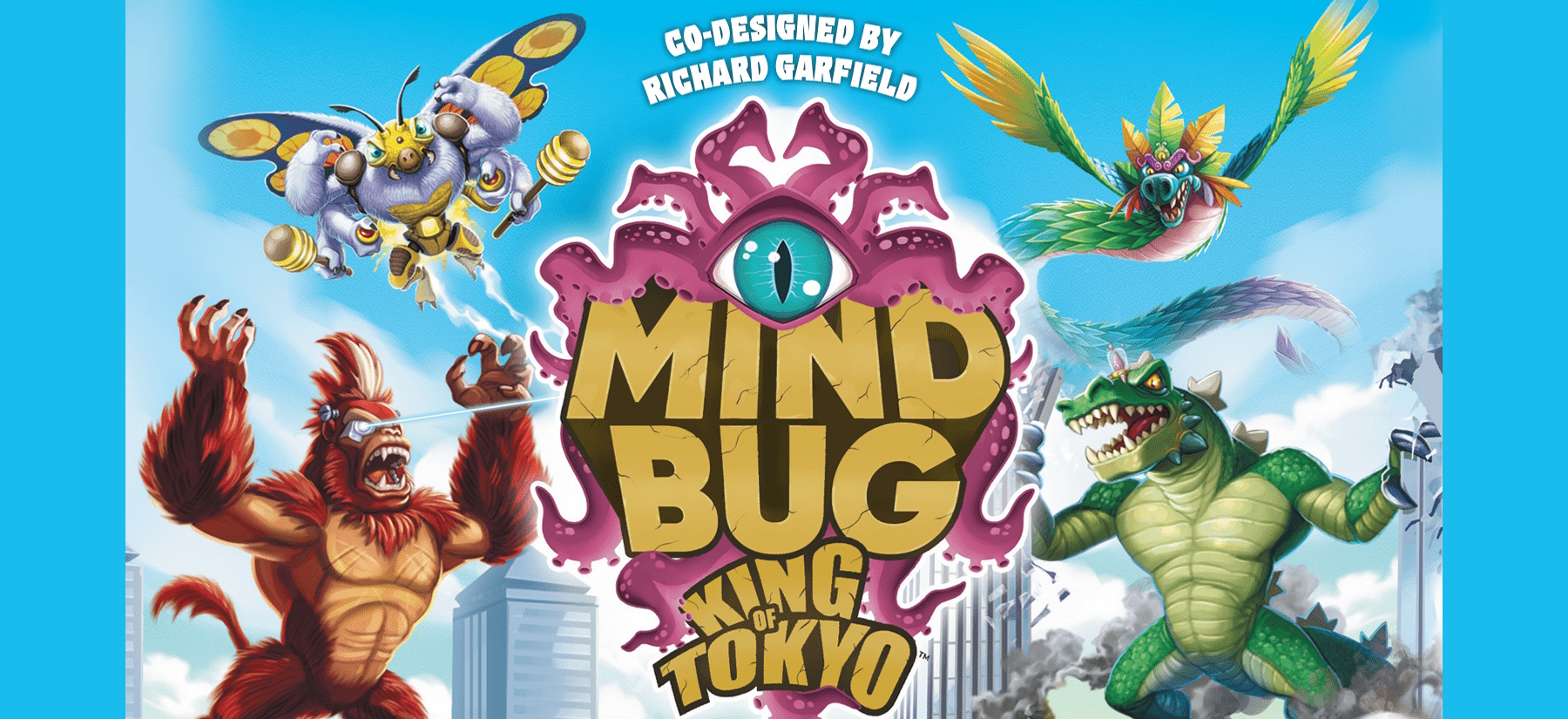
It occurs to me that I’ve never written about Mindbug. Co-designed by Richard Garfield, a fact the box prominently advertises, along with Skaff Elias, Marvin Hegen, and Christian Kudahl, there are a bunch of these things out in the world. Six core sets and well over a dozen promos, I think. It’s the sort of game some folks decry as “lucky” and “random” and “vacillating.” And it is those things. But it’s also clever in a way that feels like a remediation of Garfield’s past work, especially titles like Magic: The Gathering and its many collectible descendants.

 SPACE-BIFF!