Another Imperium

With a few years behind us, returning to Imperium is like catching up with an old friend. A messy friend, one who hasn’t ever gotten their life together, but a good friend who’s never given me reason to regret their acquaintance. When Nigel Buckle and Dávid Turczi first unveiled their hybrid deck-builder / civilization game, there was so much material that it had to be split across two separate boxes, Classics and Legends. Horizons adds half as much again to the collection, and shows these designers once again at their most creative.
Intergalactic Knizia, Verse Three: Orbit
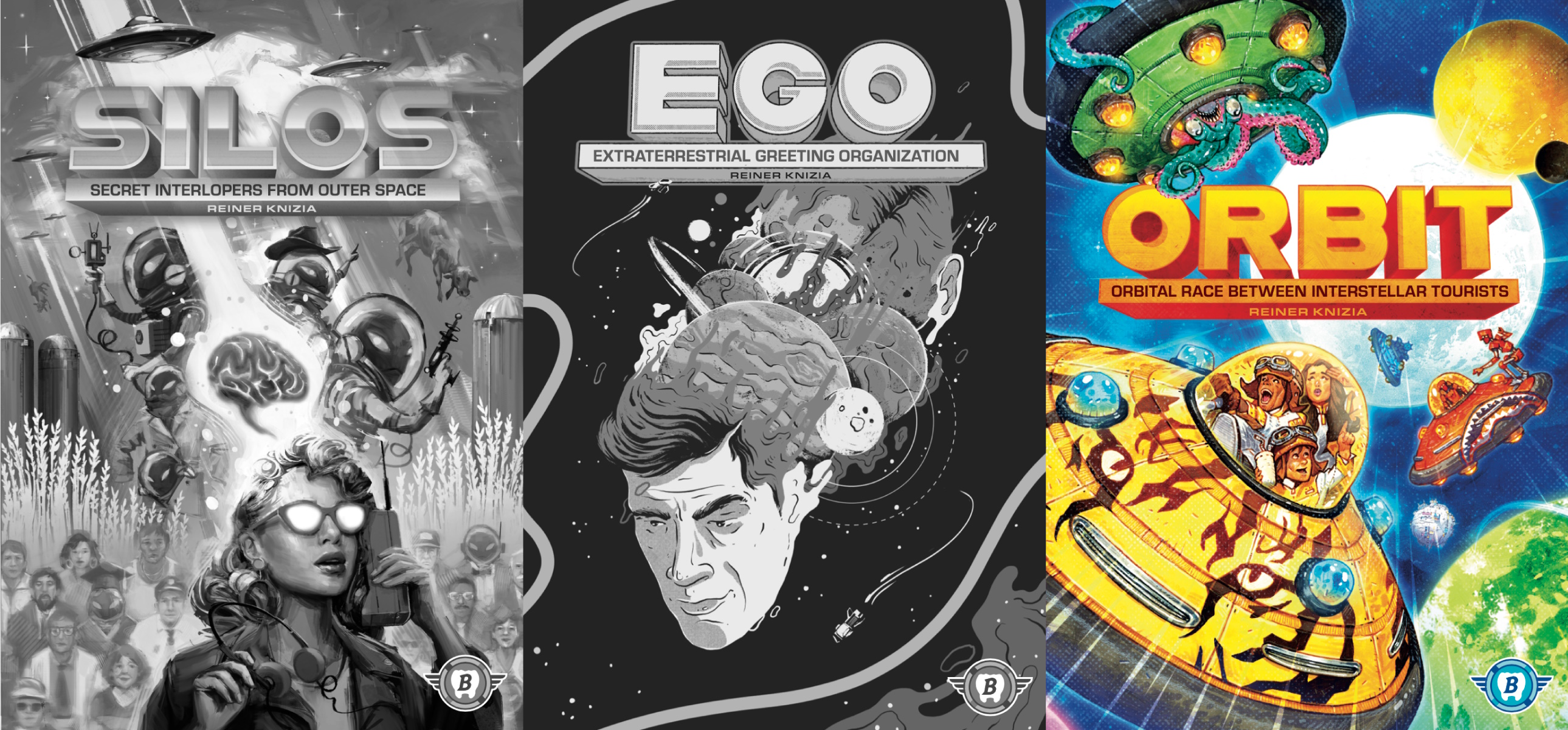
It is the future. The year 2,000. After enduring alien abductions in Silos and a testy diplomatic delegation in Ego, humanity has become just as insipid as ever. That’s the subject of Orbit, the third and final volume in Reiner Knizia’s intergalactic trilogy and the first title of the saga that doesn’t improve on one of the Good Doctor’s older games.
As reluctant as I am to say it, it shows.
Intergalactic Knizia, Verse Two: Ego

As luck would have it, getting abducted by cow-loving aliens isn’t the worst thing to ever happen to humanity. That’s right, Reiner Knizia’s Silos provides an unexpectedly happy ending. No longer prod-fodder for extraterrestrials, we now stand on the cusp of entering the intergalactic community.
Ego is the second volume in Reiner Knizia’s intergalactic trilogy. With a single vessel prepped for interstellar voyage, diplomats from every nation are ready to explore the farthest reaches of deep space. Their five-year mission: to make friends with strange new peoples; to swap technology to our mutual benefit; to hopefully not embarrass our species too badly. Don’t count on that last one.
Intergalactic Knizia, Verse One: Silos
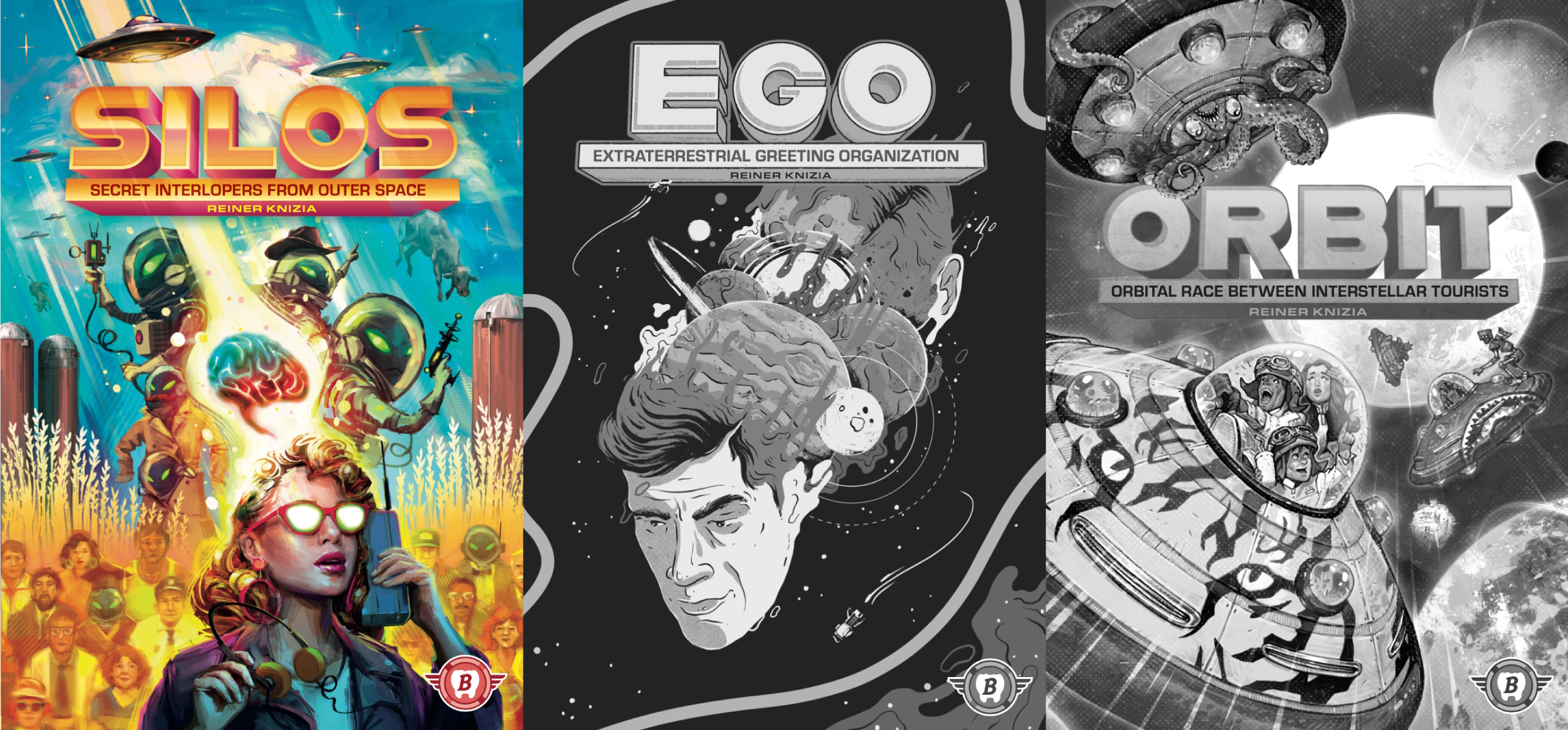
By now you’ve heard that Bitewing’s ultra-secret Reiner Knizia production is not one game but three, loosely woven together into a saga about humanity’s transformation via extraterrestrial contact. I’ve been playing the entire trilogy over the past month, and I can confidently declare it two-thirds excellent.
In the first chapter, Silos, aliens walk among us — although we’re none the wiser, since their preferred abductees are cows.
Leave It in the Pattern Buffer

Montgomery Scott, chief engineer of the USS Enterprise, was known to quadruple his estimates for emergency repairs. This excess was eventually termed “buffer time,” and allowed Scott to maintain his reputation as a miracle worker. Later, after becoming stranded on the surface of a Dyson Sphere, he kept himself in suspended animation for seventy-five years via his ship’s pattern buffer.
The moral of this story is that Star Trek contains one too many uses of the word “buffer.”
Despite growing up on The Next Generation and loving “Lower Decks,” the episode about the Enterprise‘s lower-ranking officers who lived in fear of Commander Riker rather than regarding him as a lovable goofball who never learned how to sit in a chair like a normal person, I haven’t watched even one minute of the animated series by the same name. It isn’t anything personal. I just don’t watch much TV these days. After playing Star Trek: Lower Decks: Buffer Time: The Card Game, that doesn’t seem likely to change anytime soon.
We Lack Chemistry

What to make of Chemistry Set? This is the second tabletop design by Zach Barth — not counting his many digital cribbages and solitaires — and after such a strong inaugural outing with The Lucky Seven and its depot expansion, its blandness is all the more baffling. It would be unfair to compare this to Barth’s video games SpaceChem or MOLEK-SYNTEZ; apart from their shared affection for molecular arrangements, they’re so conceptually distinct that any parallels soon get lost in the mix. But it is dispiriting to see the periodic table stripped of the enthusiasm we know Barth has invested it with elsewhere.
Idle Tricks Are the Devil’s Game Table

Fukutarou’s Idle Hands is an unassuming little thing. Its simplicity lends it a false sense of security. This is no mere trick-taker, you see, but a nasty bit of business that nearly always results in basement-level scores and more than a little anguish. Just my sort of thing.
A Triphthong of Word Games

One of my favorite things about playing and critiquing board games is seeing the way designers can push the same mechanism in different directions. It’s not unlike a creative writing exercise in which everybody begins with a single prompt yet still produces their own individual perspective.
Here’s my latest example: I’ve been playing three word games that all revolve around pulling letters, chit-style, from a container. From that sliver of overlap, three distinct titles emerge, each with their own sensibilities and tics. Rather than spreading them across multiple reviews, I figured we might as well see how they fare in the grammar arena, my totally made-up word game deathmatch.
Red Fish, Blue Fish, Fish What’s Ticklish

Comedy is hard, and that goes double in a medium with no clear speaker and a tendency toward the pedantic. Who’s on first? That guy. The guy who just batted a single. Obviously.
Fortunately, Things in Rings has what we call pedigree. Peter Hayward is a funny fellow, especially when he’s designing games like That Time You Killed Me or Fiction. Even this year’s Converge hits the right beats gameplay-wise to nearly qualify.
Our Sea-Washed, Sunset Gates

After spending countless hours trekking across Ryan Laukat’s more expansive landscapes via Sleeping Gods and its sequels, Primeval Peril and Distant Skies, Creature Caravan is a throwback to his earlier titles not only in terms of setting, but also time commitment. It doesn’t quite hit the twenty-minute duration of Eight-Minute Empires, clocking in at closer to an hour, but Creature Caravan shows Laukat in fine form, pressing his craft forward while once again proving why he achieved popularity in the first place.
Or, to use a more lively term, Creature Caravan is a banger.

 SPACE-BIFF!