Let Me Not Then Die Ingloriously

You know that moment in every ancient battle scene, whether in film or video games, where the lines have collapsed and now the burly infantry boys are fighting one on one, everybody mixed together and slashing wildly? Bonus points when two rival heroes spot each other in the fray and start murdering their way toward one another, hellbent on a personal duel where nobody will happen to spear them through the backside.
Sorry to disappoint, but those scenes are pure invention. There simply weren’t enough suicidal soldiers in the ancient world for such an engagement. Still, it looks hella cool, and it’s significantly easier to stage than an actual line of infantry trying to scare their opposite number into freaking out and running away.
One of my favorite things about Reiner Knizia’s Iliad, which I previewed last year, is the way it evokes those haphazard murder-thons, Greek boys in blue and red squaring off in a checkers-grid melee. Sure, the game is smart and all that, providing a thinky two-player match of wits that emphasizes clever investments over brute strength. But I’m really here for the chaos.
Syke!
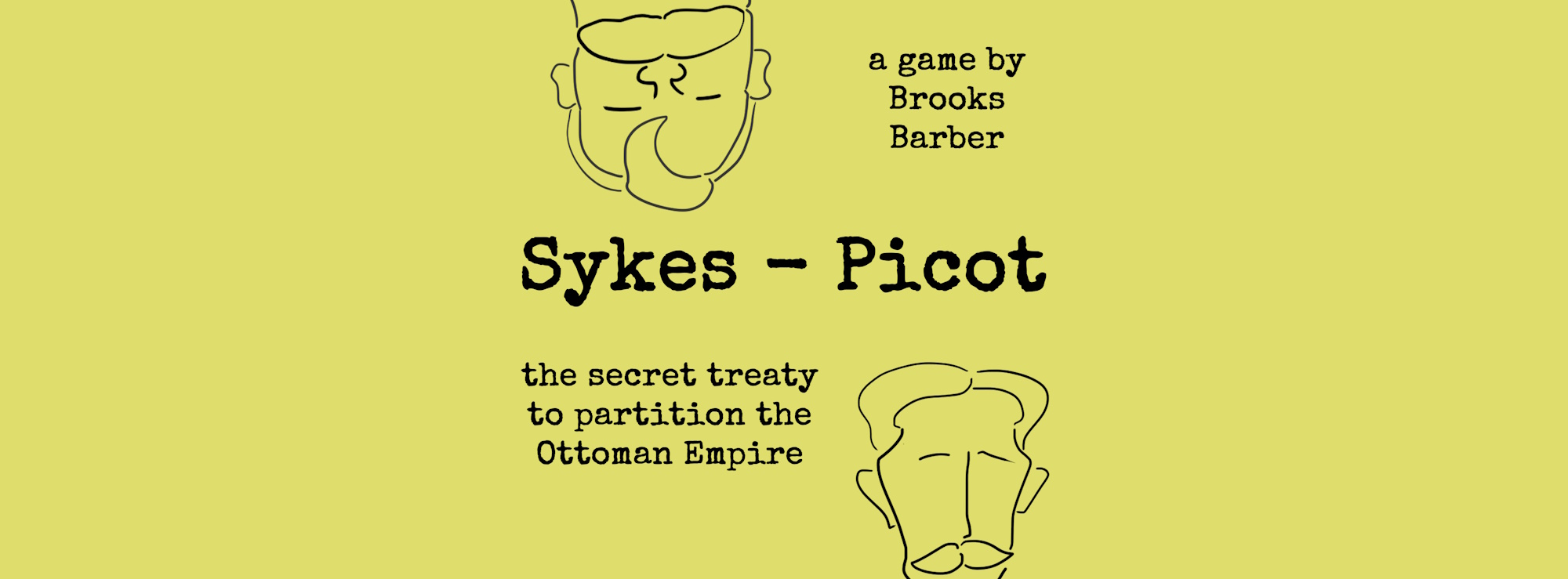
In 1916, at the height of WWI, two diplomats met in secret to outline the future partitioning of the Ottoman Empire. Those diplomats, the United Kingdom’s Mark Sykes and France’s François Georges-Picot, approached this undertaking with all due gravity and diligence.
Jokes! Nah, they more or less scribbled on a map with crayons, dividing the region between the U.K., France, Russia, and Italy. Their proposed boundaries split local polities — in some cases, they seem to have used the letters on their map as landmarks — and showed no intention of honoring their agreements with their Arab allies. Shrouded in secrecy, the agreement only came to light when post-revolution Bolsheviks published the whole thing, proving to the world that the Triple Entente had returned to their bad habit of cutting backroom deals.
This ignominious treaty is the topic of Sykes-Picot, the trick-taking, dry-erase, area control game by Brooks Barber and Hollandspiele. This one is angry, polemical, slapdash, and wholly on-point.
Gazing Up into Heaven

Last year, two designs by Tomáš Holek marveled at the stars. One of those games, SETI: Search for Extraterrestrial Intelligence, has enraptured audiences with its thoughtful quest to discover life beyond our planet. The other title is Galileo Galilei, a boilerplate Euro with a few good ideas in its head and some profoundly spurious history in its belly.
This review is for the weaker of the two. Get ready to squint into the eyepiece.
Wet Behind the Gills

Over the past year or so, my eleven-year-old daughter Cate and I have tried a handful of campaign adventure games. By far her favorite — our favorite — has been Tidal Blades 2: Rise of the Unfolders by Tim and Ben Eisner.
Not that Tidal Blades 2 is without its peculiarities. It’s an odd duck, a sprawling cooperative campaign that’s also a sequel to a game that was not, apparently, itself a sprawling cooperative campaign, set in a far-future world where fish and crocodiles are sentient bipeds, axolotls live in hive-mind communion with trans-dimensional beings, and a big old time warp called the Fold sits over the flash-frozen husk of a nearby civilization. The Fold, by the way, is what your heroes will be unfolding. Not, say, their little sister’s origami.
Opera Is Danger
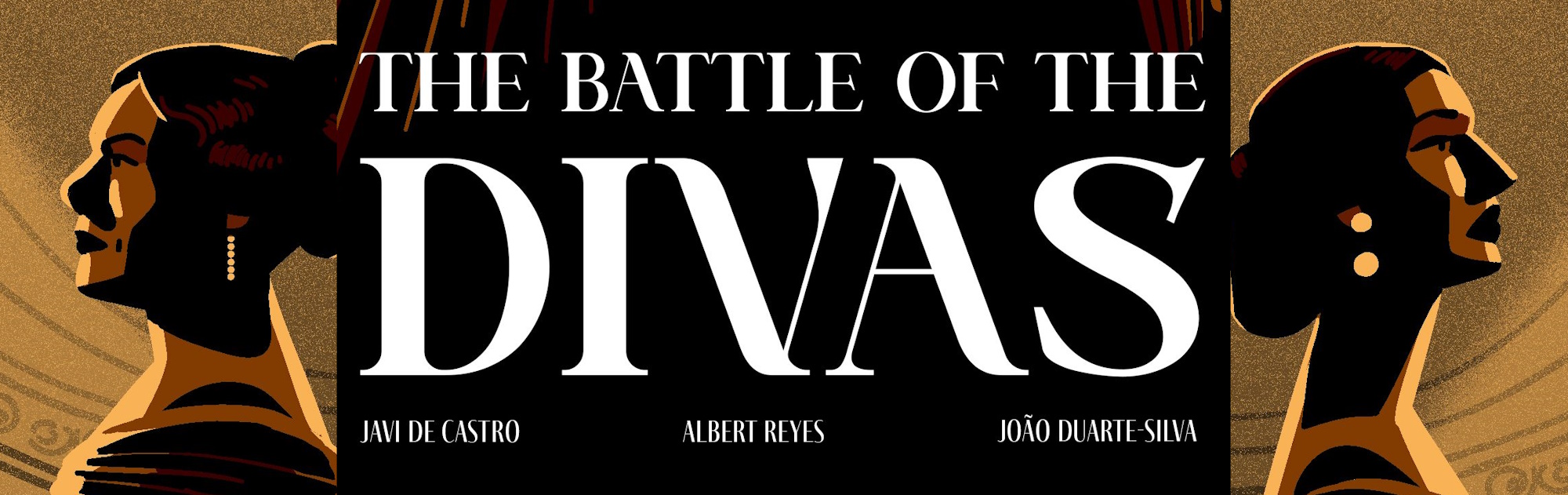
Last year’s The Battle of Versailles was a revelation, treating the world of high fashion as seriously as combat, and in the process teaching me something about an art form I’d always regarded as frivolous.
Here’s a piece of good news: apparently Versailles did so well that it’s now the basis for an entire series. For its first sequel, The Battle of the Divas by Albert Reyes, the topic is opera, a form I’ve never considered frivolous so much as impenetrable. But in Reyes’ hands, the lifelong feud between Maria Callas and Renata Tebaldi becomes gripping, a tale of self-mastery, success and setback, and hitting those high notes.
Also cattiness. So much cattiness. It’s good that Divas is leaning into what made Versailles so playable.
That Wizard Came from the Moon

Fabio! Lopiano! Truly, he has the most pronounceable name in the entire hobby. I’m something of a provisional fan, after being impressed with Merv but mixed on Autobahn and Sankoré, both of which proved too overwrought for their own good. Shackleton Base, which Lopiano co-designed with Nestore Mangone, finds the pair back in stride. It’s complex but not too tangled, indulges in the occasional digression but never loses focus, and above all takes us to a semi-plausible moon colony that feels absolutely great to bang into working shape.
Into the Woodland(ers)
All I play anymore is trick-takers.
Okay, that isn’t wholly true anymore. It seems the trick-taking bubble has, if not burst, levitated a few meters off the ground. Still, another title from New Mill Industries, this one designed by proprietor Daniel Newman himself, is always a treat. This one’s veneer is about woodland creatures trying to shirk their turn as the warden of the forest. Not that you’ll think about the fluff for even two seconds while playing Woodlanders. Instead, the real draw is the excellent poison-pill gameplay, a truly deadly capsule that once again highlights how much ground this eldest of genres has yet to cover.
Stuck in the Midden with You

The oldest known evidence of human habitation on the Orkney Islands, the archipelago off the northern coast of Scotland, is a charred hazelnut shell and some thousands of flint fragments, variously dated to either the seventh or eighth millennium BCE. That’s a long time ago. A dang long time. Later evidence is more impressive, standing henges and stone farmsteads, but those simple tools confirm that humans first came to Orkney not long after the glaciers receded to hunt, forage, and eventually heap together so much garbage (mostly shells) that later generations would repurpose the refuse into the foundations for their settlements.
Skara Brae, named for the largest of those settlements, is another historical title by Shem Phillips. I’ll confess I went into Phillips’ latest with some reluctance after Ezra and Nehemiah showed such a lack of care for its history. To my relief, Skara Brae is on surer footing, opening a limited but compelling window onto the daily lives of its characters.
Cyclades Nuts

Cyclades. Now there’s a name I haven’t heard in a long time.
Except, of course, I’ve heard it plenty. How could I not? Cyclades, along with Kemet and Inis, was the first member of Matagot’s unholy trinity, the gods-on-a-map game that urged the genre in a new direction. Without Cyclades, there’s a reasonable argument to be made that there would be no Blood Rage, no Ankh, no renaissance of plastic figurines murdering each other, but murdering each other via modern tabletop mechanisms rather than just rolling dice, Risk-style, hastening the genre’s gradual decay into obsolescence. Cyclades was the pantokrator that filled the form’s lungs with new breath.
It’s also an essential strand of my own gaming DNA. My review of Kemet was one of the first to draw any attention. Inis is still possibly my favorite game of all time. And before those, there was Cyclades, experimental and bold, off-kilter in its own way, a little imbalanced, but always gripping.
And now Bruno Cathala and Ludovic Maublanc have a Legendary Edition out. Over the past month or so I’ve revisited the classic, partaking of its deified air once more — and also marveling at how far game design has come in the intervening sixteen years.
It’s Vibin’ Time

Perhaps the most appreciable thing about Xoe Allred’s work is that it’s so very human. Yes, even when we’re talking about dinosaurs who would rather play board games than face their impending extinction in Velocirapture, and certainly when considering the desperate correspondents of Persuasion.
Take Vibes. Vibes is about being a teacher who wants what’s best for their students, even when they’re obnoxious goofballs who disrupt your efforts to bring something good into their lives. I can confirm that it’s about as accurate as it gets, teacher-wise, even in those moments when I wish it had gone a few steps further.

 SPACE-BIFF!