Category Archives: Board Game
The Cargo Isn’t All That’s Curious About It

It’s no secret that my favorite part of Ryan Courtney’s Pipeline was the pipe-laying. Scoring, automation, loans — no thanks. Give me Donnelly nut spacing and cracked system rim-riding grip configurations using a field of half-seized sprats and brass-fitted nickel slits. The McMillan way. That’s all it takes to make me happy.
Curious Cargo is Courtney’s follow-up to Pipeline, although its shaky proximity to its predecessor has me doubting the term “follow-up.” As before, piping is a major feature. More so, even, than in Pipeline. But despite that similarity, it’s very much its own thing, right down to the husk nuts bolstered to each girdle jerry.
Best Week 2020! The Index!

The wheel has turned. Below you’ll find links to every day of Best Week 2020, which despite the year’s expectations has hosted some of the finest games ever featured here on Space-Biff! Simply click the image to be transported to the relevant page.
See you on the other side, friend.
Best Week 2020! Uncommon Sense!
Common sense is overrated. I’ve known that since I was a boy and my mother kept insisting I find some. I’m more interested in uncommon sense. Piercing observations. Repudiations of the norm. Self-awareness. Now those are qualities to celebrate!
Which is why today, for the final entry of Best Week, we’re taking a look at the games that thumbed their noses at common sense. They took a long look at their genre, gave a gentle shake of the head, and decided that if anyone was going to do it better, it had to be them. Even if it meant turning the genre upside down in the process.
Best Week 2020! Parallel Dimensions!
Firestorm take incoming: more than any other medium, board games are about discovery. Yes, more even than their digital counterparts. Truly, board games are so completely about discovery that they cannot even be played until the process of discovery has begun. Beginning with the earliest formative moments when the rules take shape in our minds, they cannot help it. The flip of a card, the provocations of a rival, the epiphany of a perfect move — these are all acts of creation and discovery alike.
Today, Best Week is about discovery in a more literal sense. What follows are the best games of 2020 that left me breathless as I charted past the map’s edge, redefined my species, or recorded new knowledge.
Best Week 2020! Some Time Away!
Let’s address the elephant in the room. As far as years go, 2020 was a real downer. It isn’t necessary to say why. Such an utterance would only grant it additional power.
Fortunately, certain games were a relief. A vacation in miniature, you could say. These are the titles I was able to get lost in, if only for an hour or a few minutes, and forget the low-grade anxieties that attended every waking moment.
Best Week 2020! Agony, Sheer Agony!
There’s nothing quite like counting out your moves. Or obsessing over the perfect placement of a polyomino. Or examining the unfurling board state until your eyes cross.
Today is about those games. The ones that saw me picking over every detail, every possible move, every counter-move. These are the ones that hurt so good.
Best Week 2020! Better, Faster, Stronger!
There’s a reason Best Week arrives when it does. Popular belief would say it lands at the end of the year, but that isn’t it. Best Week happens when it’s needed most. When the world is cold and dark, Best Week is here to draw our attention to the games that mattered.
And there’s no better way to flip the bird to a dismal year like 2020 than by celebrating the games that stood up to the giant, pounded their shield-arms, and said, “You know what, jackass? Even though everyone has fallen into the habit of taking afternoon naps, even though it’s almost next year and I still find myself thinking it’s October, I’m going to be my best self.” Call them redesigns, call them spins on familiar formulas. Either way, these are the games their designers decided to revisit in order to craft something new.
The Vote Isn’t Interested in Compromises

It isn’t possible to discuss Tom Russell’s The Vote without invoking her earlier design This Guilty Land. In part because they both make use of the same game system, a masterclass of functionality that demands periodic trips back to the rulebook, though in fairness this year’s outing putters along more smoothly, less opaquely, and buoyed by a tighter narrative arc.
If only the similarities stopped there. Instead, the lion’s share are more thematic, and by extension more somber. This Guilty Land was designed to evoke frustration. With its systems, yes, but also with the injustices permitted by those systems — and worse, enabled by them. Features rather than bugs. In Russell’s hands, the gridlock that prevented emancipation is the same gridlock that prevented women’s suffrage. Which is a long way of saying that The Vote is a streamlined and more playable version of its former self. But as a metatextual continuation of This Guilty Land, it’s far more than that.
Like Sands Through the Hourglass
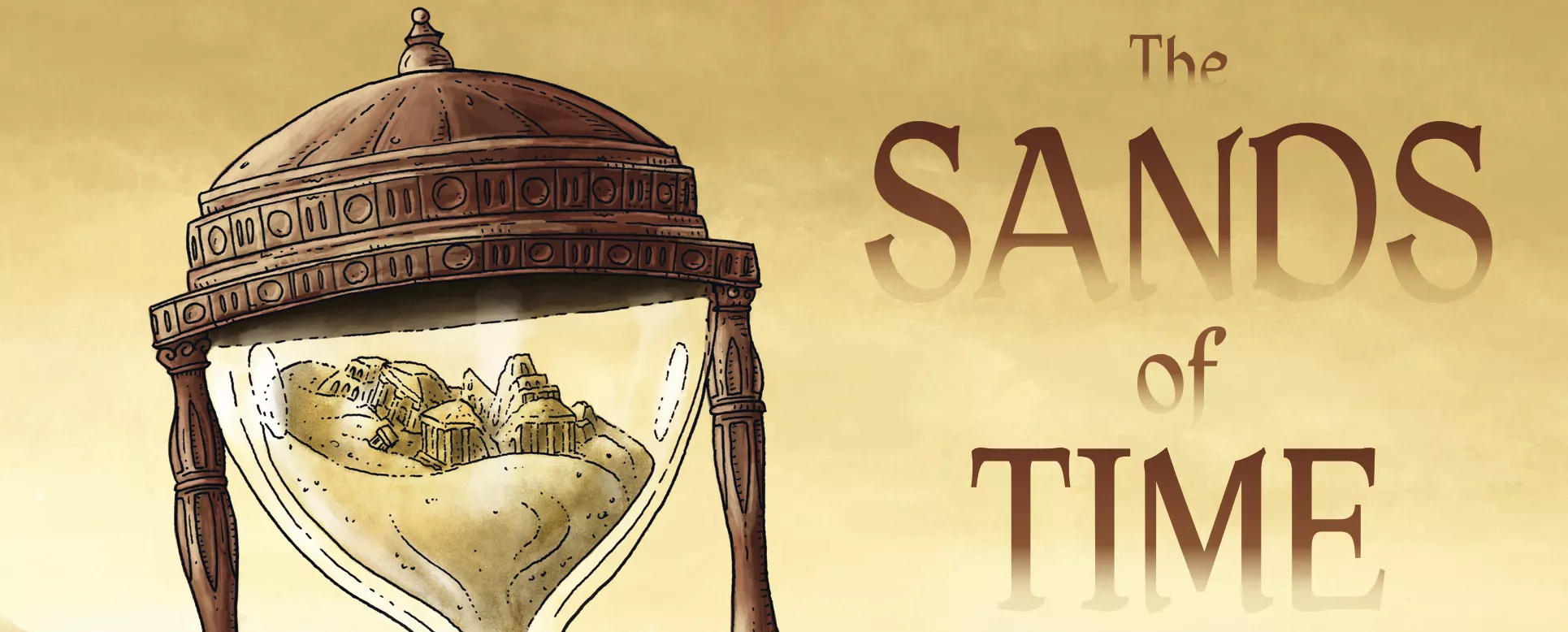
Longtime readers will probably be aware of my search for non-traditional civilization games. That’s why I was so eager to take a look at Jeff Warrender’s The Sands of Time, which flew under my radar a couple years back. Its approach could almost be described as abstract, crowded with cubes and cylinders alongside the more immediately evocative building tokens. Perhaps most notably, it manages to come across as the story of civilization as told over a long period. A millennium, maybe two.
And if nothing else, it definitely manages to be “non-traditional.”


 SPACE-BIFF!