Category Archives: Board Game
Pumpkin Party
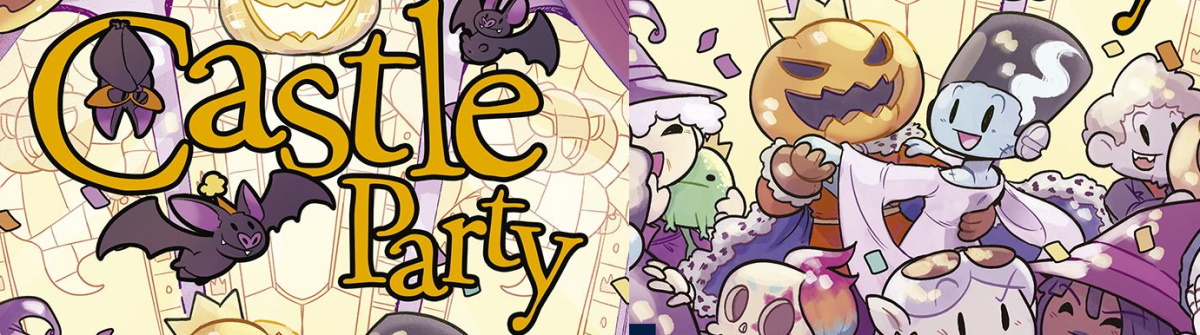
Designing a roll-and-write or flip-and-write game is like transcribing an epic D&D campaign into a fantasy novel or sampling Rocky Mountain oysters — something everyone apparently has to try once. Josep Allué and Eugeni Castaño’s flirtation with our hobby’s latest craze is Castle Party, a game about monsters crowding into a Halloween bash to watch some fireworks, do the conga, and toast the pumpkin king. And it delivers two small tricks that are a real treat.
Two Minds About Family Simulator

Anyone who knows Dan or Brock knows one absolute truth: we are a couple of gearheads. Grease grubbers. Real socket jockeys, always under the hood or behind the wheel. So imagine our unbridled joy when we discovered a Fast & Furious board game, designed by the prolific and enigmatic Prospero Hall and published by Funko Games.
It’s a great little toy box, there’s no denying that. But does it rev our engines or grind our gears? In our latest (or maybe our l8est?) Two Minds About, we’re discussing Fast & Furious: Highway Heist. So hit the NOS and let’s do this!
Ceci n’est pas un Jeu de Société

It says so right there on the side of the box for Mind MGMT: “The Game of Calm and Relaxation. Where everyone wins.” Given the portrait that adorns the cover, of a woman partially shrouded by flames and implements of murder, one gets the sense that maybe this game isn’t being entirely forthright with its advertising.
The evidence keeps piling on. Hidden messages. Sinister warnings. Visual references to René Magritte’s La Trahison des Images. Much like the reality- and expectation-bending comic book series by Matt Kindt, Jay Cormier and Sen-Foong Lim’s version of Mind MGMT appears to be one thing only to soon reveal itself as something else. Before long, this state of constant metamorphosis proves to be the rule. You can barely hold it in place for all its writhing.
The Paleo Diet

The staggering thing about prehistory is its sheer enormity. Before metallurgy, domestication, and agriculture came along to mark the Neolithic, the Paleolithic spanned two and a half million years, during which archaic humans and anatomically modern humans developed stone tools, fire, cooking, and clothing. Also interbreeding between archaic and modern species, but it’s possible that’s beyond the scope of a board game review.
Speaking of which, Peter Rustemeyer’s Paleo is the product of some significant DNA mixing of its own. With dashes of Friedemann Friese’s Friday, Joanna Kijanka and Ignacy Trzewiczek’s Robinson Crusoe, and Peer Sylvester’s The Lost Expedition, Rustemeyer’s version of prehistory is filled with resources to hunter-gather, perils to survive and, above all, things to learn.
Criminal Capers: Hot Lead

Another day, another entry in Reiner Knizia’s Criminal Capers trilogy. After enjoying Soda Smugglers and Pumafiosi — both with caveats — it’s time to ask the big questions about Hot Lead.
Question one: Why is this the best title in the whole trilogy?
Question two: Is it “hot lead” like bullets? Or “hot lead” like a tangent you pursue? Or both?
Criminal Capers: Pumafiosi
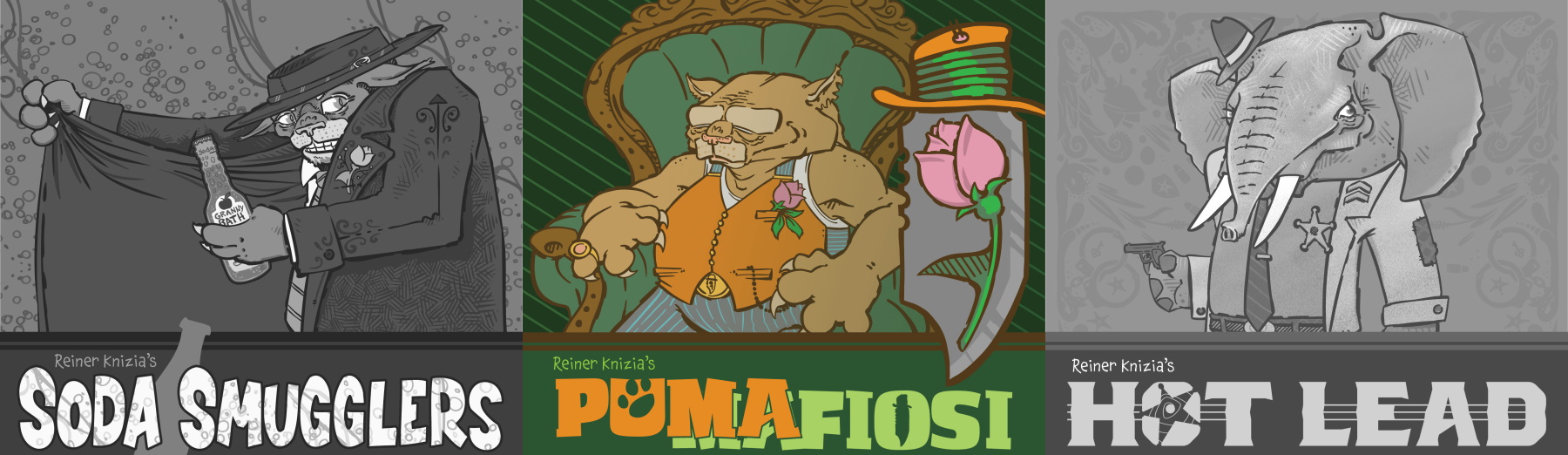
Today, Criminal Capers takes on the mafia. The puma mafia. The pumafia.
Dr. Knizia, you’re a master game designer. Surely you know the value of expertise. So maybe leave the puns to the punfessionals?
Okay, okay. The bones of Pumafiosi are based on Knizia’s own Rooster Booster, which wasn’t exactly the best-received of the good doctor’s catalog. Good thing, then, that Pumafiosi is only partly a remake. This one has layers.
Criminal Capers: Soda Smugglers
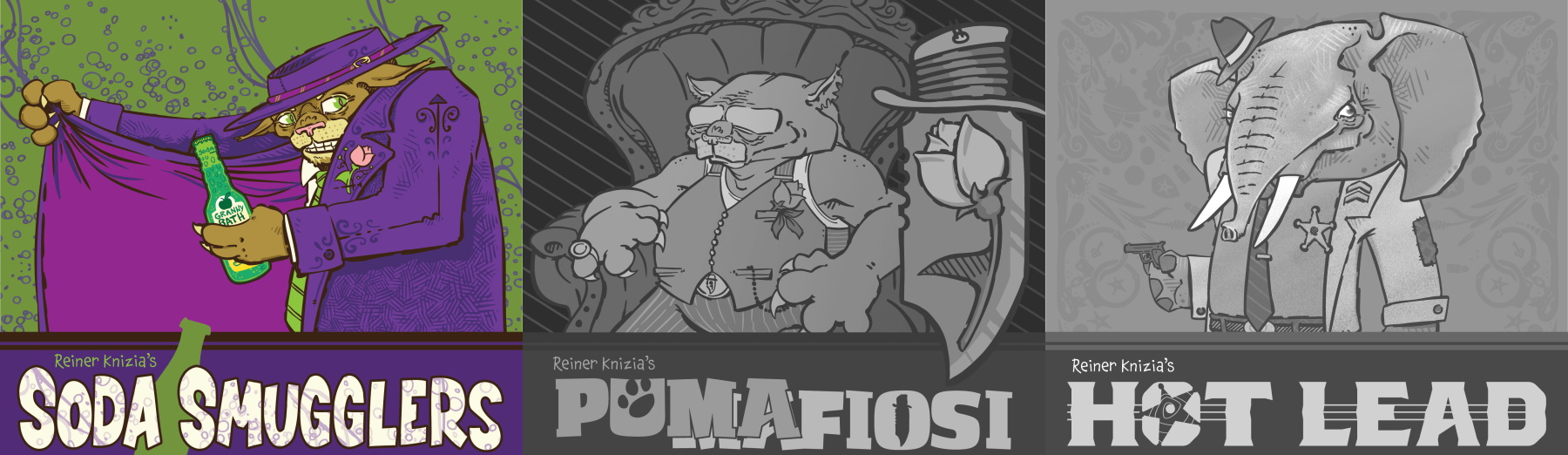
Sometimes, a little Reiner Knizia is exactly what we need. Emphasis on the “little.” That’s the goal of Criminal Capers, a trilogy of digestible titles designed by the good doctor, illustrated by Paul Halkyon, and published by Bitewing Games via Kickstarter sometime next month.
First up, Soda Smugglers.
Smash Octopoda
Some games are serious. They’re meant to model history, make a point, or get you upset about something you never knew existed. Other games are a frivolous delight. They’re here to be consumed, ogled, roughed up. When a piece falls behind the piano — a question of when, not if — the act of recovering it is as much a part of the game as scoring points. These moments aren’t interruptions. They’re continuations.
Crash Octopus is the embodiment of that latter type of game.
The Dignity and Indignities of Comanchería

Across the span of 1700 to 1875, the Comanche carved an empire into the American southwest roughly the size of modern-day Texas. Their instruments were both legendary and notorious: open-handed trade, remorseless warfare, unparalleled horsemanship. “Comanche” means “the people.” To outsiders, it came to signify “the lords of the plains.”
Comanchería, as their empire was called, would not survive. Between outbreaks of smallpox and cholera, the extermination of the great herds of buffalo, and continued incursions, the Comanche gave ground, then dwindled, then accepted the treaty that consigned them to a reservation. Far from the cataclysmic fall of a great empire, it was a succession of small cuts, gnawing infections, and inflicted indignities.
Joel Toppen’s Comanchería: The Rise and Fall of the Comanche Empire captures every excruciating detail. It is one of the finest historical games I have ever played. It also represents one of the hardest gaming experiences of my adult life.
Sans Laddersss

I am the mongoose of truth. Because I have been designated the mongoose of truth, I will never lie to you. Problem is, I don’t always know the truth. I just speak it. Which means I might be wrong. Full of good intentions, but wrong. And then there are snakes. They know the truth, though it’s rare to hear them speak it. This is because they will do everything in their power to lead you astray. Even telling the truth, sometimes. They are full of bad intentions, and those bad intentions are made worse because they know the difference between truth and lies.
That’s Phil Walker-Harding’s Snakesss in a nutshell. It also happens to be an alethiological pretzel.

 SPACE-BIFF!