Author Archives: Dan Thurot
Federation Kitbash
Yesterday we took a look at Age of Civilization, Jeffrey CCH’s take on the thirty-minute civgame, which was loaded with clever ideas that got short shrift thanks to the game’s clipped duration and misplaced priorities.
Fortunately for us, CCH revisited the concept a few years later. Age of Galaxy swaps the first game’s historical civilizations for alien societies, tasking players with cobbling together their very own Federation of Planets — or a merciless Dominion. Or a Culture. Or maybe an Imperial Radch if they play their cards poorly. The bones of that first game remain very much intact, but everything else has been overhauled. And this is one hull upgrade that proves rather appreciated indeed.
Age of Three Civilizations
Before Inheritors, before Eila and Something Shiny, Jeffrey CCH designed a civilization game. The white rabbit of “civ but in half an hour” has humbled many a talented creator. Does Age of Civilization bend the long arc of history away from failure?
Nope. But it’s an interesting failure. That’s more than I can say for many of its peers.
The Banalities of Yesterday

Growing up Mormon, disdainful opinions about smoking were in plentiful supply. I recall a mother proudly recounting her answer to her daughter’s question about why people smoked. “Some people are on Satan’s side,” she declared.
She was half right. But the wicked were not the smokers — the victims, to use Amabel Holland’s parlance in Doubt Is Our Product. They were the profiteers who killed hundreds of millions for market share. Who peddled tobacco to children and obfuscated the deadliness of cigarettes. Who flooded the zone with bullshit so that ordinary people couldn’t make informed decisions. Who continue to do so, to the tune of eight million dead per year, one million of whom die from secondhand smoke. Textual critics have long held that hell and the devil were invented as a form of cognitive easing, a way to reassure ordinary people who couldn’t square why some of their peers, leaders, and oppressors were so predatory. Surely they were being influenced by a malevolent, otherworldly agent; surely they would receive a fiery judgement at the end of time.
If there’s anybody who makes hell and the devil seem necessary, it’s tobacco executives.
Antiantidisestablishmentarianism

This might shock you, but I don’t actually love big words. Rather than elbowing pneumonoultramicroscopicsilicovolcanoconiosis into a conversation, I prefer short, evocative slashes to anything my readers might need to sound out. Let’s be real for a second: Did you actually say the word in the previous sentence, or did you blip over it like one more nickname for Raskolnikov in Dostoevsky’s Crime and Punishment? Exactly.
Five-Dollar Words, then, is a game that I am unexpectedly terrible at. Designed by Amabel and Mary Holland as the freebie for this year’s Hollandays Sale, it peddles itself as a game for sesquipedalianists and pedants. Better yet, it has a rule that prevents anybody from dragging out antidisestablishmentarianism as their word of choice.
Look Up
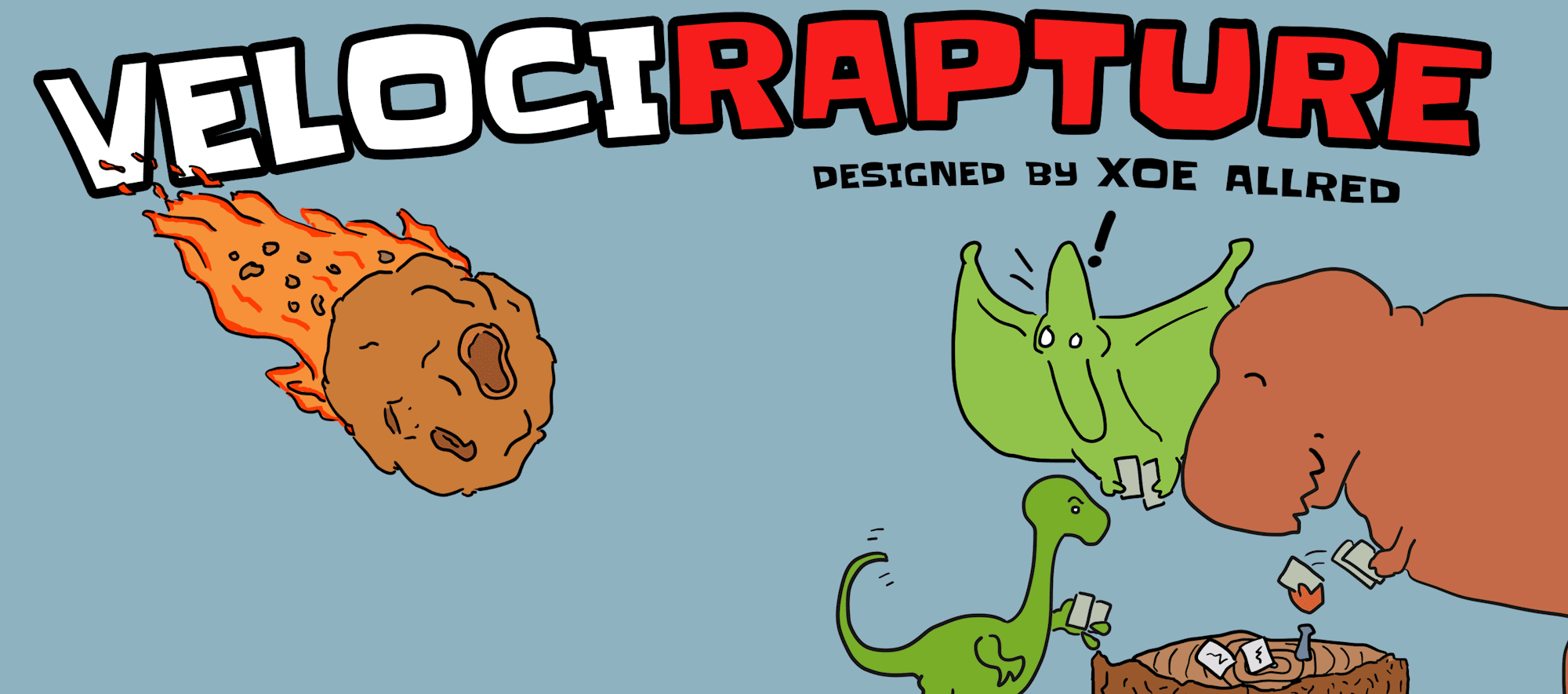
Xoe Allred’s Velocirapture is hard to describe, one suspects by design. There’s a shortcut in games criticism that’s tempting to invoke, wherein anything perplexing gets labeled a “tone poem.” Velocirapture, however, is not a tone poem so much as it is a garbled signal about the all-too-human tendency to talk around a difficult topic.
Here’s the box pitch: A meteor streaks across the Cretaceous sky. Extinction looms. But nobody wants to talk about that. Instead, these dinosaurs intend to play human games until the very end. As pitches go, it’s a knee-slapper. Largely in part because it’s so very recognizable. Just ask every single person who’s suffered from unusual bleeding or a misplaced lump and didn’t schedule a doctor’s visit right away. We are such odd creatures. Apparently, so were the dinosaurs.
You End Up Becoming Yourself

Kaiju Table Battles is one of the most intensely personal games I have ever played. It’s like stumbling across a friend’s open diary and reading a few fervid paragraphs before recognizing the artifact for what it is. The impulse in that moment, in our culture, is to clasp the diary shut, and likewise clasp shut the memory. We shy away from earnestness so readily. How, then, do we respond when the earnestness stands on a stool and demands to be seen?
Amabel Holland has always been a designer who stretches and strains the medium to its absolute boundaries. Kaiju Table Battles takes both to their limit. Maybe beyond the limit. This is a legacy game, envelopes and all, which peels itself apart layer by layer, revealing new diary lines and rubber-suited monsters alike. Along the way, it questions the very foundations of play.
Fossil Industries

It would be a lie to say I love cube rails, but there is a handful I’ve enjoyed more or less, and it’s no coincidence that three of them were designed by Amabel Holland. Dinosaur Gauge, co-designed between Amabel and Mary Holland, is, I hate to break it to you, the least historical of the set. Despite some messiness, that might also mark it as my favorite of the bunch.
Werner Placement

Despite its shared parentage, General Orders: World War II comes across as the antithesis of Undaunted: Stalingrad. Where Trevor Benjamin and David Thompson’s magnum opus of the Undaunted line was sprawling and personal, General Orders is a trifle, two heavily abstracted battles that say little about their subject matter, but really doesn’t care to in the first place.
It’s rather good, a few complaints aside.
Dudes on a Board
Match of the Century is the second game in recent memory to figure chess as its topic without simply being chess. The first was The Queen’s Gambit: The Board Game, a title I didn’t play but which seemed to draw mostly groans. Match of the Century was designed by Paolo Mori, and because Mori is one of the most assured designers working today, it is decidedly not groan-worthy.
That doesn’t mean it fits Mori’s register. This is his most overtly historical game, tackling the 1972 World Chess Championship match between Soviet grandmaster Boris Spassky and challenger Bobby Fischer. But while it’s a compelling ditty in its own right, it didn’t leave me any surer of the dynamics of that landmark tournament.
Winds of Change, Part Two: Malaya

In the West, it’s all too easy to blind oneself to the long-term consequences of colonialism. As we examined last time, the reverberations of British Imperial promises in the Middle East continue to be felt a full century after they were made. Today we’re looking at a conflict — euphemistically called an “emergency” — that was far bloodier and more pressing to the Crown than the logistical colony of Mandatory Palestine: the communist uprising and subsequent imperial deployment on the Malay Peninsula.
The Malayan Emergency is the second of four insurgencies included in Stephen Rangazas’s The British Way, and it’s by far the most robust of the multipack. Were players to pursue these scenarios in order of complexity, this would likely constitute the final installment. Unfortunately, history doesn’t gently ramp up its level of complexity for our ease of play. Cinch up that rucksack, because this one is going to require some explanation.

 SPACE-BIFF!