All for Freedom and for Pleasure
The more I play The Old King’s Crown, the more I become enamored with it. Which is saying something, given that I’ve been playing it for something like five years, beginning with Pablo Clark’s rough digital prototype, then a more polished physical prototype, and now the finished thing. It’s a hard title to describe, not quite a lane-battler, not quite a bluffing game, not quite an auction. It isn’t quite like anything because there’s nothing quite like it.
It begins with the disappearance of the king and the four factions who immediately vie to don the proverbial circlet. The contest that follows will be suitably nasty for a war of regicides, unusually vicious for a board game, and gorgeous from start to finish.
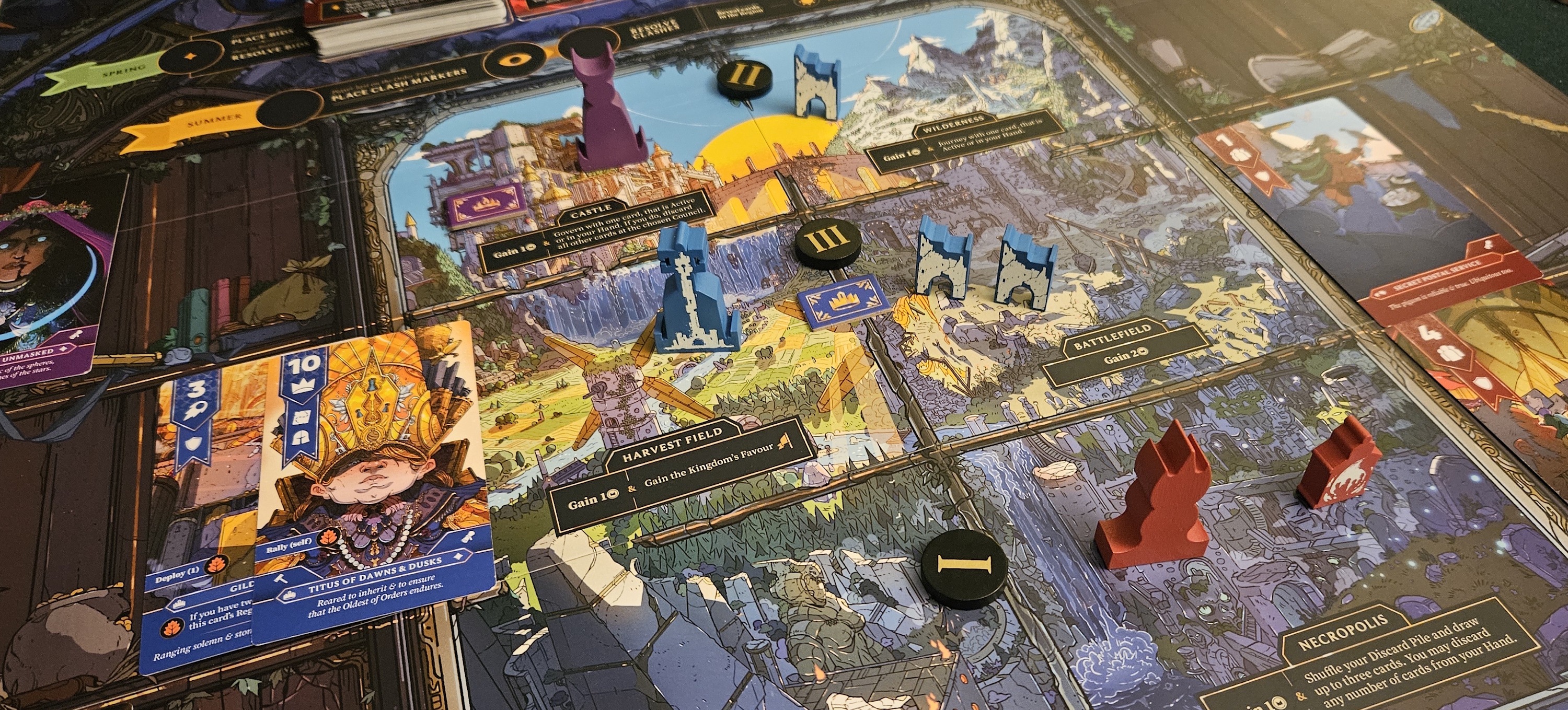
I mean, who wouldn’t want to rule this place?
There’s a reason everyone calls it a lane-battler. Including yours truly. The structure of a round in The Old King’s Crown doesn’t look all that dissimilar from a single combo in Omen: A Reign of War or a quick back-and-forth in Compile. The kingdom is divided into three sections of two regions each. There’s the upper portion, with the king’s seat of power and the wilderness beyond — the same wilderness the old man might have disappeared into, depending on who you ask. The middle section features fields for both agriculture and battle. And then there are the lowlands, the domain of shrouded shrines and mistended necropolises. They are, for all intents and purposes, lanes.
Into these regions, you play cards. Usually only one card per region. The digits on these cards are all-important, signifying who has devoted the most strength to each contest. Winning a lane confers points. Blah blah blah. I might as well be describing RiftForce.
It’s tempting to say that The Old King’s Crown then piles on its details little by little, but, well, it isn’t little by little. It’s an avalanche. The first outing with this game is like stepping onto the floor for a slow dance only to get whirled off your feet by a swing tempo. Like the crown everyone is fighting for, this thing is ornamented. Gilt. Fancy-dancy super-pantsy.
Which is to say, I understand why some reviewers have argued that it’s overstuffed. That the basic gameplay is basic, concealed under a mountain of cruft. I get it. Sometimes The Old King’s Crown feels that way.
But only sometimes. Because once the avalanche stops rolling you head over heels, you start to see that mass of white for what it is. An avalanche isn’t one thing. It’s a trillion things. It’s all those glittering pieces coming together to create something unstoppable.
That’s The Old King’s Crown.
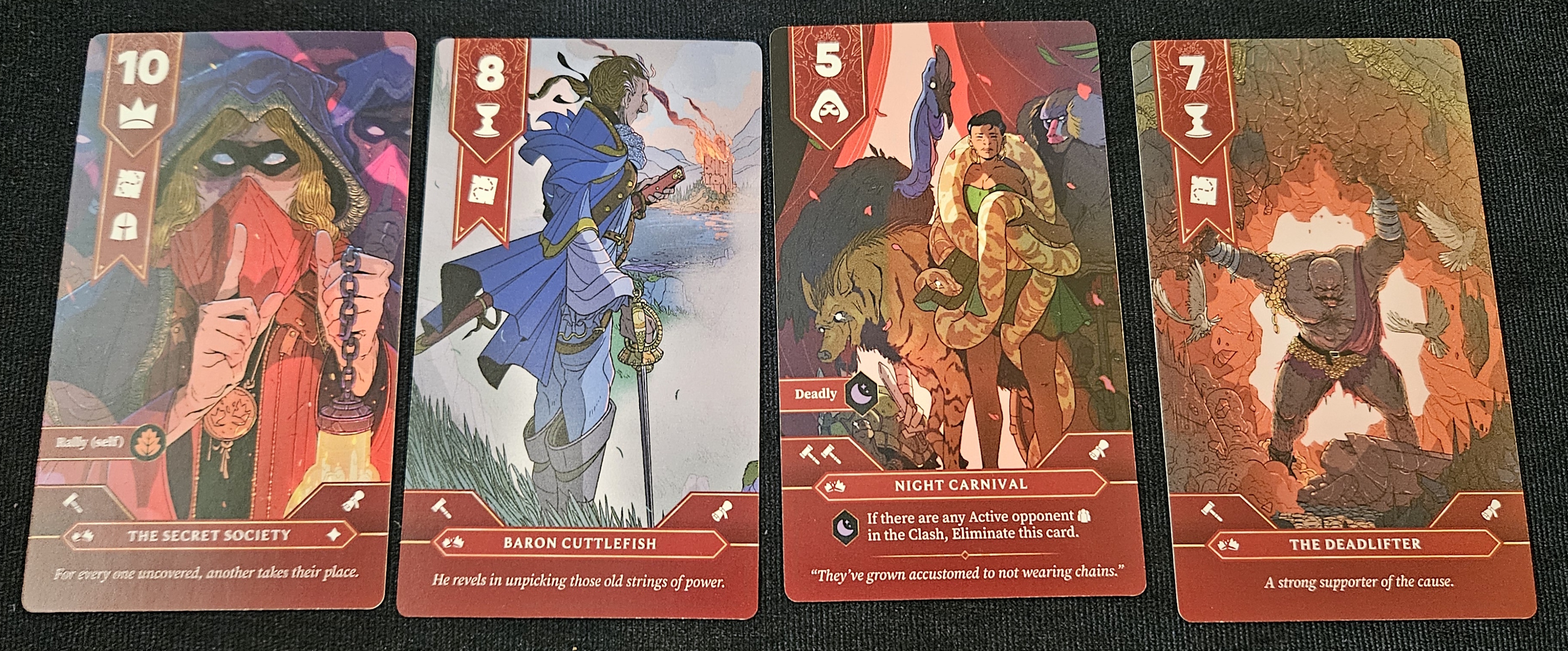
Fashion statements as factional alignment.
Consider the way the simple act of placing three cards, one per region, and then resolving them, will occupy twenty minutes rather than the commensurate thirty seconds in something like Air, Land, & Sea.
There’s the auction. Every faction in The Old King’s Crown is distinct right from the moment they appear on the table. The Nobility, with their established connections and standing army. The Clans, with their hordes encamped on the border. Playing as the Gathering feels distinct from playing as the Uprising, and not only because their art is lush in tonally different directions.
But these factions grow even more steadily apart as the game progresses. Thanks to a deck of kingdom cards and the auction responsible for distributing them, new abilities appear on the table. These are hopelessly, carefully imbalanced. Perhaps a faction’s ruler will decide to get their hands dirty, stepping personally into the fray more often. Another will strike a bargain with a Stygian boatman to swap weak cards for better peers who shuffled off their mortal coil too soon. Every time a kingdom card seems too potent, the game swings back to another auction. Now it’s possible to not only obtain new cards, but also steal those that were purchased before. That’s how to present imbalance, turning these troughs and peaks into the domain of player action. When a rival’s faction grows too powerful, you have only yourself to blame.
Or there’s the court. For first-timers, this is as close to vestigial as the game gets. Presented as a sideboard, the court allows the factions to manipulate the bureaucracy still ticking along in the background. By assigning a diplomat, you can ensure that some of your depleted troops bounce back to their feet every turn. With some preparation, a minor win on the battlefield can be leveraged into a sweeping success story. Point is, what first seems vestigial is in fact a life-bearing organ. Not that anyone is blaming those bleary-eyed newcomers for not quite getting it yet. Buried under all those snowflakes, it’s easy to miss how the court is a solid rock for dragging yourself free of the crush.
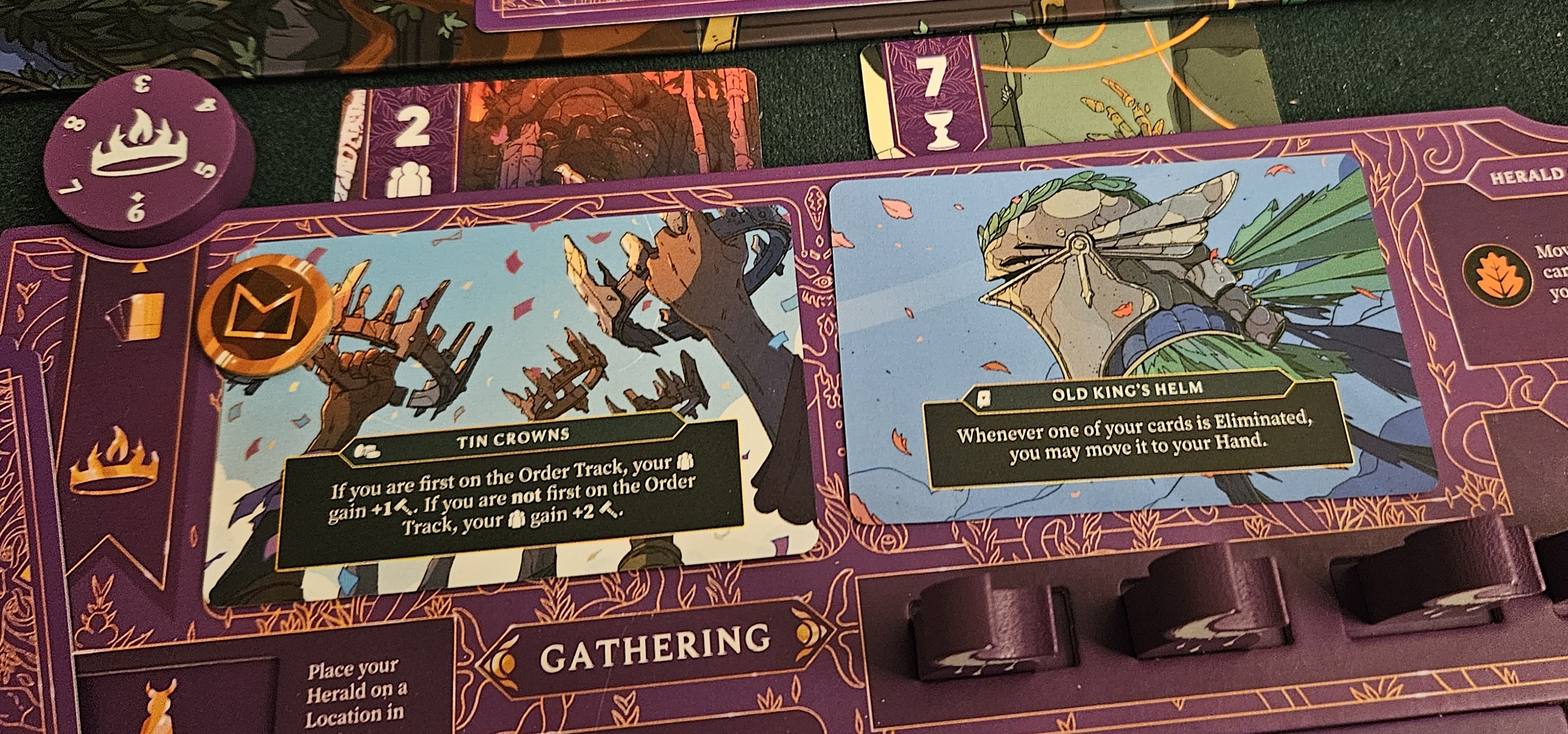
Over time, your faction becomes even more distinct.
Okay, so we’ve established that there’s a lot going on. But is all that stuff worth the effort? Is there value to learning a game that demands such a high degree of attention to detail? I mean, obviously this would be a very different sort of review if the answer were a curt “No.” But let’s dig into what makes The Old King’s Crown such a rich experience.
The first, I think, is that there’s value in waiting for a good thing, and not many games understand the preciousness of withheld gratification better than this one. Assigning a card to a region isn’t as straightforward as assigning a card. First each faction sends their herald, a token that announces to the whole world, indeed to this realm’s gods and smallfolk alike, that this is where they intend to put down stakes. It’s a powerful declaration. Winning in the location of your herald is worth an extra point — a considerable gain — but moreover, winning where your herald is sharing space with a rival herald will also steal one of theirs. It’s the equivalent of watching a regal retinue ride in, banners snapping and warhorses frothing, only for a larger and more glittery vanguard to swoop in behind them. Oh, is this what passes for a retinue these days? Psh.
Only after these theatrics are cards played. Even then, we’re multiple steps away from actually waging battle. Now armies sally forth, tweaking the values of those hidden cards. Abilities trigger, perhaps letting someone peek at their enemies’ concealed movements or shift a card from one lane into another. The tension reaches a fever pitch. Even the order of resolution matters thanks to additional details. A flanking force, for instance, might only prove advantageous if their region triggers early, giving them the time to march to a more suitable front.
In case I need to say it more plainly, this is the stuff of high drama. John Crowley called these little detours “snake’s hands.” The point being that they aren’t strictly essential to the core narrative, apart from the fact that, hey, look, this snake has hands, which is really what the story is all about. Ask yourself which story would you rather read: one featuring a dinky old snake, or one about the snake with hands who also poisons his former fencing instructor so as to claim the throne for himself? Yeah. I thought so.
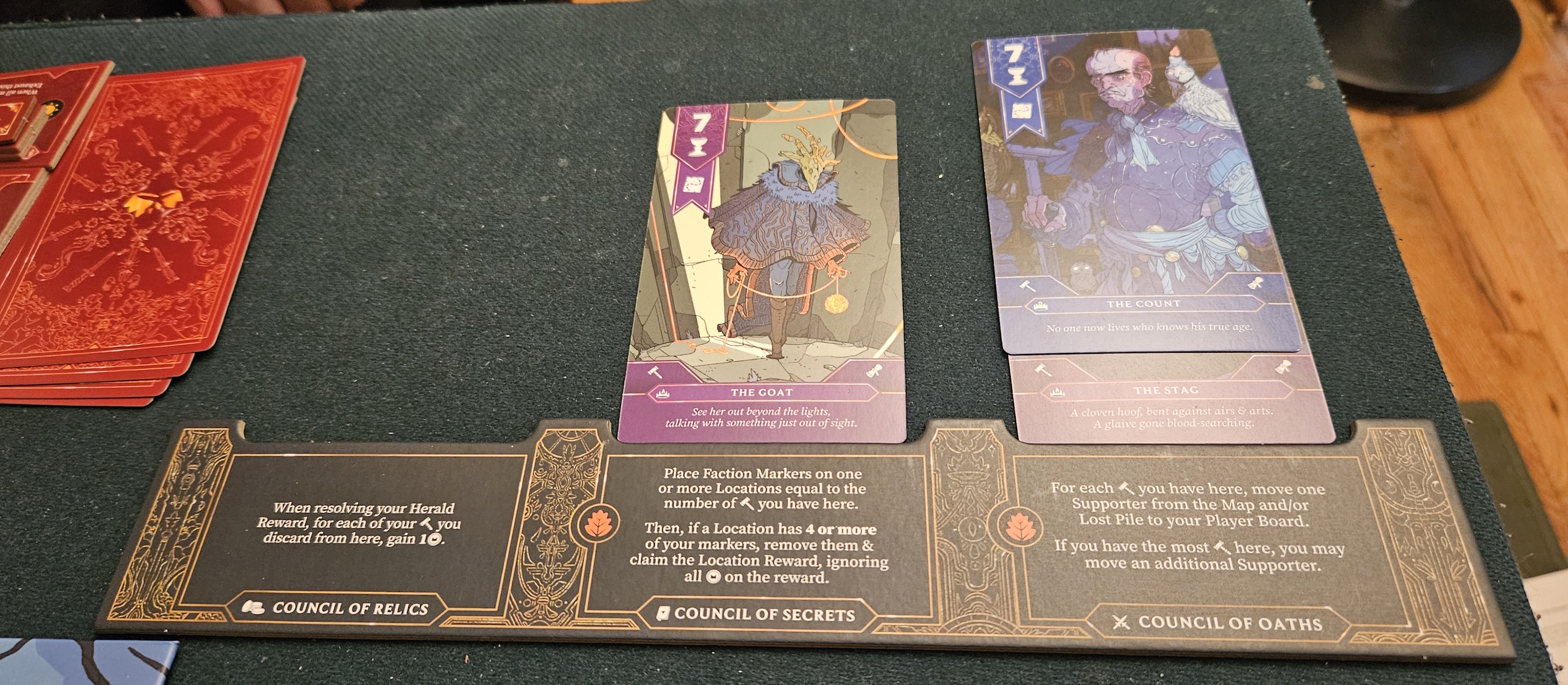
The court is the game’s most ancillary portion, but it’s as important as every other part.
The Old King’s Crown is a luxurious experience. Asking why it doesn’t focus on the bare essentials is like wondering why anybody would accept a massage at the spa when they have access to a perfectly good cold shower. This isn’t the game you play when there’s a tight thirty to burn. This is the game you play for intrigue. When somebody uses a siege engine to prep the battleground for the coming year, feints out of a region to flank into that same territory… and then finds themselves utterly undone by a rival’s plot, whether courtesy of assassins or some labyrinthine scheme by an occult secret society, there’s no repairing that core memory. That’s pure ludo, baby.
Do I sound defensive? Is this review too focused on some improper way to receive The Old King’s Crown? Maybe. But also, some things glisten all the more brightly when they go overlooked. When I previewed this game a couple years back, I liked it well enough. Maybe I even liked it a lot. But as more people play and talk about it, and sure, as the occasional bad take leaks out, the more I realize I can’t wriggle free of its grasp. Complaints about its playtime or its complexity, or the way its cards have too many little traits, or the absolutely goofball perspective that some of its subtleties should have been relegated to a dice roll (!!!), only serve to emphasize why it’s stuck in my gray matter all this time.
It’s the deliberate pacing. The drama. The little turns. The big reveals. The way every small detail matters, is unique and precious, but also accumulates into the aforementioned avalanche. It’s the way the game pauses for breath, and the way I can spend that breather getting lost in the artwork. It’s the way the game makes my friends cuss, the way it makes me cuss. It’s the masterful blend of art and gameplay that evokes a wider world, one halfway submerged between legend and reality.
![Can I say anything about [redacted]'s next [redacted], which is less [redacted] but no less [redacted]? Probably not.](https://spacebiff.com/wp-content/uploads/2025/12/6.-outro.jpg "Can I say anything about [redacted]'s next [redacted], which is less [redacted] but no less [redacted]? Probably not.")
Sometimes a game looks just as good when side-eyed.
Here’s the funny thing about The Old King’s Crown, which is also the same as my favorite thing about it. I remember dozens of story beats. Gameplay beats too, which are much the same thing in this case. It is this, that I only rarely remember who won. For a game this competitive, this sinister, that’s remarkable. I remember countless reversals. Dignitaries in the court, armies on the field, adventurers breathing deep the pines of a distant frontier. But the stuff above the table? It fades from memory. I’ve put off this review for months, letting all the big YouTube channels scoop the game and render my review redundant, just so I can have another excuse to put it on the table. I haven’t even touched the solo mode. That’s how deep its hooks have sunk.
That this is Pablo Clark’s freshman project is frankly astonishing. I hope for his sake that his next project is only a sliver as ambitious. I hope for mine that he flashes like gunpowder by producing one ambitious masterpiece after another.
A complimentary copy of The Old King’s Crown was provided by the publisher.
(If what I’m doing at Space-Biff! is valuable to you in some way, please consider dropping by my Patreon campaign or Ko-fi. Right now, you can read my third-quarter update on all things Biff!)
Posted on December 10, 2025, in Board Game and tagged Board Games, Eerie Idol Games, The Old King's Crown. Bookmark the permalink. 10 Comments.

 SPACE-BIFF!
What’s your opinion on player count? Is it indeed better to play with fewer than the maximum of four players? How would you compare the feel/time of the game at different player counts?
I can see where folks are coming from with a preference for lower counts; it’s faster and more strategic at 2p than 3p than 4p. But I like the game’s wildness at 3p and 4p quite a bit. In either case, the main things I like about the game don’t change much with player count. If pressed, I would probably say I like it best at 3p.
Shout? Shout? Let it all out?Did I notice a few Tears for Fears references in there?It’s a mad world…
Any thoughts on the extension?
I haven’t played it, sorry.
Maybe you were already aware of the Chinese proverb “画蛇添足” when describing the snake with hands. It means “to draw a snake and add feet”, which describes ruining something perfect by adding unnecessary details or overdoing it.
I was not! Thanks for sharing.
Pingback: Best Week 2025! Picture Perfect! | SPACE-BIFF!
Pingback: The Old King’s Annulment | SPACE-BIFF!
Pingback: Gods in All Their Fickleness | SPACE-BIFF!