Fetch-Building

To quote the Holy Bible, John D. Clair keeps trying to make fetch happen. That isn’t an insult. If anything, I admire the guy’s persistence. Unstoppable is his latest attempt to master the “deck-building but also you’re building the cards by sticking other cards into increasingly overstuffed sleeves” system that he kinda-sorted invented (provided we ignore Keith Baker’s Gloom), following up on Mystic Vale, Edge of Darkness, and Dead Reckoning. This one is a solitaire outing, and it’s the most expansive expression of Clair’s approach to card-layering yet.
Which isn’t to say it doesn’t have some pretty big hangups, unfortunately.
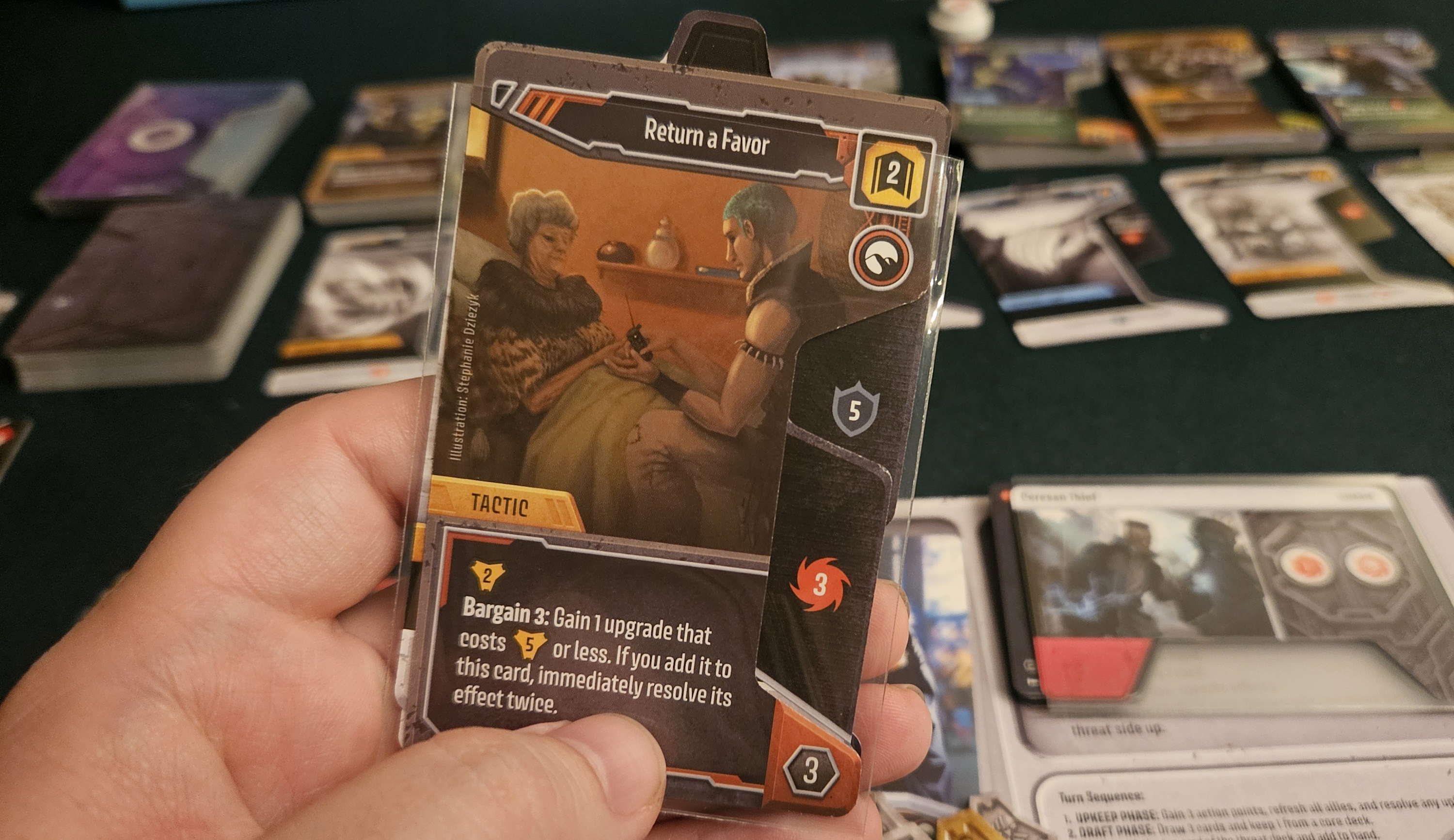
Thanks to a pair of upgrades, Return a Favor is now my most powerful card!
Welcome to the far future. Humanity has taken to the stars. There, we’ve met all manner of interesting alien lifeforms, colonized far-flung planets, and transformed countless habitats into neo-feudalist dystopias. Whew — we did it, fam!
Unstoppable casts you as one of four characters. Six if you add the expansion. Each comes with their own backstory, which I absolutely refused to read, and is now thrust into a quest for greatness against one of three existential threats. Maybe you’ll play as Julida, an alien activist whose protests have been interrupted by the invasion of a giant snail and its cultist legions, or Zephyr, who owns a cool cat and is going all Punisher on the planet’s corporate gangs, or KPop backup dancer Kai Silver as he navigates the seedy underbelly of a cyborg army. This world isn’t especially coherent, in no small part because each of these threats differs not only in powers but the way they present themselves to the player. Fighting the big snail or the corporate gangs, for example, you’re imperiled by the usual procession of threats, while facing Duomo’s Menace transforms the game into a light choose-your-own-adventure yarn complete with branching narratives. It’s ambitious, often admirably so, but its reach often exceeds its grasp.
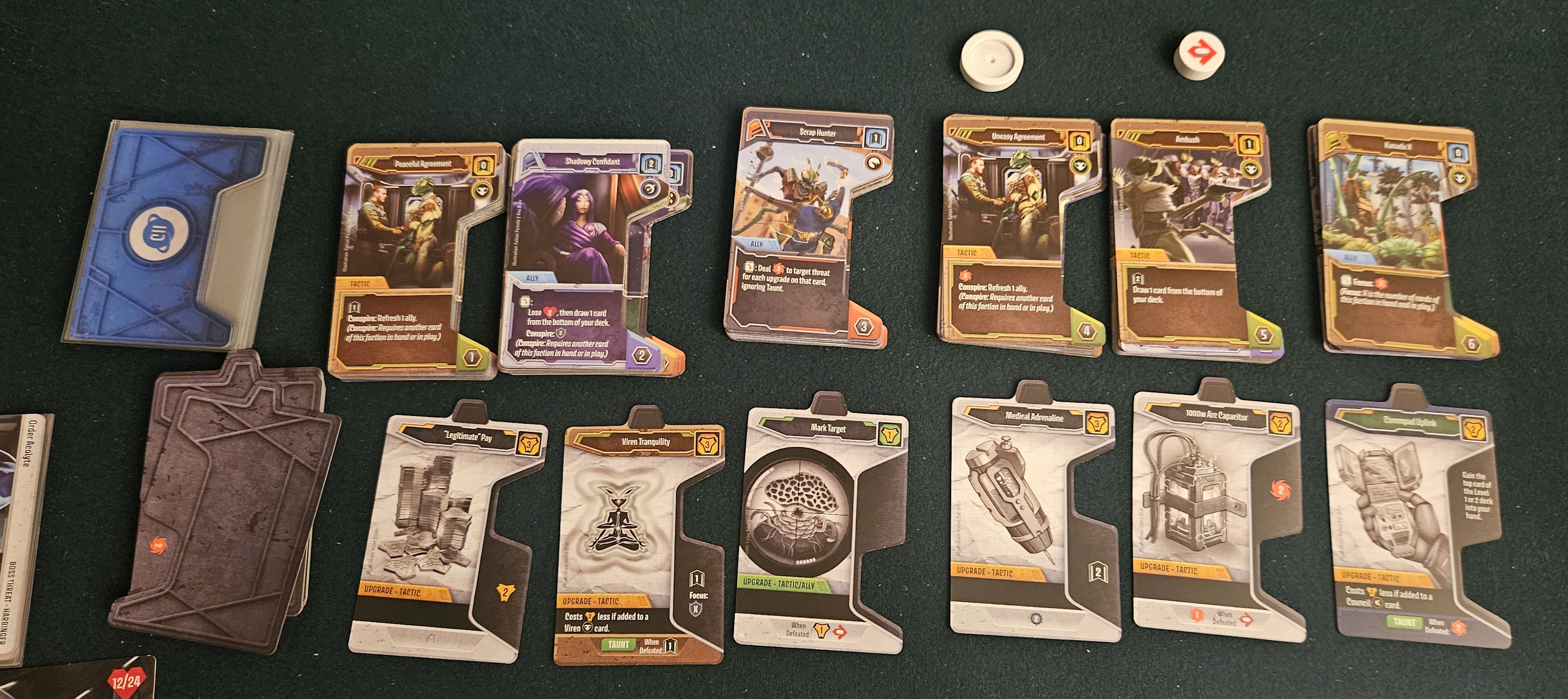
I do appreciate a nice card market.
Right away, there’s no mistaking Unstoppable’s priorities. This is a deck-building and card-layering game to the core, although this time Clair has tucked an extra card of his own into the sleeve of the system, which is another way of saying that your first-time setup is going to be a pill.
Fortunately, once you get up and running the basic idea isn’t too hard to grok. You’re playing a deck-builder — I’m assuming you know what that is, otherwise you might want to start with something lighter — except here cards are placed within a plastic sleeve to overwrite or modify other cards. Every card that finds its way into your deck is double-sided. Or rather, every “card” is technically two cards merged within a shared sleeve. On one side there’s something beneficial that you’ve chosen from the market. These offer all sorts of abilities, whether noble favors or alien resistance fighters or slick sidekicks. On the other side, there’s a threat, pulled at random from whichever collection of enemies you’re facing this time. Monsters, gangsters, cultists, that sort of thing.
These cards are double-sided because they pull double duty. When you first draw them from your deck, they’re placed to the right of your board. Here they operate as threats, which must be defeated lest they inflict damage on your currently-stoppable hero. Upon being trounced, they flip over and enter your hand. Now they can be used to your advantage to kill other cards, which also shift into your hand, and so on until you run out of action points and end your turn.
What’s more, these double-layered cards can be upgraded. This slides a third or even a fourth card into the middle, creating a sandwich of possibilities. Whether that sandwich is filled with complementing ingredients is really the game in a nutshell. Most upgrades are useful in some way. Perhaps you have a fairly basic card, something that earns a credit or two. Well, with the right upgrades, now it might bump up your character’s armor rating, letting you shrug off a few points of damage before your foes reach your squishy interior. Other times, a basic attack can become the equivalent of an atomic vaporizer, capable of eliminating multiple cards at once. These upgrades raise some interesting questions, as there’s really nothing stopping you from developing a killer card that wipes out entire enemy legions. Then again, the game is called Unstoppable, not Parity.
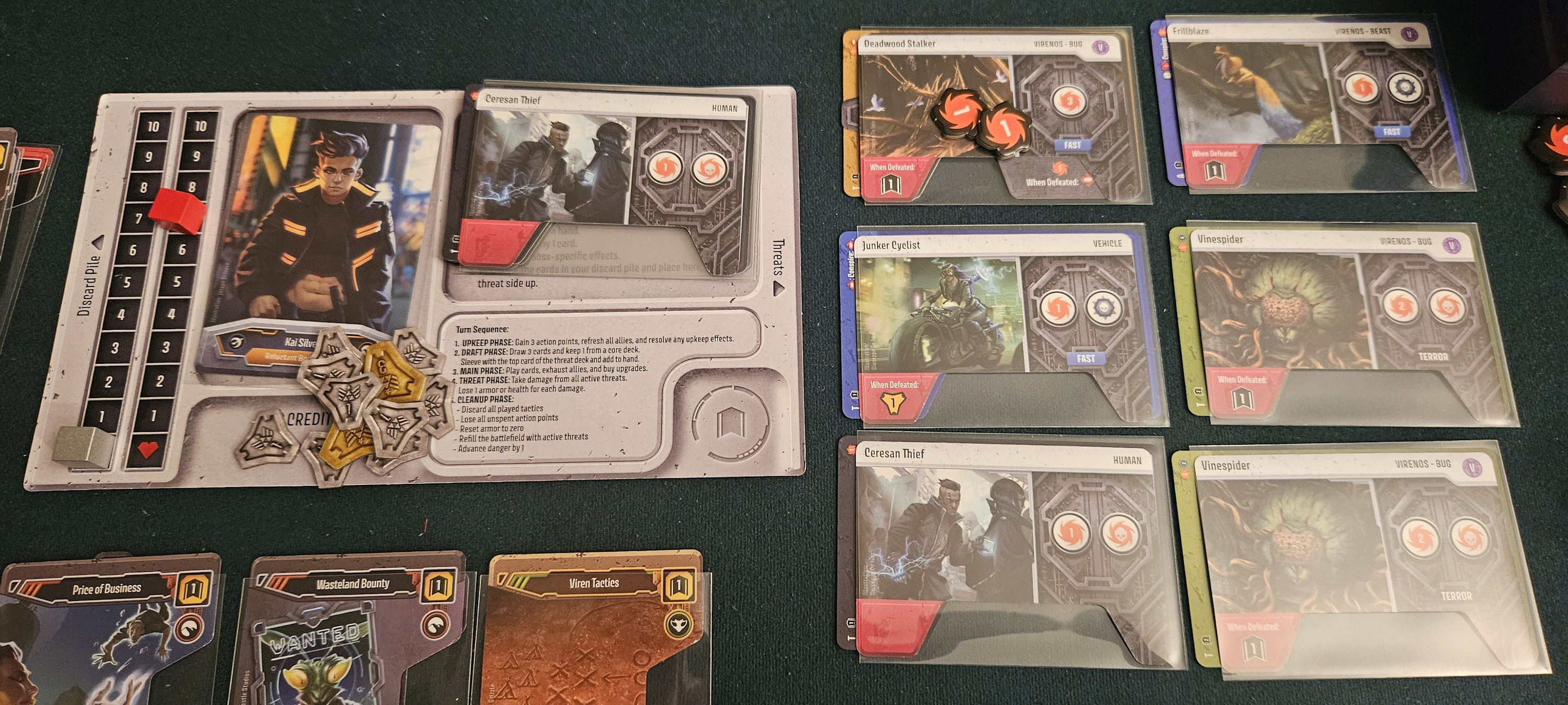
Uh oh. That’s a lot of problems for one KPop dancer.
The downside, as well as Clair’s attempt at balancing these runaway possibilities, is that even upgrade cards are double-sided. When you purchase one and slide it betwixt your paired power and threat, it shows through both sides of those oddly-cut cards. In many cases, this tweaks not only the potency of that card’s power on the one side, but also the deadliness of the threat on its flipside. Where an early threat might have been a wimpy biker, one hit point and fumes, it might gradually transform into a dangerous foe that appears over and over again to menace your campaign against snailthulhu.
In the abstract, this engenders an intriguing headspace. Upgrading your cards is often necessary, especially on the game’s higher difficulty levels, but the wrong upgrade can transform chaff into minibosses. It’s entirely possible to get bogged down by a bad draw. Unlike in a regular deck-builder, where that means you pulled a few too many starting cards in the late-game, here it means squaring off against a horde of goons who have learned how to dish out real damage. Also, they might still be your starting cards, which only adds insult to injury when you defeat them, then flip them over to earn their basic-ass abilities instead of all those cool powers you’ve been drafting.
The problem is that everything in Unstoppable is so darned generic. This is a problem we’ve seen in most of Clair’s card-layering games. There simply aren’t that many verbs in Unstoppable’s ludic lexicon. There’s damage and armor, sometimes healing, but that’s about it for the combat stuff. Credits and extra actions round out the economic side. Every now and then you can draft a higher-level card. And then there are suit-specific abilities, like the way the green aliens tend to grow more powerful en masse while the space-nobles are so incestuous that they refuse to trigger unless you mash two of them together.
Listed out like that, it might sound like there’s plenty going on. But it takes all of five minutes before everything blends together into a formless mush. Enemies, for example, are wads of hit points and occasional keywords, but little else. They even share their attack and hit point values, meaning there’s never a situation where you’re forced to shatter a glass cannon or put up with a tanky enemy over multiple rounds. The cards in your hand, meanwhile, sometimes distinguish themselves, especially when they take the form of allies who stick around over the course of the game. In those moments, a few glimmers of personality take shape through the static.
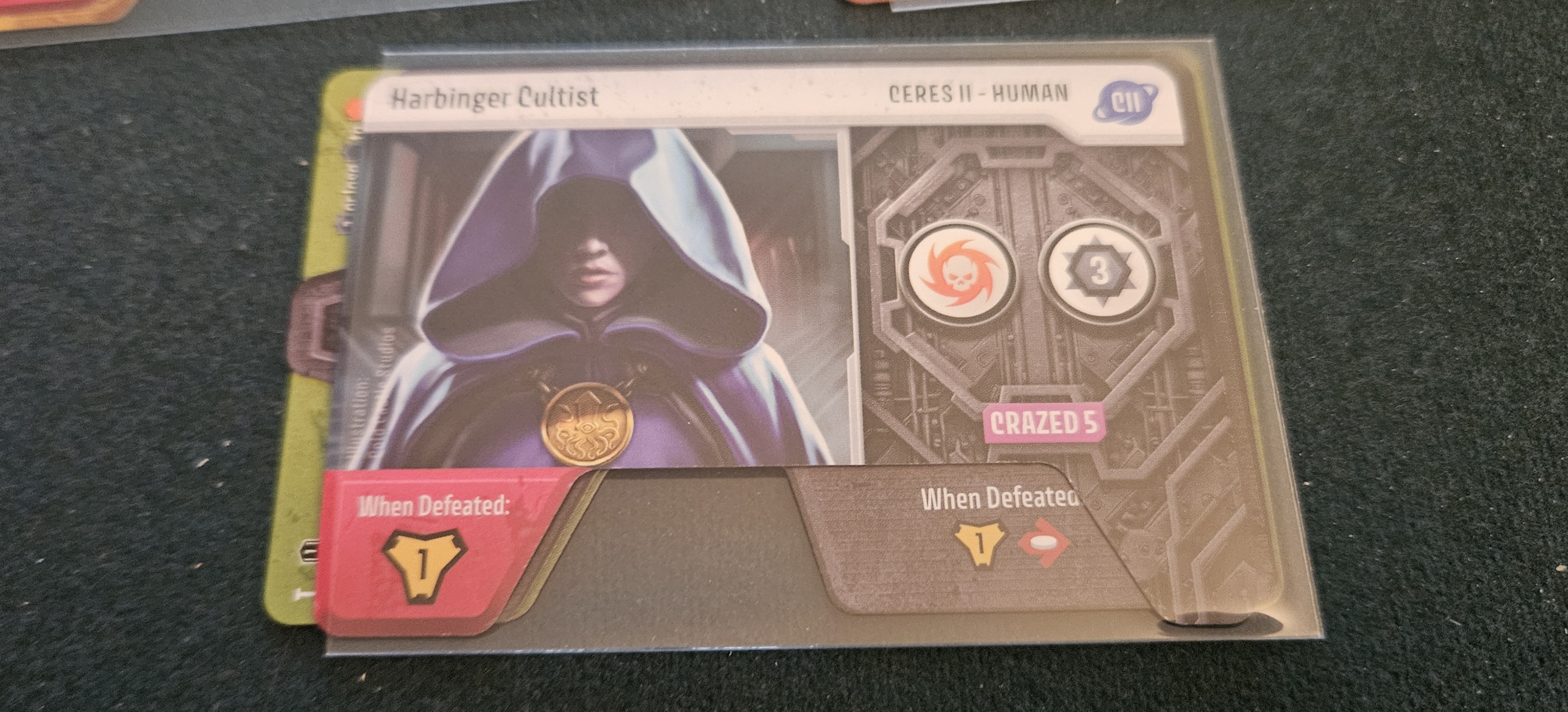
Upgrading your cards also upgrade enemy cards.
Except Unstoppable quickly puts a stop to that. Every time you level up — something that happens rather often, since leveling up is how you draft better cards — all those allies are forcibly shuffled back into your deck. Which means you’re right back to battling the same threats to trickle out the same allies, often to stick around for only a single turn before they disappear again. Fair-weather friends, these.
This speaks to a deeper issue with Unstoppable, which is that its entire format feels poorly keyed to the power fantasy it’s striving to portray. Rather than offering distinct difficulty levels, they’re just different settings on a timer. The entire thing is a race, and playing on hard mode means receiving fewer turns than on easy mode. That’s it. The threats don’t grow more threatening; they just happen to show up when there are thirty seconds on the detonator rather than two minutes.
Meanwhile, the cards’ limited verbs aren’t up to the task of evoking the necessary sense of place, or by extension the game’s intended narrative, or by extension of that, the requisite systemic depth. Which is odd, coming from the same designer who gave us Dead Reckoning, which for all its faults still imbued its piratical crewmates with a sense of individuality, and last year’s Mistborn: The Deckbuilding Game, with its huge range of intersecting magical powers. There’s a version of Unstoppable that’s exciting and personal rather than bland and undifferentiated, that’s worthy of reading a backstory booklet, that makes its recurring threats feel like foes you’ve made along the way rather than speedbumps that have suddenly sprouted nails. That version of Unstoppable isn’t merely theoretical. It’s something Clair has managed elsewhere. Sometimes spread out over multiple titles, to be sure, but tangible all the same.
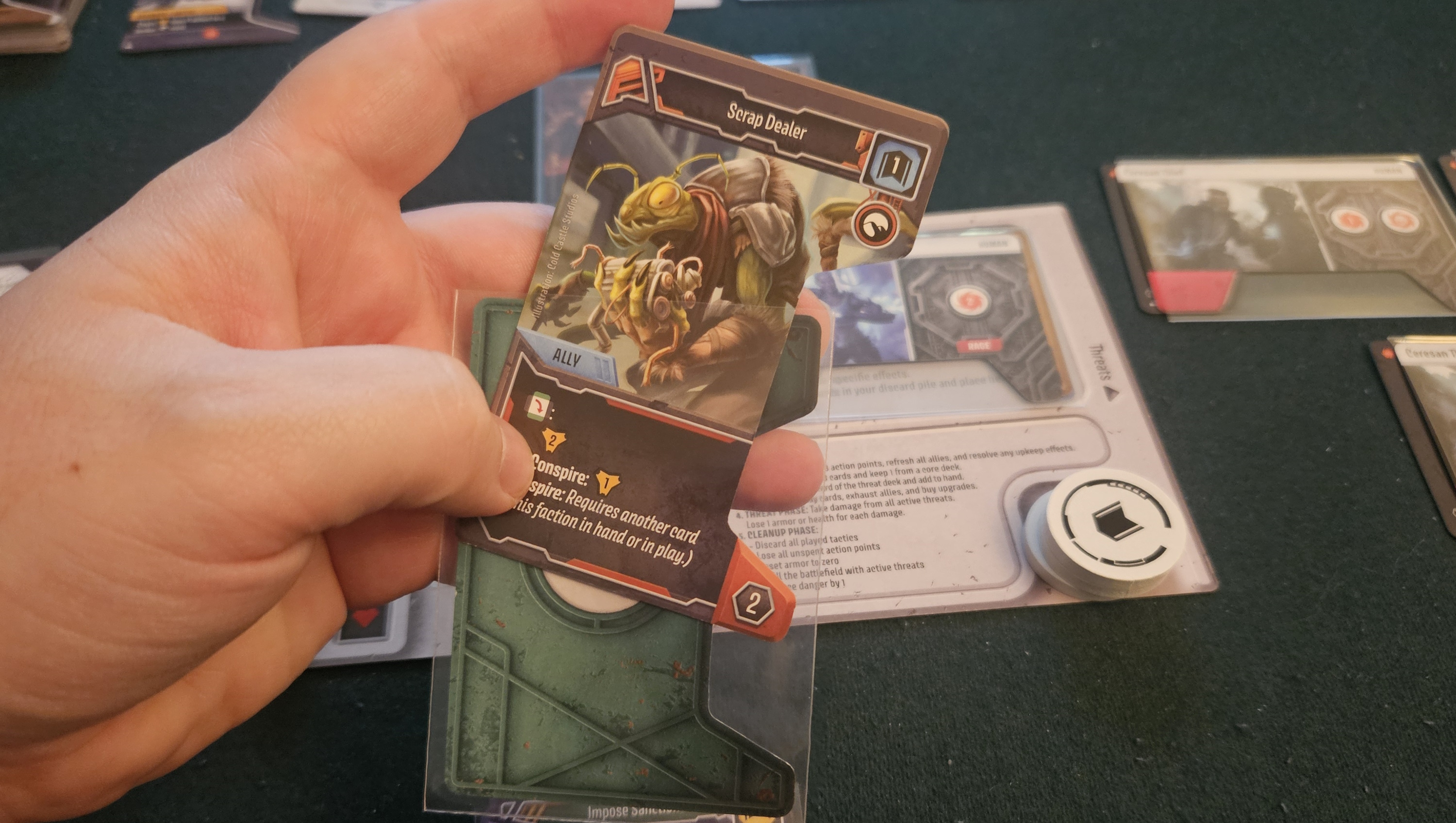
This is how cards are built, with threats on one side and powers on the other.
At a mechanical level, this makes Unstoppable interesting, sometimes even gripping. Racing to see whether you can layer the right cards to build the right deck feels good, even when the timer feels somewhat lopsided against the larger threat.
But as an integrated game and narrative, Unstoppable is a bit of a flop. There’s very little to care about here. More than once, I’ve assessed a trio of cards from the market that feel more or less the same, then deliberated over a row of upgrades that read like two and a half actual options, before mowing down a half-dozen lovingly illustrated beasties who might as well be interchangeable. As a misstep of narrative, that’s one thing. As a plaything, it grows wearisome long before its time. In both cases, it slides off the mind like an oil slick on running water.
Which is a shame, because Unstoppable is genuinely clever. The way threats and powers are paired, the double-edged nature of upgrades, even the game’s playful, if unfocused, approach to storytelling… they’re all worth a look. Certainly they’re worth revisiting, design-wise. I’ve had some interesting sessions with Unstoppable. The problem is that, in the end, I couldn’t tell you the first thing about any of them.
(If what I’m doing at Space-Biff! is valuable to you in some way, please consider dropping by my Patreon campaign or Ko-fi. Right now, supporters can read my second-quarter update!)
Posted on September 19, 2025, in Board Game and tagged Alone Time, Board Games, Renegade Game Studios, Unstoppable. Bookmark the permalink. 3 Comments.

 SPACE-BIFF!
Yeah, I have to agree with your review. But I would add that the game is a fun, quick puzzle. It reminds of a Sudoku puzzle, where in the moment you have to logic out your path to victory, but each puzzle is pretty similar and forgettable. But that “quickness” – each game lasting around 1/2 hour – is an important selling point I think.
My biggest problem with Unstoppable is that the game’s mechanics have absolutely zero connection with the setting, story, or themes. Why does defeating a giant bug monster add a repair robot to my hand? If I spend some credits and give that robot a gun, why does the giant bug monster on the back get tougher? Why does my robot buddy abandon me when I finish the deck and ‘level up’?
It’s like the board game version of Ludonarrative Dissonance; the mechanisms I’m engaging with during gameplay have little to no in-universe explanation or connection. Giving the robot a gun makes the giant bug monster tougher because that’s how the game is balanced. Killing a cultist lets you deal damage to another threat in play because that’s the reward you’re supposed to get, just roll with it.
You could honestly retheme Unstoppable to be about serving food at a restaurant and it would make as much sense The threats are customers, their damage is their hunger level, your allies are staff members, and finishing the deck means it’s the end of the day and your staff goes home for the night. Upgrades are fancy spices or tools but making your dishes better means customers become more demanding in the future.
I think I would prefer your restaurant idea, actually!