Sporks

Critter Kitchen is what you get when you take Matty Matheson from The Bear, Jon Favreau from Chef, and Daniel Brühl from Burnt, and then change almost nothing, because those are the actors who most closely resemble anthropomorphic animals in the first place. Designed by Alex Cutler and Peter C. Hayward, this is a feel-good board game about earning as many not-quite Michelin Stars for your restaurant as possible, marred only by a bit of clutter and the sneaking suspicion that the meat tokens must have been sourced from factory-farmed humans.

Sending your kitchen staff on errands.
Welcome to your very own animal-run kitchen. When the game opens, everybody has an identical staff, a combination of winged mouse, lizard, and boar that hope to strike it big in the restaurant industry. Depending on your setup, you might also draft a restaurateur with a unique ability. Hold onto that thought.
For around 80% of the game’s duration, the rules couldn’t be simpler. Turns revolve around sending your chefs out on errands to gather ingredients, secretly deploying them to the soup trucks, garden shops, midnight markets, and other destinations that offer some combination of visible, invisible, and delayed meats, cheeses, veggies, fungi, wines, and spices that are your stock in trade.
At a raw mechanical level, there are plenty of games that have done this sort of thing before. What sets apart Critter Kitchen is that the entire dish has been so carefully prepared that it’s almost impossible to identify any errant flavors. It isn’t enough to arrive at, say, the air docks to nab the freshest fish. Your chefs are distinct, with your smaller cooks moving faster — and therefore choosing first — but only carrying home one ingredient, while your boar ambles into the shop late but can carry three full items.
Hence the game’s core tension. It’s entirely possible, for instance, that your lizard will arrive ready and eager to pick up the bread you need from the desert vendor only to be preempted by three other players’ mice. That would be bad enough on its own, but the salt in this particular cut is a rival lizard who happens to be sitting ahead of you in resolution order, leaving your cook with nothing but a lone bowl of pity-soup. Cue an elephant’s sad trumpeting.
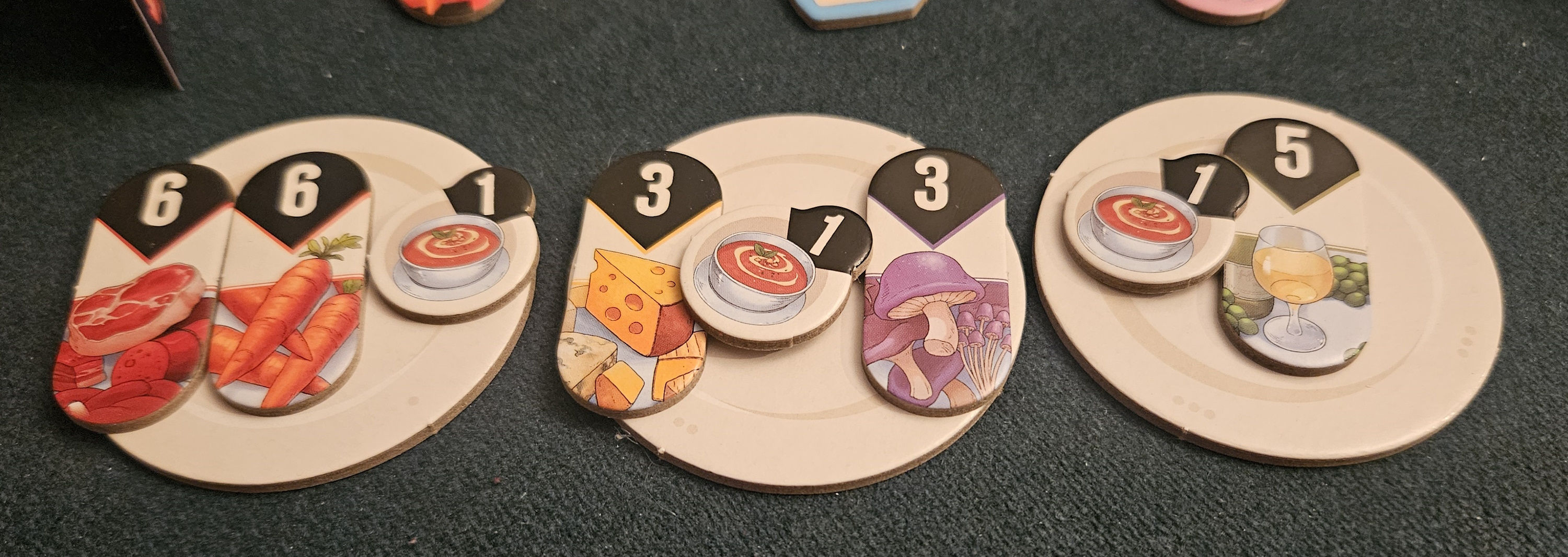
Prepping the finest dishes. On dishes!
The raison d’être for these ingredients is the dishes you hope to prepare, both for customers and for the end-game critic. These take their own forms. Rounds are clustered into sets of three, each representing a different series of meals in an ongoing food festival. One might see you scrambling to produce the world’s finest grilled cheese, while the next requires a paired wine and meat. Quite adorably — if you can’t tell, Critter Kitchen hangs its hat on its adorableness — these dishes are produced on actual little plates and presented to the table. The final test, meanwhile, is dressed up on a long platter that represents a full seven-course meal. It’s a little touch in a game full of little touches, an aesthetic flourish that isn’t strictly necessary, but serves the game’s intended purpose well.
And what is that intended purpose? It isn’t easy to say, in part because this is the most straightforward of Hayward’s games, lacking the satirical edge of That Time You Killed Me, Things in Rings, Fiction, or Vegas Strip, or even the compact innovation of Converge. There are amusing moments, to be sure. The game is absolutely loaded with puns: Martha Shrewart, Goat’n Ramsay, Guy Beari, and those are the obvious ones. Those moments, however, don’t always crop up where you most expect. Sending your boar to a now-empty market tends to be frustrating. But the moment before, after you reveal your chefs’ intended destinations but before you even spy your opponents’ selections, in that particulated second, when the regret sets in — now that’s funny.
More than comedic, though, Critter Kitchen is such a gentle game. It falls most readily into the recent trend of “cozy” art, games and books and films as comfort food in an age of turbulence, something you can hold onto and squeeze tight even though the atmosphere is shrieking. Sure, this a competitive game, but the sustaining elements are custom built to let that stuff fade into the background. Earning stars is your priority, but the margins between great and good are fairly thin. The distance between this town’s best restaurant and its middling fare isn’t exactly a gulf.
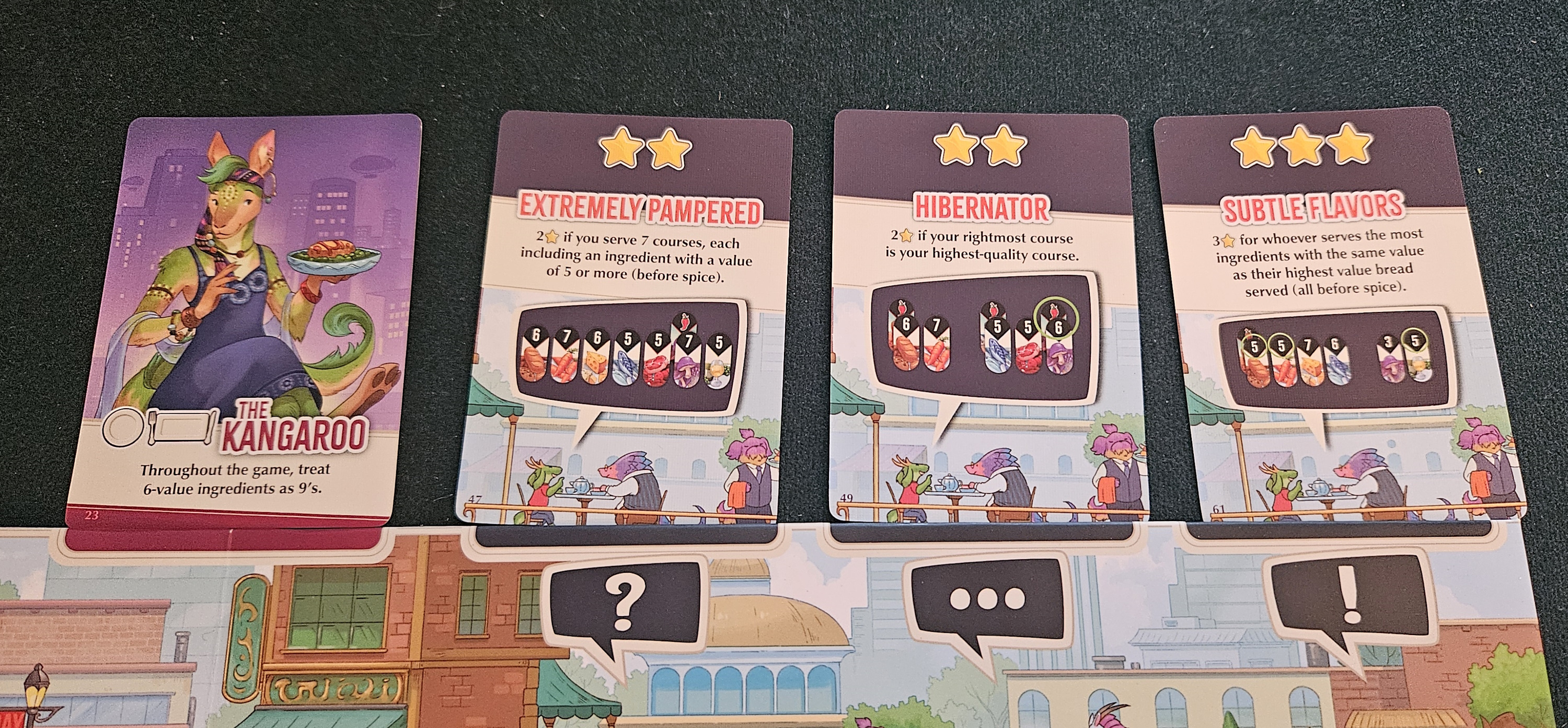
Critics have their own specialized tastes, which you can learn about through gossip.
Take, for example, the critic. This is the arbiter of your final challenge, but the categories are simple. Lots of soup? That’s a star. A full seven-course meal? Another star. Each category, from the inaugural bread plate to the final sip of wine? Stars. And in case you haven’t managed to come in first in any category, the game shrugs its shoulders and lets you score a bunch of stars anyway. Even the rumors, the critic’s hidden criteria that can be revealed by listening to rumors, are more amusing than cutthroat. Critter Kitchen is warm like an open oven.
To some degree, that warmth is chilled by the kitchen’s ample clutter. For such a straightforward game, there are so many little components to manage. Setting up a single player area requires no fewer than five dissimilar components, each sized so that they can’t be baggied together for easier setup. There are decks aplenty: critics and their rumors, dishes that need preparing, restaurateurs and location selection cards, the solo stuff that will invariably be pulled from the box. Oh, plus the temporary zous chefs (another pun!) that not only provide their own deck, but also individual standees.
It’s a lot to handle. And it only gets more cluttered. The expansion, À La Cart, adds additional locations that are more or less necessary if you want to play Critter Kitchen as a “deep” game. These food carts modify existing locations with additional items and incentives, from point-scoring pie carts to easily-flavored tofu vendors and set-making balloon stands. As expansions go, À La Cart improves Critter Kitchen in definable ways, adding some elbow-bounced salt to the usual ingredient-chasing. But also, there are eighteen carts with their own individual components. Even the coziest den can start to feel messy after a while.
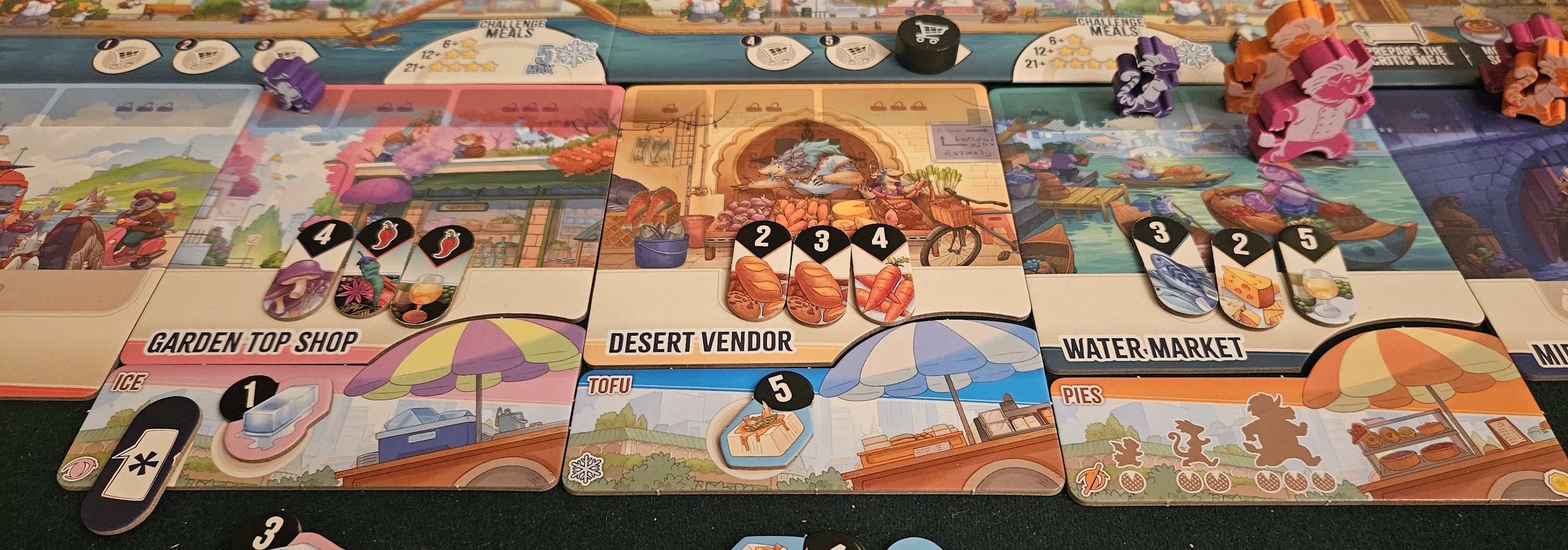
At times, it’s a crapshoot guessing where everybody will go.
On the whole, Critter Kitchen is an admirable effort. Even if it isn’t as strong as we’ve come to expect from Hayward, he and Cutler have crafted a comforting and appealing meal, a minor vacation from more competitive fare. Of course, even minor vacations can be a headache, and Critter Kitchen walks a faded line between too much and too little. As a gentle and low-stakes experience, though, its vibrant world and colorful components go a long way. As a spot of warmth on the carpet, Critter Kitchen practically rolls in it, lint be damned. Some days, that’s just the thing.
A complimentary copy of Critter Kitchen was provided by the publisher.
(If what I’m doing at Space-Biff! is valuable to you in some way, please consider dropping by my Patreon campaign or Ko-fi. Right now, supporters can read my second-quarter update!)
Posted on September 15, 2025, in Board Game and tagged Board Games, Cardboard Alchemy, Critter Kitchen. Bookmark the permalink. 5 Comments.

 SPACE-BIFF!
I chafe slightly at Matty Matheson, an actual chef, being referred to as an actor (even though he is acting, basically as himself) but I agree he is practically a cartoon character already. Good piece as usual!
Ahaha, gottem!
The game is definitely a Kickstarter era “look at all the stuff you get!” creation. I like all the toys, but the set-up and tear-down keep it from getting quite as much play as it might otherwise.
Personally, I was surprised by the amount of math involved… “Both these meals require a veggie ingredient. Which do I put the higher value one with to maximize the number of stars I get?” multiplied by the number of meals with overlapping ingredients. My brain just doesn’t process and remember those options very quickly or well.
Interesting! I’m a dumb-dumb at math, but didn’t mind it in this one. 21x, on the other hand…
what are the games that have done this before but better? Any that are food themed?