We’re the Messypotamians

I’m not sure I’ve ever played a game with so many tremendous ideas and so many disastrous executions as Sammu-ramat. Designed by Besime Uyanik and published through Ion Game Design, which Uyanik runs as CEO, it tells the tale of the titular Neo-Assyrian queen, Sammu-ramat, who succeeded her husband and seems to have co-ruled during the reign of her son, Adad-nirari III.
I say “seems” because the sources are thin on the ground — a few stelae here, some woman-queen legends there, all par for the course for an empire nearly three thousand years removed from our present circumstances — but historians largely agree that Sammu-ramat held an unusual position of prominence. This is a world I would love to see explored in detail, packed as it is with court intrigues, military campaigns, and early empire-making, not to mention the prospect of a queen bending that empire to her will. Unfortunately, this board game rendition of Sammu-ramat’s life leaves its most pressing questions unanswered.
Bones from deep down in the Fertile Crescent.
Like many of the great old stories, our tale begins in the royal court. Sammu-ramat and all her advisors occupy the imperial capital of Kalhu, more commonly known to us today as Nimrud, which sits at the center of the known world, its roads arrayed like spokes to distant provinces and kingdoms.
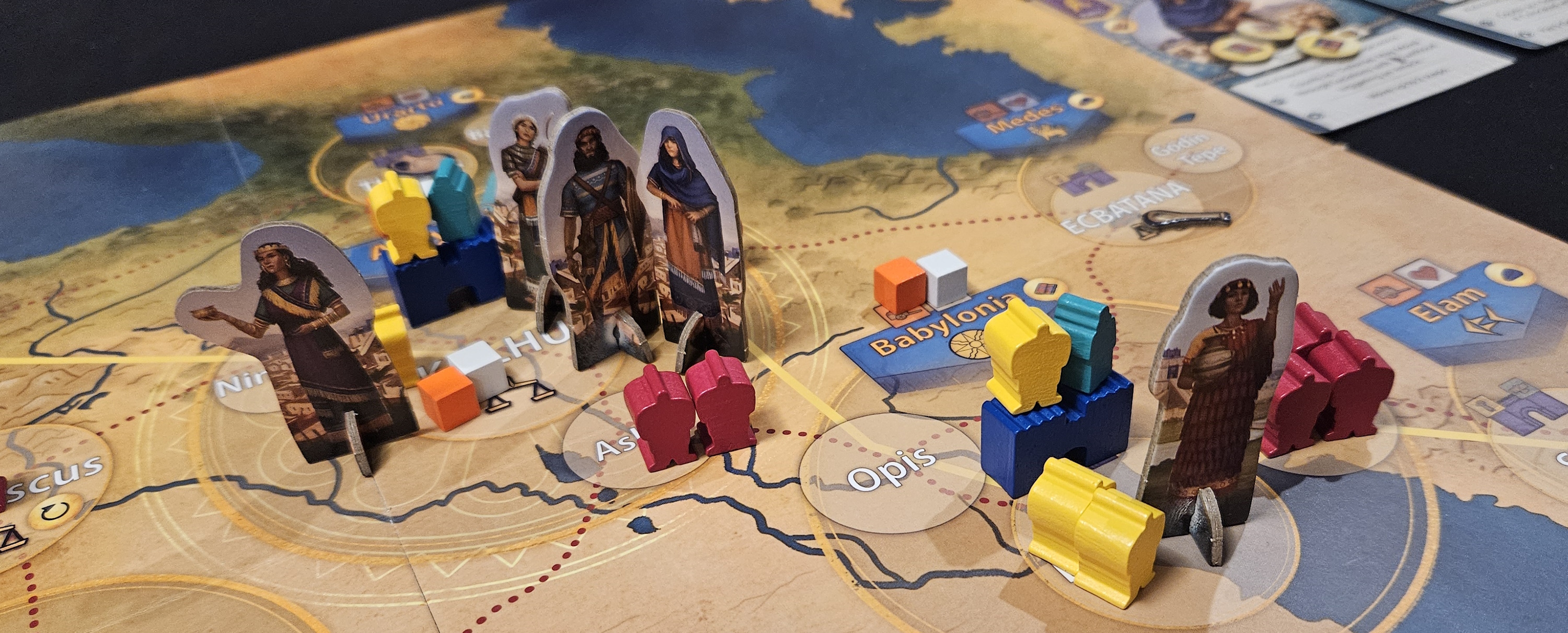
In the foremost of this game’s many tremendous ideas, the royal court is given an unexpectedly literal representation. Rather than being ushered behind the curtains, Sammu-ramat’s advisors are the playing-pieces that must be moved across the map, protected from rebel incursions, or, in the Queen’s case, safeguarded from assassination attempts.
Each advisor offers their own expertise. There’s Wardiya, the spy, whose ability to creep past rival armies makes her an expert at recovering far-flung assets or delivering much-needed resources to cities that would otherwise be out of reach. Dinah the bodyguard can protect her Queen beyond Kalhu’s borders, and press nebbish scribes into military service at a moment’s notice. Besime, presumably authored into the game by Uyanik as a self-referential wink, commands the armies, marching them along the Queen’s Road and into battle against the countless rivals who would love to see Assyrian hegemony collapse under its own weight. There’s even Queen Sammu-ramat herself, capable of deploying any of the game’s overpriced cards for free. It is good to be Queen.
This immediately establishes the stakes for Sammu-ramat. Marching an army into battle doesn’t only risk a few tokens; it puts an actual character on the front lines, where an ill-timed incursion might remove their head from their shoulders and therefore withdraw their tenure from your court. More than once, I’ve seen the kingdom resort to desperate measures, elevating some ill-suited leader to lead an army in a pinch.
More than even that, this captures some glimmer of how the Neo-Assyrian Empire extended such control over its neighbors and forged the template that would be followed by the Babylonians, Achaemenids, and pretty much every other potentate over the coming centuries. The Assyrians did not merely conquer their foes. They integrated them. Sometimes this took the form of forcibly relocating rebellious populations across Assyrian heartlands — yep, we’re talking about those legendary Ten Lost Tribes — but more often foreign leaders would be absorbed into the Assyrian court to function as new advisors and, let’s be honest, hostages.
In this case, that means gaining new advisors whenever a foreign kingdom is brought to heel. Seizing Egypt brings Amunet to court, along with her enviable ability to use scribes directly in battle. That’s even better than Dinah’s ability to convert scribes to soldiers! Annexing Kush lets the high priestess Amenirdis deliver special technology tokens to your characters, a safer and more efficient method for beefing up your forces than sending Wardiya behind enemy lines. The Medes have Deioces and his cavalry forces, capable of moving in huge clumps, Ithobaal uses his knowledge of the crossroads in Canaan to barter as a free action, and Katuzili of Elam lets you foresee the contents of the oppressive event deck. No wonder the Assyrians believe it’s their divine right to conquer the world.

Running the army.
Sammu-ramat goes one step further. Rather than inhabiting the royal court as some disembodied game-spirit, the player is asked to step into the role of one of these advisors. This card is then flipped to its opposite side, revealing a slightly improved version of its personal ability. Dinah the bodyguard, for example, still protects her Queen from assassination attempts, but can also carry other advisors around with her when she travels, effectively doubling up the game’s action economy. Besime, in addition to recruiting armies more effectively, now counts as two defense points instead of one. That sort of thing.
It’s another great idea, putting players directly into the sandals that run the Neo-Assyrian Empire. It’s also where Sammu-ramat begins to slip from its pedestal.
The real problem begins with action selection. Each round, players are asked to select which character they will consult with. This means everybody places a token on any character of their choice, marking who they will control on their turn. It’s possible to select pretty much anybody, whether Sammu-ramat or one of her advisors. The advantages are significant, preventing players from being locked into any one location of the map. Where one round you might lead an army to quell an uprising in Babylon, the next might see you delivering much-needed medicine and supplies to Cyprus. Come to think of it, it’s much like a cooperative version of the character selection from Stationfall. You’re an actual person within this world, but you’re simultaneously unbound by concerns of position and distance, freely leaping between characters as needed.
That’s all fine and dandy, but the way it’s handled here is stilted and awkward. When you consult with a character, you receive some number of actions with them. Meanwhile, everybody else stays put. While you lead armies down to Egypt and your buddy undertakes a trade mission to Damascus, the remainder of the Assyrian court sits on their rump while armies from Elam and Urartu make a beeline to the imperial capital. It feels less like you’re commanding an empire than temporarily possessing mannequins in a department store.
And the problem varies with player count. Playing solo means you’ll only consult with one character, but they receive more actions, whereas playing with five translates into five characters who all produce only one action each. Depending on how many characters you have at the table, either one advisor will do a whole bunch or a bunch of advisors will do very little. It’s frankly untenable, especially for a game that requires you to painstakingly shift supplies and armies across the map one province at a time.
Oh, and the game’s length varies with player count as well. Sometimes a session will last only five rounds, each one representing an in-game month, while others will last eight. It’s a mess. The obvious solution would have been to normalize the action system, always allowing five characters to activate no matter how many people were seated at the table.

Either you get the right cards or you don’t.
But Sammu-ramat is not a game for obvious solutions. It’s a game for as many non-obvious solutions as possible.
Consider trade. Regions produce goods, but these are locked by type. Assyria produces cloth, Egypt and Kush have access to gold, the eastern kingdoms provide lapis lazuli, and Cyprus has all the copper oxhide ingots you could ever desire. Cards, which are often necessary for producing whatever you’re short on, are not only drawn at random, but also require specific resources. Need medicine? Hopefully you’ll draw a card that produces medicine and costs the right goods.
Characters also require goods in order to enact their abilities, but in their case goods are generic. You can raise an army with lots of cloth, or iron, or pretty metamorphic rocks, with no need to actually obtain anything in particular. But sometimes a scenario will require a specific type of good. Okay, so you send a character laden with goods to a trade city, usually Damascus, to swap for what you need. Except your advisors can only take a certain number of “free” trade actions per turn. Fortunately, during the taxation phase, you can send goods to any character no matter where they’re located. Now you just need to keep teleporting your excess textiles to that one guy sitting in Damascus so he can churn it into copper or whatever.
In other words, trade is sometimes handled as this very tangible and essential thing, materials being painstakingly moved from place to place and only exchanged in limited quantities, but at other times operates according to game-logic where they can be zapped from their province of origin to a character hundreds of miles away.
That same migraine-grade duality applies to almost every corner of the design. There’s a draw-bag for both positive and negative occurrences, but no dedicated phase for drawing from it. There are famines and discontent markers that spread across territories, each operating according to their own logic, but which tend to cluster in regions you don’t care about anyway. There’s a swingy event system, but no seeding of the deck for specific scenarios. There’s even a supply track that must be painstakingly populated with armies and scribes and supplies and medicine, and which threatens to burn out your excess troops if you don’t have enough supplies on the map. Only it turns out that the supply track hardly ever matters. Sure, sometimes you care about where your supplies wind up, especially when you want to erect an Ishtar Gate over the top of a rival kingdom. But that’s only sometimes. One advisor could drag the entire harvest of Assyria to Phrygia and your troops occupying Babylon wouldn’t even notice.
Speaking of troops, you’d think a game that features so many armies would make it interesting to march and do battle. Sadly, it isn’t so. Enemy armies will actively avoid combat, marching hundreds of miles out of their way to go around a blocking force, which makes one wonder why everybody spent the entire Hebrew Bible trampling through Canaan. When battle finally commences, the combat is deterministic, both sides losing equal numbers. There’s no drama, only a grinding attrition that seems to speak to the game’s roots. Despite all appearances, this is not a descendant of States of Siege, that venerable series that sought to model the rise and fall of empires. It’s Pandemic. Complicated Pandemic.

Chillin’ in Canaan.
What is there positive to say about this game? I appreciate Madeleine Fjäll’s graphic style, and the visual design here is perhaps the best I’ve seen from Ion, without the eye-straining icons that were the bane of both Galenus and the second edition of Pax Renaissance. And truly, I appreciate the attempt to show how the Neo-Assyrian Empire wielded so much power over such a wide domain.
As for the rest of it, Sammu-ramat is a whirlwind of mismatched game systems, complete with a creaking action system, vestigial organs that ought to have been trimmed, and objects that sometimes exhibit permanence and other times move like wisps. Even the game’s protagonist gets short shrift. Sammu-ramat’s biography in the rulebook is shorter than those of her peers, which would come across as less insulting if those extras weren’t fictional. This was an opportunity to either tell us more about Sammu-ramat, the figure and legend alike, or to craft a literary approach that theorizes about the Queen’s life and reign, similar to Harold Bloom’s portion of The Book of J.
Instead, Sammu-ramat bothers with neither. The queen deserved a better cenotaph.
(If what I’m doing at Space-Biff! is valuable to you in some way, please consider dropping by my Patreon campaign or Ko-fi. Right now, supporters can read my quarterly report on all things board games!)
A complimentary copy of Sammu-ramat was provided by the publisher.
Posted on April 9, 2025, in Board Game and tagged Board Games, Ion Game Design, Sammu-ramat. Bookmark the permalink. 4 Comments.

 SPACE-BIFF!
Small correction, in the solo game, you consult with 3 characters (but each only gets 2 actions).
On that note, I think this game might play best solo using the interlinked 5-mission campaign. With the campaign, the deaths of advisors are much more impactful, and a near win in one scenario might set you up for disaster in the following scenario. Sometimes it is advantageous to take a loss in one scenario so you can gather your strength for a big push in the next scenario. These kinds of decisions make the game quite engaging, IMO.
Of course, playing solo also tackles some of the role playing problems since you actually play as Sammu-ramat, and activating her advisors to carry out your orders does feel thematic.
I guess that you have played this multiplayer? If so, you might want to give the solo campaign game a try, it is an interesting challenge and it always manages to throw some unexpected wrenches in the gears.
I played multiplayer, yes. I’ll give it a try solo. If it’s different enough, I’ll add some additional thoughts.
Nice TMBG reference in the title. 👍
I enjoyed this game quite a bit, mostly playing it 2- and 3-player. My friends and I played through nearly every scenario. I agree, however, that the event cards are too swingy. There should be some way to curate them for each play. Additionally, the rules suffer from imprecision in more than just a few areas. I was surprised when you said that “enemy armies will actively avoid combat, marching hundreds of miles out of their way to go around a blocking force.” I don’t recall that behavior in my plays, and so I initially suspected that you misread the rules. But, after re-reading the rules myself, I totally see how someone could interpret enemy movement in that manner. In fact, I actually think its the more precise reading, but I don’t think it is the intent of the rules.
I was surprised you said the supply tracks (on the empire board) hardly ever matter. Since the amount of materials we could keep in play depended on the track levels, managing those tracks was a frequent concern to us.
While the game can be swingy, we found that our success improved play-by-play, so we found it to be a rewarding experience overall, and enjoyable too! But, ugh, that rulebook… (you’ll see numerous rule queries of mine for this game on BGG.)