RETXXIIIRN

Remember how last year all those RETVRN bros couldn’t stop talking about how they meditate on the fate of Ancient Rome every single day, but when pressed it turned out they just had a big squishy for Ridley Scott’s Gladiator? Well, here’s a part of our distant heritage I think about daily: that holiday in the middle of March when we all get together and stab our nation’s self-proclaimed dictator.
23 Knives, designed by Tyler J. Brown, whisks us to that fateful day in 44 BCE when a senatorial conspiracy resulted in Julius Caesar lying dead at the feet of a statue of Pompey the Great, his onetime ally, son-in-law, and eventual rival in the preceding civil war. Those Romans sure loved their little ironies.
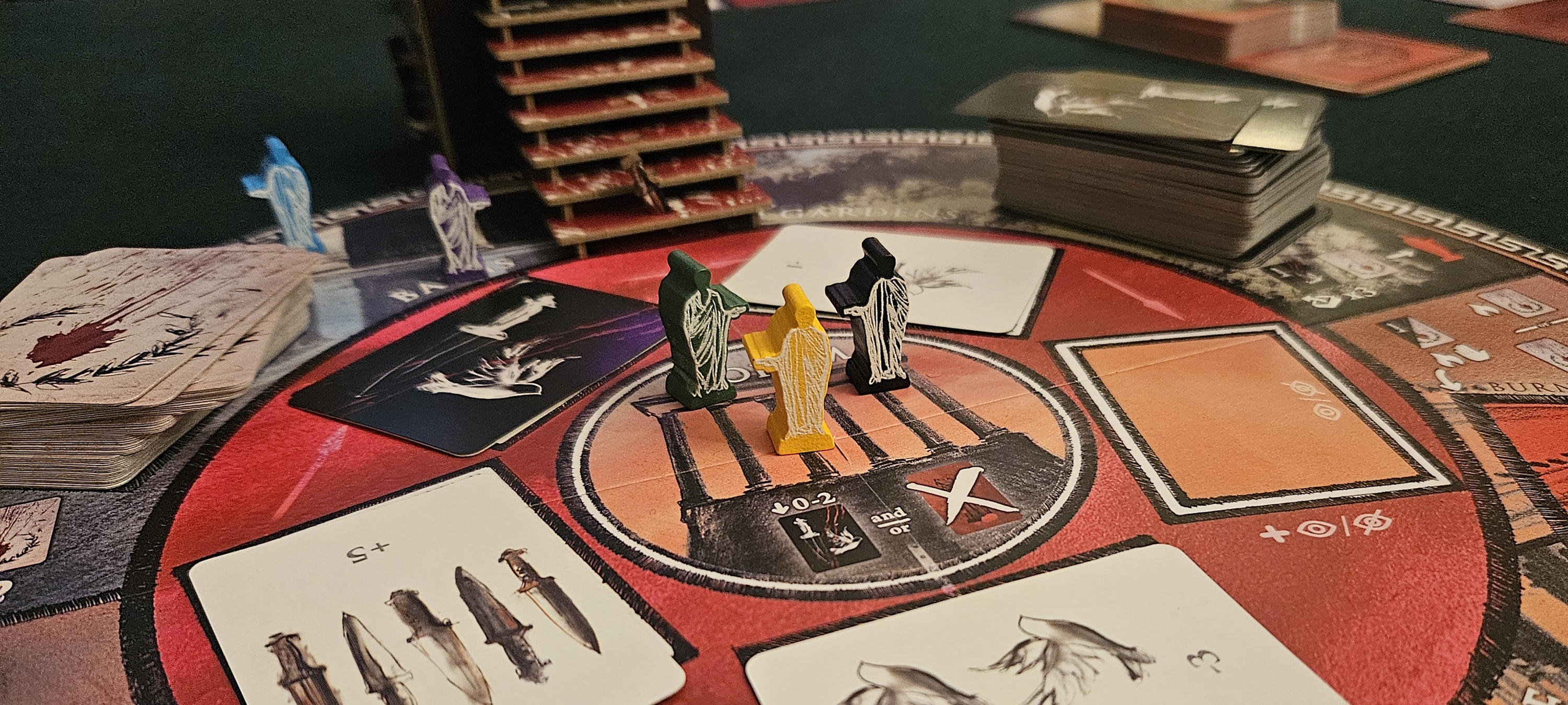
Ave, Aelianus! Have you come from the baths?
23 Knives is a social deduction game, but don’t let that epithet fool you into making assumptions about how it works. One of the beautiful things about this game is the way it plays with expectations, both as an inheritor of a long-standing genre and within the gameplay as you attempt to figure everybody’s intentions.
As framing goes, this one is a killer. The whole thing is placed on an uncertain timer, a dagger working its way up the curia staircase to the moment when Julius Caesar will either be slain, saved, or something in between. It’s the ancient version of a ticking clock stuck into a bundle of dynamite, except the second hand only ticks at irregular intervals. Such as when you step closer or try to elicit help from your fellow players.
You’re a senator. Or maybe you’re Caesar’s lover. Or his wife! (Awkward.) There are quite a few potential roles, each with its own attendant ability. As is customary for social deduction games, nobody but you knows your identity. What sets 23 Knives apart from most of its peers, though, is that your identity doesn’t draw you into a specific camp on the whole Should We Murder Caesar issue.

Si vis pacem, para aleum.
Oh, you might have an inclination. Cassius leans hard toward the stabby side of the debate, while Lepidus will go out of his way to preserve Caesar’s hide. Most roles show some quantity of laurel wreaths or blood spots, indicating loyalty to Caesar or a determination to end his rule.
Initially, anyway. Your feelings on the matter are prone to adjustment. Indeed, a large portion of the game revolves around building not only your understanding of the conspiracy at the table, but also developing your role within it. This is done by playing “sway” cards on yourself and your fellow notables — conspiring in private gardens, gossiping in the public baths, maybe mulling over your conscience while offering sacrifice at one of the city’s temples. The concept is dead simple, always returning to your sum of blood spots and laurels. Over the course of the game, your allegiance might teeter between extremes or harden into resolve for one side or the other.
But while that’s intriguing enough on its own, there are other considerations as well. For one thing, only the most dedicated among Caesar’s loyalists will win if he’s saved, while only the most vehement critic will win if he’s slain. It isn’t enough to switch camps at the last minute. You’ll need to prove your convictions in order to succeed.
For serial vacillators, there’s a third option. When the game concludes, if your allegiance is zeroed out — an even match between blood droplets and wreaths — then you’re marked as an opportunist. When the cards in the curia are tabulated, with knives adding to Caesar’s demise and doves safeguarding him, it normally requires twenty-three stabs to topple the dictator perpetuo for good. As an opportunist, however, this is your chance to play any cards you’ve been hoarding. If the opportunists can change Caesar’s fate at the last moment, saving him from an untimely death or vice versa, they win as a team.
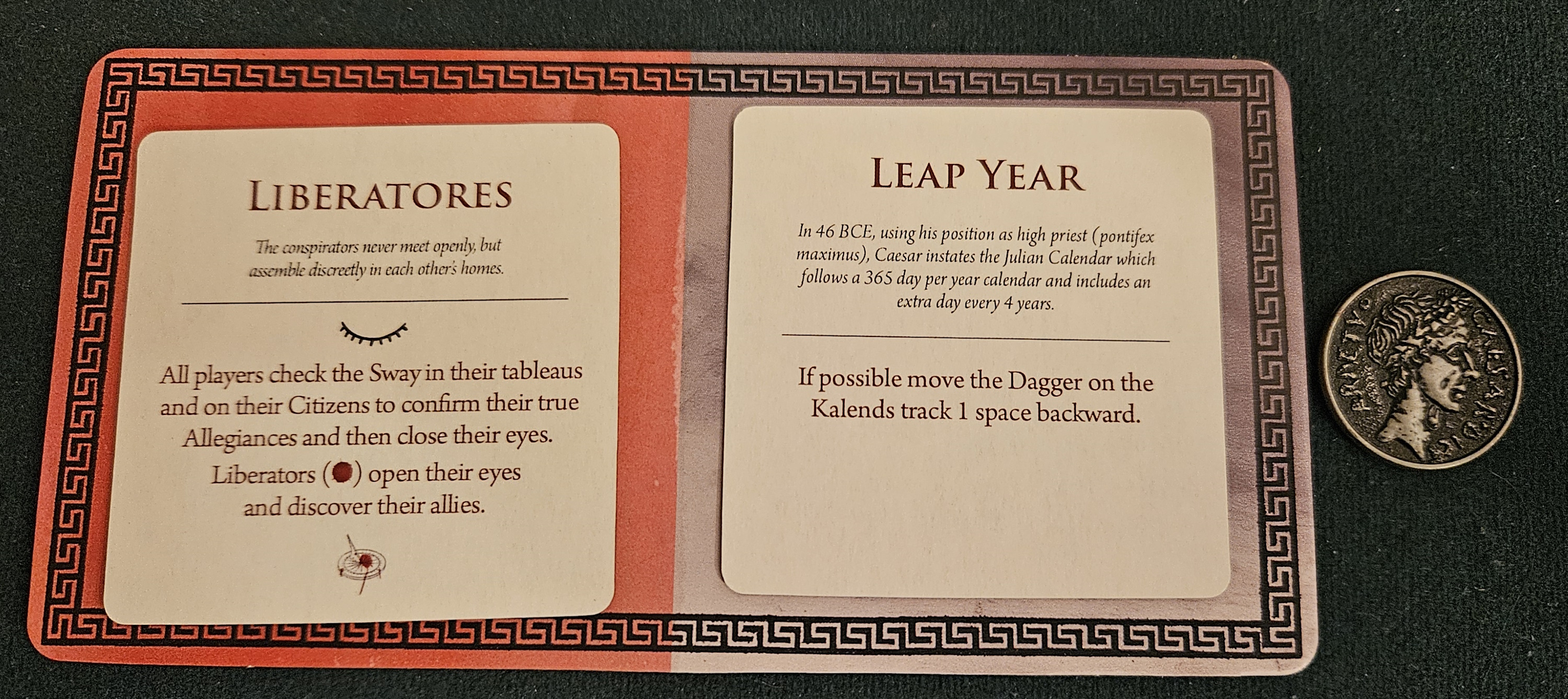
Better cast your vote while you still have the chance.
This generates one hell of a fraught social dynamic. While it’s tempting to throw in your lot with the winning side, it’s often safer to either double down on your convictions or stay as politically neutral as possible until the very end. Of course, this is easier said than done. Most turns present the option to influence another player, potentially turning them against their own best interests. In addition to emphasizing social deduction, 23 Knives is about social management.
It calls to mind the stroke of brilliance at the heart of Sean Sweigart’s Homeland, one of the most underappreciated social deduction games of all time. In that game, most players are cast as loyal agents or foreign assets, while a third role, the political opportunist, muddies the waters between the two. 23 Knives takes this concept even further, letting everybody play every role at once, while also shrugging off the certainty of their own alignment — or being unwillingly shorn of it. Rather than portraying its sides as inviolable, here the boundaries are as firm as quicksand. Sometimes, Brown offers events that run everybody through the old script, with everybody shutting their eyes and some players glimpsing their co-conspirators. Except here, after another turn or two around the table, you can’t be sure that everybody from your old cabal will still don the same color of toga when the die is cast.
The result is surely an unusual social deduction game, but it’s also one that produces its own host of emotions. Realizing you’ve been drawn onto the wrong side of history through no fault of your own produces something like panic. Your next few actions will be undertaken in a frenzy: sabotaging your former allies with seeds of discontent, perhaps, or spending extra devotions in the temple to put yourself aright. It’s a stark reminder that player agency isn’t always a virtue, or at least isn’t always limited to the range of actions permitted by your reference card. Here, the agency of your action economy is starkly limited to the locales you visit, the cards you draw, and the honey your fellow players drip in your ears and onto your tableau. But your agency as an actor, to drip honey of your own, to dissemble, to delay, are as strong as ever.

Playing as some nasty Roman bastard or another.
To my mind, this establishes 23 Knives as a strong pretender to the social deduction throne, sitting amid kin such as Blood on the Clocktower despite running at odds with that game’s player-driven improvisation. In some ways, 23 Knives is the more traditional game. There are turns, for one thing, and those turns walk players through phases, and there are resource cards and all that. It is slower, more contemplative, less rowdy.
But these are also the game’s core virtues. As I noted earlier, 23 Knives is as much a social management game as anything else. Rather than placing you on a side, its ongoing machinations make the established factions of other social deduction games feel like the latter half of a story, as though one had walked into a play’s second act. Here, we’re shown both sides of the coin. Those first tentative steps, the hardening into factions, the conspiracy, perhaps even the last-moment heel turn when one’s plans are dashed by political centrists.
In the process, Brown exhibits true craftsmanship. This is the Rome I think about sometimes: petty, self-serving, dynamic, virtuous, broken. It’s a delight when a board game lets me walk a thousand paces in its calcei.
(If what I’m doing at Space-Biff! is valuable to you in some way, please consider dropping by my Patreon campaign or Ko-fi. Right now, supporters can read big stonking essays on the movies and video games I experienced in 2024.)
A complimentary copy of 23 Knives was provided by the designer.
Posted on February 26, 2025, in Board Game and tagged 23 Knives, Board Games, Play to Z Games. Bookmark the permalink. 7 Comments.

 SPACE-BIFF!
Tyler is a good friend of mine which makes me so glad you enjoyed 23 Knives! I’ve played several iterations of the game and each time I played it I could tell it was tightening up. I’m so happy he was able to get it published and out to the world.
Great work as always!
I’m also glad this one is out there!
The Romans loved their little ironies so much they gave their dictator 23 sharpened ones.
Seriously though, thank you for this piece! I’ll have to try this if I get the chance.
I hope you get to give it a try!
NoOoo! *emits sounds of being dagger stabbed*
I was so close to backing this, but didn’t. Backed too many bummers. But this sounds PERFECT! I really hope they have additional copies for purchase.
My understanding is that they will!
Very interesting. “Dictator perpetuus”, si id vobis Planet.