A Visual Tour of ProtoCon

The Wasatch Front hosts an unusual density of board game designers. I don’t know if it’s the culture, the thin air, the altitude, or the arsenic billowing from the withering lakebed of the Great Salt Lake, but there you have it. Beginning in 2019 just in time for ‘rona, a handful of local publishers started an annual convention for board game prototypes. They named their baby ProtoCon, which I believe is short for “Protolithic Confluence.”
Last month, I spent an afternoon at ProtoCon. Hosted in the conference rooms of the architectural marvel that is the West Valley Megaplex, this was an opportunity for dozens of designers and playtesters to show off their games, get feedback, and polish their playthings. Wait, don’t cite that last part.
As ever, I would love to share some of the best sights, sounds, and scents of the convention. Take my hand as I lead you on a visual tour. No, the other hand.

Traveling through time. (Age of Anomaly)
Upon striding through the sliding doors, my first impressions of ProtoCon are positive. Hundreds of people are in attendance. The air smells of soda fountains. Neat lines of developers have formed to buy popcorn. Belatedly, I realize this is the movie theater. The actual convention is upstairs, through a corporate side door that leads past the office of the property manager. His door is ajar. Our eyes meet. His lip curls. “Nerd,” he hisses as I scuttle up the stairs like an unwieldy lobster.
The actual convention space is smaller, but also far cleaner than the soybean oil-stained floors down below. Attendance hovers somewhere above a hundred — nine or eleven dozen if we want the number to sound impressive — with rows of tables arranged outside the main hall for pickup games. Inside, the atmosphere is bustling, the familiar rumble of games being played, people laughing, the occasional clatter of dice.
The organizers greet me. “I love your work,” one of them says. “You were great in the first season of Barry.” I take their compliments in stride. This isn’t the first time I’ve been mixed up with Hollywood megastar Glenn Fleshler.

Oh no. (Unprecedented Times)
But I’m not here to have my ego stroked. I’m here to play board games. Protolithic board games.
My arrival has landed in the middle of a scheduled block of demos. Every chair at every table is full. Exactly as I planned. I plant myself in the corner, waiting for a game to wrap up so I can swoop in at the precise moment the designers are most fatigued from taking feedback. I don’t have to wait long. With the air of a divo whose bowl of Skittles has not had all the reds tweezered out by his flunkies, I flounce into the first open chair. “Tell me about your game,” I command.
The game in question is Age of Anomaly. There are two hosts, the designer and his buddy. The topic is time travel. Some catastrophe will befall Earth in the future, so the game’s factions are traveling both forward and backward along the timeline, gathering the necessary resources to survive, but also dodging meteors and battling over limited doodads. The visuals are crisp and legible. I can tell what’s going on, which is more than I can say for most board games that have attempted time travel.
“The combat is sort of like Cover Your Assets,” the designer says, sounding almost apologetic. It’s a reminder that these are works in progress, the outlines of gemstones visible beneath rougher edges. But that’s the point. For every designer, a host of playtesters is also in attendance. They’re here to give encouragement, but also break bones. It’s a difficult but necessary process, and there are as many open notebooks on the tables as there are boards.

Oh yes. (Before the Mast)
My next hour is spent observing. I have a talent for standing over people’s shoulders, hovering until they give me that glancing smile that is also a polite way of asking me to unblock their sunlight. It’s an instructive ritual, seeing these games in action without plunging into the experience myself.
There’s Unprecedented Times, a satirical take on the coronavirus pandemic. “If you can’t laugh, what else have you got?” one of the designers says, perhaps noting my discomfort. They’ve set up a poster board reminiscent of a middle school science project to show off the game’s cutesy artwork. The prospect of a “Marauding Karens” card wrings out a chuckle, while “Adopt a Puppy” feels eerily redolent of the pets we contemplated picking up throughout 2020. I don’t ask if there’s a sourdough card. The memories of my failed starter are too painful.
At the next table, my childhood infatuation with Horatio Hornblower leaves me awestruck at the look of Before the Mast. The ship is detailed, with pawns hunched belowdecks and clambering along the rigging. The gameplay looks like a cross between Battlestar Galactica and Stationfall, each player vying for command over individual pawns as they amass gold and influence the captain’s navigational choices. Development will almost certainly benefit this one — the board is cluttered, with peghole trackers and a whole sideboard for oncoming threats — but it’s one of the more tantalizing artifacts on display.
“Yo ho ho,” I say to the designer. “Ha ha,” he replies, good-naturedly. “Yo ho ho,” I repeat. Oh no. I’m stuck. This is now my thing. “Yo ho ho. Yo ho ho.” “Heh,” the designer forces out, visibly uncomfortable. “Yo,” I say. “Ho ho.”

Wait, I’ve seen this before. (Burgle Bros 3: Future Flip)
Certain tables are so crowded that I only get a glimpse. Attendees have been buzzing about 24 Hour Laundry, a game about running a laundromat as a front for your criminal activities. Somewhat less relatable is Road Trip USA, with its detailed map of the United States and an action-selection system that sees you criss-crossing the country by car, plane, or even open freight train. From a distance, I ogle Hi, I’m a Dungeon Trash Disposal, which I glean is about gelatinous cubes chowing down on the refuse left by passing adventurers. Also hopefully the adventurers themselves. Yummy.
Another table hosts a game about arms dealing. Despite the colorful tokens, I don’t catch its name. “Your game looks like it’s about arms dealing,” I say. The designer goes squirrelly and plunges one hand into his coat pocket. “How did you know it’s about arms dealing?” he demands. I politely excuse myself. When I look back, his gaze has followed me to the far end of the hall.
For such a small convention, I’m impressed by the wide array of titles being tested. Burgle Bros 3: Future Flip is pretty much finished, functioning more as a show of publisher solidarity than an actual protolith. Two tables over, Stack City is one of the handsomest games at the con, with its colorful 3D-printed spires and ferris wheels. Across the aisle is a demo of Salt Systems, a game by a teenage designer about salt mining, clearly hand-crafted but already making waves with its clever bidding system.
It’s exciting to think that any of these games might appear on my table a year or two from now. The convention recently launched its Hall of Fame, a way to celebrate those titles that began at ProtoCon and completed their journey to publication. To date there are three inductees: Gold n’ Grog, Gnome Hollow, and Oros — the last of which I reviewed a while back. Here’s proof.

My addiction is GOOD GAMES CRITICISM. (Missionaries)
After lunch at Zupas (3/5★), I tackle a different sort of tabletop experience. The game in question is Missionaries, advertised with a banner that shows a meeple wearing a white shirt, BYU-blue tie, and the black nametag of a Latter-day Saint missionary. My feelings about the LDS Church are complicated and not entirely fond, as I’ve written on multiple occasions, and it takes a few minutes to fire myself up enough to accept a demo.
It’s an instructive experience for a handful of reasons.
The first is a reminder that not every topic can be approached with the same ease. In some ways, playing Missionaries is a nostalgic experience; in others, it’s agitating. Little details, like how the planning cards are watermarked to resemble the “white planners” I used every day for two years, bring back a flood of memories. Meanwhile, the reduction of a person’s faith to an internal seesaw of doubts and persuasions makes me slightly queasy. And where, in the end, are the missionaries? Unlike our investigators, we’re interchangeable. “What about our doubts?” I want to ask.
If anything, the experience makes me grateful for the host of playtesters that appear at every table, happy to lend their unvarnished thoughts. When the designer asks for feedback, I mill around the particulars of the engine-building and so forth. I can’t bring myself to comment on the content itself. Would the designer have even be able to hear me? I’m not so sure. There have been points in my life when I wouldn’t have heard that feedback.
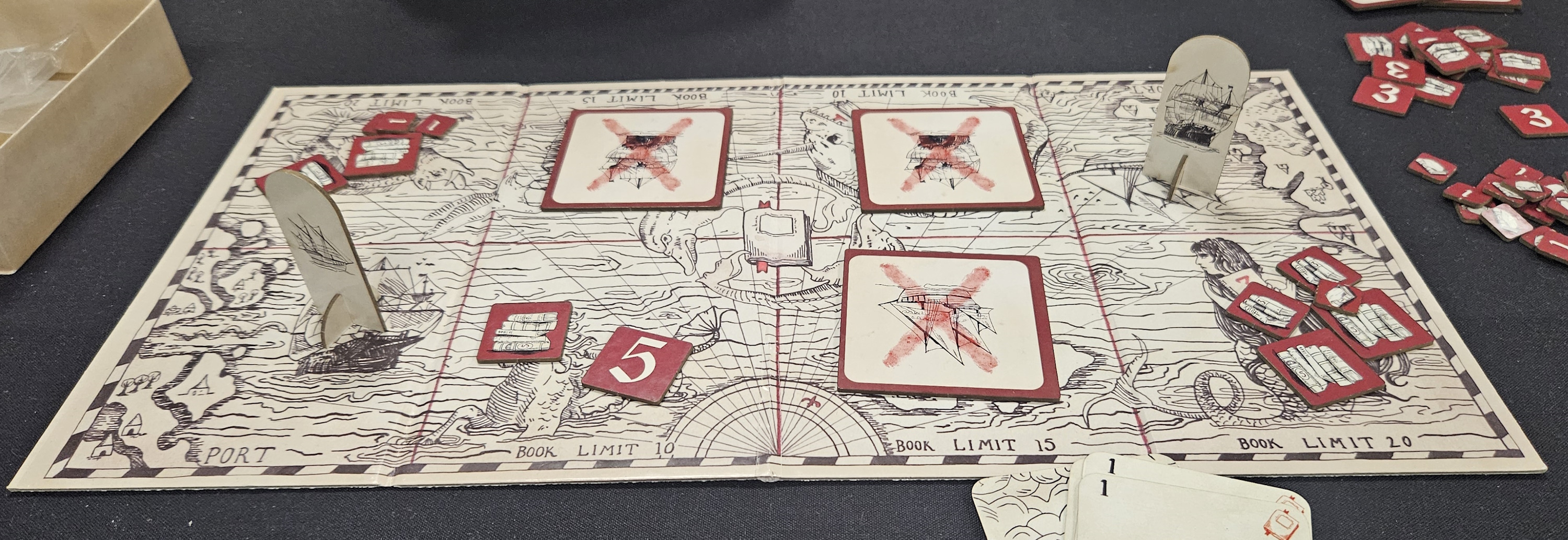
Getting crushed. (Litera-Seas)
Now in a daze, I stumble past a few more tables. A seat is open. I take it and find myself press-ganged into a blind playtest of Litera-Seas. The game is clever and mancala-like, but the player opposite me claims the rulebook for herself and takes us on a whirlwind skim that doesn’t slow my head’s spinning. Our ships circle one another, tossing books overboard. After submerging a particularly large collection in the brine, I look at the designer and ask, “Was that a good move?” She shakes her head the way a parent does when their kid drops out of college.
Fully defeated, I head toward the door, thinking I’ll maybe grab some popcorn on the way out. Instead, a designer waves urgently from across the hall. As I cast about for the intended recipient of his greeting, he waves again. Mouths words at me. Holds up ten fingers.
“I’m sorry, did you say ‘elephant juice’ to me?” I ask upon reaching him.
“No, I said I love you,” he replies. “I adore your work on The Late Late Show. Crosswalk Musicals. Those are the best.”
I draw the line at being confused for James Corden and tell him so. He apologizes profusely, then clarifies that he’s a game designer with a ten-minute dice game on display, and would I like to give it a try?
Very well, I figure. What’s ten more minutes?

Yaaasss. (Unicoin)
Ten minutes later, I’ve played the best game of the entire confluence. Unicoin. Memorize that title.
Unicoin is about getting rid of ten coins. On your turn you’re passed a chest and required to roll the game’s single die at least once, slapping a coin onto the matching number. Unless, that is, you roll a number that’s already be-coined. When that happens, you’re forced to claim every coin that has previously been placed on the chest. Great. Now you have to get rid of thirteen coins.
This is already brilliant stuff, but the game’s creator, Jordan Jensen, doesn’t stop there. One of the die’s faces is a unicorn horn. This lets you slip a coin into the chest, removing it from circulation altogether. At one point, I roll three unicorn horns in a row. The guy next to me insists I must be cheating. I am, but only because I’m on the day’s thirty-ninth loop. Nobody can tell that I’m out here groundhogging it.
The other twist is that being saddled with too many coins at once bestows a bonus. There are heaps of these, letting you double up coins on the chest, pass the entire table’s net worth clockwise, or otherwise tilt the game in your favor. When the game ends, we’re passed slips of paper on which to recommend further unicorn powers. Dizzy with adrenaline, I can’t think of anything. Instead, I sputter my appreciation for this wonderful, simple, sweary game that has saved my Saturday.
This one’s going in the Hall of Fame. Mark my words. I’ve already traveled that loop twice, so I would know.

3D printing sure helps with prototyping. (Stack City)
As I walk out, I’m both relieved and fulfilled. All in all, it was a successful Protolithic Confluence. I saw some promising upcoming titles, ate a salad, slipped on soybean oil on my way down the stairs, and fell in love with a silly game that will hopefully appeal to my five-year-old. With some luck, we’ll still be around in a year for the next one.
(If what I’m doing at Space-Biff! is valuable to you in some way, please consider dropping by my Patreon campaign or Ko-fi. Right now, supporters can read big stonking essays on the movies and video games I experienced in 2024.)
Posted on February 25, 2025, in Board Game, Convention and tagged Board Games, ProtoCon. Bookmark the permalink. 8 Comments.

 SPACE-BIFF!
This is really funny, you’re very gifted at comedic writing too.
Prototype games take a little extra effort to play through; the passion of the people there must have been sky high. We have a local designers meet-up, I went once and it was impressive to see how long they have to work to produce one game.
We have a robust designer’s guild here in SLC, so I understand that some of that energy and support translates over into ProtoCon. I absolutely agree with you — I don’t mind playtesting now and then, but it’s way too exhausting to dedicate much time to!
As someone always pestering people to try my prototypes, where was the convention located? And is it invite only (for the designers) or can anyone sign up? Thanks.
And I thought the critics were too harsh in talking about your performance in Cats
This is located in Salt Lake City. Okay, technically West Valley City, but that’s located in the Salt Lake Valley, which everybody calls Salt Lake City.
And anybody can sign up! Here’s the link to their webpage. They’re already planning for 2026. https://www.protoconutah.com/
(As for Cats, that went toward my community service hours. I am now rehabilitated.)
Fantastic fun! Thank you so much!
Thanks for reading!
stack city is now in kickstarter. would you have backed it?
I’ve been wanting more citybuilder experiences like this one, but i’m a little wary of the paid random card draw that includes negatives. Also a little weirded out by the comments in the kickstarter that seem like a coordinated push
I wish I could have played Stack City — unfortunately, I couldn’t get a demo. I can’t speak to their crowdfunding practices, either.