Catapults, Mostly
Between Tales to Amaze and Return to Dark Tower, I’ve reached the phase of my life where Restoration Games ranks among my most anticipated playthings — not for my own sake, but because I know my ten-year-old is going to gush over each new release. Crossbows & Catapults: Fortress War is a remake of Henri Sala’s 1983 original, minus the decaying rubber bands and plus, well, a whole range of things. Better tempo. Action cards. Special ammunition. Mercenaries.
Look, there’s a critical quandary here, but it isn’t a tough circle to square. At thirty-eight, this isn’t my favored way to pass an hour. For my kiddo, it’s the most revolutionary construct in existence. Take one stab at who wins that tiebreaker.

Take that, me!
It begins with a construction project.
Brace yourself, because I’m going to say some negative things about Crossbows & Catapults, but you really oughtn’t take them as statements on the game’s quality. Take the construction as a first example. Setting up this game is a chore. Starting with your castle gate, you heap those stones together, making sure to include a tiny prison for an enemy warrior, parapets and towers from which to hurl discs, and boundary-defining flags. The pieces are light enough that it’s very nearly a dexterity game, everything hanging together by a thread and a prayer.
I’ve mused in the past over the question of when a game begins, and Crossbows & Catapults is a perfect illustration. Is this mere setup, or are we already playing? Your answer may well determine how the game lands.
In our first session, my daughter crafted a perfect mirror of my castle, which, it so happens, was a perfect reproduction of the castle in the rulebook. Later, she asked if she could do whatever she liked. Within a few constraints, the answer is yes. She learned the hard way to overlap her stones for greater sturdiness, to insert the little shield-pegs at weak points, to not aspire to too much verticality. Minor details, as engineering lessons go, but essentials nonetheless.
Slow essentials, sometimes. Delicate essentials, also. It’s curious how much I prefer to knock things down than build them up.
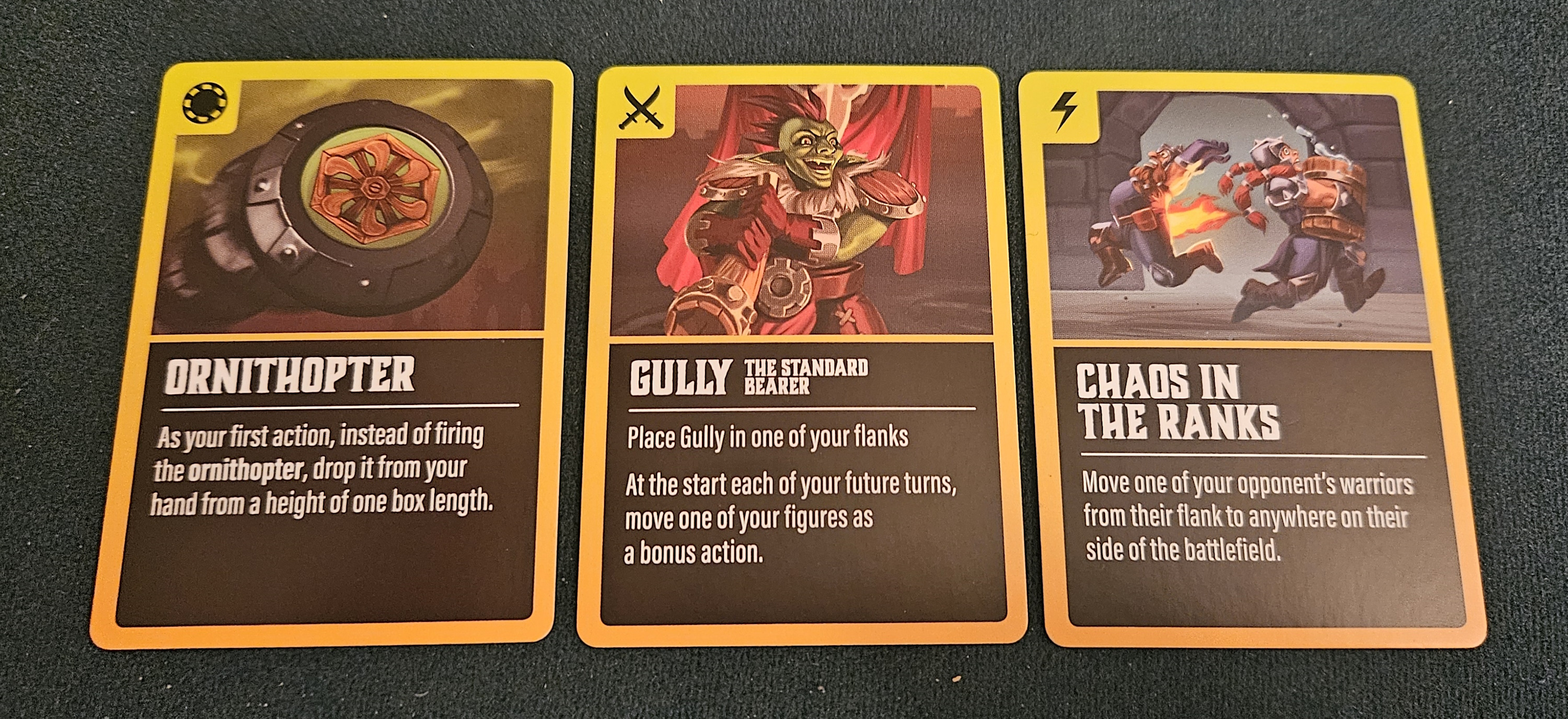
Cards sprinkle special ammunition and units onto the field.
Once raised, the castles must be razed. It would have been easy to envision a version of this game that simply saw sides trading blows. Instead, Daviau and company have designed a card system that, while not especially deep, does ask the player to make tactical choices. You begin by playing a card. The simpler offerings provide an extra action, whether to reposition one of your warriors or fire a weapon from one of their positions.
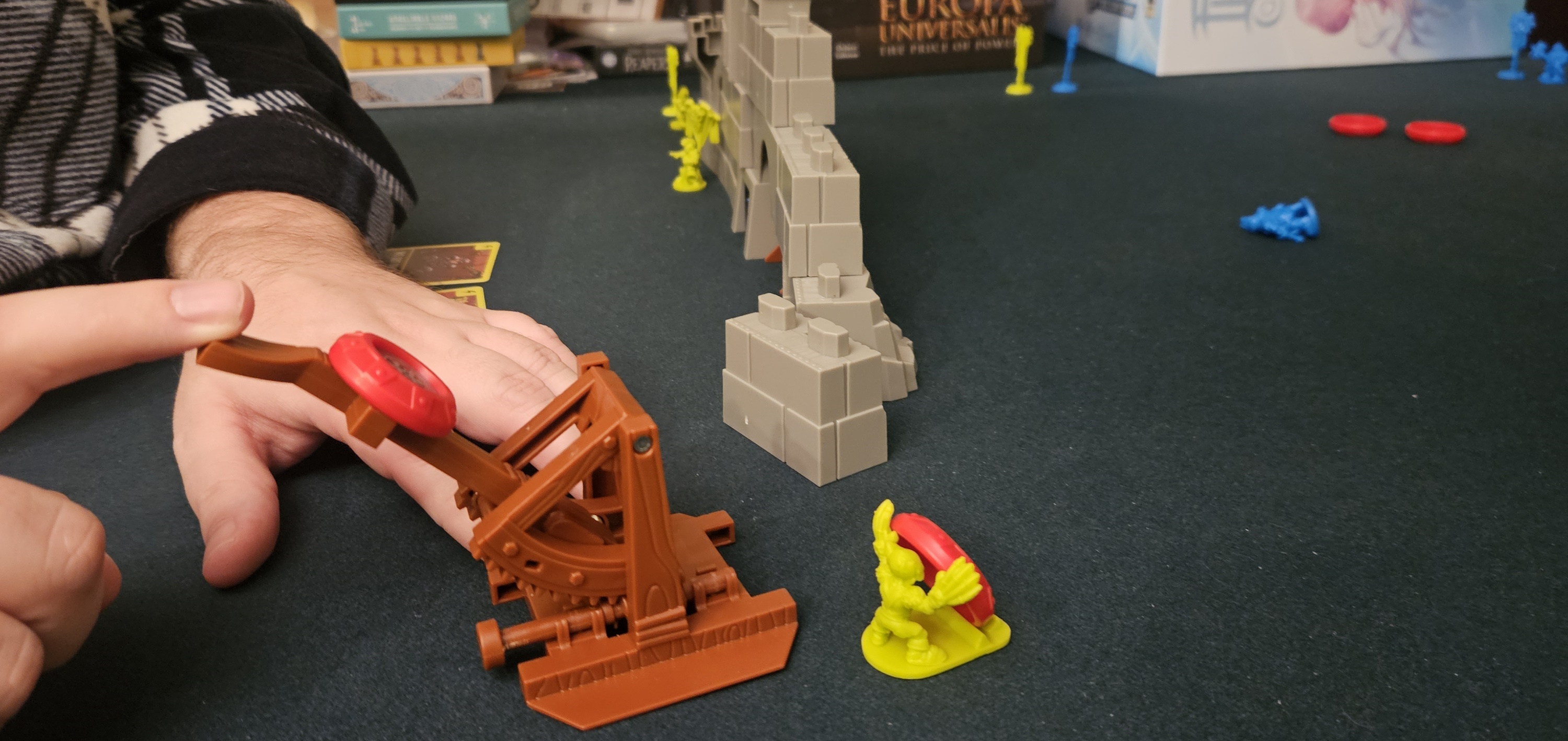
The reason for the lightness of the game’s bricks now becomes evident. Depending on what you’re firing and from where — not to mention some degree of skill — most shots will plink harmlessly off your rival’s bricks. There are two weapons in the main box, plus two more in the weapons cache add-on. The default catapults are marvelous. You hold them in place with one hand and pull back the arm with the other. Even cooler, each one has a leveling screw at its base. Turning the screw sets the angle of the catapult’s trajectory, producing either arcing shots or straight-on assaults which are frankly superior in both control and kinetic energy.
The crossbows, unfortunately, handle with the delicacy of gossamer dragonfly wings. Balancing a disc in their jaws demands precision, asking the holder to squeeze firmly but not so much that they launch their bolt prematurely. Once fired, they lack the oomph of their larger brethren. Perhaps there’s some trick that makes them less persnickety, but neither I nor my daughter have discovered it.
The other weapons… well, close your eyes if the weapons cache is a penny too far, but they’re straight upgrades of both engines in the base box. The trebuchet is a towering monstrosity that can also be adjusted via a screw and propels two discs in a single launch. The ballista is even more potent. It’s precise, easy to use, and slams a disc forward at eye-imperiling velocity. Once my kid figured out that she could demolish my entire castle in short order simply by aiming the ballista at any old corner, no matter how load-bearing, we imposed house rules to limit its use.

The crossbows are flimsy and hard to wield.
The result of these imbalances is that Crossbows & Catapults soon becomes Catapults, Mostly. Sometimes it becomes Catapults & Crossbows When Forced By Action Cards. With the weapons cache, it’s Crossbows & Ballistas & Trebuchets, But Hopefully Not Too Many Ballistas. If you’ve brought a crossbow to a catapult fight, you’re already losing.
More’s the pity, but here’s the thing: during play, we aren’t considering balance. Part of that has to do with the action cards, many of which emphasize the game’s toy appeal. Hurling discs across the table is already a delight, smacking sections of the castle earthward or picking off stragglers on the battlefield. But there are other details to consider. Special ammunition types transform occasional turns into madcap comedy acts. One type can be launched again and again as long as it lands face-up. One time, my daughter fired it eight times in a row, smacking my gatehouse and prison to pieces before it thankfully rolled face-down. Another can be dropped from above the table. I used that one to snipe my kiddo’s general behind her walls. Take that, offspring.
There are also mercenaries. These guys aren’t essential targets, so killing them won’t get you any closer to winning the battle. That doesn’t mean they don’t make a nuisance of themselves. There are standard bearers who confer free movements — a relief, since repositioning troops always feels like a letdown when there are catapults to fire — armorers who provide an extra action per turn, and faction-oriented jerks like Silnak, the goblin who can sneak onto the opposing side of the field, or Ostov, the dwarf who saps one brick from the opposing castle for each turn he goes unmurdered. The game never becomes strategic, exactly, but it’s generous with its toy box. There’s always something new and interesting to play with.
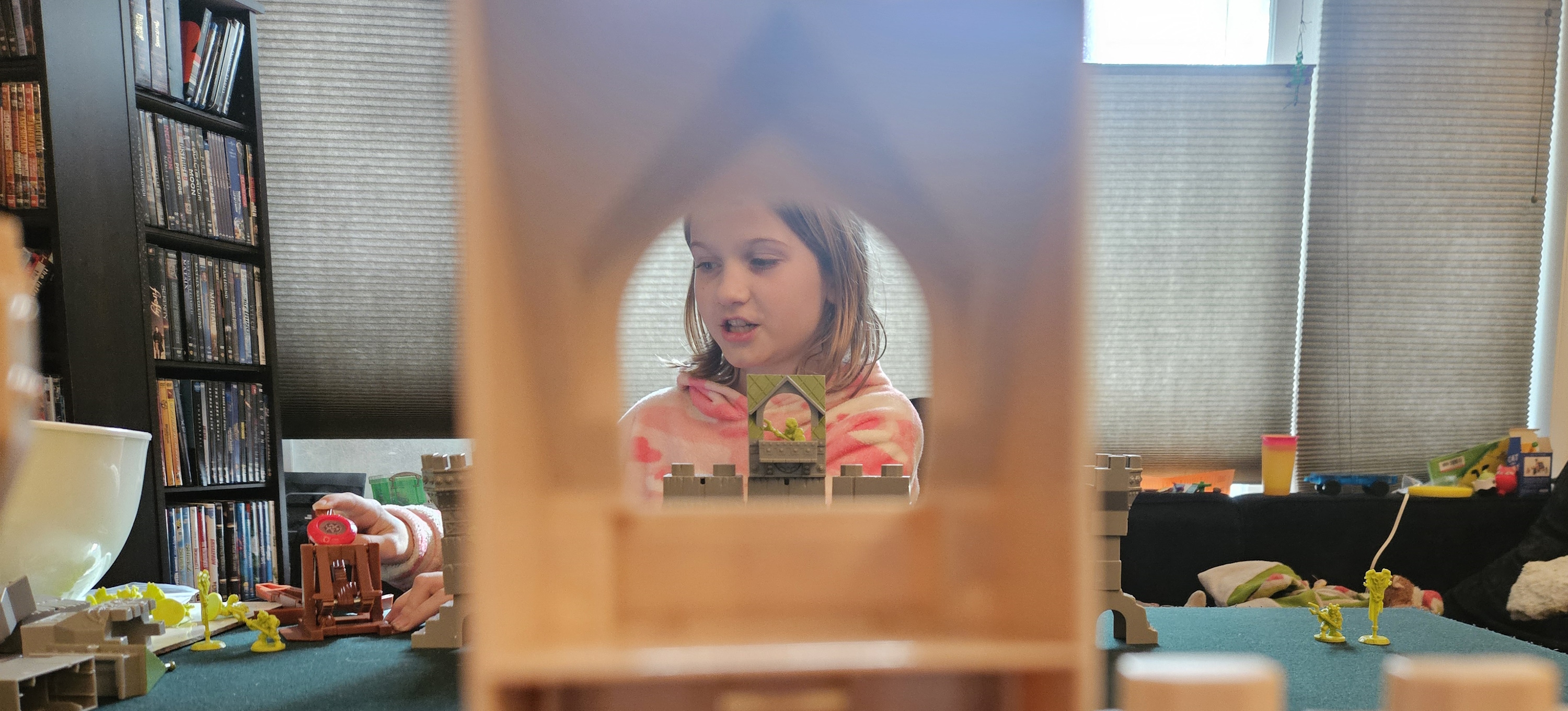
View from balcony, three seconds before being smacked with flying stone.
Play. Improvisational, sometimes directionless, childlike play. That’s the real draw of Crossbows & Catapults. I’ve noted that certain of the game’s ratings express disappointment that the game isn’t more strategic, deeper, that its pieces aren’t chunkier. In other words, that it isn’t more grown-up.
What a relief. Just as it’s easy to imagine a version of this game that had included broader strategic options, it’s easy to comprehend how those same options would have made the whole experience dour and overlong. This isn’t the tactile equivalent of a wargame, just as it isn’t an adult reimagining of something you once saw advertised on the television. It’s a kid’s game, meant to fit into that three- or four-year window where a child can use the game’s tools but before they outgrow its simple pleasures. To truly embrace Crossbows & Catapults, one must either be a child, play with a child, or embrace their inner child.
So, yes, I have complaints, especially when it comes to those twiggish crossbows. But I also can’t help but adore what Rob Daviau and his cohort have accomplished. Many of the designs at Restoration are in fact not restorations but recreations, transpositions of childhood material into a more adult setting. At their best, they can also appeal to children.
When it comes to Crossbows & Catapults, this is perhaps the purest and most honest restoration of the bunch — not only in terms of reproducing the components and heft of the original game, but also in how it captures its mindset and age group. When my ten-year-old slams a pellet into my castle and sends a balcony collapsing onto a guard below, she shouts “NICE!” and does a fist pump like you might see in a commercial from the ’80s. When I launch something in her direction, she ducks behind her castle walls even though the discs pose no threat to her gigantic frame. She screams so loudly that it rouses her younger sister from bedtime. Then she sits on my lap, the younger one, and giggles at the demolition, and commands where and what I shall fire next.
What did engineering ever do for humanity?
In those moments, I could not care one whit that Crossbows & Catapults lacks strategic depth. This is a game for goofballs and children. Thankfully, I have two of the latter to keep my inner goofball alive a little longer. When we wrapped our most recent session, my ten-year-old asked if I was going to give this one away to somebody else.
“Maybe,” I said. “Why? Would you rather we kept it?”
Her eyes glittered. “Just for ten more plays,” she said.
I hope it’s closer to twenty.
(If what I’m doing at Space-Biff! is valuable to you in some way, please consider dropping by my Patreon campaign or Ko-fi.)
A complimentary copy was provided.
Posted on November 18, 2024, in Board Game and tagged Board Games, Crossbows & Catapults, Restoration Games. Bookmark the permalink. 10 Comments.

 SPACE-BIFF!
That little snippet of dialogue at the end. That’s all I needed to know.
(I have no children and no interest in the game, but I still love this article.)
Thanks, JT!
You are a wonderful dad.
I hope my kiddos agree with you.
+1 for the Sid Meier’s Alpha Centauri reference at the end 🙂 Thank you for the wonderful reviews.
I used to think I was a Godwinite, then an adherent of the University of Planet. But when you get right down to it, I think I might be a mind worm.
Hah! I’ve had the opposite journey. Used to be University all the way; but the more I see of the world and its innovators, the more sense Godwinson makes to me. We must dissent.
Being a mind worm seems a pretty sweet gig, though.
I wonder: What kind of board games would creatures with psychic abilities enjoy? A higher level of luck/chance, perhaps? Or probably something from Hollandspiele.
Entanglement!
Awwwwwwwwwwwwww
The trick to the crossbow is to hold the disk in place by pressing one finger on top of it. This allows you to squeeze the crossbow tighter. Simply lift the finger off the disc, and it flies and can do some serious damage. Took me about 5 or 6 games, played with my grandson, to figure this out. I too, had the original and loved to play with my brother. It doesn’t hold the excitement it used to but I rarely turn down a challenge from the little guy.