Pariahs Non Grata

It’s been a hot minute since we covered a title from John Clowdus, creator of Omen: A Reign of War, An Empty Throne, that historical trilogy from a couple years back, and so many others that listing them all would quickly make this sentence tiresome. Here’s the short version: almost nobody has been creating small-format games for as long or with such consistently impressive results as Clowdus.
His most recent game, Pariahs, is a perfect example. Set in an evocative pocket universe where future humans live in capsules and only occasionally grant permission for select members to carve their own path, Pariahs riffs on familiar ideas while being entirely unlike anything else out there. It’s small, it’s weird, it’s fantastic.
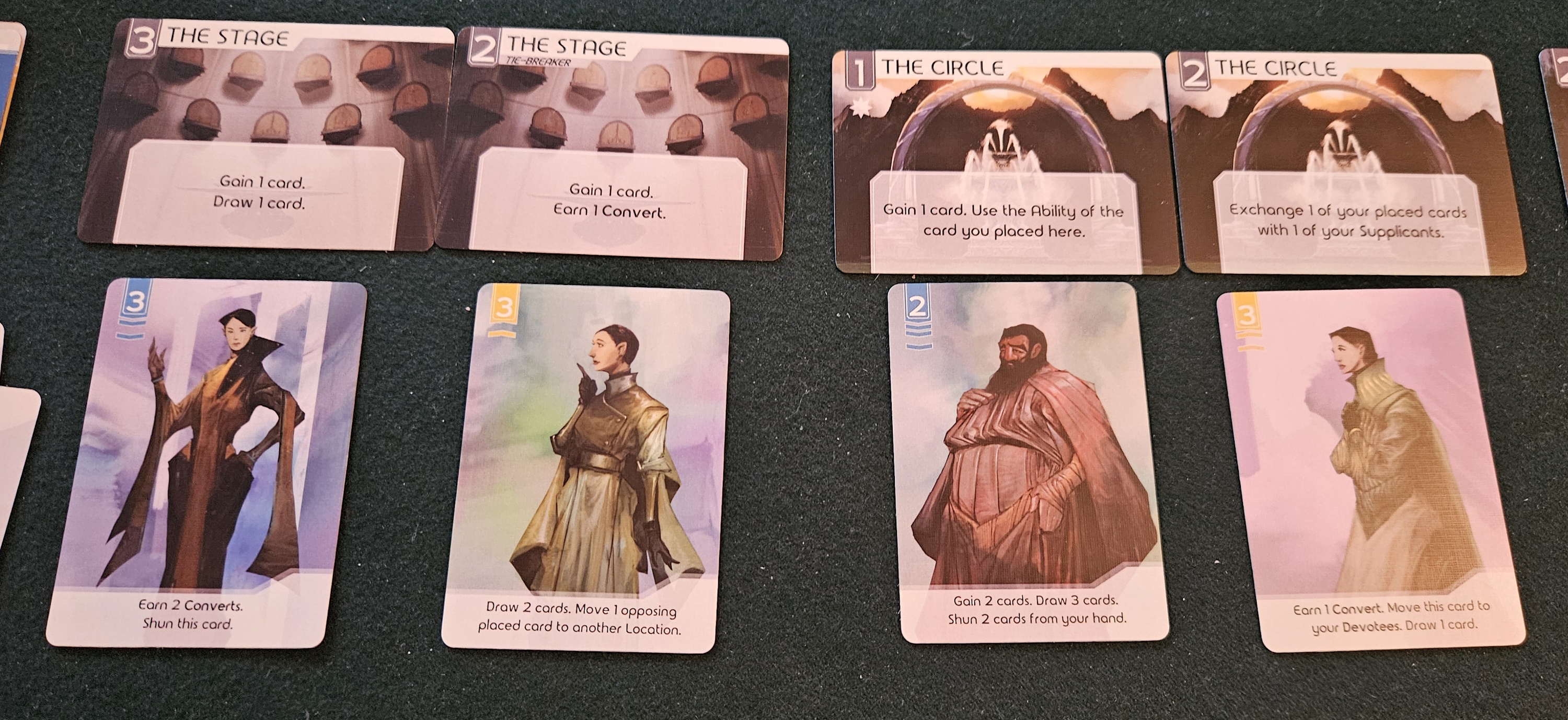
“Kick us out! I dare you!”
Like a handful of Clowdus’s games, Pariahs presents itself as a lane-battler. Both players are presented with a row of locations that they will grapple for control over.
But it’s more than that. The lanes, for one thing, don’t operate quite the way one might expect from Omen. Or, crud, from most other lane-battlers like Air, Land, & Sea, Riftforce, or Marvel Snap. Players contest control and build up their strength in more or less the usual fashion, but these locations function more like worker-placement slots than anything else. Each location is split into two halves, both of which have their own ability and strength modifier. But you can only deploy one card into each location. This keeps that location’s other half open for your opponent. So there’s an element of area denial at play, with both players constantly jostling to secure their desired locales and prevent their rival from laying claim to slots that might confer some advantage.
Except the cards excel at shifting things around. This is also a deck-builder, albeit, in fine Clowdus form, a rather non-traditional deck-builder. As the game progresses, your deck gradually takes shape thanks to — well, thanks to a lot of things. You can recruit supplicants, the game’s fancy word for the market, to pad your future selection. You can also “shun” cards to drop them back to the bottom of your supplicant deck, thus taking them out of regular circulation. Meanwhile, some of your cards will become devotees, moved off to the side to produce the game’s equivalent of victory points, while cards can also be peeled off your rival’s deck to become converts, also for points.
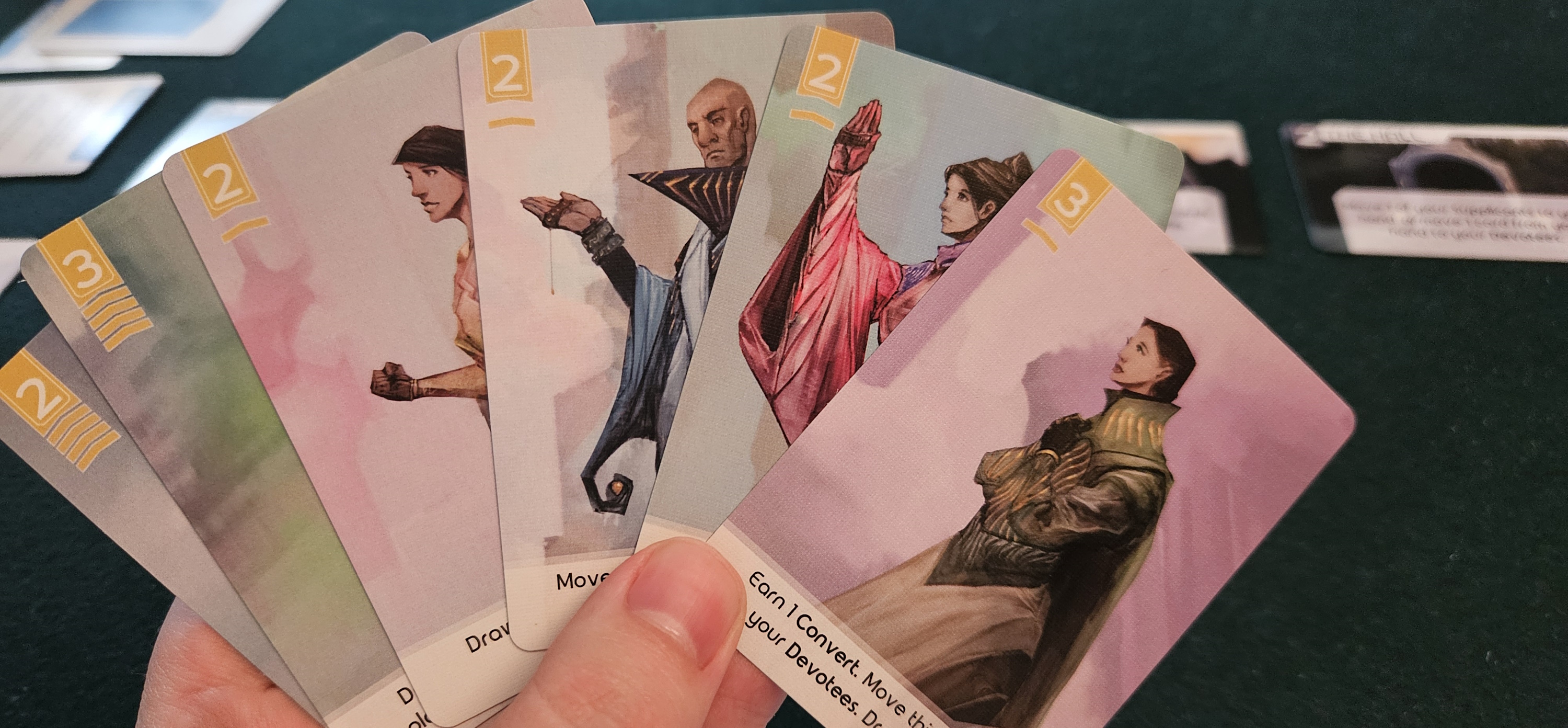
Check out that drip.
It sounds like a lot, but as is customary for Clowdus’s designs it all comes together like the belts and pins of a well-oiled engine. The right card can shift an opposing card out of the way, turning an early bid for position into a judo-style reversal of momentum, or claim extra devotees and supplicants, or simply draw a bunch of cards to ensure you have the right stuff in hand for your next play.
In many cases, churning your deck is sexier than in other deck-builders, if only because you’re always on the lookout for the proper ranks. In addition to its strength, every card comes with one of these ranks, a number of pips in its top-left corner. (In one of the game’s few overt flaws, it’s somewhat difficult to tell the difference between the one-pip and two-pip cards, but now I digress.) These are useful for a few reasons, but the gist is that you’re trying to send matching ranks to your devotees pile but unique ranks out to the lanes. In both cases, the reward for properly juggling your cards is an extra point. And, given that a winning spread is often something like fifteen to twelve, those extra one or two points can provide quite an edge.
This isn’t the first time we’ve seen Clowdus ask players to wrestle against their own card placements as vigorously as they wrestle against their opponents. If anything, that’s been a hallmark of his designs for as long as he’s been creating the things. This time, though, the scales tip slightly in the other direction. There’s still some bite to the card effects here, but direct aggression has been traded for a more measured contest. Your rival can move your cards, but deleting them outright is beyond the game’s scope. As befits the game’s notional conflict, a clash of debates and underhanded compliments more than, say, a bunch of demigods pillaging Hellenic city-states, most of your interactions are indirect and snitty.
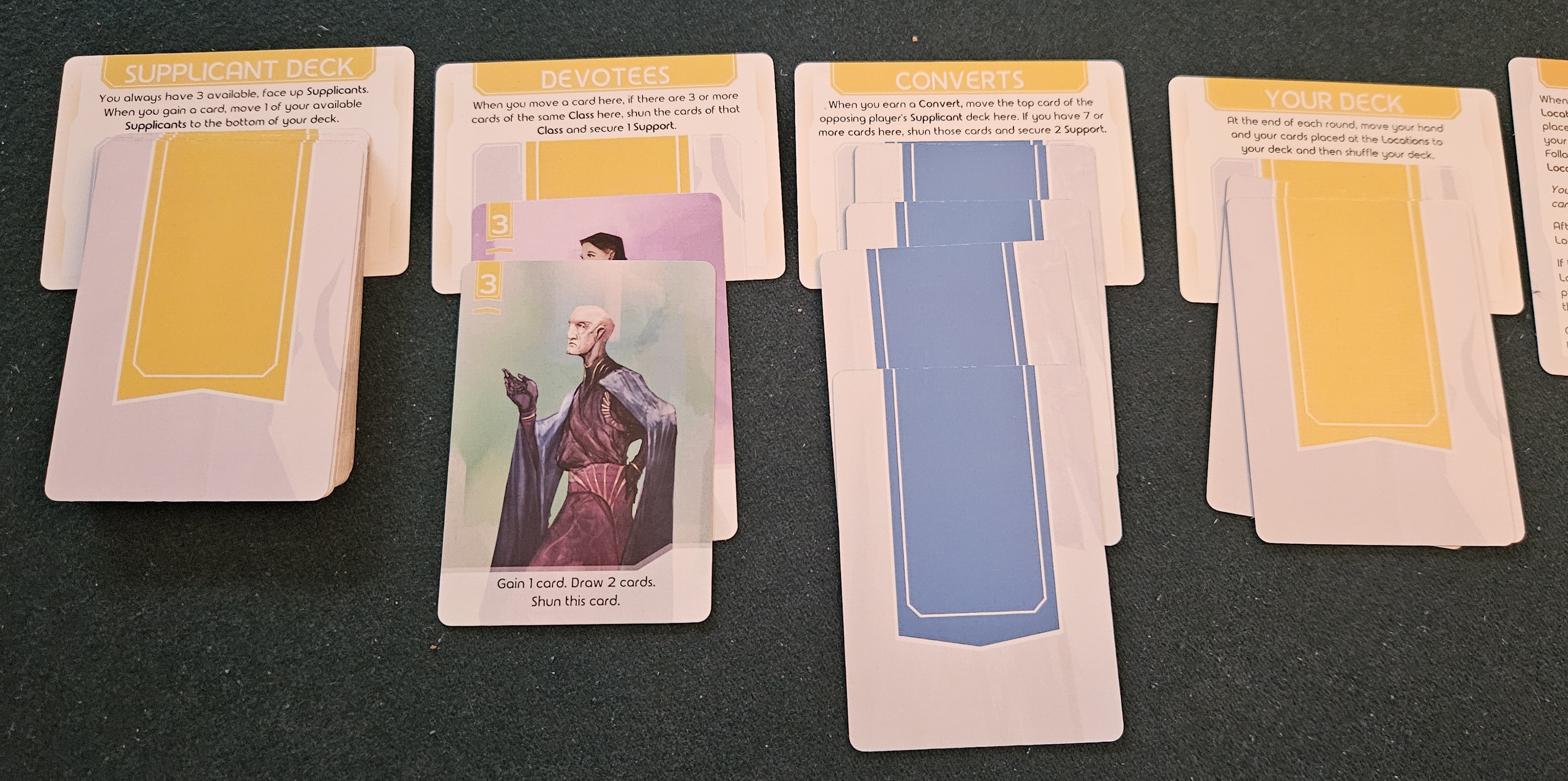
Devotees and converts offer alternate approaches to earning support.
Don’t get me wrong, Pariahs is still unmistakably a Small Box Game. It’s just that it falls into Clowdus’s subtler oeuvre. You’re maneuvering, not crunching the rim of a shield into your partner’s face.
Here’s an example of the sort of decision on offer. The entire thing is structured across six rounds. To keep track of which round you’re on, the game uses a set of six cards, three from each player, drawn at random from your starting decks. When a round opens, you pull one of these cards from the initiative deck. That card’s owner then makes a choice. They can either shun it, sending it to the bottom of their supplicant deck and likely losing access to it forever, in order to take the first turn. Or they can draw it into their hand but let their opponent go first.
It might not sound like much, but as initiative systems go, there aren’t many out there as clever. It’s fair — both players get three chances to determine the play order. But it also puts the burden of fairness on the players rather than the system. If you want to go first, you’ll sacrifice a useful card. If you want the card, you’ll sacrifice tempo.
At the same time, going first isn’t always a boon. See, for instance, the abilities that can shift a previously-placed card’s position. But tempo is king and a round can end before one player has filled up their half of the locations. With so few ways to earn points it behooves you to chase every opportunity, but what happens when some opportunities preclude others? Choices, choices, and none of them easy.
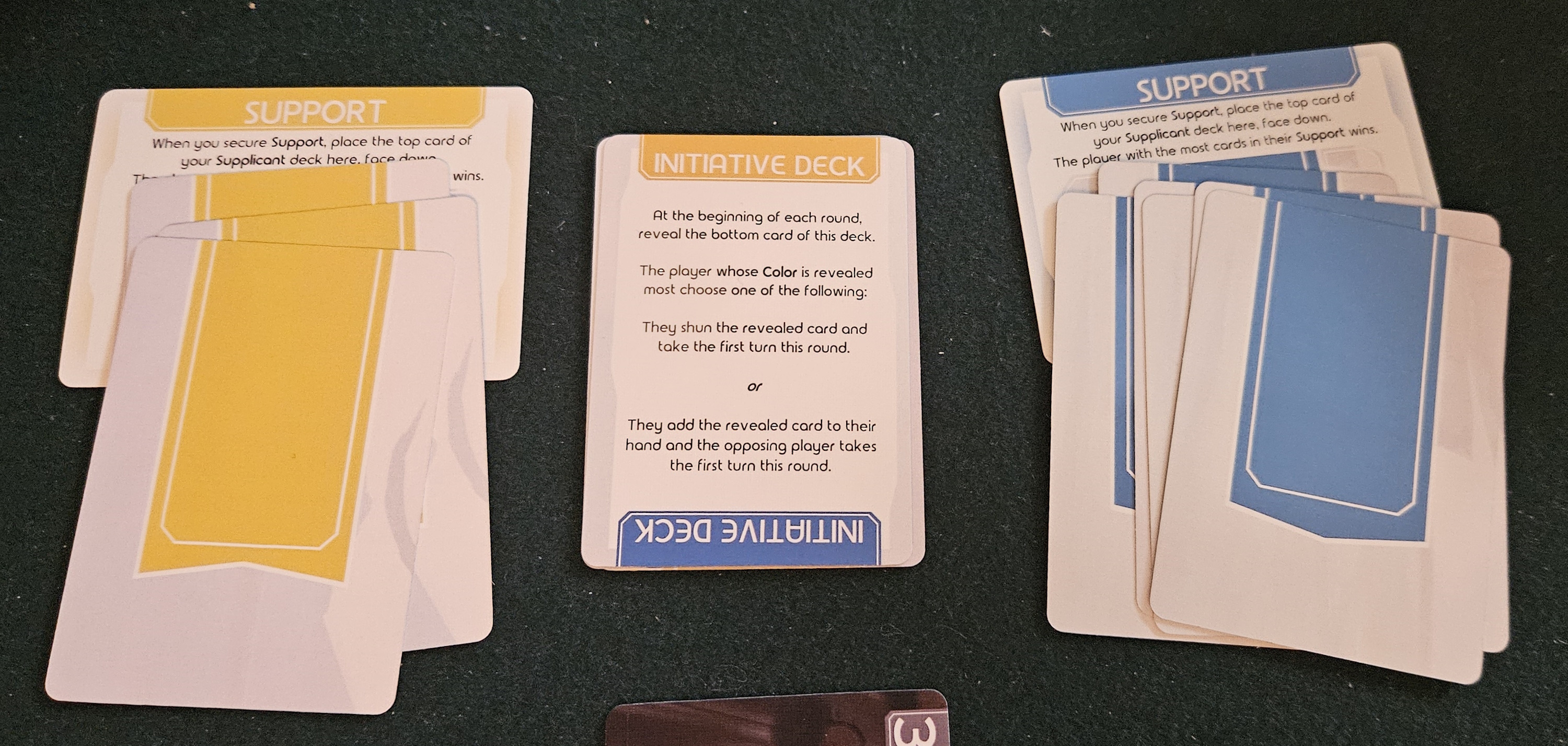
The scoring is nicely unburdened. Support: that’s it.
I’ve said before that there are a few designers whose work feels like a gift from some dimension where board games developed along a parallel but alien track. John Clowdus is one such designer. Even when I don’t love one of his games, I’m glad to have experienced it, if only for a glimpse into what’s possible when a designer rejects traditional wisdom.
Pariahs is one such game. Apart from me loving it, that is. This is Clowdus at peak form, a diminutive mishmash of an evocative setting, familiar mechanisms bent into strange shapes, and gameplay that emphasizes the joys of feeling, placing, and manipulating cards. Time to leave the capsule.
Pariahs is on Kickstarter right this very moment. It will be there for a little less than a week, so hustle up if you’re interested in nabbing a copy.
(If what I’m doing at Space-Biff! is valuable to you in some way, please consider dropping by my Patreon campaign or Ko-fi.)
A complimentary copy was provided.
Posted on September 13, 2024, in Board Game and tagged Board Games, John Clowdus, Pariahs, Small Box Games. Bookmark the permalink. 12 Comments.

 SPACE-BIFF!
Dan, Would you willing to do a bit more comparison with Omen?
Sure. The quick and dirty comparison is that there really isn’t much comparison apart from a few superficial details. This also feels like a lane battler, but isn’t quite (it’s more of a worker placement game). There’s no card drafting; you have your own deck, which you build from your own pool of cards. You earn points from a variety of sources — controlling the row in the middle, but also from earning devotees and converts, putting the right ranks in the middle, and tallying up your cards at the end of the game.
In short, it may look similar and have a few minor parallels, but it really is an entirely different game, with its own strategies and feel.
Thanks! Does it rank as 10/10 like Omen does for you on BGG?
So… I never recommend that anybody take my ratings all that seriously. They run on vibes, not any objective system of organization. One 7 isn’t the same as another 7, for example.
But I will say that I currently have Pariahs rated an 8. It doesn’t have the storied history (or dozen editions!) of Omen, so it wouldn’t be a fair comparison anyway.
Thanks Mr. Biff, backed. I love how he uses Kickstarter for how it should be used – short, inexpensive campaigns, made domestically, and with delivery planned for this November too
Agreed. I like seeing independent creators using crowdfunding to produce projects they wouldn’t be able to afford otherwise.
“I’ve said before that there are a few designers whose work feels like a gift from some dimension where board games developed along a parallel but alien track. “
That really hits the nail on the head – playing Clowdus’s games is like exploring an island ecosystem, where an unexpected subset of previously familiar fauna have exploded into entirely new and fascinating niches. (now that I write it out, it’s funny he designed a game about the Galapagos…)
Haha, too true. Turns out that Galapagos was Clowdus’s most autobiographical game.
Neat! The best thing about seeing a new Clowdus’ game is waiting for an article about it to appear here. I find it really weird that his work doesn’t get more attention. Even without taking his authorship into account, he’s got a real thing for finding artists which style look fresh.
As a european, I’m really grateful to John for having a PnP option (and, honestly, I think it should be higher!)
I’ve told John multiple times that he under-prices his games. Not because I want people to pay more, really, but because I want his game design work to be sustainable!
I would love for John to make more money making games. For all the labour he puts into them, and for their quality, he deserves it.
Pingback: Atlas Boogied | SPACE-BIFF!