Float or Flounder
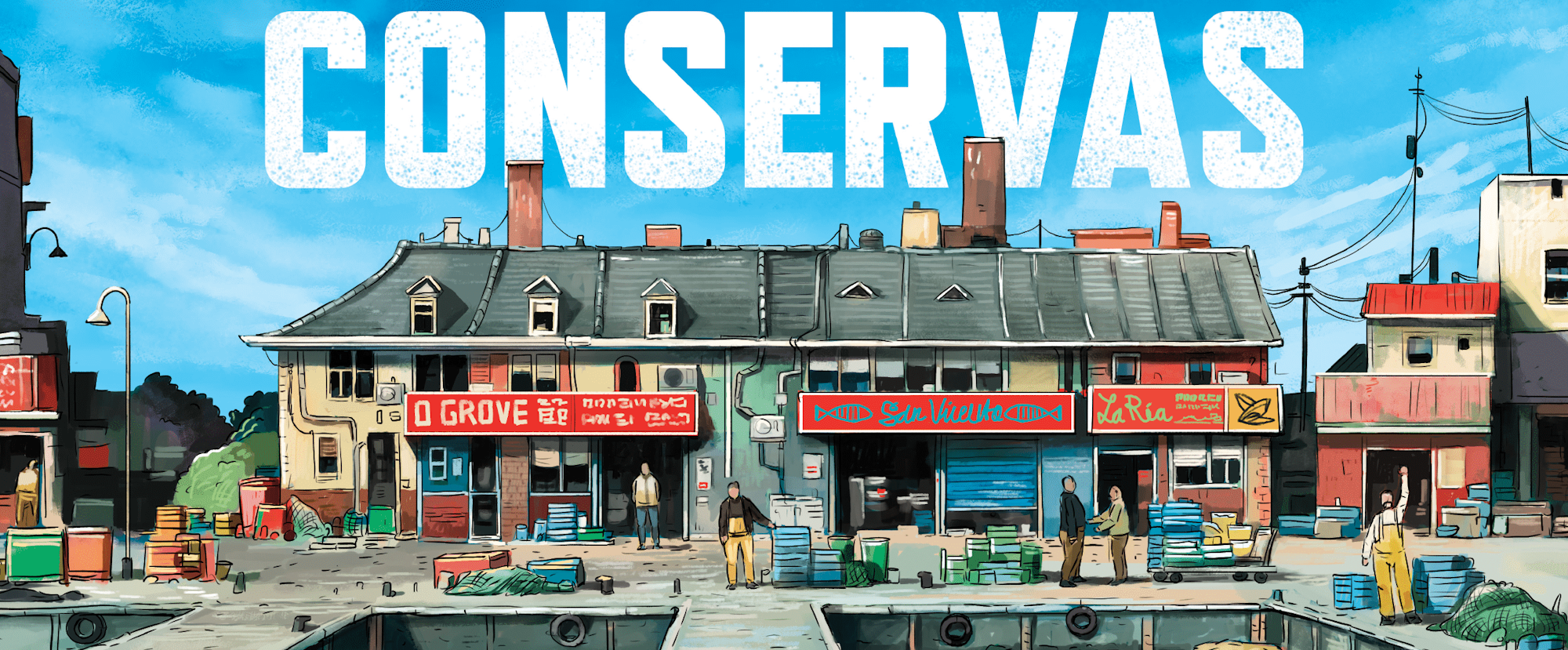
Tinned fish! Potted pulpo! I know so little about conservas that I can’t tell whether it’s a staple or a delicacy. In Scott Almes’ hands, it’s more of a double-edged pun, both a commercial enterprise and a matter of survival. In this solitaire game, you take on the role of a tinning factory. Your goal is to land and sell conservas — but not so much that you overfish the sea and leave yourself unable to operate next season. As such, there’s a delicate balance to be struck between your needs right now and the promise that tomorrow can be just as rich as today.

Filling my boats with yummy treats.
It’s no secret that I’m a sucker for games that tightly knit topic to gameplay. Maybe that’s why I’ve been having such a whale of a time with Conservas.
At a purely mechanical level, it’s all about pulling discs from a bag. When the game opens, you have one boat plus a single open water card. Over time, your fleet will grow to contain additional vessels, each with its own capacity. To bring home your catch, you pull five discs from the bag. These are divided into various hauls: mussels and scallops, sardines and octopuses, plus more than a few representing empty nets.
This sounds chancy — it is chancy — but Almes anchors each pull around a series of seemingly small but crucial decisions. Which boat to assign a pull to, for instance. Because each boat can only lift so many fish from the sea, there’s a tremendous distinction between a boat that can carry one token back to the factory or three tokens. Every so often there’s an outlier, a vessel that can carry four or even the full catch of five tokens. And then there’s the open water card. One of your pulls must be assigned here. Early on, it’s easy to think of this as the bag-building equivalent of a reroll. Drew a bunch of water tokens? Toss ’em back to the sea.
But the open sea card isn’t only a chance to pull again. It’s also the root of the game’s motif of conservation. After all the usual stuff — canning and selling conservas for profit, outfitting new vessels, paying upkeep, selecting upgrades — the chores that countless board games have tasked us with in the past — Conservas does something different. You count up the fish you left in the sea, both on that open water card and under the hulls of your ships, and you add new tokens to the bag based on that count. These are the fish whose reproduction has gone uninterrupted. You threw them back or steered clear of their waters during spawning season. Now their generations will keep the sea bounteous in the turns to come.

I’m cheating right now, but the bag’s lightness lends itself to the occasional peek.
It’s a smart move, and Almes links it to pretty much every corner of his design. Your long-term objective, for example, rarely focuses solely on cash. As a businessperson, you’re here to make money. But sessions also conclude with a tally of what remains in the bag. If a sustainable population hasn’t survived the season, then you lose as surely as if you hadn’t outfitted the proper boats. In one of the tougher scenarios, you even need to ensure those fish hit a specific target, neither too populous nor too dwindled, lest one overtake the other.
As a knock-on effect, the bag becomes as deep and unfathomable as the sea it represents. Plenty of bag-builders include sensible prohibitions against examining the contents of their pouches. In Conservas, where your bag represents the denizens of the deep rather than, say, the composition of an army of questionable sanity or your superhero’s remaining stamina, it makes sense that you wouldn’t quite know what’s lurking under the surface. You can guess, of course. If you really wanted to, I suppose you could count the remaining tokens in the supply. But if that’s how you want to play it, you might as well cheat and just look in the bag. In one of the game’s few production flaws, the bag is a translucent white, which makes incidental cheating almost inevitable. Look, the game facilitates those peeks!
But it shouldn’t come as a surprise that Conservas works best when you aren’t sure whether you’ve met your conservation goals or not. Played this way, the game requires constant guesswork. Have you brought home enough to keep your company afloat? Or so much that this season’s mussels won’t repopulate themselves?
With experience, you might even bring home some fish that won’t make much on the market to winnow the bag’s contents for later outings. It helps that each of the game’s twelve scenarios present different marketplace considerations. Most seasons offer straightforward objectives. Sell fish for money! Others complicate matters. Now you need to sell certain combinations of fish, or finish an entire column before moving onto other contracts, or play an adjacency-based minigame. Without major alterations to the rules, each scenario keeps it fresh.
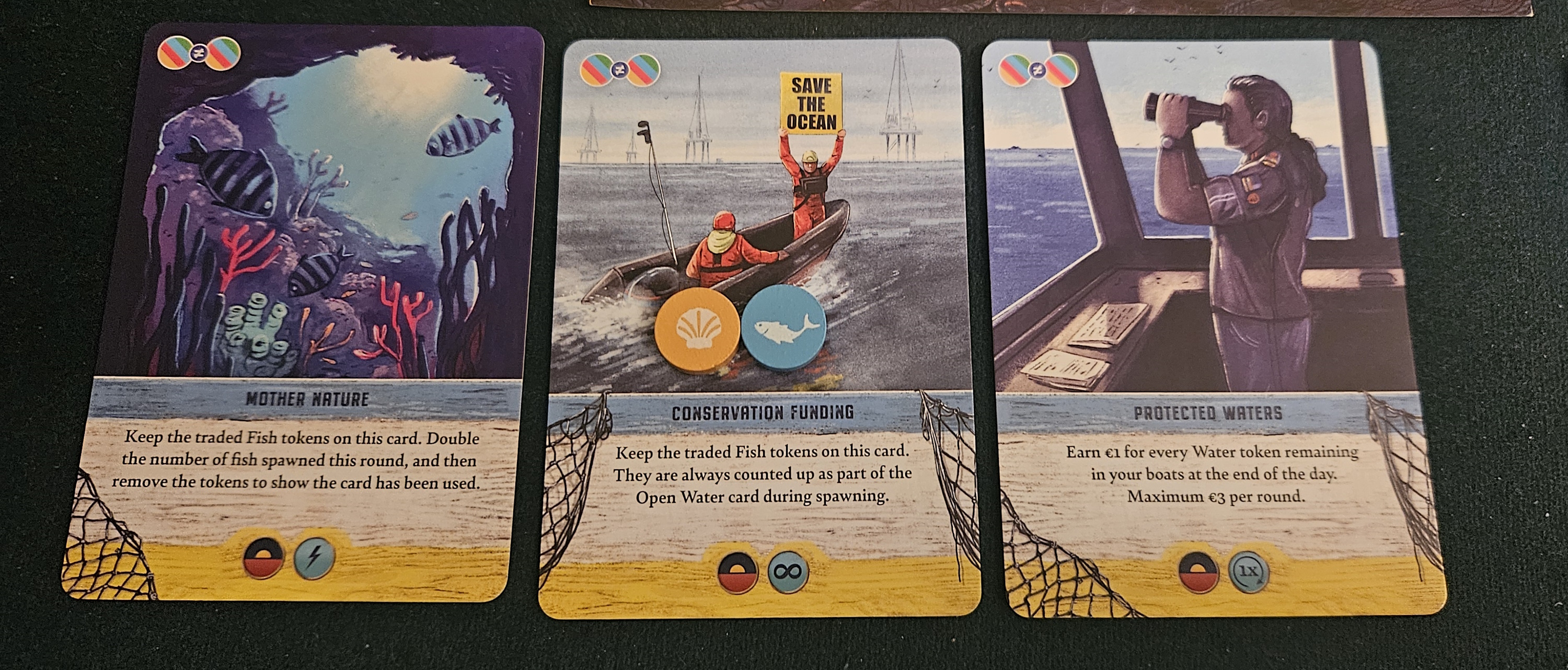
Getting the right upgrades puts you on the fast track to success.
Which isn’t to say this conservas doesn’t occasionally smell fishy. Its biggest limitation comes in the form of upgrade cards. These can be purchased with fish. This forgoes any money you would have earned by selling them on the market, but confers the upgrade’s ability.
Their utility varies wildly, with some being more or less worthwhile depending on the scenario. If you’re strapped for cash, certain moneymakers can stretch your euros. Protected Waters pays out a subsidy for bringing home blank tokens on your ships, the Maintenance Shed decreases the upkeep of your boats, and New Recipes lets you sell the same old fish for extra fishbux. On the flipside, Conservation Funding adds extra fish to your spawning tally, Mother Nature doubles a single round’s spawn rate, and Size Limits — my personal favorite — throws extra fish into the bag whenever you draw three matching tokens.
While plenty of upgrades are valuable, others are more spurious. This isn’t a problem, per se. If anything, I appreciate the variety, not to mention the challenge of meeting a scenario’s goals with mismatched tools. But this disparity often results in sessions that are neither challenging nor rewarding. In most cases, I can tell within two rounds whether I’m going to succeed or not. Either a few early missteps take too many fish out of circulation or result in too thin a payday, at which point I’m guaranteed to wither on the kelp vine, or else things go so swimmingly that I blow past both the scenario’s standard and advanced objectives with ease.
This doesn’t always occur, mind you. Sometimes Conservas provides a wonderful conundrum. All too often, though, it’s float or flounder, with very little room to tread water until washing ashore.

Oh hey, it’s September right now. What a curious coincidence.
Despite some unevenness, Conservas is probably the strongest title I’ve played from Almes. Even when a scenario doesn’t achieve that goldilocks difficulty rating, this is a game that delights in the process of filling and emptying its bag, flipping and shifting cards, accruing and spending tokens. In that sense, it provides exactly what I want from a certain brand of solitaire game: a tight twenty minutes filled with constant decisions, tactile gameplay, and nary a trip to the rulebook.
(If what I’m doing at Space-Biff! is valuable to you in some way, please consider dropping by my Patreon campaign or Ko-fi.)
A complimentary copy was provided.
Posted on September 4, 2024, in Board Game and tagged Alone Time, Board Games, Conservas, Salt & Pepper Games. Bookmark the permalink. 4 Comments.

 SPACE-BIFF!
Almes iis the second designer I realized I just don’t gel with. Maybe he and I think too similarly or maybe too differently, but in game after game of his I felt the true meaning of “mechanical”. Your review has me intrigued though. It doesn’t sound like it will turn me around on Almes’s designs, but it might at least make me look twice.
The first designer was Faidutti. I think he gets very different things out of games than I do.
It happens! I feel similarly about most of Faidutti’s games, for what it’s worth.
A game I bought just because it is set here in Galicia, Spain, where I live. Well, not exactly, I live inland, but O Grove is here in the coast and yea, we have a lot of fishing and canning. I’d say more staple than delicatessen, although some are stuff that you reserve for some event, but doesnt have to be a big event.
And I’m still to play it, because… dunno, I’ve been postponing testing for some reasons or another. Maybe… because I dont eat any of that? 😛 Half my allergies and half me being a picky eater. Should test it now and see if I agree with you!
If you give it a try, I’d love to hear what you think!