Understanding the Obsession

The first and only time I had played Dan Hallagan’s Obsession was shortly after its release in 2018. At the time, I regarded it warily. The Eurogame model has produced a net positive for board games as a whole, but like all genres it comes with its own inbuilt limitations, and Obsession struck me as overly shackled by the model’s conventions. Specifically, that Eurogame tendency to flatten everything to a grocery list of scoring categories and an airiness in what we label “theme,” a quirk of wording unfortunately particular to our medium that betrays a suspicion that board games are closer to amusement parks than novels. Like many Eurogames, Obsession seemed to excel at setting while missing what would constitute thematic import in any other medium. Full of “theme,” low on theme.
But Obsession endured. Oh, how it endured. On BoardGameGeek, it’s currently rated as the sixtieth best board game of all time. Thirteen thousand people have rated it. A steady schedule of expansions have rounded out the experience, including a few that have taken direct stabs at some of my original nitpicks with the design.
More than that, a fellow scholar insisted that it deserved another look. In both of our fields — him as a literature guy, me as a historian — there’s a concept called reception theory, a method for investigating a work of art on the basis of its interaction with audiences over time, as opposed to focusing on authorial intent or critical reading. So I took a step back. Why was this game so popular? How was it speaking to people? I agreed to try to understand the obsession with Obsession.
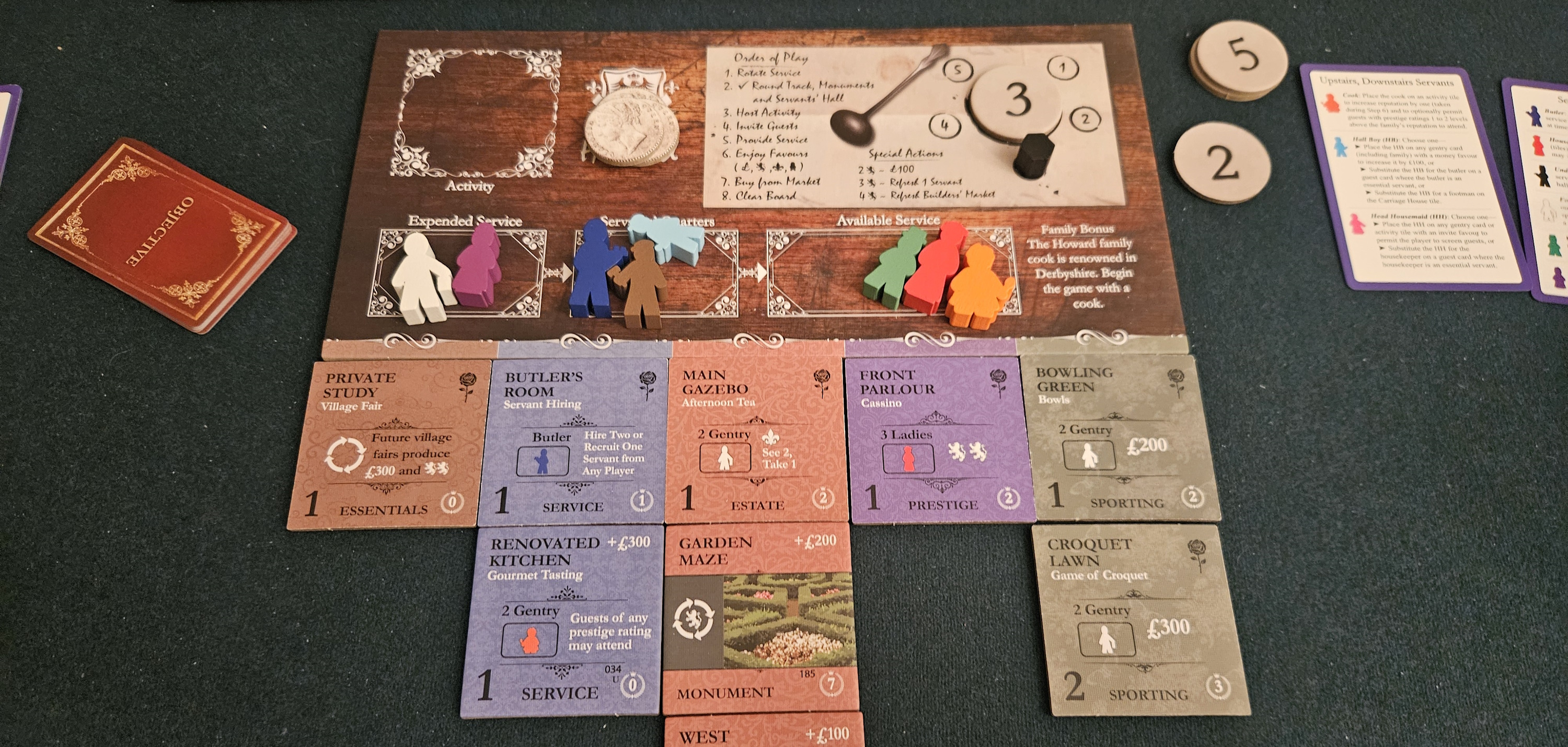
My nice little house. Disclaimer: it’s a huge house.
The setup for Obsession reads like the back cover of a romance novel. That isn’t an insult; these opening paragraphs are essential to Obsession’s sense of place, a reality severely dampened by the fact that only around one in four people will actually read the rulebook. The Fairchild family recently endured tragedy when the parents of Charles and Elizabeth Fairchild fell ill and passed. Now the scions have moved to Alderley Hall in Derbyshire, where their eligibility (and annual income of £20,000) has perked up the ears of every family in need of a match. Players are given the roles of those nearby families, desperate to improve their estates and fortunes in order to attract the attention of these wealthy young scions.
Like many romance novels, there’s a certain ickiness to the whole thing, a rind of vulnerability-turned-opportunity that’s suitably at home in the milieu. Once again, that is not an insult. I’m always disappointed when somebody dismisses Jane Austen or Thomas Hardy novels as being about the petty concerns of the well-to-do. From a certain perspective this is true enough; unlike the wandering gypsy children who harass Harriet Smith in Emma, nobody involved in these matchmaking schemes faces outright starvation. But this attitude still leans on a moral blindness of its own stripe, failing to account for the shocking vulnerability of the women whose long-term comfort, health, and dignity depends on finding a suitable match.
Obsession, much like Austen and Hardy’s novels, is packed with characters such as these. Nearly every one of the people who will cross your path qualifies as gentry, with land and money and servants at their disposal. But not everybody. There are cads who pursue wealthier women out of desperation, con men produced by the absence of any social safety net after the collapse of their enterprise, spinsters who rely on the charity of those who invite them to tea, widows left with no recourse after the passing of their husband, adventurers and soldiers valued only for the tales they can impart over cigars. The inhabitants of Obsession may have some scratch, but they’re one bad step away from a fall.
Even the wealthy don’t escape. Obsession is as much a prison as it is a matchmaking simulator, only the bars and buzzers are prestige and social rank. When players arrange social occasions by combining events, servants, and guests, the variable standing of their characters is never far from mind. It’s one thing to invite somebody to the house for an afternoon ride through the countryside. A formal gathering, a political discussion, a cricket match — these require other considerations entirely, delineated by boundaries that are as fathomless to most moderns as any caste system. It isn’t uncommon to hear some imperial apologist bloviate about how British colonialism rid the savages of their backward ways. Like all nostalgia for this perilous time, these statements are all bark, a means by which to forget that local customs such as the more fluid Indian jati were calcified by imposed British social ranks so as to become stricter, more rigid, easier for the European mind to define and delineate. These characters are imprisoned in a cage of their own culture’s making, one they exported with gusto in the name of civilization.
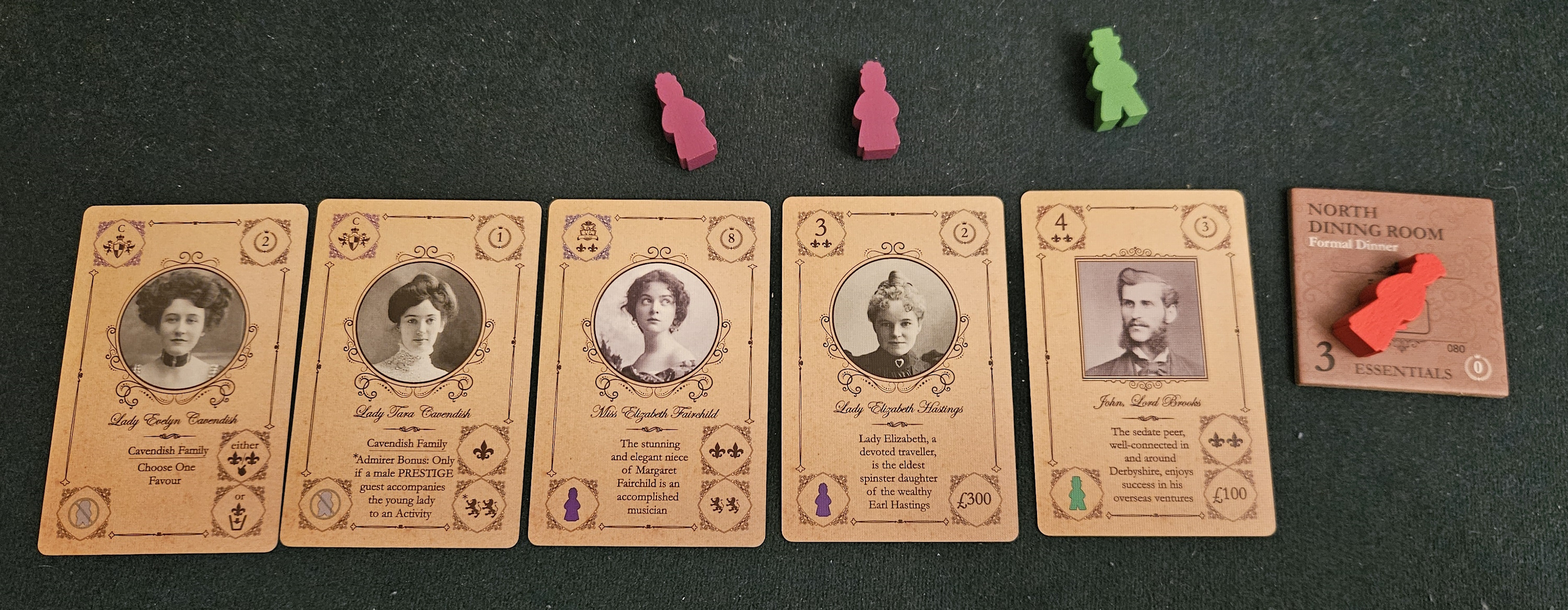
Hosting a formal dinner for social favors and cash.
It’s easy to say that Obsession isn’t about all that, but I think to do so misses the twinned romance/tragedy that is at the heart of its processes. The game’s title is not, after all, Happy Regency Romance. This is Obsession. There’s a note of pining to such a title, a yearning to break past the boundaries we’ve thrown up around ourselves, the terror of wanting, nay needing, to find a suitable match before the requisite number of years have labeled you unmarriageable. Like livestock, one becomes too aged and is put out to pasture, where they are only invited to social events when all the better cards have been played, to ever after hint that they need somebody to cover their expenses for the winter.
This brings us, obliquely, to the game’s servants. More than one commentator has pointed out that these laborers are nameless and faceless, interchangeable apart from their function, and warrant no upkeep compared to the frills one adds to their estate. Yes. And? Obsession overflows with concern and empathy for its actors, a world that’s shadowed by an ocean of carelessness for those beyond its sphere. Is there room for an examination of the downstairs people, a Gosford Park or Downton Abbey treatment that recalls that these humans also had aspirations and passions? I’m not convinced the scope of such an expansion would be within the game’s reach. At any rate, this blankness of your household staff strikes me now as a crucial element of the game’s theme — theme, not “theme.” Every game has these cutouts. We rarely question them. When we play games about ancient Rome, we don’t see the toiling slaves. When we trundle armies across the front, we don’t see the baggage trains and camp followers. If Obsession errs, it errs by showing them at all. It acknowledges a human cost that most games would leave to the side in the name of good taste.
I prefer this method. In one sense, it heightens the sickliness of the whole thing. If these social conventions are chains, it follows that some are more bound by them than others. Where our households begin at one prestige and may gradually improve our standing by hosting better guests and installing imported granite floors, then the little people who enable those events have their own worth rated a zero at best. In some cases, their number might drop into the negatives.
Yet in its own peculiar way, one’s staff soon take on a definition left out by the gelatin-silver photos that are your gentry. Around a session’s midpoint, I’m liable to spend more time fretting over my housekeepers and valets and butlers and footmen than worry about which notable I’m inviting over for tennis. Any old bum will do. The expansions deepen this dependence, not to mention allay some of my concerns with the original game’s chanciness. Cooks whose confections draw higher-reputation guests to my doors, handymen upon whom we rely for every little detail of our estate, housemaids who screen our potential connections for ne’er-do-wells with all the attentiveness of a grandmother. These figures are not unimportant; they’re crucial. But in their importance, also out of reach. In Obsession one strives to reach out of their appointed status. But this is only acceptable if one strives in the proper directions.
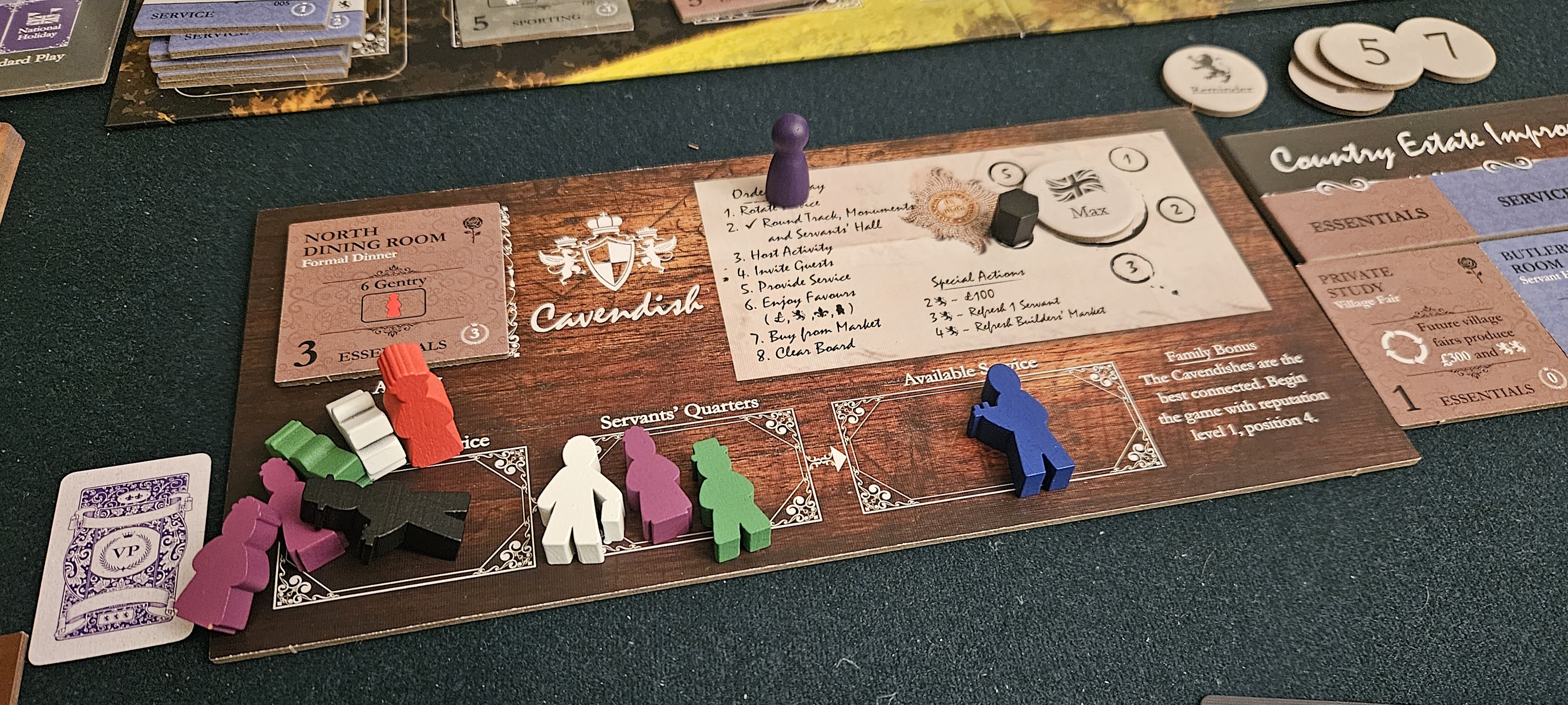
These people are interchangeable. I think that’s intentional.
Do these statements matter? I think they do. I’m sure there are as many ways to interpret Obsession as there are ways to read Regency romance novels, but Obsession strikes me as nearly as poignant an examination of the English society that we are inheritors of as John Company or Molly House, if not as explicit in its messaging. They function like the angular prongs of a caltrop. In John Company, one confronts the banality of imperial endeavor in all its grubbiness, and sees how adventurers eventually bring their pillage home to wreak havoc on the same systems that exported them. In Molly House, one is asked to witness those cast adrift from cultural mores, whose appetites and affections have been labeled deviant by a society that, let’s face it, had some deeply unequal ideas about permissibility versus restriction. Sexual histories have long reckoned with the booming popularity of London brothels, where all those fine gentlemen propped up their heels when not engaged in domestic and business endeavors. Foucault called us “we other Victorians” for a reason.
Obsession is the domestic prong of the equation. I can’t determine the degree to which Hallagan is celebrating or reflecting on the sexual politics of the period. Maybe both. He would hardly be the first person to fall for the hazy romance of country estates and circumscribed gender roles, when men were men (or else) and women were women (or else), with very little wiggle room available to either in terms of, well, anything. There are enough breadcrumbs leading into the woods, though, to lend the impression that there’s a sliver of razor behind the gauze. Romance in Obsession is barbed for more than the usual reasons. It’s hard enough to find one’s life partner. Now imagine doing it under these circumstances, with the proper installations in one’s home, the requisite help in dresses and buttons, the right honorifics or epithets. Here, love is only sometimes love. Love is war. Love is a cage. Love is an unlikely and precious discovery, not anticipated in any given union.
I will say, it still feels too hidebound by the language of Eurogames. Obsession’s list of scoring objectives is as overwhelming as I remember them, with so many little wellsprings of points that none of them matter except in the abstract, right down to the included pie graph listing the percentage availability of various scoring values. The game’s relationships go missing in the clutter. Xoe Allred’s Persuasion cuts a little closer to the bone, especially in its postscript, focusing on partnerships both blissful and wretched, sometimes even within the same household or as escapees from polite society altogether. In Obsession, one family or the other might “win” without the slightest consideration for any of the individuals you shuffled back and forth. Everyone is leveled by the tyranny of the final tally, servants and gentry alike. Is that also a commentary? Somehow I doubt it.
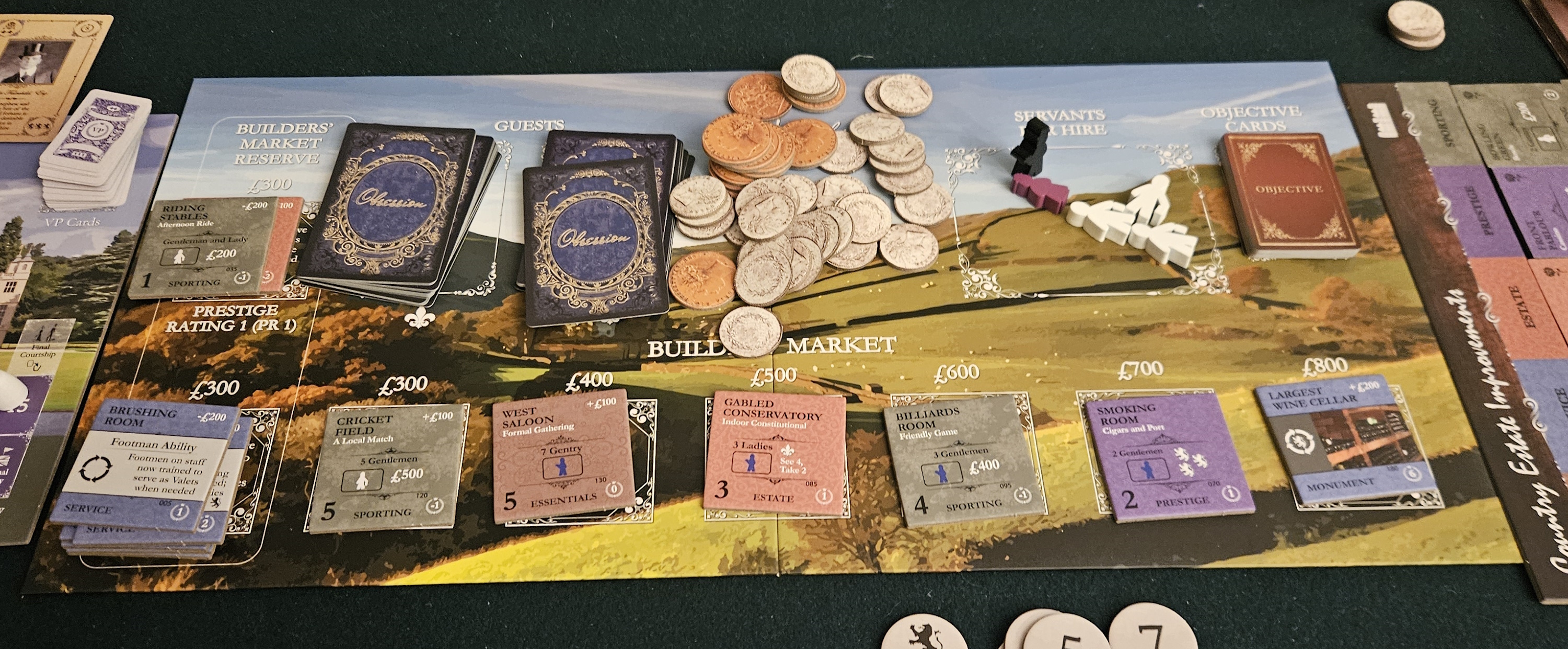
I do so enjoy managing river-style markets.
After all this time and a half-dozen plays, where do I land on Obsession? I think I get it now. There isn’t anything quite like it, even if we only assess it mechanically. You’d think after all this time that another worker-placement game would have replicated its taut interrelationship between workers and benefactors, between culture as enabler and jailer, between theme and “theme.”
It isn’t so. Obsession still stands unchallenged. Oh, I have my complaints. As a Eurogame, Obsession sticks a little closer to the classic beats than I would prefer. But those aren’t really the purpose of today’s examination. As a cultural peepstone, it bends the links of its chains. This is a game that does more than toss a drop-cloth over a few systems. Am I obsessed? Nah. But I get why some folks are.
(If what I’m doing at Space-Biff! is valuable to you in some way, please consider dropping by my Patreon campaign or Ko-fi.)
A complimentary copy was provided.
Posted on August 28, 2024, in Board Game and tagged Board Games, Kayenta Games, Obsession. Bookmark the permalink. 22 Comments.

 SPACE-BIFF!
What an excellent commentary on one of my favourite games. It’s given me food for thought, even though I obviously like it more than you do. You keep doing that to me, Dan! Making me think! How dare you…
Thanks, Dave!
Great article.
However ‘ can’t determine the degree to which Hallagan is celebrating or reflecting on the sexual politics of the period. Maybe both’. – I suspect neither. I don’t think there’s anything more in the intention than a ‘Downton Abbey’ style setting.
Totes possible.
Thank you for this analysis! I think I also played it in 2018 and thought it was fine, a better than average euro with a better than average setting. And ever since then, as I kept hearing breathless praise, I’ve been wondering what I missed.
At the very least, I think the setting does it a ton of favors. Eurogames at large might treat settings as interchangeable, but a good designer can recognize how a topic enhances their game.
My takeaway from Obsession is that a lively setting which truly charms us and animates our imagination is huge (and rare). I hope it’s not churlish to say we view this as a ‘decent enough’ game that gets by on the merit of its faintly satirical theme.
I wonder if the fact that twee British stuff seems to have special appeal abroad is a factor in the success of the game. In my experience, the pomp and glamour of the Royals and Victorian England ‘obsesses’ some Americans much more than us cynical Brits. The game could be succeeding simply on the level that it presents a ‘cosy’ setting and a solid set of mechanics.
It’s worth pointing out that this a self-published game and by all accounts Dan Hallagen is working tirelessly to support the game and its customers, which is nice to see.
Small typo in the last paragraph (Bbut). This was an amazing review, you are so gifted when it comes to writing.
The ability or inability of people to see and value theme in games is so interesting to me. A lot of my friends and family are programmers or math-minded, so they often completely miss the the theme and story games. The world must look so different to them.
When faced with in-game risk, they enjoy calculating the percentage chance of modified dice rolls instead of feeling what the risk represents, or letting it change the story. They’ll play entire games on the ratios of turn efficiency. (I was angry when they wanted to play Pandemic Legacy with the exact same strategy for the entire run instead of interacting with all the game design).
I kind of what to try just playing an RPG with them just to see how they react. Maybe the lack of winning objectives will open things up in their minds.
Ugh! Thanks for the typo check!
Thanks for bringing up John Company–that game and subsequent research has helped me better understand how British Empire abroad enabled this kind of society at home. Obsession often comes to mind when I’m doing the London Season phase!
Right! I’ve had tremendous success using John Company as an educational tool. There are additional hurdles to using Obsession that way, but I still think it expresses its time and place rather well.
Hi Dan, thanks for the interesting re-review of Obsession. I am always interested in second look reviews / re-reviews of popular games. This hobby has a tendency to review and forget, review and forget, review and forget, which becomes tiring after awhile. There are so many gems that are quickly tossed aside and forgotten, apparently like Obsession – yet they gain a following and stay “alive” even after the review hype has died down. I hope you do more of these types of reviews in the future. Thanks again.
P.S. I loved your early coverage of Arcs and interview with Cole Wehrle. Great stuff.
Thanks, Stephen! If you like coverage that revisits games, I recommend my series “New Year, Old Year,” where I revisit my Best Week picks from years past to see if they still hold up.
Nice commentary on a game I have yet to play. Now I’m intrigued.
Btw, there’s a small typo in your final paragraph. “Bbut” should be “but”.
Thanks! That typo should be cleared up now.
Any chance on eventually getting around to Ankh: Gods of Egypt?
I would love to at some point, but there are no current plans.
Would love to read your take on Ankh too – it’s been quite some times since you’re last proper god-botherer game (though I suppose the sub-genre as a whole may have taken a bit of a dip in recent years…)
Noted!
Great read! I this is one of those games that had a tickle in the back of my brain when it came to game and theme and I think your comparison to John Company makes sense, even if I know I can play ‘Obsession’ and John Company scares the heck out of me LOL
My group likes to lean in on the role play for this game, which I think is why my friends who might usually find it too “heavy” for them still enjoy it. There is nothing like sighing heavily that another American has appeared in your choice of cards.
Ew! Americans!
Pingback: I Don’t Wanna Do Your Dirty Work | SPACE-BIFF!