Snack Packs

AAAHHH! Too many games! I didn’t ask for this. Literally, I did not ask for this. I requested A Message from the Stars, and Allplay sent me these four tiny boxes. That’s one way to manage your warehouse overfill.
Fortunately, I wouldn’t call them half-bad. One or two might even be quite good. But since they’re all tiny, it seemed appropriate to write about them all at once. I’ll tackle them in alphabetical order so as to avoid the appearance of favoritism.

Holding a scoring card in one hand.
Fairy
Fairy, designed by the Japanese artist Mashiu, was originally self-published as Instant Celebrity. Get used to seeing some variation of that sentence throughout this article, because Allplay is continuing their trend of propelling lesser-known designers into wider circulation. I’ve been introduced to some truly fascinating games and designers thanks to these imports/rethemes, so I appreciate the practice even when I don’t fall for some of the individual titles.
That’s a nice way of saying I don’t love Fairy. This is a wagering game that rides on two things: a well-tuned deck and a bunch of gestures.
The deck is slender, only twenty-one ranked cards across three suits. Each suit also has a fairy card. Your goal is to correctly wager on what will appear from the deck next. Not the specific card, but whether the card will be higher than the one before it, lower, the same suit, or maybe, just maybe, one of those elusive fairies.
You place these wagers by gesturing, roshambo-style, at the count of one two three. The scoring card fits neatly into your other hand and shows both the deck composition and the various gestures. If you think the next card will have a higher rank, you point up. The inverse, you point down. Same suit? Lay your hand flat. Fairy? Make a creepy grabby hand, like you’re about to kidnap that poor fae.
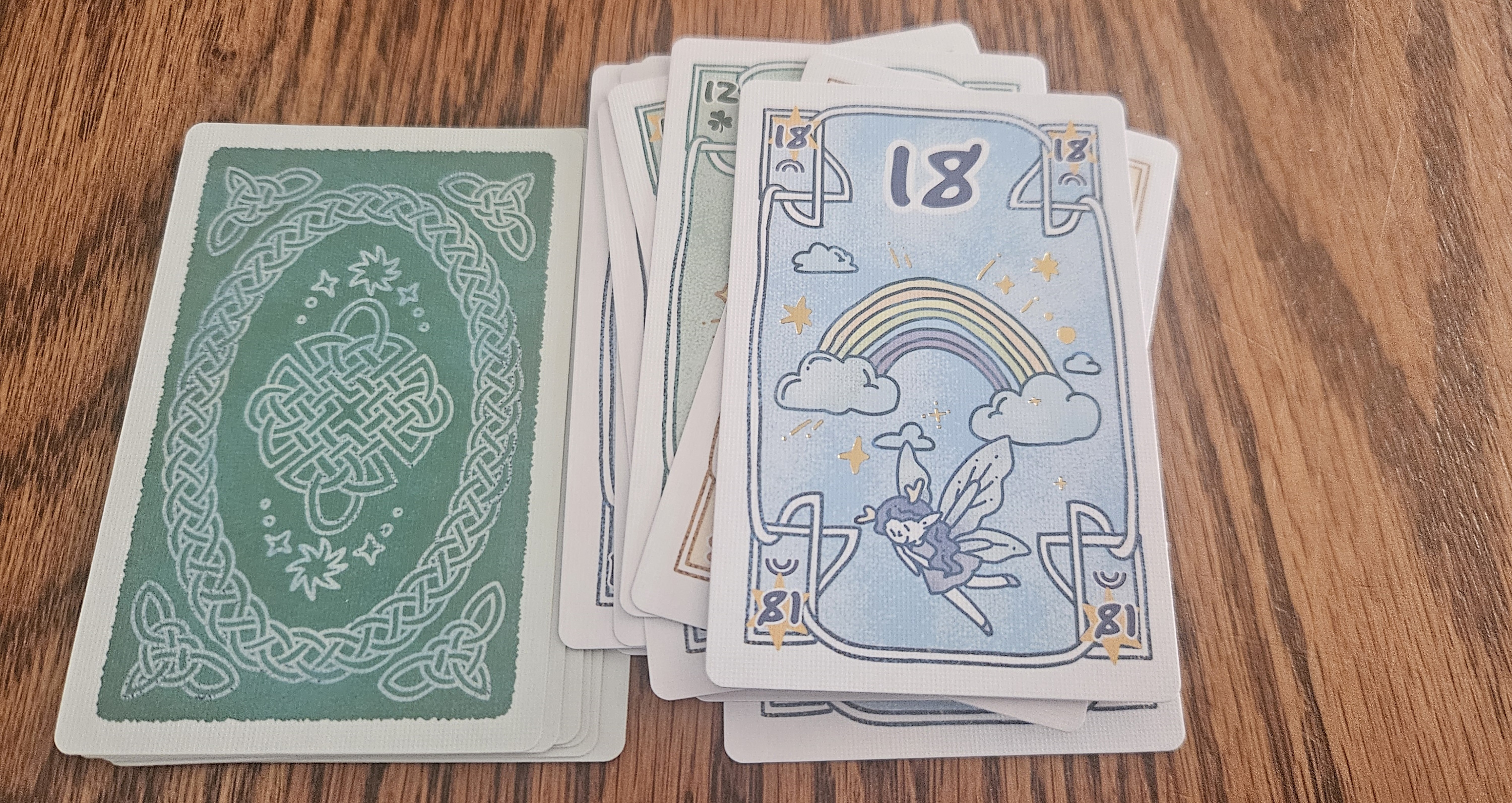
We found an actual fairy!
Depending on the type of wager, you earn varying scores for a correct guess. Fairies are worth the most, “up or down” points are worth the least. Either way, you lose a point for a failed wager. There are a couple ways to play, either running through the deck once until all the fairies appear or stopping once somebody reaches an appointed scoring threshold, but the gist is the same either way.
It’s dead simple, with enough room for informed guesses. The more you peel through the deck, the more informed your wagers become.
Provided you’re paying attention, that is. I don’t mind counting cards, but Fairy is a little too light for my tastes. As a result, it flips into that wonky no-space where I can’t give it enough attention to make the requisite wagers with anything approaching good sense. Ever wanted to see Dan Thurot get zoned out? Ask me to play Fairy.
It might have to do with headspace as much as anything. One friend pointed out that it’s the sort of game you play at night during a convention. It can handle up to ten players out of the box, and despite offering some minor strategy it isn’t exactly going to refry your tired brain.
For me, though? Nah. Next tiny box.
These cards will not behave!
Panda Panda
Ready to repeat the formula? Panda Panda was designed by Kaya Miyano and originally received a small print run as Cat Poker. Now instead of being about fickle cats, it’s about fickle pandas.
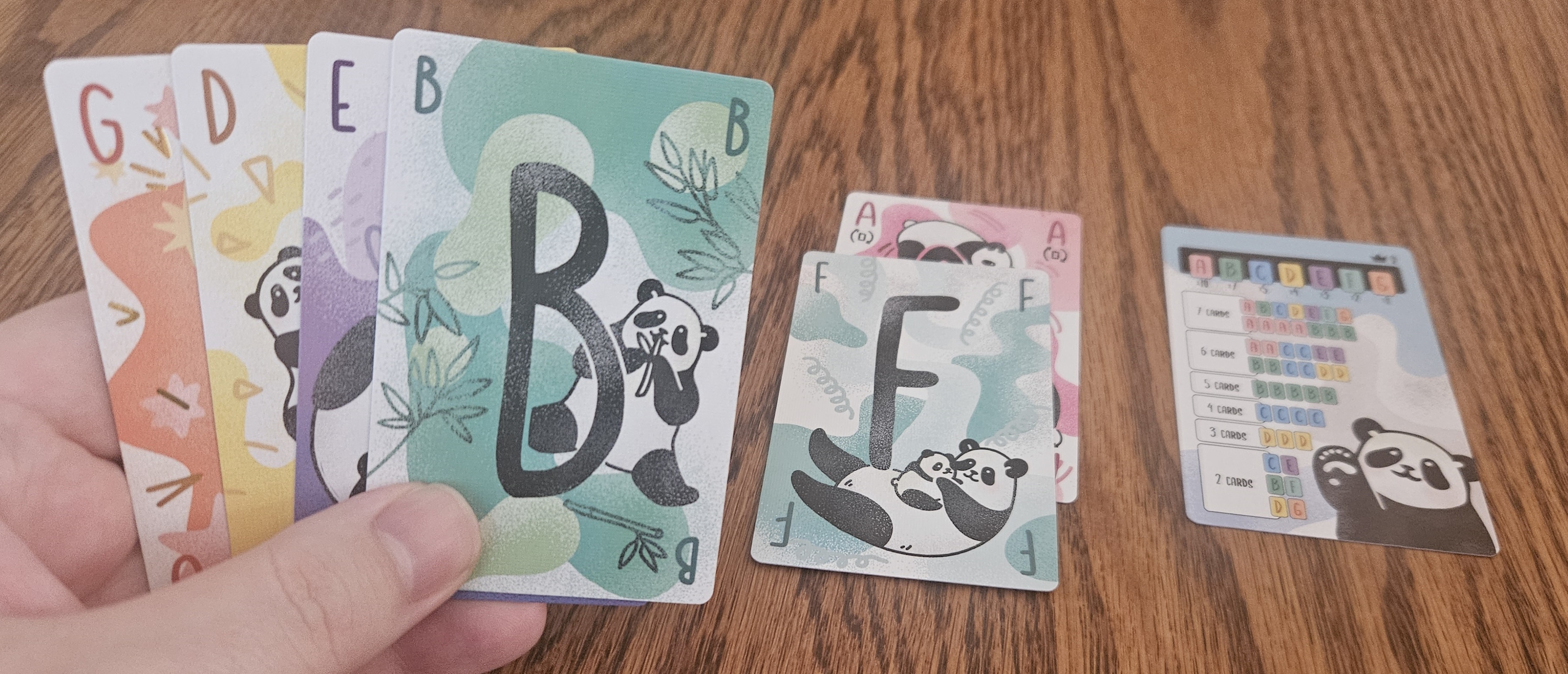
Like cats but unlike pandas, it’s also unexpectedly sinister. The gist is that you’re trying to build a precise hand of cards that varies depends on how many you’re holding at that exact moment. When the game opens and you’re dealt five cards, the only winning move is to have five B’s. B’s, by the way, are the deck’s second-most plentiful suit, behind A’s but ahead of C’s, D’s, E’s, F’s, and a singular G.
But cards will enter and exit your hand regularly, and hence your target will always be shifting. Draw a card and now you’re holding six of the things, which means you can only win by holding two A’s, two C’s, and two E’s, or maybe two each of B, C, and D. Discard down to four cards and only a full set of C’s will win.
Worse, you can only win at the start of your turn, so it isn’t possible to grab the spare card you need and win immediately. Worse worse, pandas are known for rolling all over the dang place. Whenever somebody discards an A, everybody at the table is forced to pass a single card to their left. These panda rolls are a great way to shake up your hand, but they also bust any chance of keeping your hand intact for more than a few minutes.

Do the panda roll!
As you might expect, these antics prove limiting. It isn’t uncommon to build a winning hand, finally, only for it to get panda rolled one turn before you can actually win. The inverse is also true: in some cases, your best bet is to play the numbers and hope you’re passed the card you need right before your turn. In some cases, the game state can degenerate into a peculiar stasis, with everybody panda rolling their hands around the table.
But that’s also no small part of Panda Panda’s charm. I haven’t played anything quite like it. You’re always on the move, always shifting approaches, and sometimes cursing your neighbor for breaking up a perfect hand. Or thanking them for passing you exactly what you needed to edge closer to winning. If games had spirit animals, a panda would be the perfect fit for Panda Panda, with its deliberations occasionally interrupted by buffoonery.
In other words, it’s exactly the sort of wackadoo game I want from a low-risk tiny box. It’s fast, silly, and contains pandas. The trifecta.
NEXT.

Yes, this is a trick-taking game.
Prey
Mad Libs it with me: Prey was created by TORU II, either a pseudonym or a robot that’s one bad day away from airlocking the International Space Station, and received limited publication under the much worse title Double Side Play. I’m not strict on how we theme trick-takers, but I’m gonna hazard that most of us will find “predators and prey” more relatable than “double side play.” As near as I can tell, that’s an oft-misunderstood soccer ruling.
Prey is also probably the strongest of this set of tiny boxes. In the usual fashion of Japanese trick-takers, it sticks to the basics right until you realize that its central wrinkle is downright brilliant. Said wrinkle is that your cards are double-sided. (Double… side… play! Aha!) One side is the “predator,” while the other side is the “prey.” The first six tricks use the predator side; the last six use the prey.
Okay, so what’s the big deal? Well, you’re trying to meet a certain contract. Unlike most contract-bidding games, though, these are determined by rolling two dice at the start of the round. If you roll, say, a three and a four, that means you need to win either three or four tricks. If you’re lucky enough to roll a six, it offers two outcomes, letting you win either on six or a zero.
This is where the cards’ dualistic nature comes into play. During the first half of each hand, you’re building the set of cards you’ll use in the second half. Because this is a must-follow trick-taker, sometimes you won’t have a choice of which card to play. More often, though, you will, and this is when you’ll get to decide whether to keep a card for the rank it will provide later or use it for the one it has right now.

Using my first tricks to prepare for my last tricks.
This is smart stuff. I wouldn’t call it a deck-builder, but it draws on a few familiar concepts, functioning like one big exercise in winnowing your hand in order to achieve your desired outcome. When the first six tricks are done and you flip your hand to its opposite side, it feels like the music crescendos. Time to see whether you pull off the big win or face-plant into the referee.
This is easier said than done. Everybody is trying to fulfill the contract foisted on them by their own pair of dice. You know how in trick-takers you can sometimes base your contract on what everybody else has announced before you? Yeah, that ain’t happening here. There’s a faint, animal-kingdom-esque air of desperation to the whole thing.
For all that, your goal is to be the first player to score two points. In most cases, that means two hands. Like all the rest of these tiny boxes (except Fairy, because I hate it), Prey is fast and hard-hitting and undeniably clever. Is it the trick-taker of the year? Nope. It’s too tiny for that. But it’s a worthwhile plaything, offering a nifty wrinkle that I would love to see given a fuller expression sometime.
Plate!
Unicorn poop!
Rainbow
Rainbow was designed by _____ and originally published as _____. [Note: Insert “Mito Sazuki” and “Neon” in post.]
Yes, this is another trick-taking game with a wrinkle. What sets Rainbow apart is that it’s perhaps the briskest trick-taker I’ve ever played. Played over the course of only a single hand and occupying approximately half the duration of Prey, words like “fast” cease to hold any meaning. This game isn’t fast. It’s a blink. It’s a flutter of a hummingbird’s eyelash.
Rather than playing regular tricks, here everybody plays cards as either singles (one card), runs (sequential ranks), or sets (matching ranks). You’re welcome: I’m sure you needed those parenthetical explanations. You can always play a single, but as soon as somebody deploys a run or set into a trick, everybody is temporarily “locked out” of the opposite type.
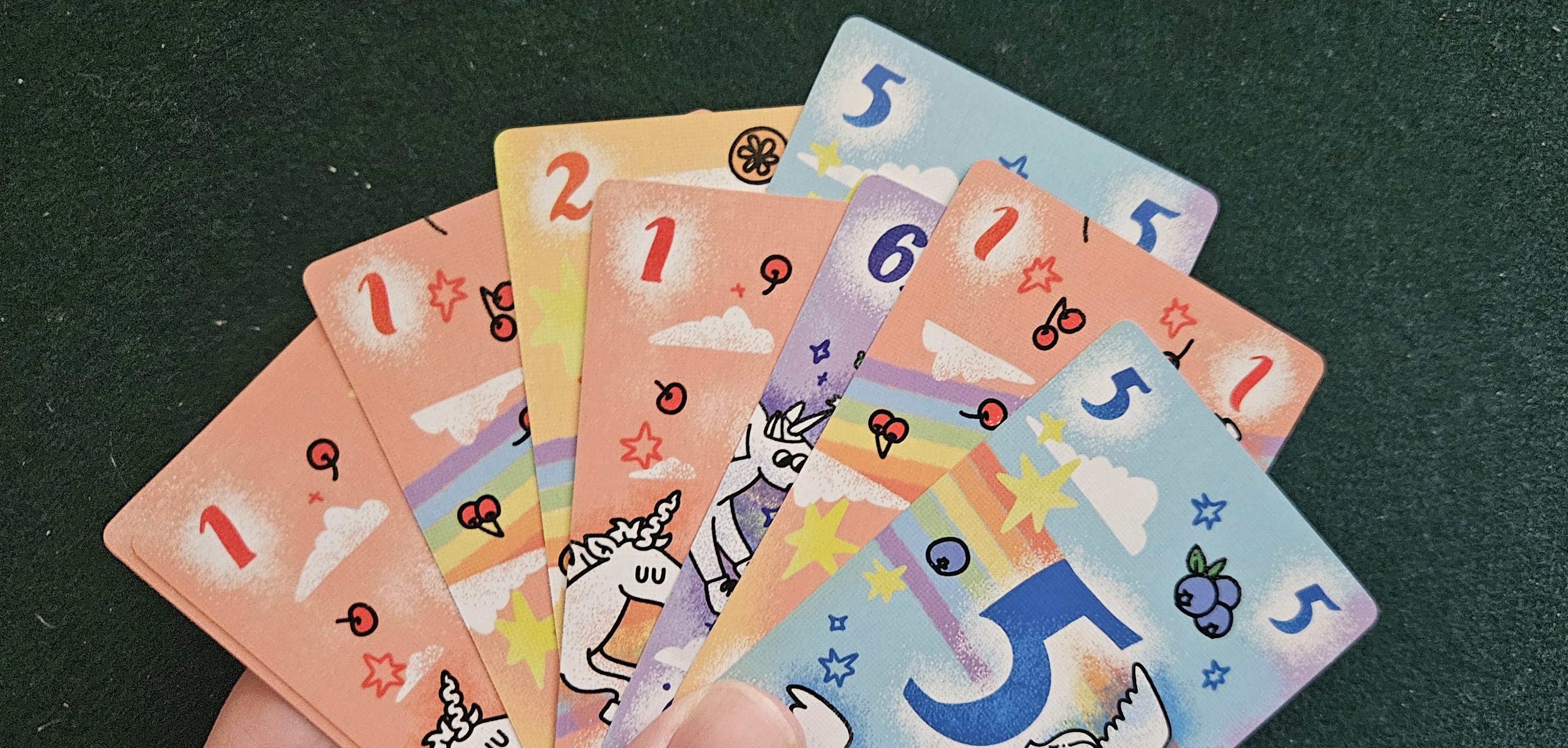
That isn’t the big wrinkle. The big wrinkle is that everybody figures out their relative standing — first place, second place, and so forth — and then picks up scoring cards from the middle of the table. There isn’t much decision-making here. If you win, you pick up the highest-value set. Obviously.
But now something interesting happens. Everybody takes the cards they played and tosses them into the middle. Plenty of cards are now available on their own. Any pairs are placed together, becoming a single double-value card. Onto the next hand.

The value of scoring cards is constantly shifting.
Over time, the value of the scoring pile shifts dramatically. Sometimes there are pairs of 5’s and 6’s in there — time to go hard. Other times, you’ll be staring down the barrel of flimsier offerings. Meanwhile, it’s worthwhile to be careful with the tricks you play. While it’s possible to win with four 6’s, maybe that isn’t such a good idea unless you also have an idea of how you can win the next hand. Now go again. And again. Until two players have run out of cards. Which, by the way, implies that maybe you shouldn’t burn through your hand too quickly, lest you miss out on a round of scoring.
Is it smart? Undoubtedly. Too brief? Yeah. That too.
But as an intro-level option, it isn’t bad at all. It’s simple and doesn’t overstay its welcome. Crud, it barely even walks in the door before turning heel and walking out again. The same goes for its play count; unlike Prey, which maxes out at four players, Rainbow effortlessly goes to six. I’d be withholding critical information if I didn’t confess that it makes for a raucous ten minutes. Not my favorite of the bunch, but I would still rate it as a good one.
That’s it. Whew. Tiny boxes complete.
FINAL TALLY: (1) Panda Panda (2) Prey (3) Rainbow (4) Feeling bloated from drinking too much protein shake (5) Fairy
(If what I’m doing at Space-Biff! is valuable to you in some way, please consider dropping by my Patreon campaign or Ko-fi.)
Complimentary copies were provided. (Albeit unsolicited.)
Posted on July 29, 2024, in Board Game and tagged Allplay, Board Games, Fairy, Panda Panda, Prey, Rainbow. Bookmark the permalink. 3 Comments.

 SPACE-BIFF!
Prey looks cool. Reminds me of the 2-player trick taker “Claim” – which has a similar sounding structure where the cards you “win” from tricks in the first round go into a stack that become your cards for the second around. Have you played claim?
I have not! Looks nifty. I should give it a try sometime.
♫ Never gonna point you up
Never gonna point you down
Never gonna play Fairy-uh,
Again-uh
Never gonna panda roll
Never gonna pair rainbows
Never gonna prey on card tricks
With friends-uh ♫
– Not Rick Astley
Was this the tune you tried to present to your mother-in-law? No? This one is much worse? Ah, got it.