Who’s Your Daddy?
Blood on the Clocktower is special. That’s always been apparent. Steven Medway not only succeeded in making a better social deduction game, he set a benchmark that might not be surpassed anytime soon.
But while I’ve enjoyed my time with Blood on the Clocktower, it wasn’t until I was invited to a session with a local gay gaming group that its true power became apparent.
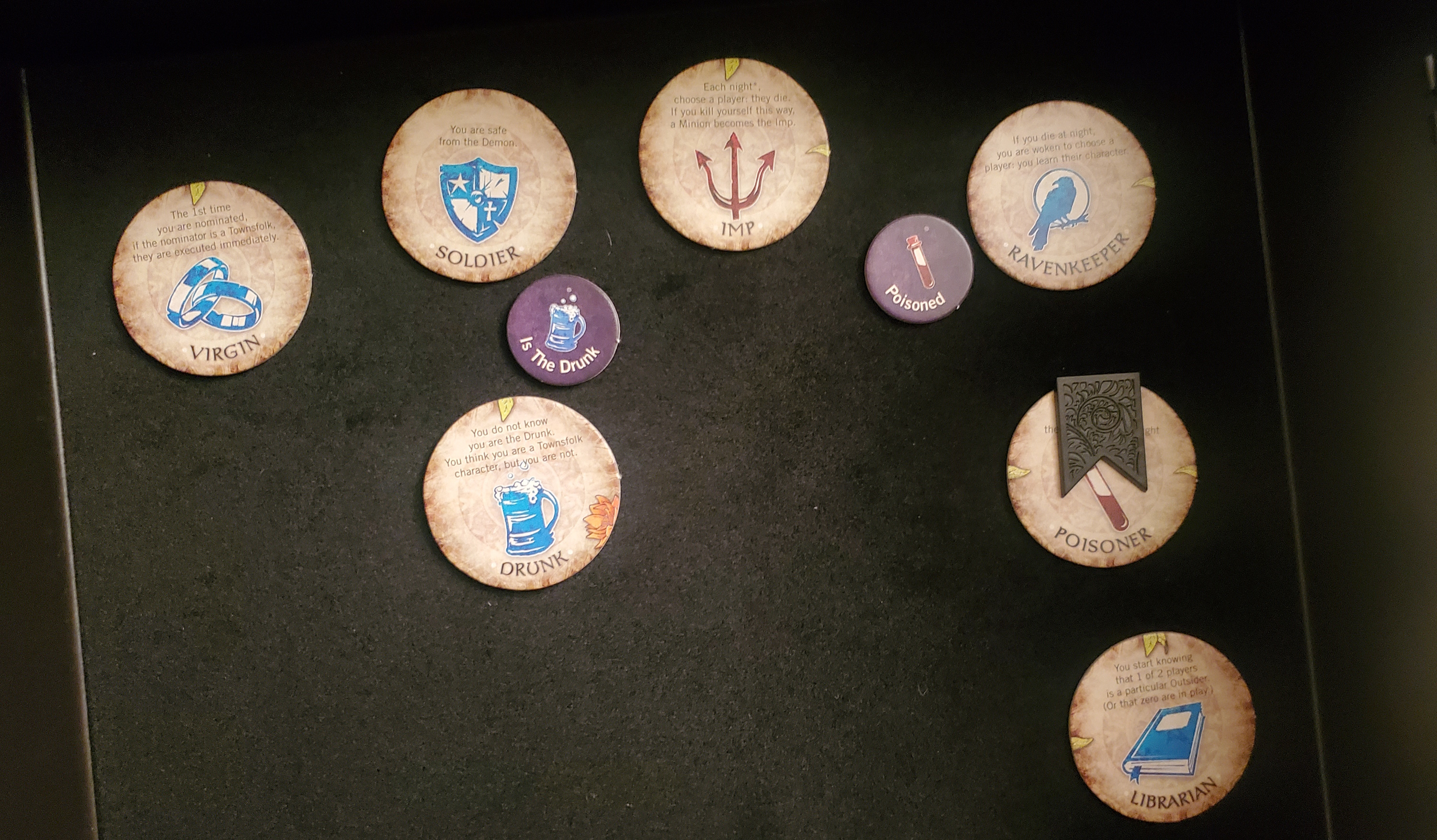
Personalities in collision.
Our story begins not with a murder, but with a hug.
Nine hugs.
More hugs than I’m accustomed to, if I’m being honest.
I was here courtesy of a friend. He was recently out of the closet and bright in a way I’d never seen before. Face upturned, eyes alive. I’d always known him to be… “whimsical” might be the word, given to unusual hobbies and enthusiasms, but quiet, too, a person two frames out of sync with the world around him. Until recently. Until his world was thrown into disarray by his acknowledgement of his identity. In that disarray, something about him grew paradoxically clearer. Like tapping a VCR that’s gotten off track, his image had resolved, new and whole. Now here we were, at this game night for gay men.
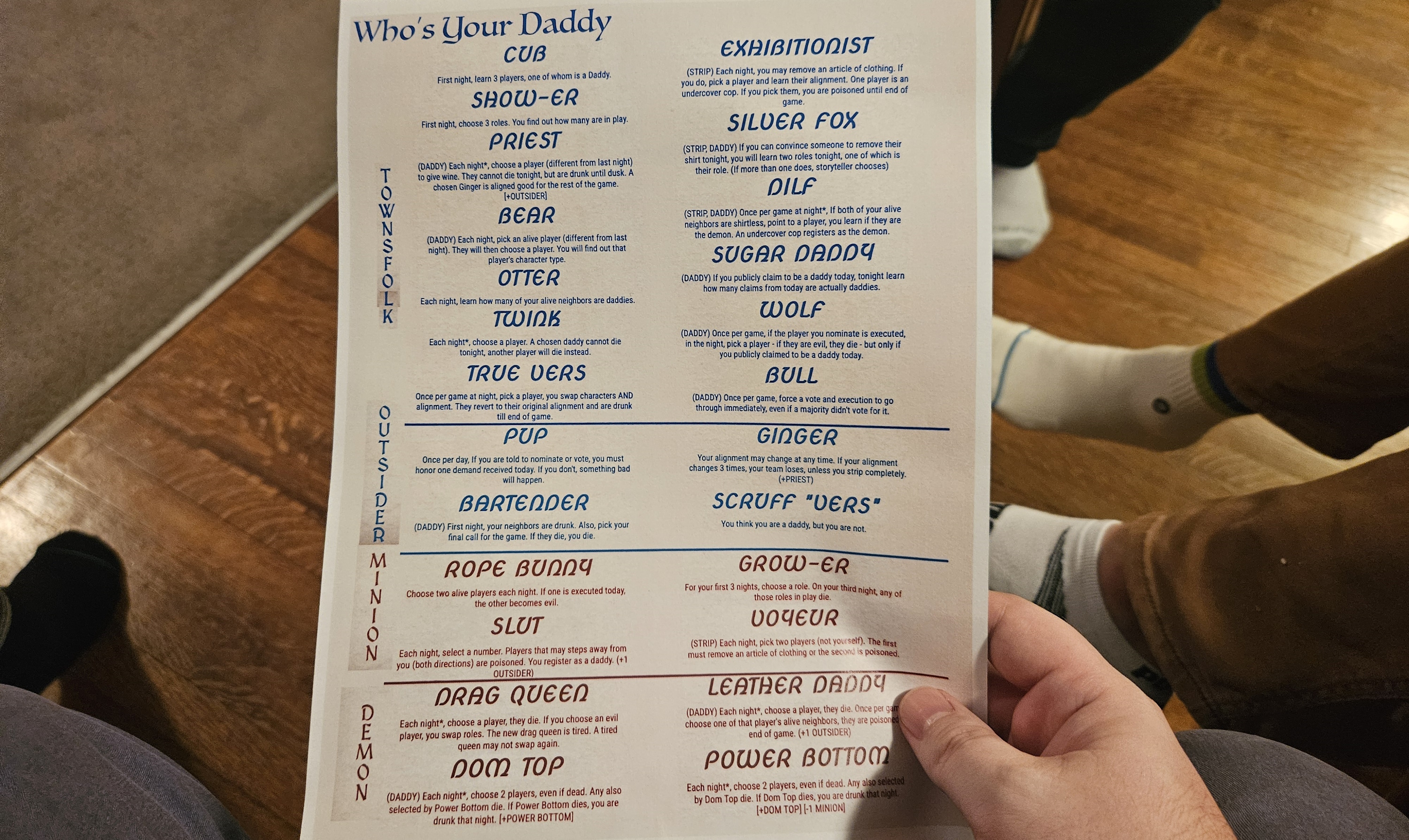
We arrived slightly late. The game hadn’t begun, but the rules of this particular scenario were already being explained. Even so, our entrance was met by embrace. Not everybody stood up to greet us, but most did. We were hugged. Placed in chairs. Welcomed into the circle. It reminded me of being drawn into a family space, although I hadn’t met anybody in the room apart from my friend. Within seconds we were handed sheets revealing the roles for this particular scenario. It was a homebrew. “Who’s Your Daddy?” it asked. “My daddy is Bert,” I said. It took a moment for the fella sitting next to me to ask the obvious question. “Is that your partner or your dad?”
Yeah. I’m always this slick when meeting new people.
Like the three scripts that come in Blood on the Clocktower, this one was designed to sow both maximum confusion and leave breadcrumbs for the eagle-eyed. The object depends on one’s team. If you’re good, suss out and slay the demon. If you’re evil, kill enough of the town that there’s no hope for the remaining townsfolk to rally against you. In this case, our demon came in two halves: the Dom Top and the Power Bottom. These separate players would both secretly indicate two players at night. If they happened to agree, their victims would perish; otherwise, nothing would occur. The problem lay in the agreeing. Every day permitted about ten minutes where everybody was allowed to mingle, go off into other rooms to discuss, or (in my case) mill around the snack table. But these conversations were largely open. People could wander in and out, eavesdrop, observe. If two people appeared to be conspiring, well, there’s a good pair to recommend for interrogation.
The script featured other unique traits. Certain characters, such as the Exhibitionist, Prude, and DILF, could persuade people to disrobe their shirt at night. Alternatively, one could simply elect to so do on their own. When we opened our eyes in the morning, the circle was spotted with bare chests, little hints that something had gone, ahem, bump in the night. I fretted a little over this. Ever since a pair of lifesaving surgeries, my torso has been crisscrossed with unsightly scars. The storyteller quickly laid my concerns to rest: removing one’s shirt was entirely optional. That provided the fortitude I needed. If anybody asked me to remove my shirt, I would do so as shamelessly as I could muster. Of course, nobody asked me. I’m telling myself that they missed out.
Meanwhile, some characters were “daddies,” and before going to bed each day we were required to claim and count how many daddies were in the game. I’m still not exactly sure what function this served. I claimed to be a daddy. Mostly because I am a daddy. Twice. That’s the first trick of lying effectively, I’ve been told: lead with the truth.
Except I learned something curious within the first few days. The men seated in that circle were exceptionally good at concealing their identity. My previous sessions with Blood on the Clocktower have always included at least one or two people who wear their lies on their face, or in their shoulders, or in how verbal or silent they go once the game’s afoot. Not so here. These men were practiced at donning masks. When near the end of the first game I was outed as a minion — one of the demons’ helpers — my face burned red. There may have been some question about my identity before that moment. Once outed, even only slightly, no doubt remained.
Who’s Your Daddy?
My role was that of the Slut, and I was uniquely positioned to be of no use whatsoever to my demon overlords. The Slut, in this script, selects a number each night. The storyteller counts that number of seats in both directions and “poisons” them. There’s really no talking about Blood on the Clocktower without mentioning this sublime piece of craftsmanship. Poisoning — also known as getting drunk — breaks the ability of its recipient. In the game’s most basic script, Trouble Brewing, the town drunk thinks that they’re somebody else. Other scripts provide new ways for the concept to flex itself. Here, the Slut’s promiscuity apparently spins everyone around until they don’t know which way is up.
Except I was seated equidistant between one of my demon overlords and the Priest, a good guy jerk who kept making my master drunk to prevent any nocturnal murdering. This meant that any attempt on my part to intoxicate the Priest would also befuddle the Dom Top. Oh no. My sex-positive thinking was proving my own undoing. (Worse, it only occurred to me the morning after that I maybe could have announced a huge number — say, thirty-nine — in order to loop the count all the way around the circle multiple times and thus target my victims more selectively. So it goes.)
With me outed as a minion, the conspiracy began to collapse in on itself. Nearly two hours after the script opened, the demon was slain.
But here’s what makes Blood on the Clocktower such a force to be reckoned with. Throughout the night, that saying from Henry James kept echoing in the back of my mind. “What is character but the determination of incident? What is incident but the illustration of character?”
I’ve played dozens of social deduction games. Some of them even rank among my favorites. But I can’t think of a single one that proves that theorem so resoundingly. To play a role is to don a mask, but it’s also to remove the masks we wear throughout the course of our daily lives. As a straight man, I haven’t worn many masks. Oh, some. I’m a quiet person by nature. Observant, a little remote. Accustomed to feeling like an alien in the culture of my birth. But I also wear my feelings on my sleeve. Masking has never been a question of survival.
The same couldn’t be said for these men. These homosexual men who live in a complicated state that’s both relatively gay-friendly and gay-hostile at the same time. Writing on the internet brings out the loonies, and I’ve received my share of nasty notes, but they’ve always been theoretical, even amusing. It wasn’t until I began speaking openly about my work with LGBTQ+ youth in the Mormon Church that I received a death threat from a member of my own congregation. That struck closer to home. It mentioned my wife, my daughters. It was written by somebody who knows where I live. And in that moment, I received a glimpse behind a mask I’d never had to wear. When local church leaders expressed their horror, I found myself wondering if they were wearing masks, too. Because I couldn’t know whether maybe, just maybe, it had been one of them who had sat down at the computer and typed out that threat.
Over the course of that evening, the wounding incidents of a social deduction game had laid me bare. I had been welcomed so warmly that I found myself capable of considering removing my shirt. Showing literal scars. But I also found that I folded like a lawn chair when confronted with accusation. It was a paradox: comfortable in one sense, discomfited in another. At home in my skin, alien in my identity. It brought to mind those tropey moments that sometimes happen in movies, when kindness proves so disarming that our protagonist is stripped of their armor. My anticipated apprehension had fled. In its place, the peace I felt was unsettling in its rawness, pink and fresh but shy of blistering. It is breathtaking, how discomfiting security can be.
And it’s a rare game that asks us to play a role, but also to inhabit ourselves.
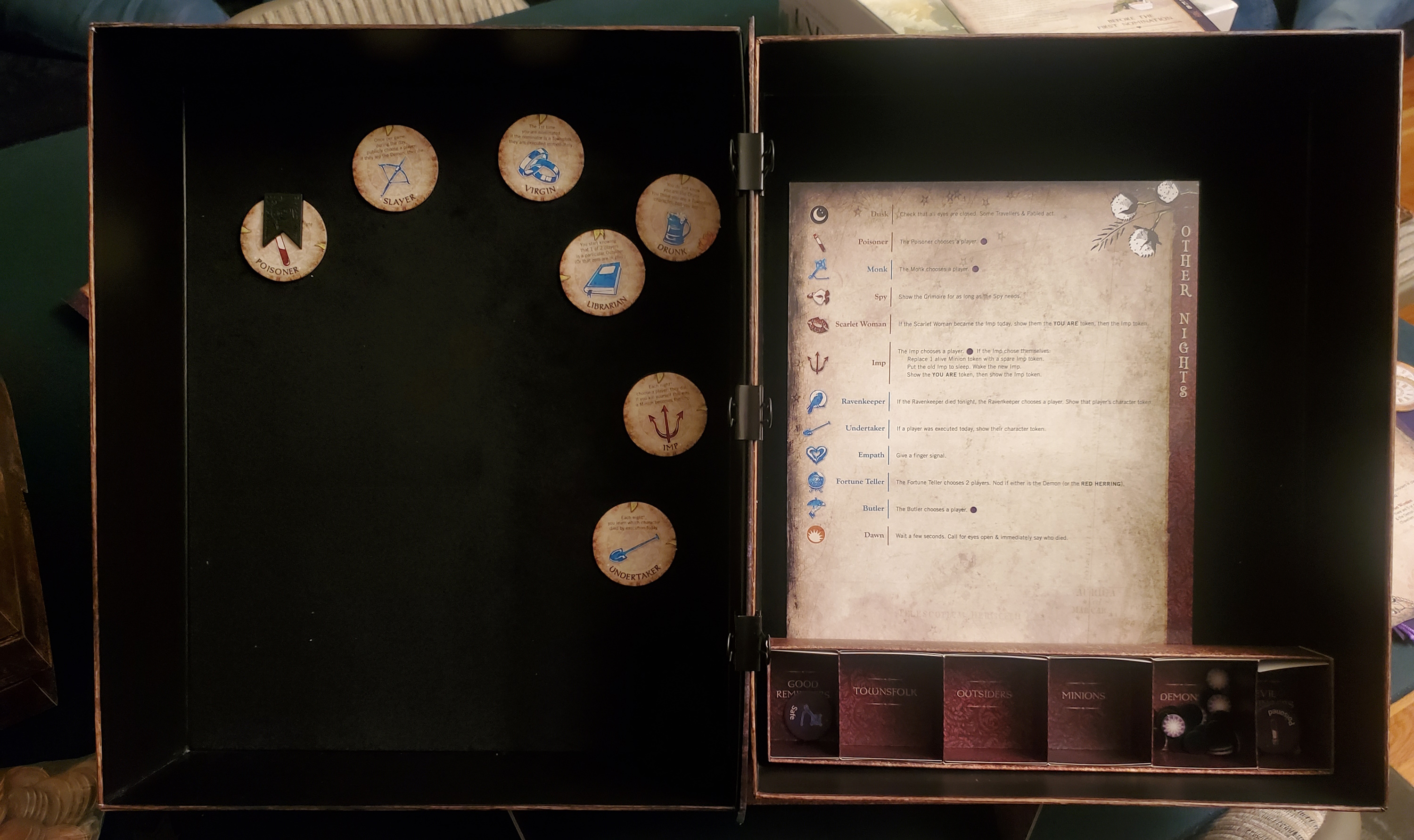
The grimoire, the secret heart of BotC.
We played another script after that. A shorter script. Only a little over an hour this time. Trouble Brewing, which I’ve played on many occasions. I fared better. I lied convincingly, drawing attention to myself so that I was murdered, and then revealing that it had been my intention to be killed all along in order to provide a crucial snippet of information to my fellow townsfolk. When we left, I received six hugs.
More than I’m accustomed to, if I’m being honest.
But welcome all the same.
(If what I’m doing at Space-Biff! is valuable to you in some way, please consider dropping by my Patreon campaign or Ko-fi. My next supporter-funded article, on the many forms of bias critics encounter while writing about media, is already available there.)
Posted on April 12, 2024, in Board Game and tagged Blood on the Clocktower, Board Games, The Pandemonium Institute. Bookmark the permalink. 13 Comments.

 SPACE-BIFF!
Awesome as always Dan. Thanks for this!
Niels
Thanks for reading!
great piece, i had never considered this dimension to the game. i play in a group that is heavily skewed towards neurodiversity and there are some similar issues at play with “masking”
I could see that, sure.
This is a cliche way to start a comment but here goes. I’ve always been a lurker on the internet. Most things don’t go over the threshold that I would want to comment or such a comment I would want to say already exists. In this case this post has both.
I found this post to be resonant and helpful. I’m a trans person who’s struggling to find their identity who’s struggling to become someone. But the way you articulated both your friends experience and the nature of the game was honestly very eye opening. Particularly this quote “a person two frames out of sync with the world around him.”
I just want to say thank you. Thank you for your wonderful writing. Honestly it’s helped me more than I know, and I wish you the best!
(Even if you never see this that’s okay I just needed to get it off my chest!)
Nicole, thank you for the kind words! I’m so glad to hear that this piece resounded with you, and I wish you all the best in your journey to become yourself.
I have played trouble brewing nine times. I’ve been the demon six of those times. People now come to expect it and seem to assume I’m going to be the demon. I was the demon the first three times we played. Prior to the second game I told everyone I was going to be the demon again and insisted I was the demon but no one believes me. I eventually won. The third time I told everyone in advance that I wasn’t gonna be the demon again. And then acted like I wasn’t and they all believed me.
it’s a great game.
Your powers of persuasion grow with each play!
I played this on the first night of last week’s convention. Then I played it a second and a third time since it brought so much joy. It’s a fascinating social deduction game, and now I understand the praise it’s received.
Thanks for sharing your insights playing with others accustom to wearing masks daily. In my experience with the game I grew to appreciate the challenge of inhabiting roles with conviction for couples, siblings and one father & daughter pair in our groups. It’s one thing to fool your friends, it’s another thing to fool your loved ones. I was entertained watching those moments unfold. This is a great game and one with many nuances to discover as it’s played among different groups.
Glad to hear you’ve become acquainted with Blood on the Clocktower, Lee! It really is something special.
Pingback: Smuggin’ | SPACE-BIFF!
Pingback: Love and Heartbreak in Georgian London | SPACE-BIFF!
Pingback: Nebulae, Medusae… Crownae? | SPACE-BIFF!