From Grave to Cradle

If I keep saying the same thing it risks becoming a running joke, but even compared to People Power and The British Way, Vijayanagara offers an easy entry point to the formidable COIN Series. Designed by a quartet of designers — Cory Graham, Mathieu Johnson, Aman Matthews, and Saverio Spagnolie — this is the first in GMT Games’ Irregular Conflicts Series. The pitch is that this is not your ordinary COIN, with all the procedure and chrome the title implies. These are experiments, salvaging the system’s baseline concepts and taking them in a new direction.
I’m not so sure about that. Vijayanagara is about as COIN as they come. That doesn’t stop it from being a perfect gateway drug for an unsuspecting playmate. This one goes down smooth.
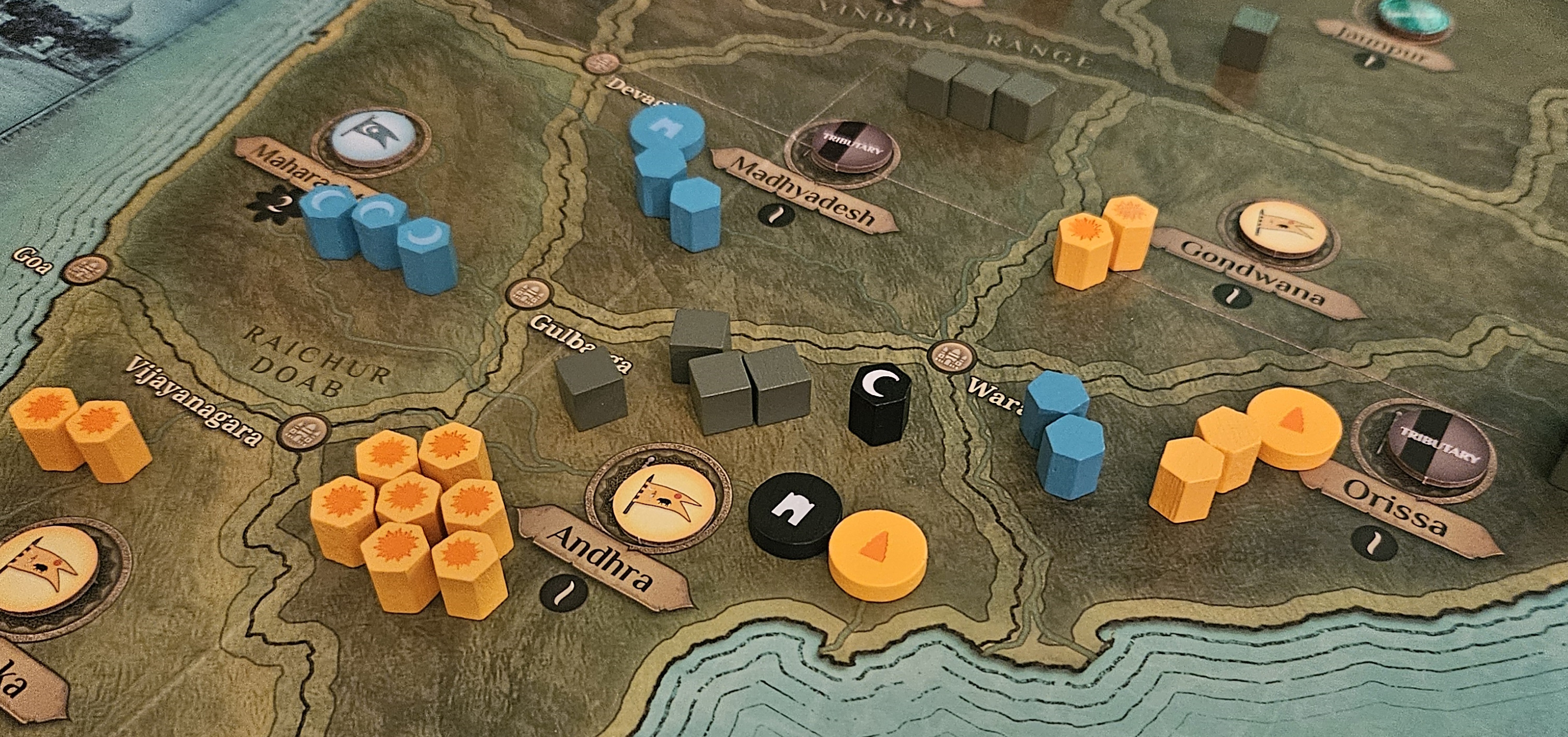
It’s COIN all right.
There’s a long-running question about the COIN Series. If you’ve flirted with getting into the newer brand of historical wargames, those that are card-driven and owe a debt to the Eurogame format, you may have heard it. “Which COIN should I try first?”
My answer depends entirely on who’s asking. It’s an issue of experience. If the person has a long history in board games, they get the deep end. “Try whichever topic grabs your interest,” I’ll say, while secretly hoping they don’t start with Fire in the Lake or Pendragon, the most daunting volumes in the series. But interest (and a learning video) can go a long way toward overcoming any number of barriers.
For others, I take a different tack. The idea is to start them out gently. For years, the answer was Cuba Libre, the breezy second volume of the series. Last year, both People Power and The British Way also sidled into that niche.
Now I don’t see how it could be anything other than Vijayanagara.
There are a few reasons for that. Some are mechanical. This is the least burdened title to derive from Volko Ruhnke’s counterinsurgency system by a fair measure. But there’s also the question of setting. Vijayanagara exemplifies what I appreciate about this type of historical game by being colorful and enthusiastic about an overlooked slice of the human story. Even better, it knows where to apply pressure to evoke a particular mood. Listen to me. “Mood.” But it’s true. For most of the volumes in the COIN Series, the closest thing to a “mood” is a spreadsheet. In Vijayanagara, it’s the stink of a giant’s corpse.
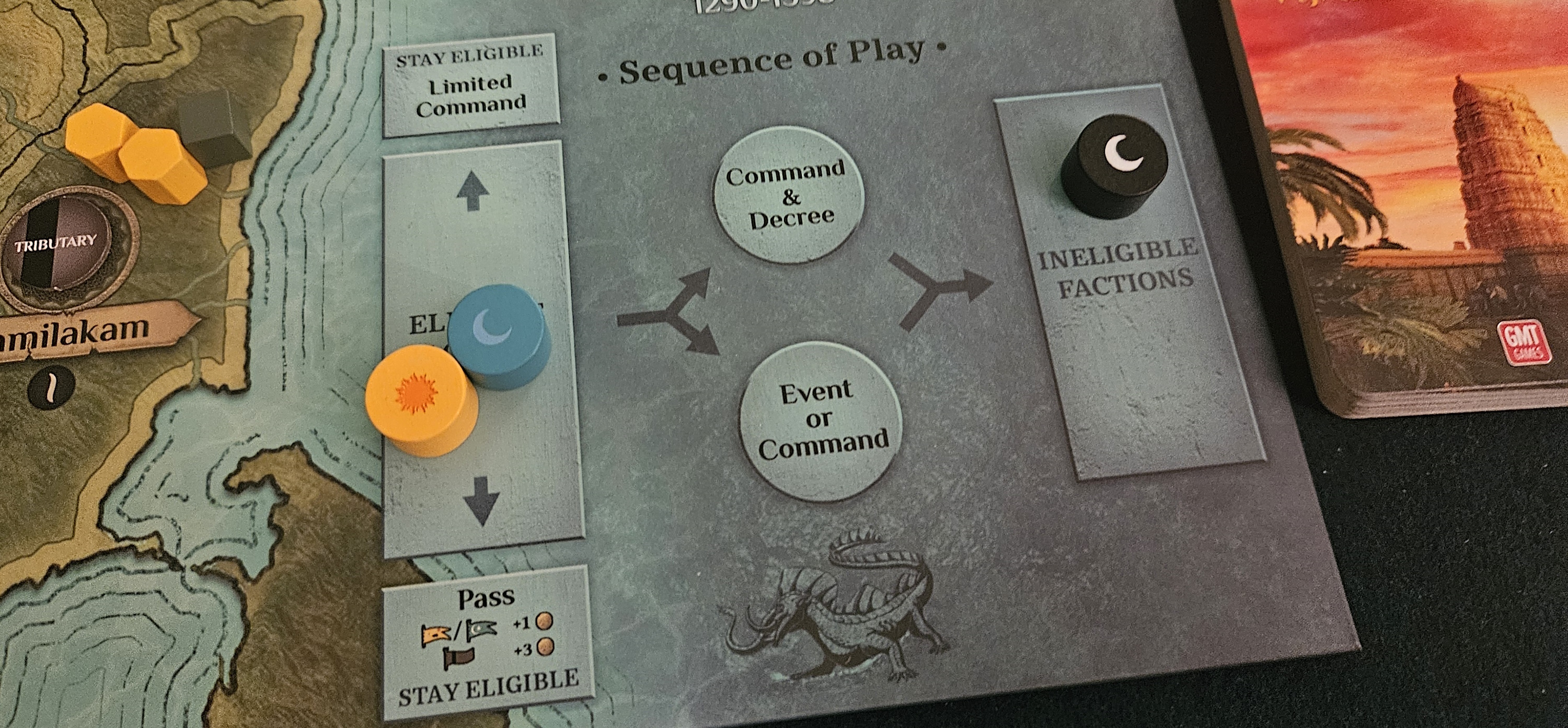
Everything has been streamlined.
That giant just so happens to be the Delhi Sultanate. Formed a century before the start of the game, the Sultanate was one of the many formations of the Islamic Golden Age, a spur of the Ghurid Dynasty that invaded northern India, achieved independence through the rebellion of its Mamluk slave-warriors, and eventually outlived its parent’s demise. It was a turbulent power, marked by violent dynastic succession and jealous hegemony over the rest of the subcontinent. While its rule in Delhi was near-absolute, the many small kingdoms of the Deccan Peninsula proved easier to intimidate into tribute than to conquer outright. But it proved a unifying force in other ways, through market controls, architecture, and the creation of a shared language. Like all great powers, its presence seemed inviolable.
Until bit by bit, and then all at once, things changed.
The game opens on the cusp of the 14th century, when the Deccan kingdoms are beginning to grow ambitious. A confluence of factors have begun loosening the Sultanate’s grip, ranging from petty dynastic turnover to the more pressing issue of roving invasions from beyond the peninsula’s protective mountain barriers. The Delhi Sultanate was formed when nomadic warriors settled into the cities and bureaucracies they had forcibly vacated. Now they’re threatened with turnabout courtesy of the Mongol conqueror Timur.
This is the volatile situation presented by Vijayanagara, and like the best COIN volumes it presents a political thicket in which its principal actors take turns collaborating and clashing with one another. Pruning away some of history’s smaller branches, three factions are offered leading roles. The Delhi Sultanate begins in command of the whole map — literally the entire thing, divided into thirteen tributary states that operate under the good graces of their overlords to the north. Along the western coast is the Bahmani Kingdom, a gathering of scheming administrators with ambitions to carve out their own Muslim successor state. And to the south lies the nascent Vijayanagara Empire, bound together by Hindu patriotism and sufficient distance from Delhi that their uprising stands a chance.
A fourth faction, the Mongols, occupy the northwestern portion of the map. These are effectively trapped on a straight track to Delhi, and are therefore controlled not by any one player directly but instead via cards seeded into the event deck. Every so often, Timur will reach out to either the Bahmani Kingdom or the Vijayanagara Empire, letting them take a couple of actions that directly undermine Delhi, and then offering a devil’s bargain that gifts them resources and horses but diminishes their reputation among the Deccan Plateau’s ruling class. This isn’t the first time the COIN Series has included a non-player faction — that would be the Germanic Tribes from Falling Sky — but the Mongols are inserted with so little rules overhead that their presence is impossible to begrudge. You know, unless you’re the Delhi Sultanate they’re determined to sack.
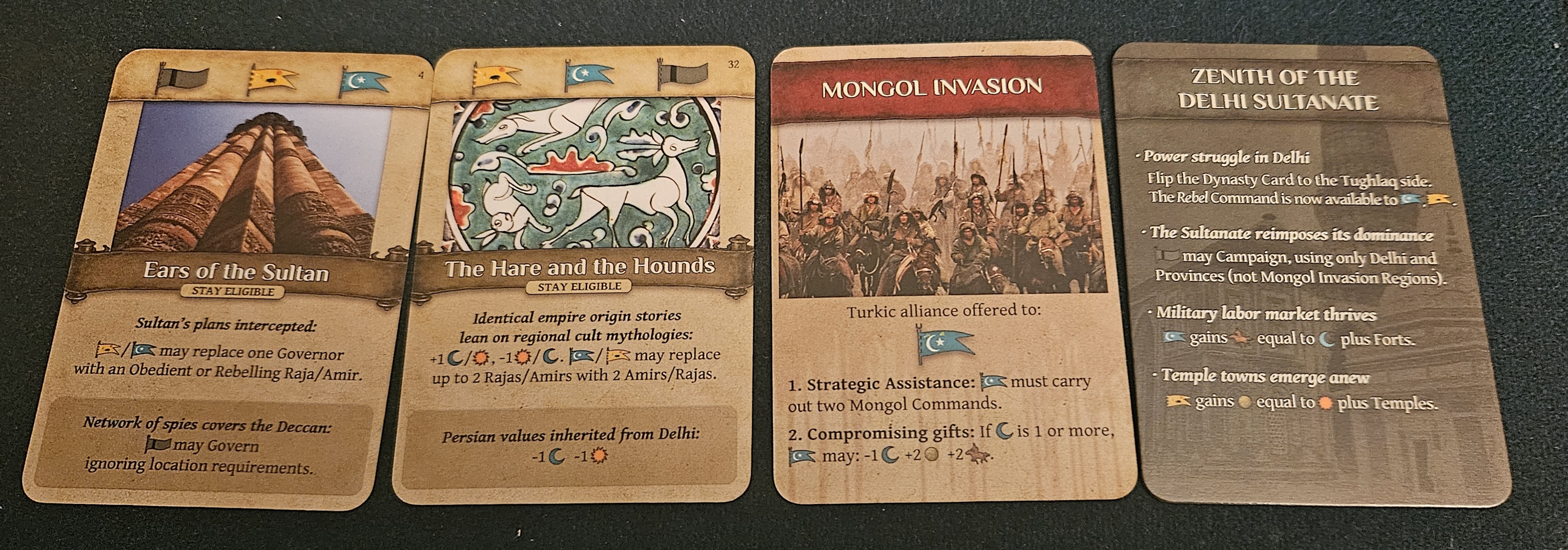
The cards and map are gorgeous.
Much of the game’s appeal arises through its testy social dynamics. The Delhi Sultanate begins with absolute hegemony over the map, but there’s simply too much territory to reliably control. Before long, Mongol invasions also sap both its cash and manpower, forcing it to either dedicate large contingents of troops and tide-turning cavalry to the frontier or else suffer raids on its heartland.
Meanwhile, the Bahmani Kingdom and Vijayanagara Empire are natural bedfellows — for all of twenty minutes. This is a brisk game, wrapping up in perhaps an hour and a half, and while these breakaway states are likely to conspire to some degree, working together to stretch the Sultanate’s forces thin, it isn’t long before they’re at each other’s throats.
This speaks to the game’s sturdy but easily tracked set of incentives. Everybody earns points for controlling territory, whether it’s Delhi forcing regions into submission and tribute or the more direct rulership of the two rebellious factions. This provides the bulk of the game’s back-and-forth, an evolving contest for control that requires some measure of recruitment, positioning, governance, and battle.
But there are other concerns to keep in mind. For the Sultanate, that’s the inviolability of Delhi itself. Depending on whether Timur ransacks the city — and how badly — they’re looking at a spread of points from the positive to the negative. The Bahmani, meanwhile, exert their authority via forts that can reinforce neighboring provinces in battle, while the Vijayanagara erect temples that declare their intent to carve out a defiant Hindu state. Both of these structures are also worth points. Maybe a game-deciding amount, given the razor thin victory margins this game produces.
It helps, too, that the map is immaculately arranged. Delhi can’t be entered by the rebels at all, forcing collaboration with the Mongols to erode the Sultanate’s power. The relative strength of each territory must also be taken into account. The Bahmani and Vijayanagara homelands in Maharashtra and Karnataka respectively are almost impossible for the Sultanate to hold, but the temptation of wealthier provinces, such as far-flung Gujarat and Bengal and the centrally located Malwa, force everyone into pressure cooker proximity. And that’s a proximity that matters, especially once the arrows start flying. The rebel factions are both vying for Deccan influence, and that’s won only when they directly oppose one another. It’s entirely possible for the Sultanate’s enemies to become its best friends, especially once they’re so distracted fighting one another that their newly independent territories become ripe for forcible reintegration.

The Mongol invasion is a dire threat to Delhi.
For all that, Vijayanagara is surprisingly easy to play. It imports almost everything from the COIN Series, but shorn of its wool until all that remains is a fine fuzz.
There’s the event deck, complete with initiative orders and special cards that intrude on the ordinary process of play. But these events are a little bit easier to consider, sometimes earmarked so that the faction taking them can act on the following turn rather than missing out on the action entirely. Similarly, those seeded cards are less daunting. Where the series has always paused for “propaganda rounds,” long-form victory checks and resets that require their own bulleted lists to resolve, Vijayanagara drops them entirely for cards that present minor adjustments. Early on, the collapse of the Khalji Dynasty and the rise of the Tughlaqs throws the peninsula’s balance of power into disarray. In game terms, this allows the Bahmani and Vijayanagara to openly rebel against the Sultanate. Later, a resurgence in the Sultanate’s authority allows them to conduct a free military campaign, effectively redistributing some of their troops, while the breakaway kingdoms earn an infusion of capital. Later still, two cards herald the appearance of Timur and the conclusion of the game. Compared to COINs past, it’s dead simple, providing a three-act structure without backing the game into a narrative corner.
Everything else has also been streamlined. The initiative system returns, but in a much simpler format. It’s still possible to block events or take advantage of an opportune moment, importing the tradeoffs that are essential to the series. But the rubric that guides the sequence of play is more intuitive, making previous installments appear clunky by contrast. Region control is still crucial, but it’s calculated via majority alone, and without the support/opposition stuff that tends to make COIN’s approach to area control so complicated. Even battle has received an overhaul. Unlike the combat resolutions of, say, Liberty or Death, with its myriad additional perks and fortification bonuses and various leader strengths, everything has been reduced to army sizes, dice rolls, and cavalry chits that can be spent to reduce enemy hits or guarantee your own. Recruiting cavalry, by the way, is directly tied to your faction’s economic prosperity, creating a tidy feedback loop between your kingdom’s performance off the field and on it.
That’s all very technical. Here’s the protein. While the system dips closer to “complicated Risk” than any of its predecessors, it’s also so much easier to play. Of course, simplicity and ease aren’t the sole virtues of game design, and to some degree Vijayanagara sheds the granular focus that makes its system so appealing in the first place.
But where some of the COINs require their chrome, Vijayanagara is right to shrug off the extra layers. By stripping away the particulars, it’s free to focus on its thesis. Along the way, something impossible happens: for the first time in the history of the COIN Series, the rules take a backseat to the narrative. They fade into the background. In their place is the tale of a great power that’s begun to rot at the edges, the predator that senses its moment of weakness, and the scavengers who see the opportunity to make something of themselves.
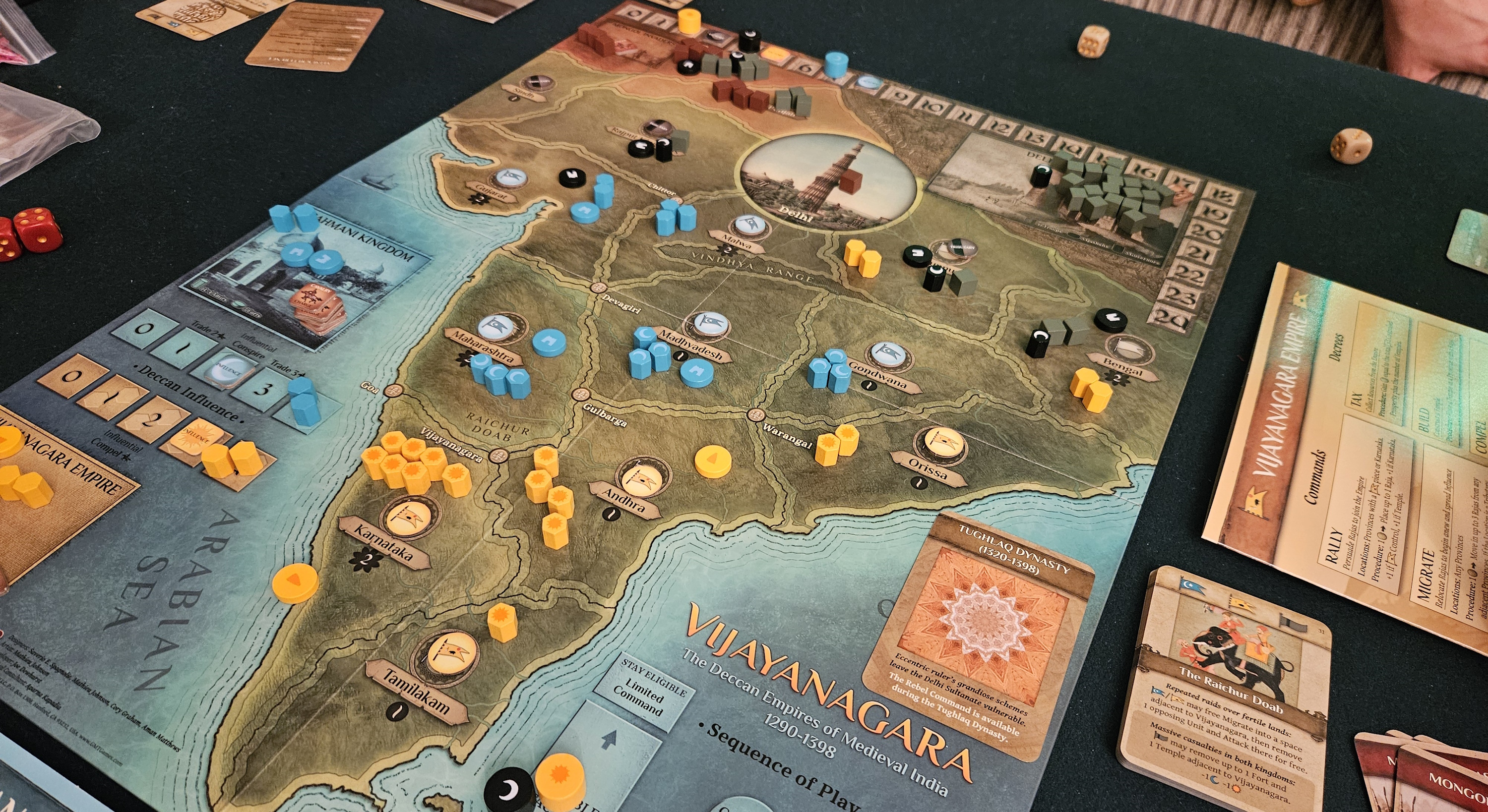
I love this depiction compared to the more sparse maps.
It’s a visceral, memorable recounting. Plenty of historical games have endeavored to show how moments of great change are carried along by many small hinges. Usually via the Fall of Rome, if we’re being honest about this hobby’s tendencies.
Vijayanagara outdoes most of them. That’s because most of them assume that the fall of an empire is only about the empire that’s falling and the invader that makes it fall. Vijayanagara places due emphasis on those forces, but also lends attention to the successors who step into the vacuum. The Delhi Sultanate that clung onto life for many decades after Timur’s sacking. The Bahmani Kingdom that ruled the highlands of India for nearly two centuries until it splintered into smaller principalities. The Vijayanagara Empire and the revitalization of Hindu religion and society it fostered. The march of history, every collapse providing the cradle for the next thing.
Something ends. Something begins. If such crisp depictions of historical nooks are what we can expect from the Irregular Conflicts Series, I’m all for it. And if the mainline COIN Series needs to collapse for that to happen… well, I think I’d be fine with that, too.
(If what I’m doing at Space-Biff! is valuable to you in some way, please consider dropping by my Patreon campaign or Ko-fi.)
A complimentary copy was provided.
Posted on March 26, 2024, in Board Game and tagged Board Games, COIN Series, GMT Games, Vijayanagara. Bookmark the permalink. 13 Comments.

 SPACE-BIFF!
Mood? Mood is a thing for cattle and love play!
Sounds like Vijayanagara to me!
Great review. I’m curious though, when you talk about COIN games not having good narratives, if that means you’re rethinking your praise of the series as a whole.
Hey Anonymouse, good question. I’ll copy in an answer I just posted in the COIN Discord:
I’m not saying that COIN doesn’t produce narratives. It does! But those narratives tend to be partially obscured by procedure. By easing the procedure, Vijayanagara’s narrative is clarified.
Rallying is a good example, because most COIN volumes require players to rally quite a few times before they have sufficient manpower to accomplish anything. Another is the loop where you need to secure a province with control/troops/police in order to shift support/opposition. These make sense within the procedure-oriented COIN volumes. Because COIN originates as a system about the procedures of counterinsurgency, they gel within the context of what the series is trying to express. But in terms of telling a story, those procedures tend to be highlighted above, say, the larger tale of a revolution, or Caesar’s pacification of Gaul, or whatever.
So I’m not really offering that as a critique of the core series, because that’s what the core series is about. But some of the more recent offerings, especially The British Way and now Vijayanagara, tell very different sorts of stories.
You’ve nailed it with this review, I am so impressed with this game: It’s fast, smooth, full of interesting decisions and it tells such an interesting story about a period of history which I knew absolutely nothing about.
I think it’s also worth highlighting all the support material that comes with the game. Not only do you get the base rulebook, but a separate learn-to-play book, a solo rulebook and (the highlight) a historical booklet which goes into the history the game portrays. It’s a top-notch product all around! I am very curious where they go next in this series.
Right! The support materials are excellent.
I wish GMT posted the solo rules booklet online like they did with the other ones. I play only solo and I always read the rules before I decide to make a purchase.
I know that’s a point of contention among some of the designers over there. Some feel publishing the rules cannibalizes sales. Others feel the Vassal crowd winds up buying the games they play digitally. I tend to fall into the latter assumption.
No worries now. I’ve obtained a scanned copy. Now the designers have a chance of getting another sale, from me. Where-as just before this, their probability was 0%.
Vijayanagara is the first COIN-like has produced for me an actual sense of the history while playing. The designers clearly wanted to tell that specific historical narrative, and worked hard to create a game that reflected the central tensions at work. I of course have no idea of the distribution of ideas or work among the team, but including Dr Aparna Kapadia as a historical consultant clearly made a difference. Especially when compared with Gandhi, a game that desperately needed sources beyond North American and European texts.
It’s interesting, because I’ve received some pushback about this one having the clearest narrative of the system, but it seems pretty apparent that many folks are connecting with it in a way they haven’t with other COINs. I’m not even saying that as a slam on the mainline series. It’s meant to be procedural! It’s about literal procedures!
And yes, I couldn’t agree more on the game’s broader authorship. Its materials and essays are exceptional.
Pingback: Infinite Gest | SPACE-BIFF!
Pingback: Best Week 2024! Better Together? | SPACE-BIFF!