MORE RHUBARB

All I play anymore is trick-taking games.
Pies, a remake of Matthias Cramer’s 2015 Plums, does not happen to be a trick-taker. Oh, I’m aware there’s some debate over the matter. Couldn’t this be considered a trick-taking game with but one suit and a slew of ranks? I guess so. That would transmogrify a whole lot of games into trick-takers, but sure. And a hot dog is a sandwich.
Semantic athletics aside, my concern has less to do with trick-taking essentialism and more with this pastry’s sogginess. Cramer has produced some excellent games over the years, from hefty fare like Weimar to more accessible titles like Watergate and The Hunt. Compared to those, Pies doesn’t rate.
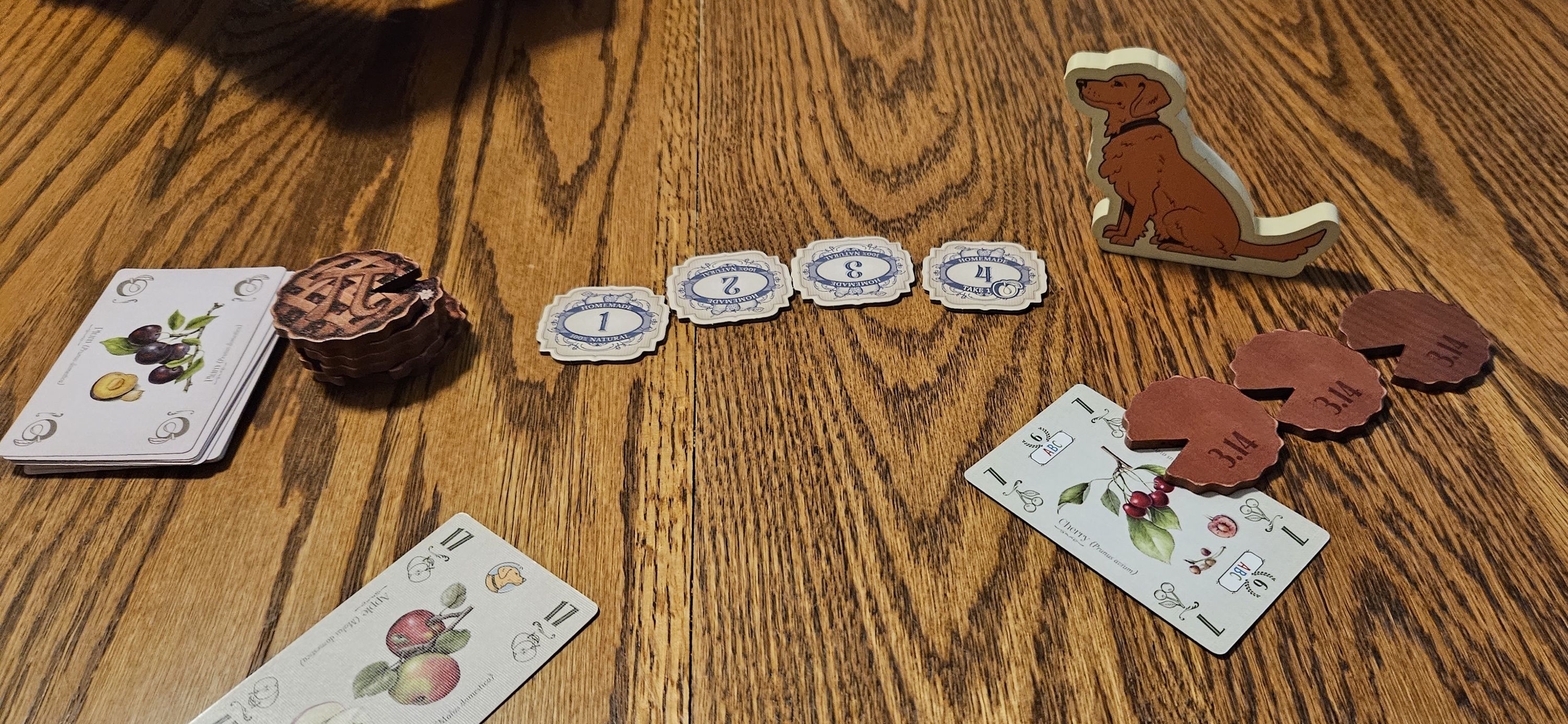
Good boy. (Deluxe components shown.)
Let’s put the trick-taking thing aside. Pies, at its core, is an auction game. Everyone at the table is dealt a hand of cards. These depict a few things: a rank, an ingredient, and possibly a special ability. All at once, everybody plays a single card. These are arranged in order of rank. Then whomever won first place chooses a card, enacts its special ability if any, and adds it to their growing pile of ingredients. Now and then, they might use those ingredients to bake a pie. Everyone else follows that process, one by one, until all the cards have been claimed.
Within that framework, there are a few subtleties to consider. It’s possible to steal ingredients out from under your rivals, transforming Pies into a baking reality show on one of the nastier cable channels. Sure, you could track what everyone wants and try to bid on those ingredients, but the easier method is to pick up a card that lets you steal outright. That, in turn, can be blocked by the dog, a moveable guardian and card ability. Also, playing the lowest card forces you to choose your ingredient last, but you also get a plum card to pad out your crisper and more easily bake a pie.
That’s pretty much it. There’s some meager strategy at play. It’s better to play the highest or lowest card, as getting caught in the middle neither lets you pick a card early nor awards a plum. Certain tokens, cutely represented as pies, add pi to the value of a future card rank. Each of the game’s three rounds — signposted by three separate decks — escalates the potency of the abilities and the value of a successful pie. And the winner of the “trick” goes first in the next play, creating the usual turn order shenanigans found in other games of this stripe. Not by happenstance, that’s where the comparisons to a trick-taker feel most pronounced, promoting a hyper-awareness of where one sits in the overall sequence.
But while it couldn’t be described as unpleasant, this is one pie that skimps on the filling. It’s sleepy much of the time, asking players to assemble fairly easy sets. But it’s also weirdly mean thanks to all the windowsill thievery. This tension isn’t an intriguing ambiguity so much as a tonal backhand across the face.
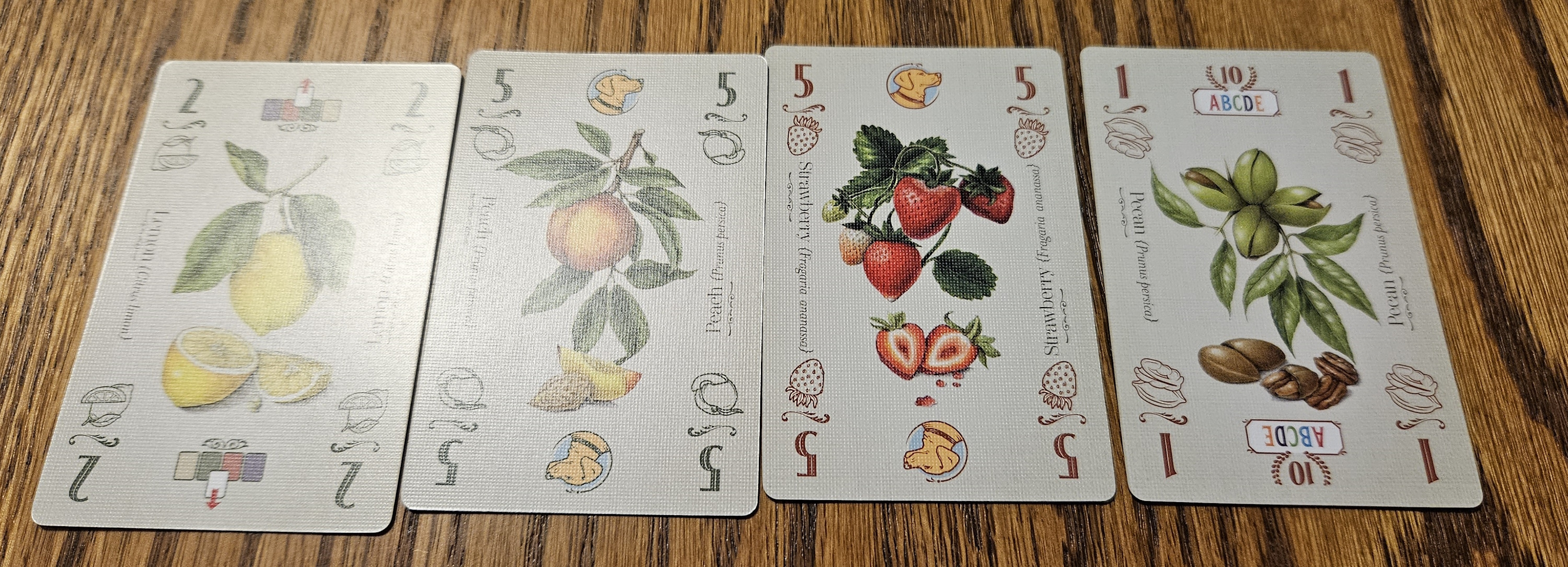
My special: lemon peach strawberry pecan glare pie.
Perhaps Pies would stand out more if we were starving for innovative trick-takers that could be played with extended family. Perhaps in 2015, before the genre’s current explosion, Plums felt more essential.
But this is not 2015. There are so many trick-takers I’d rather play with my mother-in-law, many of them published by Allplay. As such, Pies feels like a weary sigh, the first glimpse of genre fatigue, despite predating the current affluence of trick-takers by eight years. It’s like stumbling across a family recipe from pioneer times, excitedly sliding the ingredients into the oven, only to discover that our modern tastes have diverged from rhubarb and prairie dirt, or whatever it was that our bonneted ancestors found toothsome. Pies is fine. In today’s market, fine isn’t good enough.
(If what I’m doing at Space-Biff! is valuable to you in some way, please consider dropping by my Patreon campaign or Ko-fi.)
A complimentary copy was provided.
Posted on November 29, 2023, in Board Game and tagged Allplay, Board Games, Pies. Bookmark the permalink. 4 Comments.

 SPACE-BIFF!
“All at once, everybody plays a single card.” Not so, sir!
The rulebook clearly says that one player leads and each player follows in clockwise order. The player who had the one token leads the next trick. That change will make the game much more strategic for you and give you much more control – I guarantee it. Please try it with these rules and see if your opinion changes.
Sadly, I played it correctly. But also sadly, I phrased that part weirdly.
Oh well, I tried. 😛 Thanks for your reply!
Pingback: Gnobody Gknows | SPACE-BIFF!