Federation Kitbash
Yesterday we took a look at Age of Civilization, Jeffrey CCH’s take on the thirty-minute civgame, which was loaded with clever ideas that got short shrift thanks to the game’s clipped duration and misplaced priorities.
Fortunately for us, CCH revisited the concept a few years later. Age of Galaxy swaps the first game’s historical civilizations for alien societies, tasking players with cobbling together their very own Federation of Planets — or a merciless Dominion. Or a Culture. Or maybe an Imperial Radch if they play their cards poorly. The bones of that first game remain very much intact, but everything else has been overhauled. And this is one hull upgrade that proves rather appreciated indeed.
Exploring spaaaaace.
From a design perspective, contrasting Age of Galaxy with its forebear highlights how a few minor changes can result in a radically different game. When I say that the bones of Age of Civilization are intact, I mean it — although they’ve undergone a few transformations of their own. Like CCH’s earlier effort, there are two core experiences that have made the jump to FTL.
The first, of course, is a huge stonking pile of faction cards. There are forty this time around, a small downgrade in quantity that’s more than made up for by their greater distinctiveness. As before, everyone is asked to merge three of these cards, adding at most one per round to their own tableau, in order to create a unique combination with its own abilities and priorities. Also, this time, its own ideology. But we’re getting ahead of ourselves.
Meanwhile, everyone is also required to assign workers to an action selection board. There have been more changes to this system than the aforementioned factions, but the gist remains the same. The biggest departure from Age of Civilization has to do with population. Rather than basing your pawns on your current empire’s population, every round permits the placement of exactly three cubes. This puts everybody on equal footing, stripping out the pesky meta-consideration that burdened the previous game’s card selection and letting everyone focus on making ideal selections rather than fretting over their dwindling reproduction rate.
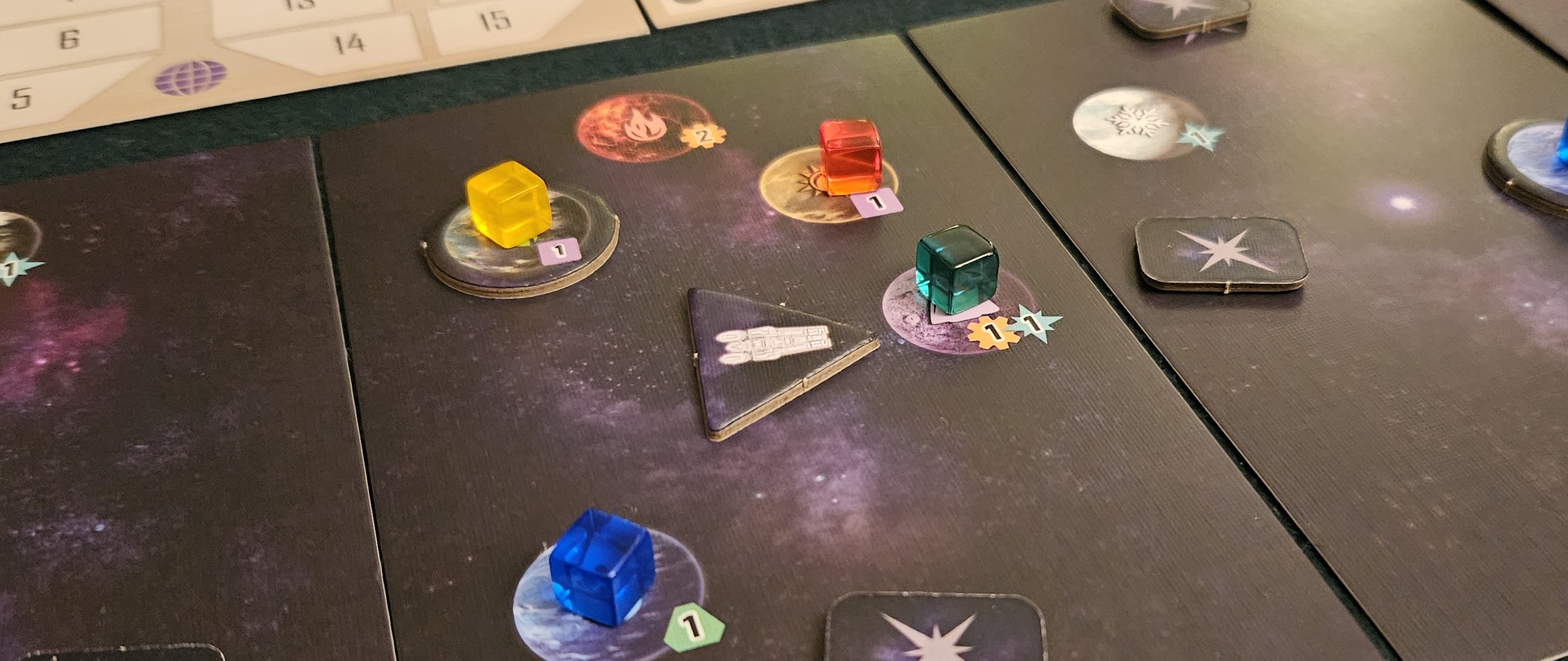
On the whole, though, Age of Galaxy is a heftier game, and this time around there’s a shared galaxy board to consider. This isn’t a map as such; there’s no geography to consider, no considerations of proximity to other factions or borders to safeguard. It functions more as a way to track each player’s colonies and whether there are spatial anomalies worth investigating. As the game progresses, new sectors of space become reachable, adding to the quantity of planets and anomalies in play. When war is sparked at the end of each round, maybe the dominant empire will conquer a single planet. It’s simple and streamlined, but produces a core interest that Age of Civilization lacked entirely. Where previously empires existed in a vacuum, here they’ve been given solid footing by, of all things, the vacuum of outer space.
This time around, cards get more mileage.
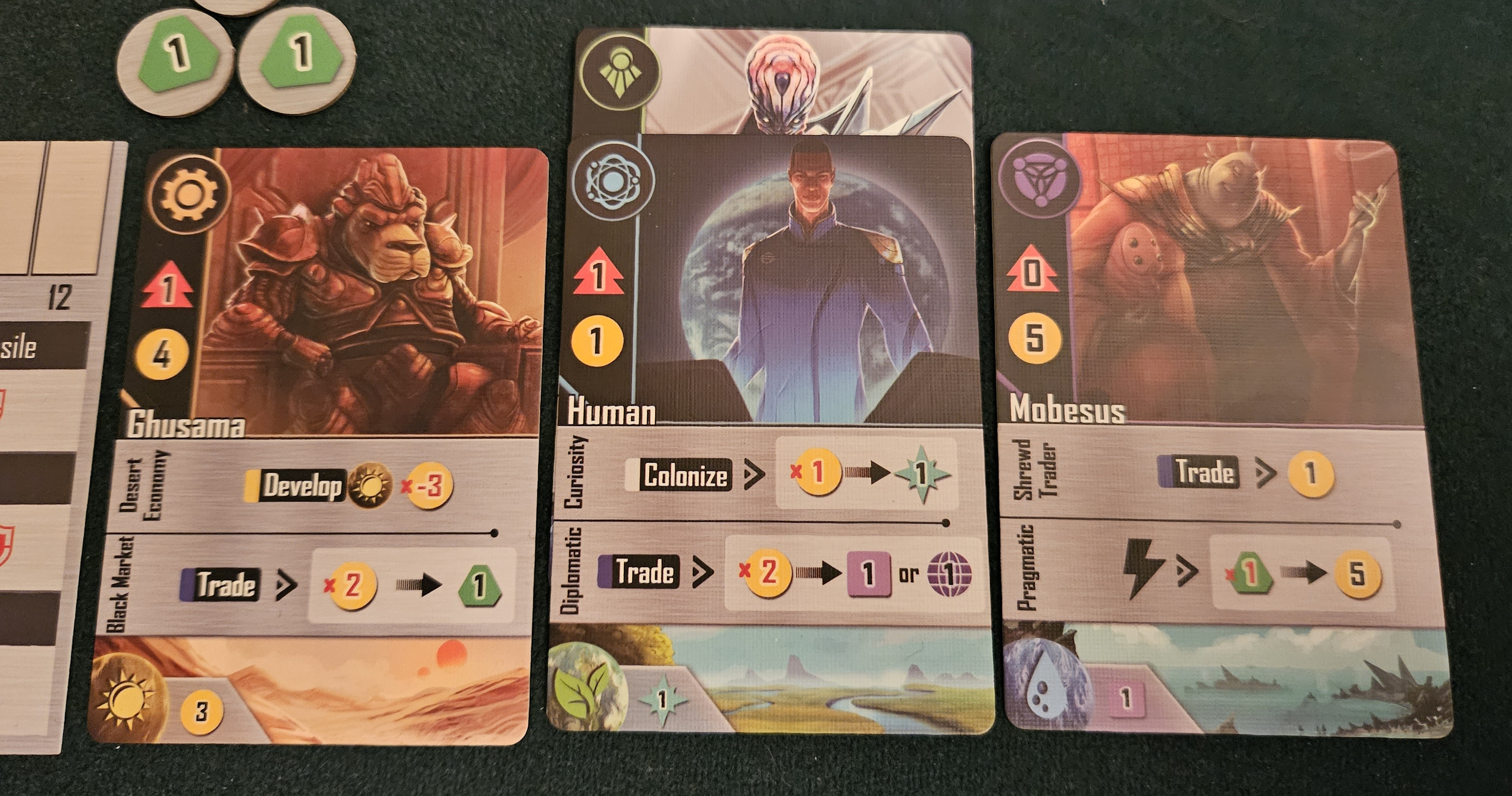
The faction cards were easily the highlight of Age of Civilization, but CCH has outdone himself here. Each is a force unto itself, providing a range of perks that make it a worthwhile inclusion in any starfaring meta-civilization. Rather than awarding population, selecting a faction immediately awards a bonus in cash and ships — spending and military power, respectively — along with two traits that modify other actions, provide new techs to unlock, or add new ways to exchange resources.
As you might expect, the joy of these cards is derived from how they combine. A federation that includes the buglike Scythe and the scheming Quowen may seem like unlikely bedfellows, but the former’s additional income from scavenging, normally a catch-up action, and the latter’s ability to purchase political influence with cash can make for a potent combination. Every species is worthy of consideration. Struggling to protect your planets from the Slashers? Invent the Legarchaea’s Water Dome Shields. Want to make the retrieve action more worthwhile? Let the Inaam transform it into a relic- and influence-earning powerhouse. Feeling too wacky? Deploy the Humans. They’re defined by two words: Bor and Ing.
There are some crucial modifications to how these factions work. The first is that cards are drawn or drafted at the outset of the game rather than purchased from a market. The absent marketplace feels like a missing tooth at first, but the tradeoff is a quicker play. Your hand of cards immediately becomes a familiar and reliable companion, with combos and possibilities ready to go, and we didn’t miss pausing the game to pore over a shifting row of cards.
More importantly, these factions get more mileage. Of the eight cards you begin with, you’re free to use one per turn. Only three are assigned as members of your federation, while the rest can be spent for smaller bonuses, like a few extra coins or the one-time ability to settle a planet that would normally be outside your federation’s habitable type.
There’s also ideology to consider. Scores in Age of Galaxy don’t soar all that high, stretching to perhaps thirty points at the upper end. Consequently, every little bit matters. To help push your score as high as possible, each faction has its own archetype, such as militaristic species that prefer conquest or builders who earn extra points from developed planets. If two of your three factions share an ideology, it becomes dominant, unlocking one of these endgame scoring opportunities.
But there’s a way around this limitation. Each meta-civilization can support a fourth species — an overlord. This punk sits at the top of the food chain, providing no benefit other than its overriding ideology. Since this counts as your card play for the turn, it also robs you of resources you might otherwise gain from that faction. This adds texture to your selections. Is it better to take a slightly suboptimal pick that establishes a dominant ideology and lets you use your remaining cards for cash? Or is it better to hold onto some cards for a late-game pivot to a new way of thinking? It’s a smart system, adding one more splash of character to each card, not to mention a formidable decision that informs how you approach every other aspect.
The action selection system is much expanded.
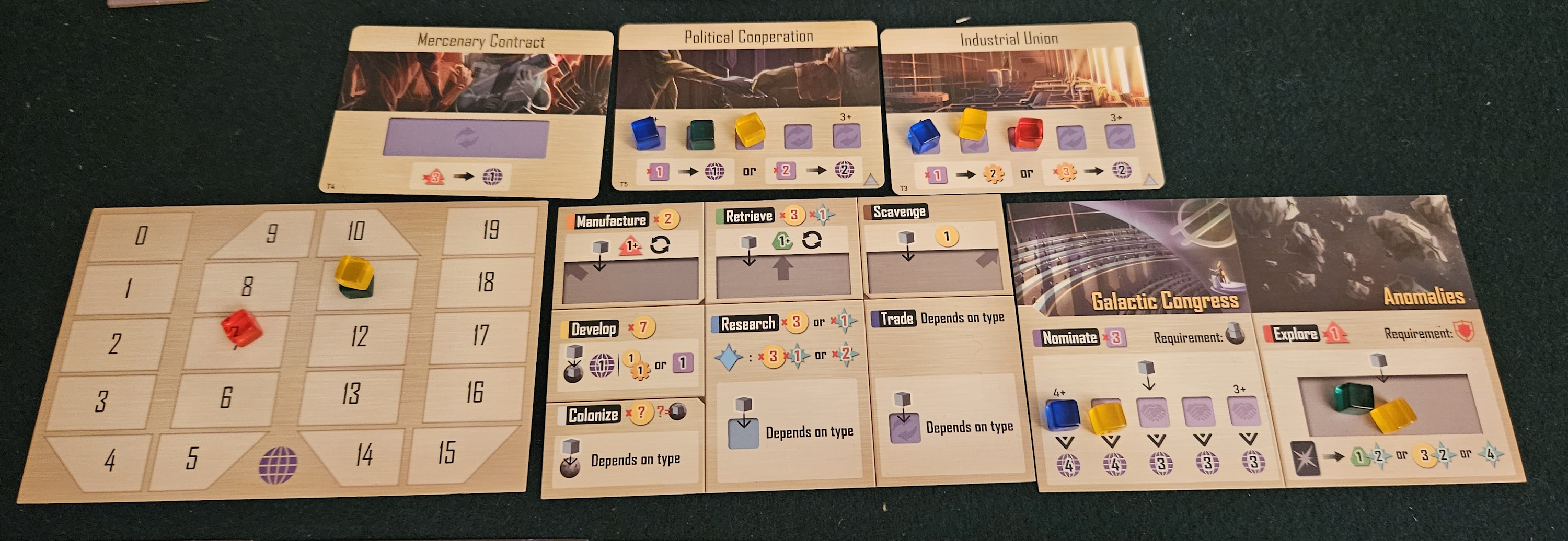
Speaking of those other aspects, Age of Galaxy still sometimes finds itself adrift without a functioning warp drive. It’s a victim of its compact format; while the action selection system is more permissive than the one found in Age of Civilization, it’s still rather thin and inexpressive. Cubes are assigned to various boxes, colonizing planets and building ships and all the usual stuff, as well as a few details of CCH’s vision that are interesting but underdeveloped. In particular, trade occasionally triggers a “golden age” that sees those cubes bounce back to players for an enhanced next turn. The only problem is that the game lasts only five rounds, so a golden age is only likely to happen once, and only for those players who emphasized trade or some specific corresponding actions. Adding injury to ache, it’s most likely to occur on the last turn, when any benefit is lost. Bummer.
War, meanwhile, is only marginally more interesting than the tallies from Age of Civilization. Here the main resource is ships, while the tiebreaker is one’s military ranking. Winning the war lets you occupy a planet, but only if one is unprotected. If everyone is paying attention, that’s a rare occurrence. The result is all arms race, no kinetic war. I hate to say it, but a focused objective, such as a Mecatol Rex for everybody to quibble over, wouldn’t have gone amiss.
There’s also exploration, but only in limited fashion. It’s possible to sacrifice an action and a ship to uncover an anomaly token for resources, but these hardly constitute a Five Year Mission. It doesn’t help that the galaxy feels so tiny; depending on player count and which galaxy boards are placed, there might only be one or two opportunities to explore in the entire game. So much for the final frontier. This galaxy is more like a backyard with an unkempt lawn.
All that said, however, Age of Galaxy does some genuinely exciting things. Its most significant highlight is its cards, which allow for delightful combos and unexpected plays. It helps that every faction is imbued with a well-rounded identity. After only a few sessions, I’ve learned to watch out for the Haiqarim’s ridiculous military might, the Cheiki’s tendency to colonize everything, the ease with which the Feimur-V5 sacrifice ships. They’re recognizable in a way that Age of Civilization’s nations are not.
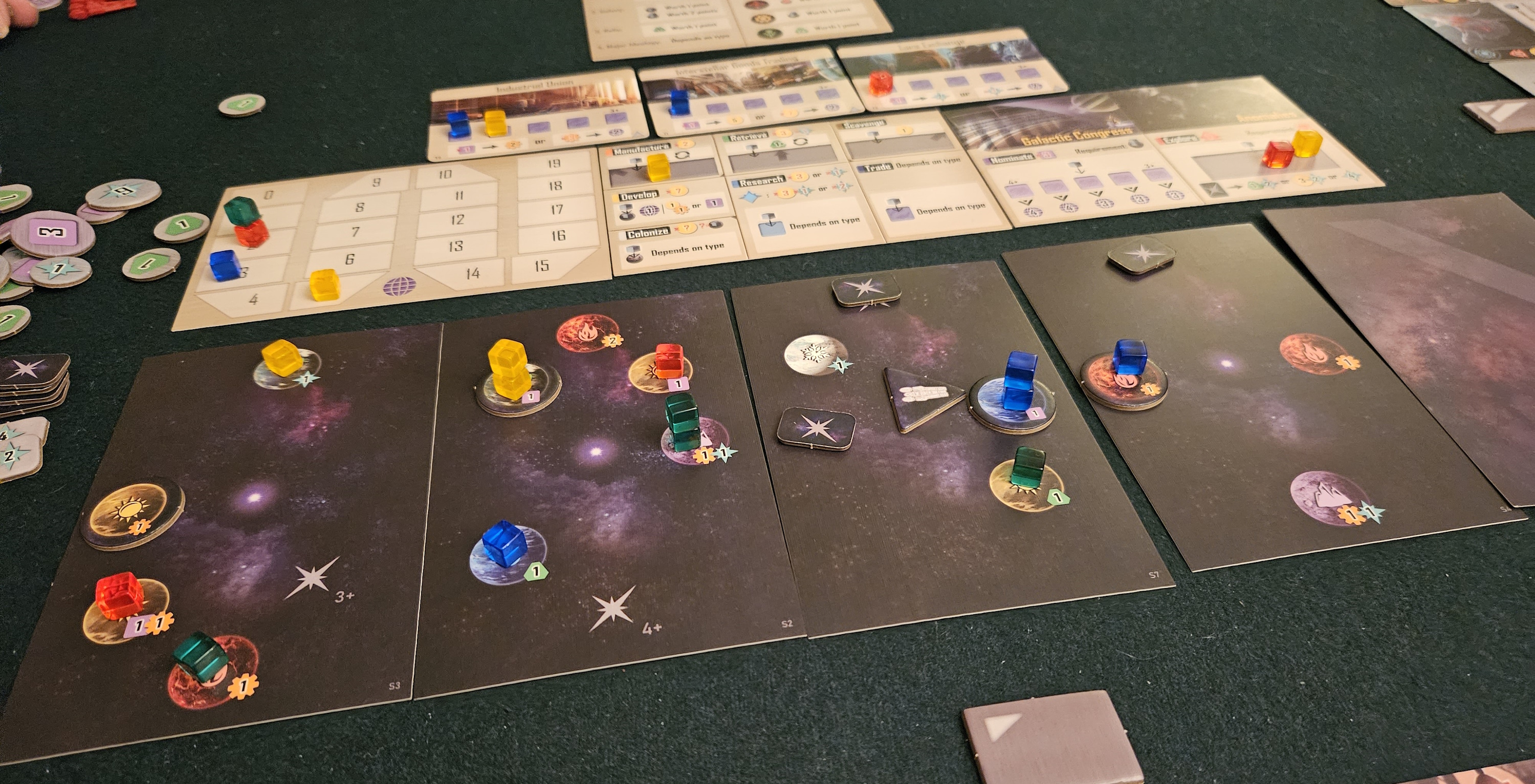
Balancing tiny cubes makes it a dexterity game, no?
In the end, it’s the factions that make the game. Almost on their own, they elevate Age of Galaxy into one heck of a forty-minute civgame. An imperfect civgame, to be sure, one that looks to speculative fiction rather than the annals of history to formulate its perception of the world. But the result is still fascinating despite its rough edges and awkward title. It’s an imaginative strip mine of science fiction, and easily the best of Jeffrey CCH’s titles I’ve played thus far.
(If what I’m doing at Space-Biff! is valuable to you in some way, please consider dropping by my Patreon campaign or Ko-fi.)
Posted on November 28, 2023, in Board Game and tagged Age of Galaxy, Board Games, ICE Makes. Bookmark the permalink. 7 Comments.

 SPACE-BIFF!
Then would it be worth exploring it as a game that doesn’t get clipped at 5 rounds?
I really couldn’t tell you. The game seems capped at five because that’s how many sectors will be unveiled. If somebody wants a longer experience, they would probably need to test the balance of anything further.
Despite your valid points about disappointments like the elusive “golden age” carrot, I much enjoy Age of Galaxy. Impressive that such a game is crammed into so tiny a box.
Unfortunately I had a friend who refused to even try it because he could not get past the use of iconography — among other things, a lightning bolt bonus which does NOT mean an instant effect. His loss. Because yes, some aspects of the game feel awkward. And — puzzling out how to work those race powers to your best benefit (and before your opponents do) always captivates me. I’d recommend anyone give it a try.
Ha, right, that lightning bolt sure is misplaced. But I agree! This one is worth trying.
Pingback: Age of Three Civilizations | SPACE-BIFF!
Pingback: Terrace Jerks | SPACE-BIFF!
Pingback: The Little Crunch | SPACE-BIFF!