The Wine-Dark Aegean Sea

I know Carl Chudyk can design a great game. That’s because he has. Many times. The Glory to Rome black box sells for like a bazillion dollars, and not only because it’s out of print. Innovation has fifty editions, all well deserved. And I still regard Impulse and Red7 as overlooked gems. Not because they’re overlooked, really. Because they don’t get the same attention as those first two I mentioned.
So it’s with no small degree of perplexment that I have struggled to understand Aegean Sea. The bones of a Chudyk game are there. You can line them up to make a proper skeleton. But once assembled, there’s no telling how this dinosaur was meant to function.
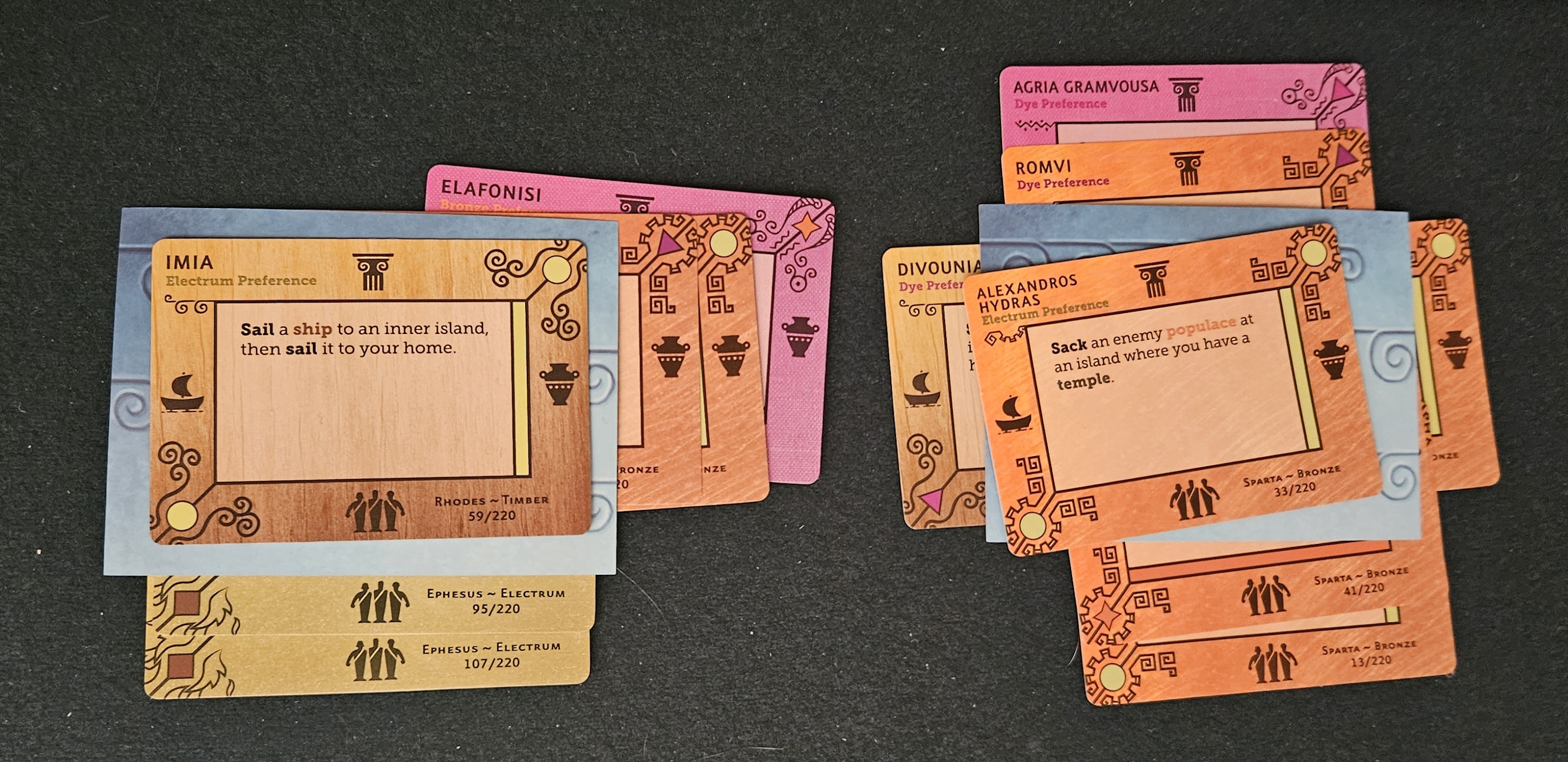
Two pleasant Greek isles.
Here’s how I think it was supposed to go.
Like most of Chudyk’s games, Aegean Sea is an idealized Antikythera Mechanism. Every card has about thirty possible uses, like multi-purpose gears that can slot into many places. They are resources called “trade goods,” the object of your expansion, the stuff you produce at far-flung islands and then haul back home. They are also the islands themselves, and the ships that do the hauling, and the manpower that commands the islands, and special actions that break the normal rules, and maybe temples for doing something, and another type of resource that you spend to enact all the other stuff. Oh, also combat resolution and other randomizing elements. Those too. Properly slotted together, they surely fit into something beautiful and elegant.
Except much like the actual Antikythera Mechanism, there’s no telling what any of this is for. It’s either been lost to time and decay or it was never actually functional to begin with.
Oh, the gist isn’t too tough to grasp. Your goal, broadly speaking, is to produce trade goods and ship them to your home island. The more of a good you squirrel away, the more points they’re worth. Holding one dye equals one point. Five marble, though? Twenty-five points. Time to specialize this economy.
Easier said than done. Nothing in Aegean Sea operates the way you’d expect. Even the most straightforward, banal action, like moving a ship from one place to another, is loaded with caveats and footnotes. And that’s before the game decides to slam everybody at the table with a veritable Minoan Eruption. Again and again and again.
Take, for example, your home island. The cards you see on the table constitute the game’s “inner” islands, the contested spaces where troops and ships and temples (I guess) will vie for control of those precious resources. By contrast, your home island is less prone (although not immune) to rival provocation. This is the destination for all those trade goods. It’s also your reference card, and an excessively text-heavy one at that. There are four broad actions in Aegean Sea. I say “broad” because the first of them constitutes five different sub-actions, each dependent on the card you’re spending. Bronze cards place population. Marble cards build temples. Electrum cards produce trade goods. These all come with their own steps and sub-steps, which at this point means we’re piling bullet points beneath our bullet points.

(Greek) wrestling against my hand.
Okay. So far so Chudyk. But your home island is also where you’re instructed to place your quest. Basically, every turn lets you use a card action and use the special ability printed on its face. Okay, fine. Except maybe you can’t or won’t want to conduct this special ability. So you can let it sit around as a quest. Okay, got it. But now it’s sitting there on your reference card. The same reference card under which your home islands manpower, ships, and temples are splayed.
The same reference card that has your faction abilities printed on its reverse side.
Now, a reasonable person might say, “Not a big deal, right? You can place your quest anywhere. And you can flip your reference card to the reverse side when you need to see what your faction does.”
But we’re cutting to the heart of why Aegean Sea has a dysfunctional relationship with its own intentions. Because you pretty much want both references available at all times. Faction abilities aren’t simple things. They aren’t, like, “Move ships faster.” They’re whole paradigms. They’re things like, “Rhodes, when it sails or zephyrs (ugh, that means “teleports”) one of its ships to an island, creates a good there.” That’s one of the easiest examples, and already we’re looking at sub-sub-bullet points, because there’s a substantive difference between this game’s verbs. “Convert,” “change,” and “replace” mean different things, each with their own subtleties. So do “create” and “pay” and “add,” and “sail” and “zephyr,” and hell if I can remember what “recolor” is supposed to mean. Multiple of these verbs mention “placing.” Is that another of the game’s action verbs? I couldn’t tell you.
Again, this is one of the easy abilities. Crete engages in piracy, which might sack whole islands and all of their tucked cards out of the game on a whim. (“Sack” is another action verb. It’s a fancy but limited word for “discard.”) Ephesus can tax and trade, effectively generating victory points with very little effort compared to everyone else. Athens can construct special temples that are worth points at the end of the game. Sparta builds statues praising their toned abdominal muscles. Also worth points at the end of the game. I have yet to see one of them survive more than ten minutes.
The point is that these are all transformative, offering unique paradigms that affect not only how each faction behaves, but how everyone else at the table reacts to them. Fun fact: The word “paradigm” comes from a Greek rhetorical concept that roughly translates into “show side by side.” To put it at its most basic, a paradeigma was an example from which a general rule could be drawn. For example, in the Iliad, when Priam is starving himself due to the grief of losing his son Hector, Achilles brings forth Niobe, who has lost twelve children but is still gathering the strength to eat. By putting two situations side by side, this paradeigma demonstrates the proper course of action.
I’m not bringing this up for funsies. Rather, it’s illustrative, even paradigmatic (oho!) of a larger point. Aegean Sea is a game that bonks you on the head with information. So much information, splayed over and under other tidbits of information, that it swamps together into an indecipherable mess. It doesn’t even have the good graces to make its icons legible. T.L. Simons’ lovely illustrations, sparse as they are, are not the issue. The issue is that there’s only one icon for a trade good, but there are five of the things, and it isn’t always easy to tell at a glance the difference in watermark texture that distinguishes wood from bronze, or marble from electrum. And that’s before we mention that cards have a resource preference, a long-winded term if ever there was one, also printed on them. All of these details matter. Sometimes they matter even when a card has been tucked under another card, forcing you to pick apart multiple layers of information like an archaeologist picking through sediment. Hope you haven’t trimmed your fingernails too recently.
Despite this Gordian Knot of information, Aegean Sea doesn’t even bother to offer its own paradeigma by putting its reference materials side by side. No, it buries them too. It puts its reference materials on the backside of its faction abilities, and then commits the (all too common) sin of not even putting an extra reference on the back of the rulebook. If ever a game needed that extra nudge, this is that game.

Gah!
These user interface failures aren’t even the worst thing about Aegean Sea. Let’s say everyone gets past the five-hundred-foot learning plateau this game has thrown up in front of you. Because, hey, this is Carl Chudyk. We expect plateaus. We expect poor reference materials and repetitive but distinct verbs and icons layered over other icons. We expect cards that stack and tuck and splay until the slightest muscle tremor turns the whole thing into an alphabet soup. (By the way, you know how first player is decided? Everyone places an island from their deck and then assesses which one is earliest in alphabetical order. I guess it’s a better rubric than asking which person at the table is the richest.)
No problem. Or not an insurmountable problem. We expect it.
But the problem is that Aegean Sea is the sort of game where you can know the rules and still have no idea how the play the thing. Not in the sense that it readily produces new challenges, although I’m sure that was the intent. Each faction has a unique deck of cards, all with their own composition and abilities. It’s often the case that you won’t have the right stuff to take basic actions. What do you do when you don’t have any timber to move ships? You occupy your attention elsewhere. Building temples so you can draw a better hand. Stuffing manpower into contested situations to prevent rivals from moving goods. Kicking down the whole tower of blocks.
The kicking is so, so easy. This is bound up in the way all those card abilities function. Abilities are tricky to trigger in Aegean Sea, and cannot be used only in part. If a card says to deploy five ships but you don’t have five extra cards in hand, well, you won’t be deploying four ships or three ships or any ships. This straitjacketing means that putting anything together is a question of multiple steps. You need enough cards, the right cards, the right “suits,” so to speak. More than that, you need the right board situation. Temples built, ships ready to go. Opposing stuff, too. Enemy temples and populace in exactly the right configuration. It isn’t uncommon to believe you’re about to pull off something productive only to discover that, nope, you haven’t met that card’s list of requirements.
On the other side, though, destructive and destabilizing abilities tend to trigger without much effort at all. Sometimes it happens flippantly. Sometimes accidentally. When Ephesus forces a swap of trade goods between home islands, messing with your score and increasing theirs, it feels cheap and dirty, but at least it was deliberate. When Crete conducts a piracy check and an entire island slips into the wine-dark sea as surely as Atlantis, it’s cheap and dirty and wipes the slate of potentially dozens of actions because of a card flip.
Is this a metaphor? Are we meant to become Sisyphus? On a day when the hill is especially slick with guano? The cardplay in Aegean Sea is uncompromising, everything having to come together just so, but the boulder rolls back downhill at the slightest breeze. The result is a game that’s only intermittently functional, and even more rarely intentionally so.

Why are these icons all the same.
What an unpleasant experience. It’s rare that I outright hate a game. In most cases, I even enjoy playing bad or poorly optimized titles. At least I’m spending time doing what I love. At the very worst, we can kvetch about it at the end.
Aegean Sea, though? This isn’t play. It’s emotional labor. It’s one bewildering user interface decision after another. It’s verbiage that direly needed a stern editor. It’s all the fun of playing kickball on the island of Thera in 1600 BCE while the ashes and volcanic gases sweep into the village. I would say let the sea claim it, but some poor turtle would probably choke to death on its waterlogged cardstock. Perhaps a pyre will do.
(If what I’m doing at Space-Biff! is valuable to you in some way, please consider dropping by my Patreon campaign or Ko-fi.)
Posted on October 3, 2023, in Board Game and tagged Aegean Sea, Asmadi Games, Board Games. Bookmark the permalink. 14 Comments.

 SPACE-BIFF!
Chudyk is like a swimming pool that goes from five feet to the Marianas Trench.
I like splashing around in the shallow end (GtR, Innovation, Impulse), but and further out and I’m drowning (Mottainai, Aegean Sea apparently).
That’s a good way of putting it, yeah.
I haven’t read beyond the first paragraph. In that paragraph you didn’t mention Mottainai and this game will probably be the same. Since Mottainai, and the integral obfuscation, he is no longer on the must play list.
Sadly, or perhaps fortunately, I’ve only played Mottainai once, so I really couldn’t comment on the comparison.
It was an unpleasant experience. I don’t see any way to get into it (short of fitting the designer’s brain like in Joe 90). The logic seems back to front, so that the theme doesn’t work. I am not too old to remember that I always had a little hill to climb every time I played GTR, but I always got over it. In Mottainai I never do. I end up shaking my head. And in the end, I am pleased to put it back in the box.
I don’t say this lightly, but I hated Aegean Sea.
In addition to all of the problems you mentioned, I really did not like how specific some of the effects were. The were so specific, it seemed almost impossible to plan for. And while someone who hasn’t played the game could “think” that this just means it’s a chaotic game that rewards tactics and taking advantage of opportunities, in practice the game is not fun to play.
I considered contrasting Aegean Sea with the Pax Series. Because I love chaotic games! Many of my favorite games are deeply reactive and tactical! But this was already stretching to 2k words, so I figured I’d put it in my back pocket for some other time.
That does raise the interesting question of why? I think be both agree that Pax series work in a way Aegean Sea doesn’t, but at least for me it’s not immediately obvious why that is the case.
I think there are some solid reasons that aren’t too tough to mine out. The Pax Series, for all the disruption it permits, always does two things. First, the disruption is player-driven. And second, you can see the disruption coming (and perhaps mitigate or avoid it) thanks to the market. Attentive play is largely about assessing and minimizing risk, and the series provides the tools to do so. By contrast, Aegean Sea’s separate decks and blind draws make it impossible to really plan ahead without memorizing dozens of cards. And even then, I suspect that not every possible effect can be covered. Imagine playing any Pax with blind draws!
While Mottainai was hard to get my head around, it has so far been worth the trouble. And if I get the game down to twenty minutes a play, I suspect Mottainai could be a perfect 10, for me.
Sadly, it sounds like this has a similar usability barrier as Mottainai, but with far more cards and far more rules per card. That… makes me think that I should likely wait to try it for when it shows up in bargain bins or a more developed second edition.
This makes me sad, as I tend to enjoy Asmadi output (if only they had stuck with Germany/USA for production, although using China for AS is why I did not back it, so I guess that worked out well for me) and Chudyk. Heck, I even regret ridding myself of Flowerfall some days.
It is a bit frightening, mind, to think that your experience, a stranger, can have such a dampening impact on my desire to play it. So, good on you for writing well enough to be one of my few sources of board game reading.
Well, that’s kind of you to say. But take heart! This is descriptive, not persuasive. My experience may well be different than your experience.
That said, a few folks have wondered if maybe I didn’t play Aegean Sea enough. That’s a possibility. But I played the dang thing six times. If that isn’t enough, then I’m seriously doubting that any number of plays will bring me around.
I suspect the same problem people had with Mottainai (in my top 10 all-time) surfaces here as well. Which in short is – it sounds like a wild game with wild powers (ie Innovation), but it isn’t.
In high level Mottainai, the most common action is to pass your turn and draw a card, fine tuning the hand over many turns. Once in a while you pick up a material here and a helper there. Its a slow burn of setting up incremental advantages . You only build stuff (which are points+special powers) at critical moments and timing that play accurately to swing the game is the crux of the design.
And (from admittedly just one play) it looks like Aegean Sea is designed to the same tempo. People are getting frustrated when they play a card and aren’t able to get the special power to go off. I suspect what you are supposed to do most of the time, is just the basic action, and discard the card without doing the special power (the special power is optional). You set up some temples here, a population there or a ship elsewhere. Then when the right opportunity comes, identifying the cards and timing a big play to that moment to swing the game.
In my one play, Rhodes beat Crete 11 points to 10. We didn’t really hit the issue of Crete player demolishing everything (Rhodes protected key islands with population). It was quite a tense and enjoyable match. It could be that in further plays I may hit a wall as to how much depth there really is compared to Mottainai, but I’m excited to try more.
Probably the review of yours I disagree most on. Over ten plays I had Aegean Sea quickly skyrocketed to my second favourite Chudyk game, and one of my favourite games of all time. Teaching it is definitely a bit messy, though I think I got it mostly nailed down. The hard part to explain are conflicts and player powers, because of all the preference/material confusion, but the basic flow is relatively straightforward.
But once it clicks it *really* clicks, and pretty soon you’re actually able to trigger card abilities you need fairly reliably, and do some very powerful stuff from time to time.
The experience it reminded me of is playing Innovation for the very first time. At first you’re lost and confused, but then you see an opportunity to do something cool, and again, and again, and then you go “wait, I can do THAT?”, and soon you’re deeply analysing every hand, trying to maximize opportunities it provides, trying to figure out what your opponents are trying to do, and what you can get away with. Ab absolute gem in my opinion
yes yes and yes. I think at some point in the near to medium future scholars who study ludology will have essays and essays to write about Chudyk. We have our Knezias and our Stefan Felds and our Martin Wallaces and our Uwe Rosenbergs that are all heralded and with good reason, but Carl is special. I see his new game is a little bit simpler card shedder and I don’t bemoan him trying to mass market a little. Uwe has his patchwork, Vlaada has his code names. I think Carl already nailed it with Red 7. But I hope the odd negativity he gets for Aegean Sea doesn’t discourage him from continuing to challenge what a great an innovative card game can be.