The People Person’s People Power

Between its eleven volumes, two spinoffs, and a handful of spiritual successors, the COIN Series has covered a lot of ground over the past decade. It’s a series I’ve always appreciated for how it dusts the underappreciated corners of history for conflicts that are otherwise too unconventional for easy gamification. That said, it’s also a challenging series, both thematically and as player experiences, not least because of its unswerving dedication to force asymmetry. Perhaps that’s inevitable. It is, after all, dedicated to showing how small irregular forces can paralyze military juggernauts with their unpredictability and tendency to disappear into the countryside rather than trade blows with tanks and helicopters.
Somewhere along the way, the series morphed into a depiction of not only governments and insurgencies, but also popular movements. Kenneth Tee’s People Power: Insurgency in the Philippines, 1981-1986 leans into this more recent characterization. It’s also the simplest and most approachable the series has been since its second volume.
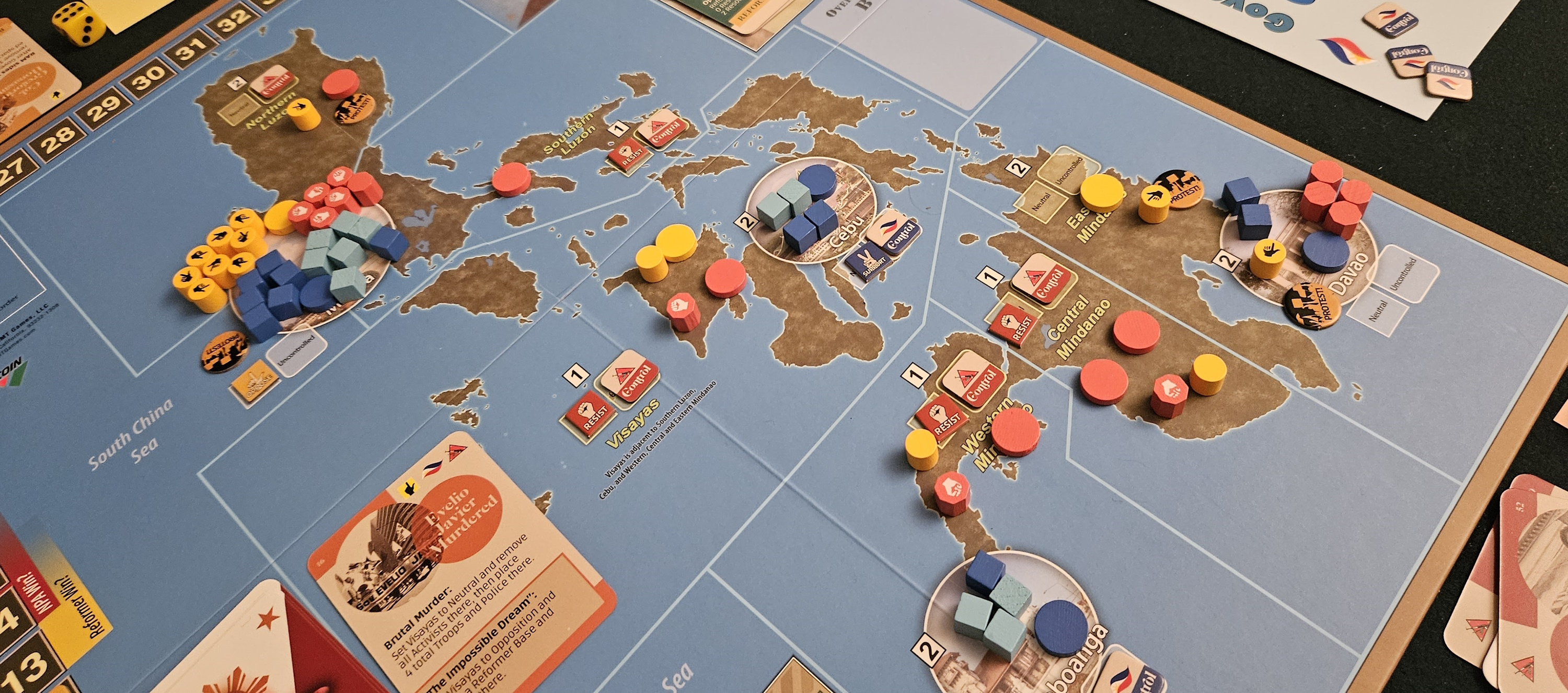
The Philippines on the eve of revolution.
Let’s set the scene. It’s 1981 in the Philippines. Ferdinand and Imelda Marcos have ruled since Ferdinand’s election as the nation’s 10th president in 1965, including a years-long period of martial law enacted to extend his power beyond the end of his legal two terms. In the banal tradition of all dictators, his rule has been marked by human rights abuses. Although Marcos has now lifted martial law to curry favor with the incoming Reagan administration in the United States and to coincide with a visit from Pope John Paul II, he retains most of his privileges and powers.
But power is a slippery thing. That has been the background thesis of the COIN Series since the very beginning, when Volko Ruhnke’s system-inaugurating Andean Abyss exhibited the government crackdowns and evasive drug cartels of Colombia. The Marcos regime has ruled with an iron fist, only to galvanize its opposition with one slap after another. Now two major factions have arrayed themselves against single-rule. This is, like all things in the COIN Series, a painting of broad strokes. But for all its necessary omissions, it’s a robust and dynamic landscape that Tee has splashed together. There’s the New People’s Army, the armed wing of the Communist Party of the Philippines, who have been outlawed and scapegoated across Marcos’s tenure. The NPA fills the usual insurgent role, launching ambushes against government police stations and roving troops, but also embracing the Party’s ground-level ideals, letting them initiate workplace strikes and other labor actions. They’re contrasted by the Reformers, the historical victors of the coming change, who begin with no presence on the map at all. This group, which is both grassroots and planted in the country’s Catholicism, function much like the Congress of Bruce Mansfield’s Gandhi, a faction of invisibles until they appear en masse to launch protests. Given that the People Power Revolution was escalated and concluded by such a gathering, their sudden game-swinging appearance feels like one of those happy details that arise so organically from this series and really no other.
There were historically others, including the Moro resistance that’s been fighting against foreign rule for four centuries, but those have been rounded out in favor of these big three. What a tripod they make. Marcos’s government is all about raw control, using troops and police to secure cities and the countryside while he extracts as much wealth as possible from the people to grant as patronage to his inner circle. The NPA is placed in his path, using guerrillas to launch terror campaigns and build up bases of resistance. And the Reformers sit somewhere in the middle, benign until they present an overwhelming majority that could topple the presidency or crash under their own weight.
It’s a delicate balance, but it’s handled so smoothly that it puts the series’ previous three-sided effort, All Bridges Burning, to shame. Perhaps the biggest change is that every faction can act in a single turn. As before, each round is framed by an event card, a flashpoint that draws the attention of at least two of the game’s sides. Where previous volumes in the series allowed two factions to act per card, that number has been bumped to all three, provided they accept a lesser action and remain eligible for the next event that comes around. This, combined with fewer cards per campaign, results in a pacier game overall, one where players are constantly asked whether they should accept minor gains but remain flexible, or take big impactful actions that will leave them unable to pivot on the next card.

The COIN Series has always emphasized the fluid nature of current events.
Meanwhile, Tee adds some other adjustments to the COIN formula — and they’re possibly the most significant shakeup the series has received since the pivotal event cards of Mark Herman’s Fire in the Lake. Each faction now has two further avenues to success: Personalities and Acts of Desperation. The first represent significant figures in the revolution, here represented as minor adjustments to their faction’s operations. The Marcos regime, for example, might deploy First Lady and “Iron Butterfly” Imelda Marcos for the duration of the upcoming campaign, leaning on her charms to attract larger bundles of foreign aid. But during that same campaign, the Reformers might emphasize Corazon Aquino, who became the core of the People Power movement after her politician husband was murdered by the regime, to sow chaos in urban centers by drawing in new activists.
These Personalities add yet another dynamic to each campaign, not to mention goose the system into some much-needed ideological clarity. COIN has always been somewhat ideologically blank in that we’re shown the outcomes of these ideologies rather than the core values they express. We’re told that a faction is “opposed” to the government, but less often shown in gameplay what one is opposed to, resulting in a flattening of these disparate regimes. Without the benefit of either the playbook or some paraludic context, one could, for instance, mistake Fire in the Lake’s ARVN for the Coalition-backed Afghan Government of A Distant Plain. By putting faces and specific rulings to each faction’s operations, Tee gives us a glimpse into the actual goals of each side. And more than that, shows how these factions don’t represent a single ethic or voice, but must navigate the disparate interests of their adherents. Perhaps the clearest example is the game’s representation of the New People’s Army. An NPA run by Rodolfo Salas will focus on paramilitary attacks, and Rolly Kintanar launches terror campaigns, but Leandro Alejandro is more interested in appealing to workers via workplace strikes. What emerges is a more rounded faction than “insurgent.”
Where Personalities add ideological clarity, Acts of Desperation patch the series’ more temporal struggles. Although political resistance to the Marcos regime lasted many years, the actual People Power Revolution was a demonstration that only lasted four days. The COIN Series has always relied on ambiguous timing to get its point across — a single event card might represent months or minutes depending on the state of the map. But its simulation trends toward the former, giving the sense that years are passing in between each stack of cards, an impression supported by People Power’s framing around multiple elections.
Enter Acts of Desperation. On the second-to-last election round, each faction secretly chooses one of these. They remain dormant until the final election, when suddenly everybody reveals and launches their final action of the game. In many cases, these may have been obviated by developing circumstances; in one recent play, the NPA couldn’t launch a nationwide strike because they hadn’t managed to spark any local worker actions to begin with. However, if the right preconditions are met, these trigger unexpected outcomes for the rest of the table. In that same session, for example, the government successfully concealed their election tampering, resulting in a swing of opinion from the Reformers back toward Marcos. With such compact but crucial impacts, it’s arguable that these cards are the People Power Revolution, hiccups that change the course of history after multiple years of preparation.
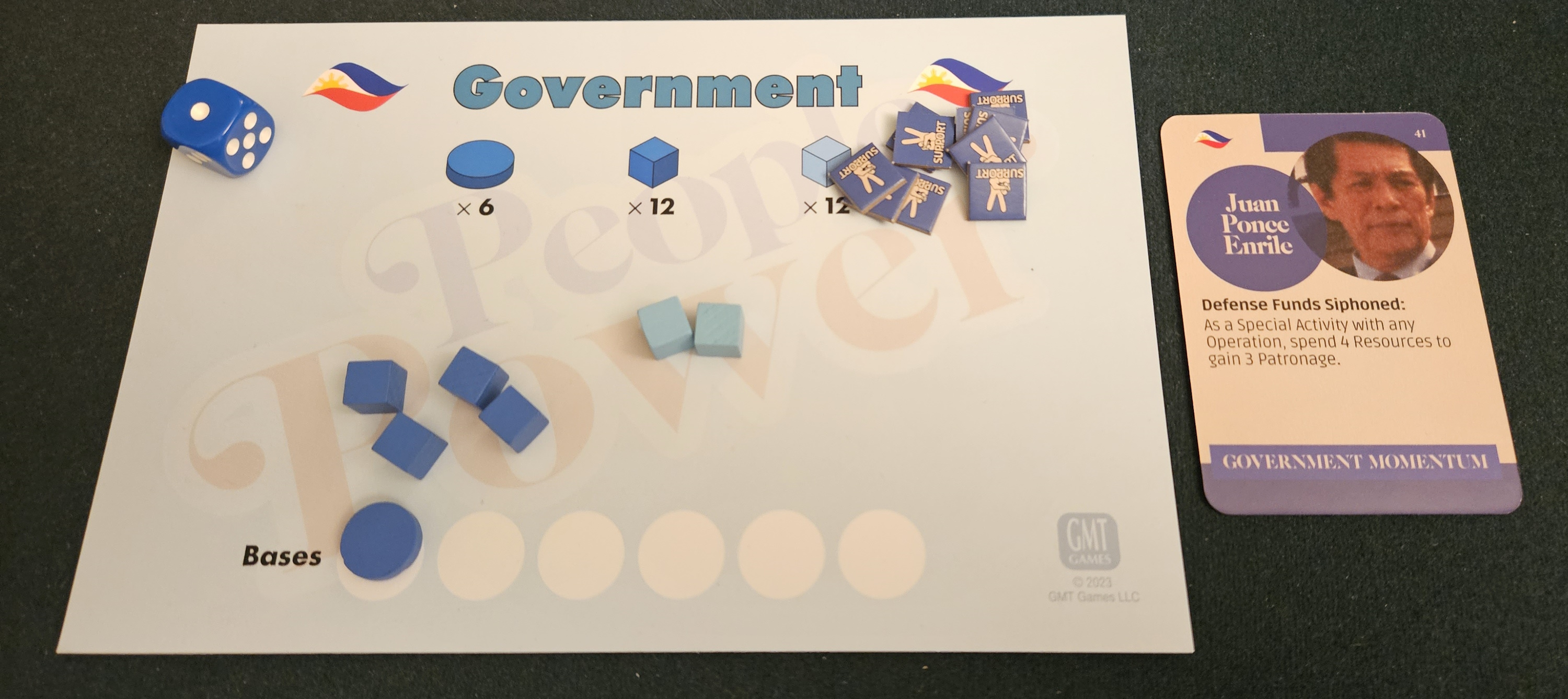
Factions now have access to personalities and acts of desperation.
If People Power has a central weakness, it’s the same one shared by every volume since Ruhnke debuted the system. Like his predecessors, Tee’s political landscape is so carefully tuned that even the slightest nudge can topple a leading player and hand the win to the runner-up. To some degree, this works in the game’s favor. Winning in COIN means tending to both the chronic and acute bodies politic. It isn’t enough to establish support; one must also not abuse that support. At least not too badly, lest one’s power base erode. In this case, it’s surprisingly easy to gain some measure of power, usually by swinging the popular imagination toward resistance or reform, only to see it melt away. People Power is the easiest entry point into COIN since Jeff Grossman’s Cuba Libre, and it teaches both the highs and lows of the system. Both are formidable. The highs demonstrate how insurgencies, counterinsurgencies, and popular movements vie for power in a modern landscape, but the lows bring accusations that the game is decided on the last card flip. That isn’t quite true — a whole lot of careful positioning goes into that final reveal — but it’s easy to see how the series has garnered that reputation.
As for functioning as a stepping stool into the wider series, such a statement should be taken as a relative one. People Power may be simple and approachable for an entry in the COIN Series, but that shouldn’t be taken to mean that it’s simple or approachable as a whole. Indeed, some of its subtleties are so carefully fine-tuned that they escape easy notice. It draws from Eurogames in its abstraction, but stalwartly rejects its tendency for hand-holding. Not only are wrong moves possible and permitted, but it’s often the case that you’re presented with no good moves whatsoever. That, too, is part of the appeal. Appropriately, every event is double-edged, and certainly many of the actions are. To squeeze the country, Marcos must deplete his support. To swing attention to their cause, the NPA opens themselves up to Reformer rhetoric. To draw large crowds, the Reformers put themselves in physical danger.
And there is danger here. In most of our sessions, the Marcos regime has retained power. That’s common for this series, especially in the learning stages. Whether that continues to be the case is beyond my current play count to call. The real People Power Revolution has often been called a miracle, a whirlwind of change that didn’t extract the expected blood toll. Tee’s portrayal can go either way. That strikes me as appropriate, not to mention a timely reminder that our version of events doesn’t always go the worst possible way. There are gaps in the game’s hypothetical. What might have happened if the defecting military had come to blows with those who remained loyal to Marcos? Would the Reformers have been forced to develop a militant arm of their own? These questions are left unanswered, perhaps appropriately so. There are only so many counterfactuals a game like this can explore.
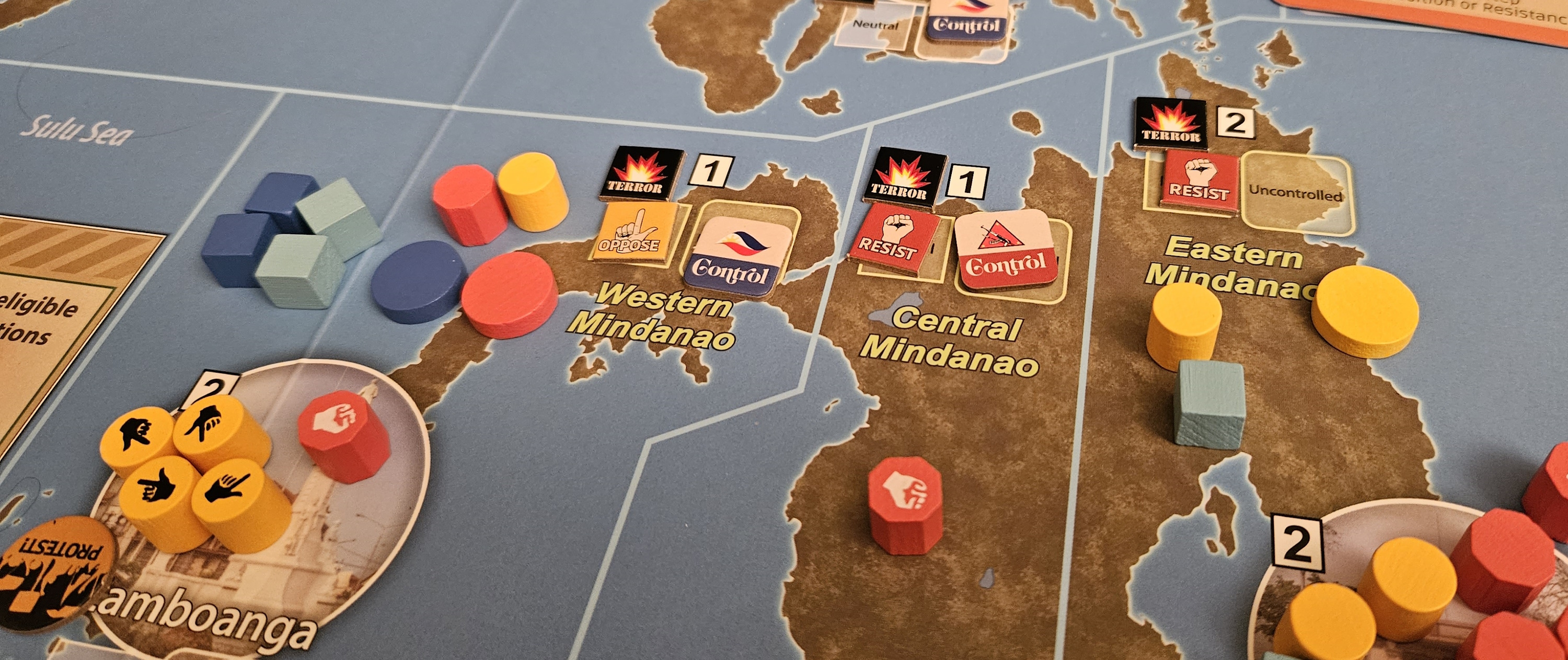
Every type of political power on display.
The result, I must say, is the most excited I’ve been for a main-line COIN volume in quite some time. By refocusing on the basics, Tee has scraped away the barnacles that have adhered to the series over the course of its previous ten volumes. Despite its own complexities, People Power is unburdened. And what it adds in its Personalities and Acts of Desperation feel so suitable to the topic, and add so little overhead, that it would be a shame not to see them represented in the series going forward. I can’t wait to give it another dozen plays.
(If what I’m doing at Space-Biff! is valuable to you in some way, please consider dropping by my Patreon campaign or Ko-fi.)
A complimentary copy was provided.
Posted on August 24, 2023, in Board Game and tagged Board Games, COIN Series, GMT Games, People Power. Bookmark the permalink. 16 Comments.

 SPACE-BIFF!
Great review, I couldn’t agree more with your assessment. People Power really boils the COIN system down to its essence. It plays quickly, its rules are relatively straightforward, and the game is dripping with theme. I’m very impressed with this design.
Excellent review Dan, as usual! I’ve been dipping my toes into COIN and this sounds like just the ticket for my next one!
Best of luck! I hope that you stick with it; the system is deeply rewarding once it clicks. Please let us know how it treats you.
“Without the benefit of either the playbook or some paraludic context, one could, for instance, mistake Fire in the Lake’s ARVN for the Coalition-backed Afghan Government of A Distant Plain.”
[whistling emoji…]
exciting! as a filipino and first time GMT-er, this is what I should get.
If you do, please let us know how it treats you!
Sounds like this is the better 3-player version. When All Bridges Burning came out it was being touted by some as an entry-level version, but I found the player-aids and general faction abilities more convoluted than usual and a poor first impression. I only wish this map looked more exciting/inviting – ABB has a nice table presence, while the map for this one just looks incredibly bland (which is strange because the card design looks to be tremendously more appealing).
All Bridges Burning does some neat stuff, but it is decidedly *not* an entry point to the series. If anything, it’s one of the more radical volumes, given its two-act structure.
Agreed on the art. When GMT wants a COIN game to look great, they can. See: Liberty or Death. And the cards are more exciting here. But the map… yeah, it’s bland.
I’m not sure that the cards aren’t a little too exciting. We played this recently, and some of the Events totally swung the board state.
Wonderful review! I’ve not been able to rope an in person group into this, but I’ve done the tutorial solo and then immediately played a solo game, albeit not with the personalities or Acts yet; I’ll have to incorporate those ASAP once I get comfortable with the flow of play and with the bot flowchart (which is comprehensive but not quite elegant enough for my liking, though I suppose analog bots seldom are).
You’re bolder than I am! I’ve still only used the bots in Cuba Libre. I do not aim to tackle the rest.
“The result, I must say, is the most excited I’ve been for a main-line COIN volume in quite some time.”
I wonder if you can expand on what non-mainline COIN games have you been excited for. I can guess at least Robotech Reconstruction but others?
Sure. Robotech Reconstruction is among them, but also A Gest for Robin Hood and The British Way.
Pingback: Fashion Is Danger | SPACE-BIFF!
Pingback: From Grave to Cradle | SPACE-BIFF!
Pingback: Infinite Gest | SPACE-BIFF!