In the Pale Blood Moon Light

Ryan Courtney is mostly known for games about pipes, but it seems I will forever prefer his less squiggly work. Bear Raid leaps to mind.
From now on, I expect it will be Spectral that leaves the strongest impression. Once every million years, give or take a thousand, the blood moon bathes a haunted house in its crimson light. On that night alone, spectral treasures can be found within. Also curses. Maybe look out for those.
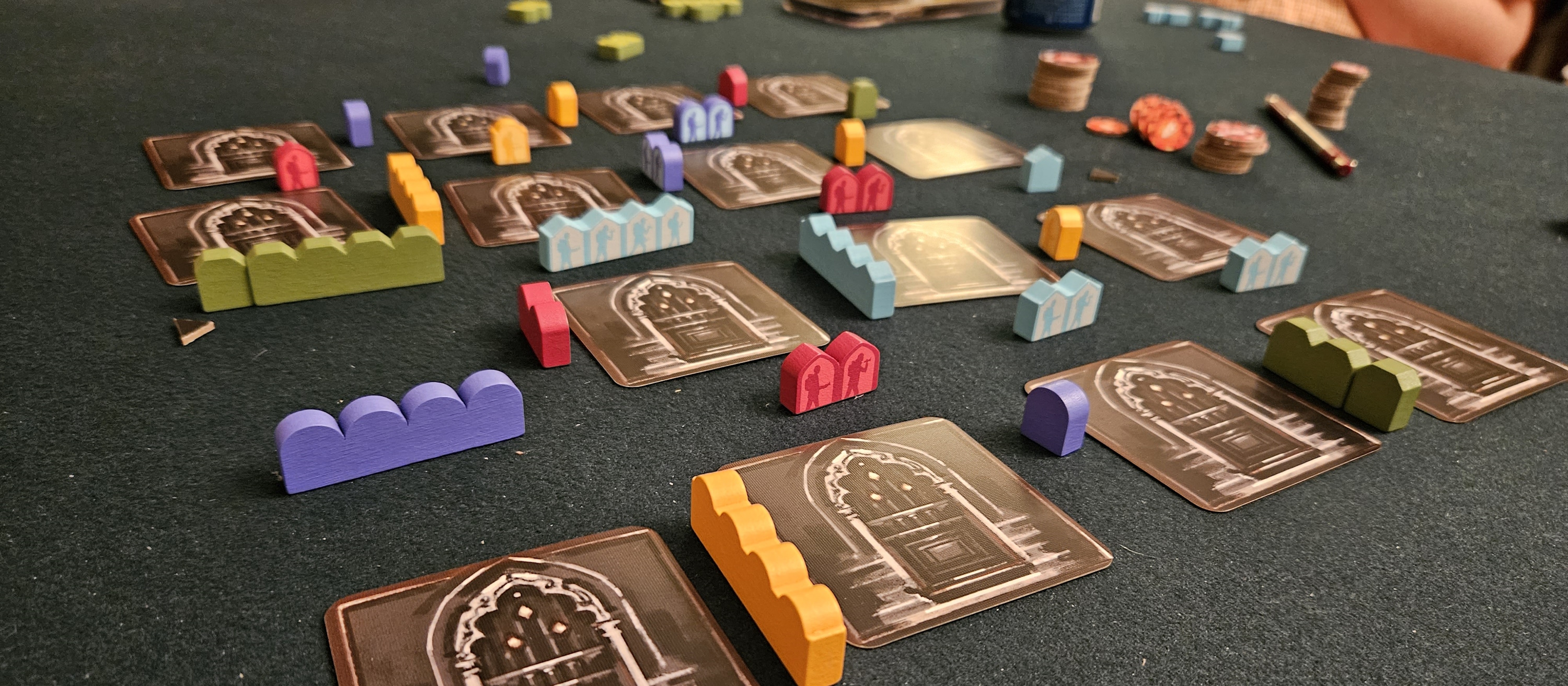
The non-deluxe version is perfectly serviceable.
For all its getup, it’s charming the way Spectral posits itself as a haunted house game that has zero desire to scare anybody — but that it somehow, despite that lack of interest, gets everybody to step lightly all the same. Certainly I’ve wrung my hands harder over its dangers than many of its more straight-faced peers.
That’s because Spectral, far from being a more avant-garde version of Betrayal at House on the Hill, is a deduction and bidding game at heart. Rather than sidestepping specters and ghouls, you’re more preoccupied with the searches conducted by rival treasure hunters. Basically, you can’t round a corner without tripping over another self-styled paranormalist. These aren’t the three-person crews of the Blair Witch Project. You’ve got an entire entourage in tow. Add together all your pieces, and there are something like eighteen people packed into this old house. Per player.
You’ll need them. Every turn functions as both a bid and a clue. In the first case, you place a group of your treasure hunters in one of the mansion’s hallways. This allows you to peek at one of the neighboring cards. These are the aforementioned clues, dropping dollops of information according to a rubric that starts out seeming too obvious, only to grow more complicated with experience and the occasional twist.
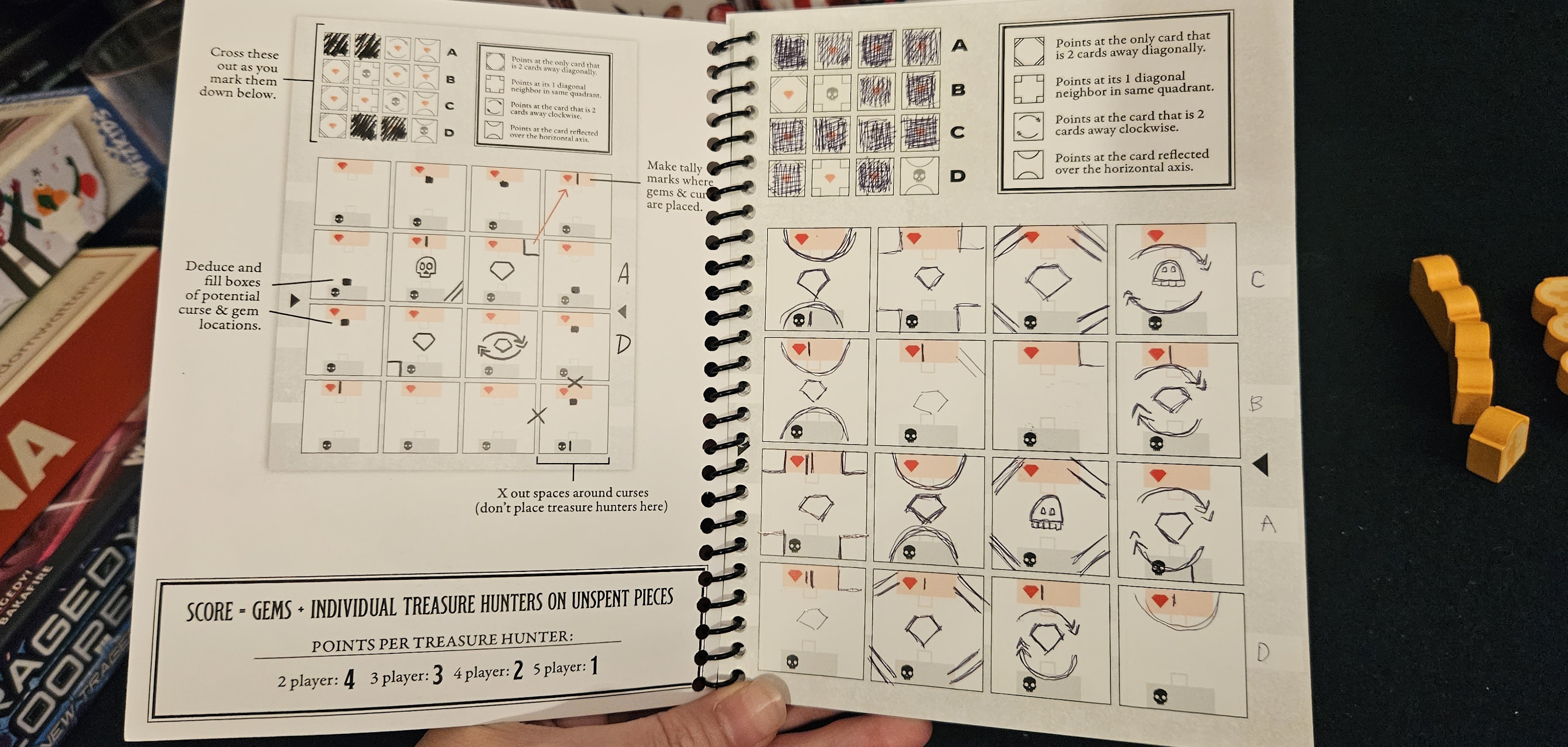
This is a record-keeping game as much as anything.
And there are twists aplenty. The first has to do with the game’s bidding system. Every placement functions as a bid, but they’re also tied to the information you’re dredging from the house. Over the course of placing a hunter here and a hunter there, perhaps you’ve uncovered the location of some gems. Great! Except two of your rivals may have already sussed out that tidbit and placed their treasure hunters in the nearby hallways. Okay, well, you can displace them with your own crew. Except this requires you to double their bid, placing four hunters to bump two, six to bump three, and so forth. By kicking up such a clamor, it’s possible that you’ve now attracted wider attention, bringing yet another player into the auction. Meanwhile, these placements are yielding new clues of their own, generating a spiral of both greater knowledge and escalating bids.
Also escalating danger. When the game ends, you flip over all those cards and finally see where all the gems and curses were located. Gems are the good stuff, getting divvied up between everybody who’s occupied the adjacent hallways. Curses, on the other hand, send any nearby hunters screaming from the mansion in terror. I think that’s what happens, anyway. Maybe they’re ordered to stand in the corner while their friends are murdered. Either way, those treasure hunters are no longer in place to gather up any of their hunted treasure.
The result is a higher degree of apprehension than I’ve felt playing an actual, honest-to-goodness haunted house game. Maybe I care more about stealing diamonds under the sanguine light of a blood moon than I do about random events nipping away at my health points. Because it’s so directly confrontational, Spectral has some bite to it. Losing a squad of looters because you were tricked into sending a whole bunch of them into a corner of the house that was Swiss cheesed with ancient curses is more humiliating than a bad roll.

Watch out for those curses.
This isn’t to say that Spectral is always as nail-biting as it might have been. Its opening turns pass slowly, and the intricacies of how its bids and breadcrumbs interrelate only becomes apparent after a play. That’s usually when it’s time to mix in some more advanced tiles. This, too, presents a unique problem. While Spectral’s puzzle proves deterministic after that initial randomization, which portions you observe may as well be a crapshoot. Every placement is worthwhile to some degree, but there are occasional jackpots. Like, say, discovering a room where two or even three gems will be placed, or isolating the location of the house’s curses. By the time the game concludes you’ll likely have a relatively robust portrait of the map’s layout, but the goal is to isolate those essential clues early enough to act on them. That part is rather uncertain.
Still, navigating this maze takes skill and attentiveness. It isn’t only a matter of gathering and recording information via your own hunters, but also a case of observing the reactions of your foes. Spectral’s tools for social deduction aren’t as robust as its location-based puzzling, but it pays to watch how everybody else is playing. In one recent session, I wandered into a corner of the house everybody seemed to be ignoring. What fools! Why would they avoid this spread of untouched loot boxes! Of course, it turned out that both of my rivals had discovered three curses in close proximity. When at last we revealed the map, nearly all of my crew fled got eaten. That was on me. Even though I hadn’t seen the proof of those curses with my own eyes, I’d seen everybody else tiptoeing around the screaming maws in the floorboards.

The infamous Skittles house.
Perhaps what I like best about Spectral is that there isn’t anything quite like it. It’s thematic in the way Reiner Knizia’s games express theme, drawing focus away from superficial labeling — “Here is a scary thing,” written as italic flavor text — and instead nudging players to behave according to the game’s logic. It’s hardly frightening in the classical sense, but then it isn’t trying to be. Instead, it lets players ramp up their own stakes, lets them make missteps and clever plays by grappling with the incentives and punishments it provides. The result is an inventive and uncommon little thing, deduction with just a whiff of interpersonal dynamics, bidding with just a snatch of horror. Ryan Courtney keeps getting more and more interesting.
Spectral is on Kickstarter for a while.
(If what I’m doing at Space-Biff! is valuable to you in some way, please consider dropping by my Patreon campaign or Ko-fi.)
A prototype copy was temporarily provided.
Posted on August 21, 2023, in Board Game and tagged Bitewing Games, Board Games, Spectral. Bookmark the permalink. 3 Comments.

 SPACE-BIFF!
These sounds really interesting! I love the kind of theme you describe here, where the players (have to? get to?) enter into a particular mindset to navigate the game world. I think it’s really the only kind of theme that interests me long term, after the window-dressing of the setting has faded.
It sounds brilliant. Especially since it’s almost like they chose the theme to fit the gameplay. And it fits!
Thanks for the write-up.
Thank you for reading!