Blog Archives
Criminal Capers: Pumafiosi
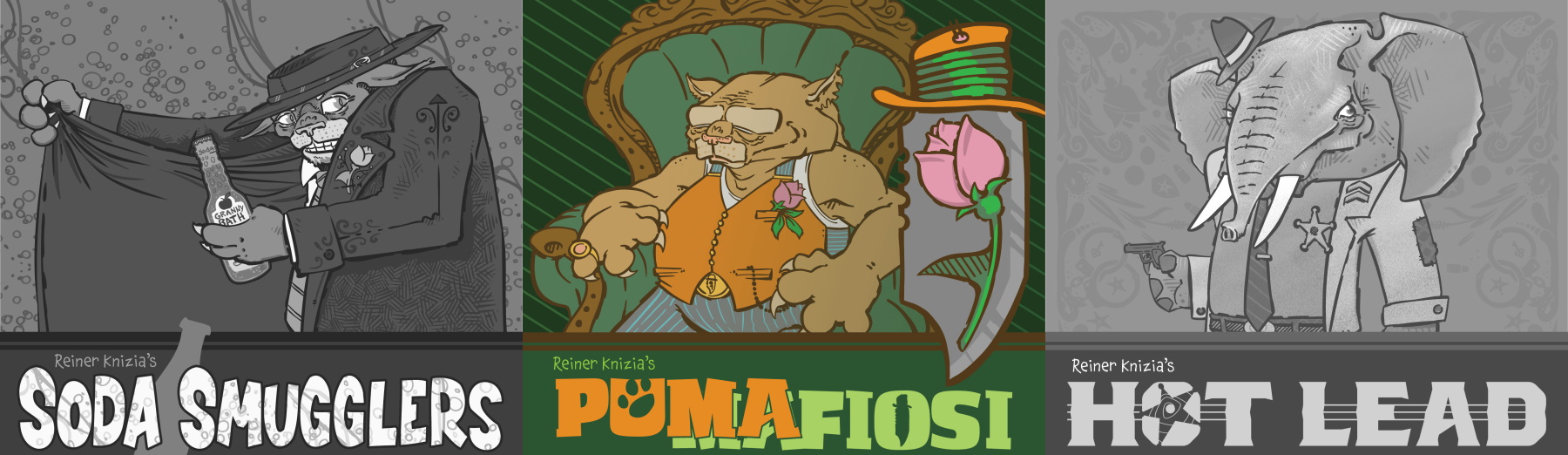
Today, Criminal Capers takes on the mafia. The puma mafia. The pumafia.
Dr. Knizia, you’re a master game designer. Surely you know the value of expertise. So maybe leave the puns to the punfessionals?
Okay, okay. The bones of Pumafiosi are based on Knizia’s own Rooster Booster, which wasn’t exactly the best-received of the good doctor’s catalog. Good thing, then, that Pumafiosi is only partly a remake. This one has layers.
Criminal Capers: Soda Smugglers
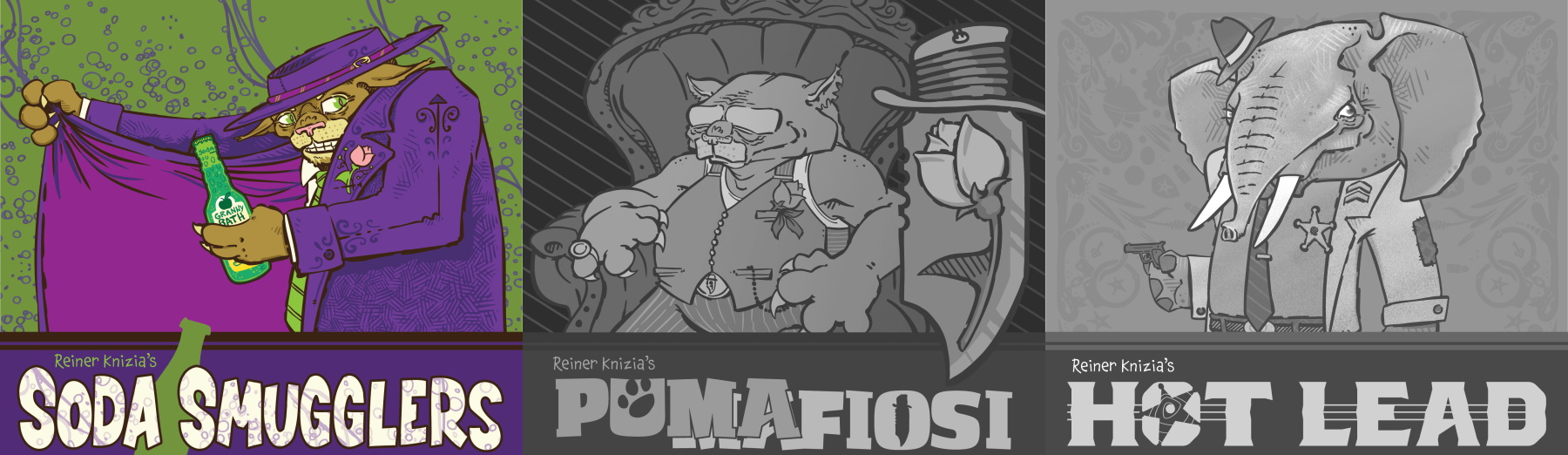
Sometimes, a little Reiner Knizia is exactly what we need. Emphasis on the “little.” That’s the goal of Criminal Capers, a trilogy of digestible titles designed by the good doctor, illustrated by Paul Halkyon, and published by Bitewing Games via Kickstarter sometime next month.
First up, Soda Smugglers.
Smash Octopoda
Some games are serious. They’re meant to model history, make a point, or get you upset about something you never knew existed. Other games are a frivolous delight. They’re here to be consumed, ogled, roughed up. When a piece falls behind the piano — a question of when, not if — the act of recovering it is as much a part of the game as scoring points. These moments aren’t interruptions. They’re continuations.
Crash Octopus is the embodiment of that latter type of game.
The Rival Punworks
Hello. How do you feel about puns? Your answer may well determine how you feel about The Rival Networks, Gil Hova’s latest game — and a minor Hova all around.
Hellenica Handbasket

Civilization games face a particular conundrum. It’s a small thing, even a niggle. I wouldn’t even describe it as solvable. It’s just there, always putting up a fight, demanding a reckoning from designers and forbearance from players. Hardly fair that it always pops to mind when I sit down to play one of these things.
That conundrum is movement. Literally, how your units move across the map. To use it as a metaphor to describe Scott DeMers’ Hellenica, imagine an ancient army departing their city-state, well-provisioned and suitably optimistic, supported by baggage trains and ships and combined arms and allies, only to falter exactly one step short of capturing the city of their oldest rival.
Oaf

Oath is Cole Wehrle’s most off-putting game yet. I mean that affectionately. I also don’t anticipate everybody will feel the same way. Riding high on the goodwill generated by Root and Pax Pamir — and dressed up in Kyle Ferrin’s affable illustrative style — this sure is a beaut for something Wehrle called a “hate letter” to the civilization genre. Would it be rude to accuse such an attractive package of false advertising? Because Oath is so determined to make its audience reconsider their assumptions that it sometimes feels like it’s asking too much.
Sometimes. The rest of the time, I’m glad it asks so much.
Wakey Wakey, Gods and Bakey

Narrative board games — now there’s a phrase that’ll get me yammering. There’s no quicker way to make my eyelids droop than by forcing me to read a middling Young Adult novel in between rounds of combat. There are exceptions. Ryan Laukat’s Near and Far and Above and Below were both charming enough to stick around for a few plays, even if their marriage of choose-your-own-adventure snippets and Eurogame sensibilities wasn’t entirely harmonious. I enjoyed them in bursts before largely forgetting they existed.
But then there’s Laukat’s latest offering, Sleeping Gods. In sharp contrast with both of his earlier narrative games, this is a landmark title. Not only is this his strongest work by far, and not only is it an entirely smooth merger of narrative and cardboard, but it’s possibly the first time I’ve been persuaded that a narrative game can accomplish something remarkable.
Shazan!

It’s been a while since we took a look at Zain Memon’s Shasn, a political game with both comedic and nasty streaks. At the time I called it “one of the most unhinged, perceptive, outlandish, and timely games you might never play.” One crowdfunding campaign, some development, and two whole years later, Shasn is finally here. Let’s see how it holds up in 2021.
I Can’t Help Stationfalling in Love With You
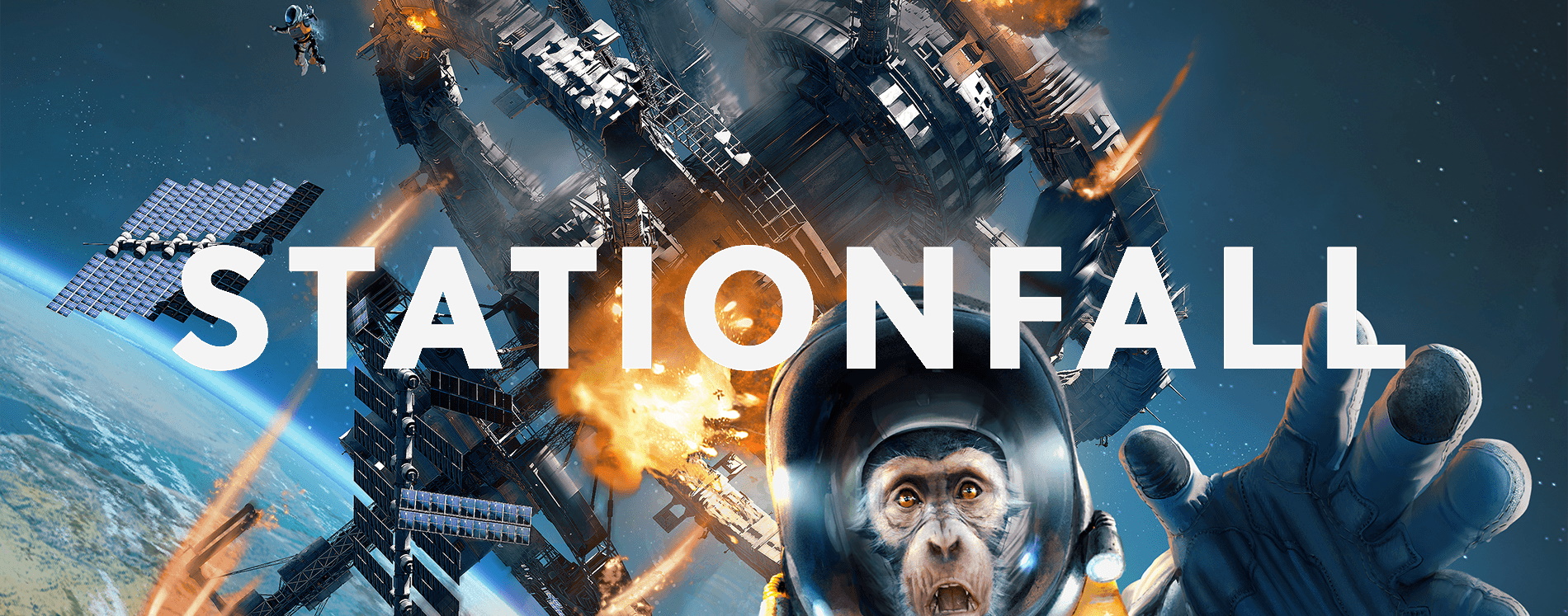
I have a pet theory that board games are great at enabling humorous moments but terrible at comedy. Humorous moments are singular: a joke, a misstep, a callback. Comedy is sustained. That makes it harder because even a single flub can ruin the whole thing. Ever played a party game that was funny for a few minutes but quickly grew dull? Or something like Munchkin, with the occasional cutesy card but agonizing gameplay? It’s one thing to provide prompts and let players riff. Another entirely to keep the humor coming. There’s a reason funny games are usually short. They exist to enable humorous moments, not real comedy.
Hence my personal metric: It isn’t enough to be funny. A great comedy board game has to be funny even when you’re losing. By that metric, Matt Eklund’s Stationfall is the latest addition to my personal pantheon of games that never fail to make me laugh.
Eighty-Caliber Smooches

More and more, I hear acquaintances saying things like, “Oh, I might have played that game back when I had reflexes.”
As someone whose video game reflexes existed for all of two months during the halcyon days of Unreal Tournament 2004, I’m happier with cardboard. Joshua Van Laningham’s Bullet♥︎ is an adaptation of the shoot-’em-up genre. Frankly, I like it better than any shmup I’ve fumbled through.

 SPACE-BIFF!