Blog Archives
Arabian Hammer
Periodization is a funny thing. Sorting history into discrete blocks is useful for the sake of memory and study, but often proves misleading the instant somebody takes those blocks as gospel rather than as a loose mental framework.
Take the unification of the Arabian Peninsula. From the European perspective, the ascent of the House of Saud was paved by the evaporation of the Ottoman Empire. On the Peninsula itself, however, the conflict had deeper roots, bound up in feuding tribal dynasties, the distant interests of multiple imperial overlords, and the passage of many decades.
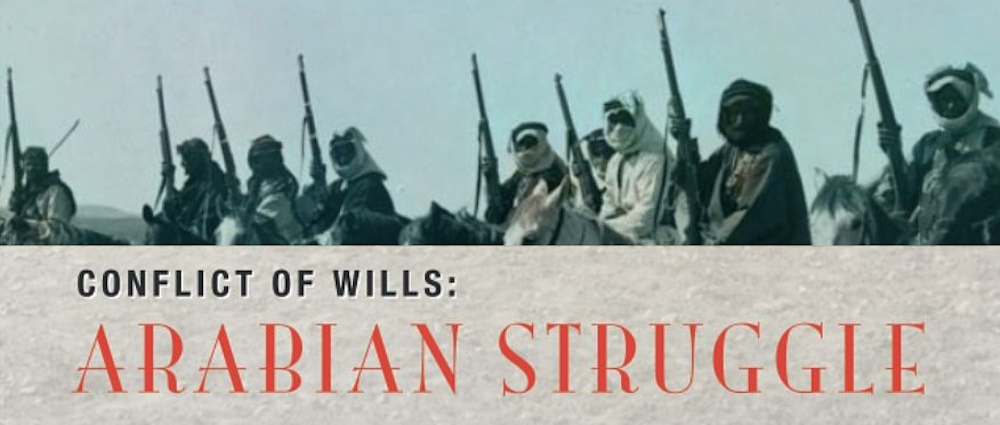
Arabian Struggle, co-designed by Nick Porter and Tim Uren, and drawing on the Conflict of Wills system initially expressed in Robin David’s fascinating Judean Hammer, emphasizes the long view. A dozen wars, countless battles and raids and negotiations, and even the Great War itself are mere beats in its epochal narrative. At ten thousand feet, the details get fuzzy. It’s to Porter and Uren’s credit that the overall thrust of the conflict never goes missing.
Space-Cast! #30. Remembering Stonewall
On this day in 1969, a police raid in Greenwich Village sparked three days of intense rioting by members of the gay community. This was the turning point in the fight for LGBT+ rights in the United States. Today we’re joined by Taylor Shuss, designer of Stonewall Uprising, to discuss how his game charts the beginnings of the Pride movement, wading into the muddy waters of gamifying the AIDS epidemic, and how playing as history’s baddies can give players a deeper perspective on civil rights.
Listen here or download here. Timestamps can be found after the jump.
The Ungovernable Stonewall Uprising

This past August, an apostle of the Church of Jesus Christ of Latter-day Saints spoke to the assembled faculty of Brigham Young University to call for both the building and the defense of that institution. His twin metaphors were a trowel and a musket; the topic, same-sex marriage. There’s been much hubbub over what he “really meant.” Such a discussion will always be academic, inherently disconnected from how his words were actually received by their countless recipients. Within hours of that talk, I sat by the bedside of a fourteen-year-old girl. She hid her freshly scarred forearms from view. She asked me why God hated her. Why God had made her this way if only to hate her. Why that kindly apostle hated her. Why she hated herself.
Hate is not an easy topic for a board game. Nor, really, is love. With Stonewall Uprising, designer Taylor Shuss takes a chance by asking his players to embody both of them. One player becomes Pride, determined to carve out equal rights in a land that has always promised big and fallen short. The second player becomes The Man. The Man is there to hate. To hate and to take and to demoralize. It’s exhausting to play as The Man. Exhausting but essential.
His Glory Shall Be Dung and Worms

This one is going to take some explaining.
Our story begins with Alexander the Great. If he were the archetype of a Civilization player, he was the guy who scouts and attacks in only one direction, conquering much of three continents while leaving his capital city way back in the rear. Upon his death, it was unfathomable that anyone could administrate a kingdom that stretched from Macedon to India, so his generals spent the next forty years warring over the pieces. Alexander’s empire was fragmented, but his successors spread Greek culture and language and warfare across the known world. The Hellenistic Period was now in full swing.
Jump forward a century. One of Alexander’s many acquisitions had been Judea, claimed during his war against its former overseer the Achaemenid Empire. The encroachment of Hellenistic culture chafed at the Judeans, but they managed to endure the oversight of one Greek successor state (the Ptolemaic Kingdom) until a second state (the Seleucid Empire) claimed their suzerainty during an invasion of the former. The Judeans were now under the rule of Seleucid King Antiochus IV Epiphanes, who took a somewhat more liberal view of his rights within their territory, including the capacity to dictate local religious practices. When ordered to sacrifice to the Greek gods, a priest named Mattathias expressed his disagreement rather sharply by stabbing the king’s representative. This act of disobedience sparked a general rebellion under Mattathias’s son Judas Maccabeus, a years-long conflict that concluded with Judean victory and the founding of the Hasmonean Dynasty.
That revolt against the Seleucids is where the Jewish holiday of Hanukkah comes from. Less importantly but more relevantly, it’s also the topic of Robin David’s Judean Hammer.

 SPACE-BIFF!