Blog Archives
We Call Them Cylons

There was never a chance that Unfathomable would sweep me off my feet. From its very announcement, when news broke that Tony Fanchi would be recasting Cory Konieczka’s Battlestar Galactica: The Board Game as yet another volume in Fantasy Flight’s loosely connected Arkham Horror Files, a single unexpected, uncharacteristic thought barged into my head:
How distasteful.
Am I Happy or in Misery?

Bernard Grzybowski’s Purple Haze, currently funding on Gamefound for the next day or so, claims to be “an immersive story-creation campaign game for 1 to 4 players that drops you into the heart of darkness: Vietnam, 1967.”
As buzzwordy an introduction as that is, it’s all true on a technical level. It’s a game. It’s immersive. It openly asks its players to take its icon-laden framework and breathe the life of a personal story into its vacant lungs. Yes, smart-ass, it plays with 1 to 4 players.
More than that, though, as I’ve been playing it over the past couple of weeks, I can’t help but think there’s a better descriptor. Purple Haze is all of those things. It is also a neon-lit warning sign about how difficult it can be to make a game about serious subject matter.
Checking the Rules: The Board Game

In Nathan Woll’s Free Radicals, the free radicals are not the sexy cyberpunk characters frolicking on the cover. A free radical is apparently what we’ve decided to name the hovering alien spacecraft that have settled over the surface of our planet. These artifacts are fonts of limitless knowledge. But where Denis Villeneuve’s film Arrival, based on Ted Chiang’s short story “Story of Your Life,” posited that first contact was an exercise in linguistics, these free radicals are more interested in helping us do capitalism better.
In game terms, that translates to ten different factions each playing their own game. Keep those rules sheets handy. You’re going to need them.
The Little Bang

Sometimes when I’m feeling anxious, I’ll wander over to the NASA page to look at the most recent images coming in from the Hubble Space Telescope. There’s something about two galaxies colliding that makes my problems seem small by comparison. I’m not joking. The sheer enormity of the cosmos is utterly calming.
With Cosmogenesis, Yves Tourigny sets out to present only a small slice of the cataclysm of creation that is our universe. As with my Hubble pics, I’m enchanted despite its shortcomings. Even more so because, somewhere behind the colliding debris, Cosmogenesis is about the interrelationship of all things.
Sopophoria

Multiplayer solitaire gets a bad rap. Some folks use the phrase as an insult. But the truth is that sometimes I want to interact with my friends directly and other times I want to sit alongside them, maybe chatting, maybe sharing snacks, while playing in parallel without the pressures of competition.
Cascadia, designed by Randy Flynn and beautifully illustrated by Beth Sobel, is multiplayer solitaire to its core. So much so that its best descriptor is “sleepy.” And not necessarily in a bad way.
McDune
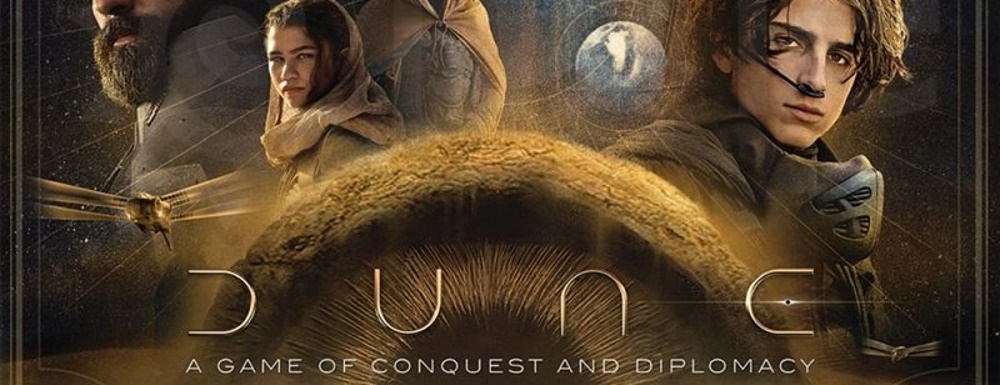
Dune. That inscrutable novel. As a youngster it seemed to me to be about purpose and awakening, puberty maybe, definitely victimhood, all trammeled by the reality that every life touches everything else, sometimes for the better but often for the worse. Its game adaptations, both cardboard and digital, were disappointingly narrow, preoccupied with the competing factions that served as the backdrop to its larger questions. Of those many attempts, however, the closest anything came to approximating the feel of Frank Herbert’s magnum opus was Bill Eberle, Jack Kittredge, and Peter Olotka’s 1979 board game, the very same that received a supernal remake only a few years back.
Dune — the 1979 board game — was also longer than Shai-Hulud. In an attempt to bring it under control for modern audiences, Gale Force Nine tapped Greg Olotka and Jack Reda to help create something more digestible. An abridgement, if you will.
The resultant Dune: A Game of Conquest and Diplomacy is certainly more playable. But it’s more playable the way bowdlerized Shakespeare is more watchable. Most of the individual beats have survived intact. All the same, the cutting has not been kind to the overall intention of the piece.
Roshamdon’t

Only a big damn nerd would know that the Kardashev Scale is a hypothetical measurement of a spacegoing civilization’s energy potential. Theorized by Soviet astronomer Nikolai Kardashev in 1964, it posits that a civilization might fall into one of three levels, either harnessing the energy output of their entire planet (type-I), planetary system (type-II), or host galaxy (type-III). The concept plays a minor but pivotal role in Liu Cixin’s The Three-Body Problem. If you don’t remember that part, it’s when Ye Wenjie figures out she can bounce a signal off the sun, effectively granting our sub-type-I species the communications potential of a type-II civilization. Spoiler alert.
Like I said: big damn nerds.
Stephen Avery and Eugene Bryant’s Kardashev Scale might also appeal to big damn nerds. But probably more because they’re hopping up and down at the sight of a board game entitled Kardashev Scale than because it’s any good.
The Socialist Bloc
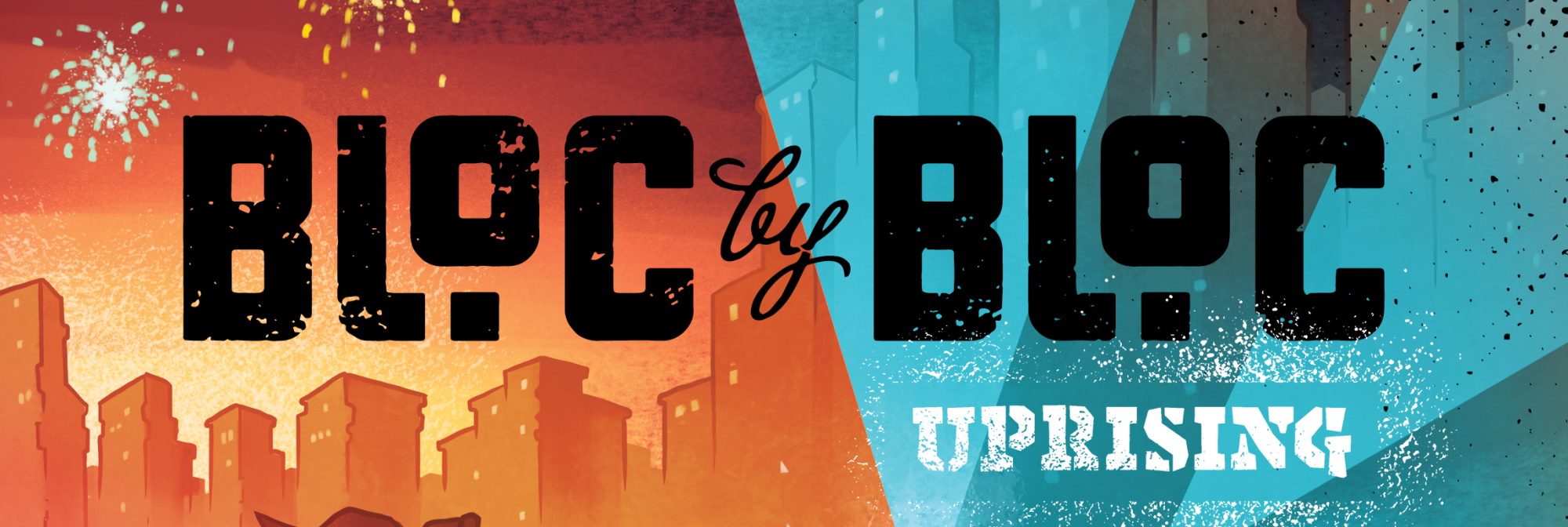
It’s impossible to separate T.L. Simons’ Bloc by Bloc from recent events. I can’t imagine it isn’t intentional. Black Lives Matter. January 6th. Anti-vaxxers outside public health professionals’ homes. The ban on peaceful protest handed down by Brigham Young University. That last one was two weeks ago. Yesterday, the university tweeted about Martin Luther King Jr. and Gandhi. Has irony died or did somebody seize control of the company login? We may never know.
To be absolutely clear, I’m not placing these examples on equivalent moral footing. I suspect most people would agree that at some point a government may become too corrupt or too detached from the will of its people to continue, and that when peaceful action is no longer possible then more dramatic measures become necessary. But if the last few years have taught us anything, it’s that we all boil at different degrees. Also, we boil at very different degrees of truth claims. And while some pots boil, others explode feces all over the walls.
Thankfully, Bloc by Bloc isn’t ideologically agnostic. It’s radically and refreshingly committed to egalitarianism, clear-eyed about the contradictions that tug at modern efforts to effect change, and both deeply angry and hopelessly idealistic.
Foucault in the Woodland, Part Three: Devouring Your Children
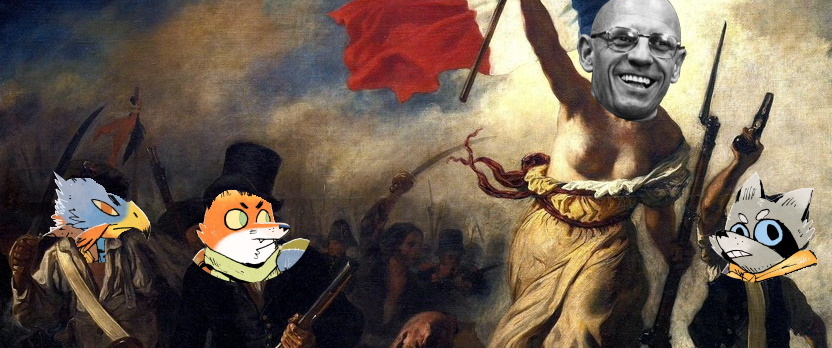
It was the Genevan journalist Jacques Mallet du Pan who wrote the famous phrase, “Like Saturn, the Revolution devours its children.” Writing in 1793, the year of King Louis XVI’s execution and the establishment of the First French Republic, du Pan was a proponent of the juste milieu, a “middle way” between autocratic and republican impulses. Considered both hopelessly naïve and tragically Cassandran, he died in exile in 1800, having watched his adoptive country pass through the Reign of Terror and into the hands of Napoleon Bonaparte.
Over the past two installments, we’ve investigated how Cole Wehrle’s Root leverages the philosophies of Michel Foucault to tell a fable about power and control. Today, we’re putting those tools to use.
The North Goes West

It’s been a while since we traveled to The North, John Clowdus’s high-tech take on an apocalyptic wasteland. Such a while, in fact, that there’s now a sequel, The West: Ascendant, which abandons the robotic striders of the frozen wastes for the latent facilities of the blasted wastes. Seems a wanderer can’t catch a break.

 SPACE-BIFF!