Blog Archives
We’re the Messypotamians

I’m not sure I’ve ever played a game with so many tremendous ideas and so many disastrous executions as Sammu-ramat. Designed by Besime Uyanik and published through Ion Game Design, which Uyanik runs as CEO, it tells the tale of the titular Neo-Assyrian queen, Sammu-ramat, who succeeded her husband and seems to have co-ruled during the reign of her son, Adad-nirari III.
I say “seems” because the sources are thin on the ground — a few stelae here, some woman-queen legends there, all par for the course for an empire nearly three thousand years removed from our present circumstances — but historians largely agree that Sammu-ramat held an unusual position of prominence. This is a world I would love to see explored in detail, packed as it is with court intrigues, military campaigns, and early empire-making, not to mention the prospect of a queen bending that empire to her will. Unfortunately, this board game rendition of Sammu-ramat’s life leaves its most pressing questions unanswered.
A Mindful Rain

It’s been said many times before, but A Gentle Rain is not Kevin Wilson’s typical fare. Highly abstract, both in setting and objective, and showcasing a willingness to sidestep victory conditions altogether — a willingness that Wilson doesn’t wholly indulge in, although he gets close — this has all the makings of a pet project. For all that, it’s beautifully crafted and clearly wants to communicate something, even if that something is fuzzier around the edges than most board games manage.
I didn’t get it. The first time I played it, that is.
Resistance in France

“Timely” isn’t my favorite descriptor. It’s such a trite word, like we’re trying to persuade somebody to take our hobby seriously. I tend to feel that board games are timely because somebody bothered to create them right now, in this time and place, and the sooner we assume that contemporary objects have contemporary meanings, the better and more durable they become.
Unfortunately for all of us, concentration camps are back in fashion and due process has been downgraded to an inconvenience. These are the years that make art like In the Shadows not only timely but necessary, if only as a reminder that people have, elsewhere and in other times, resisted movements every bit as stupid and cruel as those rolling off their overfed haunches today. Dan Bullock and Joe Schmidt have an eye for such examinations, and In the Shadows is no exception. As models go, the history they display here is both a reminder and a corrective. If only we didn’t need them so badly.
In the Margins

At a mechanical level, In the Ashes, the gamebook by Pablo Aguilera, is a major accomplishment. Full of novel solutions to problems that have dogged the format since somebody first decided to put a game inside a book, I was repeatedly struck by Aguilera’s creativity. Nearly every encounter did something new, exciting, or innovative. Sometimes all three at once.
But before you order the thing, let’s rein in our expectations. In the Ashes is also a hot mess. At least in the format I played it, anyway.
Fire Hazards

Alley Cat Games recently sent me three board games that have one thing in common: each one of them is about a different fire hazard. That’s right, kids. Only you can prevent forest fires.
I guess there are some other commonalities. Like the fact that each of these games is packaged in a mint tin, costs fifteen bucks at most, and knows exactly how to make a tiny board game look amazing. Take my hand as we kindle each fire one at a time — or douse them. It’s safety time!
A Desire for More Cows

Something is in the air. Unseen. Vibrating. Friscalating. Between A Message from the Stars, City of Six Moons, and Out of Sorts, it almost seems like we’re being prepared for some grand task, an entire species press-ganged into the labor of translating alien missives.
Or maybe I just really like first contact stories.
Signal, created by the design collective Jasper Beatrix, bears a singular honor. This is the best of the recent spate of games about communicating with aliens. But more than that, it’s a game I’ve delayed writing about so I could play it over and over again, reveling in its unparalleled sense of experimentation and discovery.
Gleaning Aidalon

I suspect there’s some wordplay behind Hubworld: Aidalon, the forthcoming card game by Michael Boggs and Cory DeVore. In ancient Greek literature, an eidolon is an image-spirit, a sort of displaced hologram that allows a character to be present without actually, you know, being present. In his drama Helen, for example, the Athenian tragedian Euripides contends that Helen of Troy had been whisked away to Egypt prior to the great war. There she languished, replaced by a phantom who launched a thousand ships in her name.
As references go, it’s a subtle but fitting nod. Hubworld: Aidalon is itself an eidolon, an image-spirit of Android: Netrunner that may perhaps launch a thousand icebreaker runs in that game’s absence. Certainly it’s already launched a couple dozen such runs on my table. Coming soon to Gamefound, Earthborne Games is offering two decks for the cost of shipping while supplies last. And I’m pleased to report that this early peek is as promising as they come, not only burning the afterimage of Netrunner into our retinas, but in some ways offering a fuller and more exciting take on the concept.
Cul-de-Sac Caper
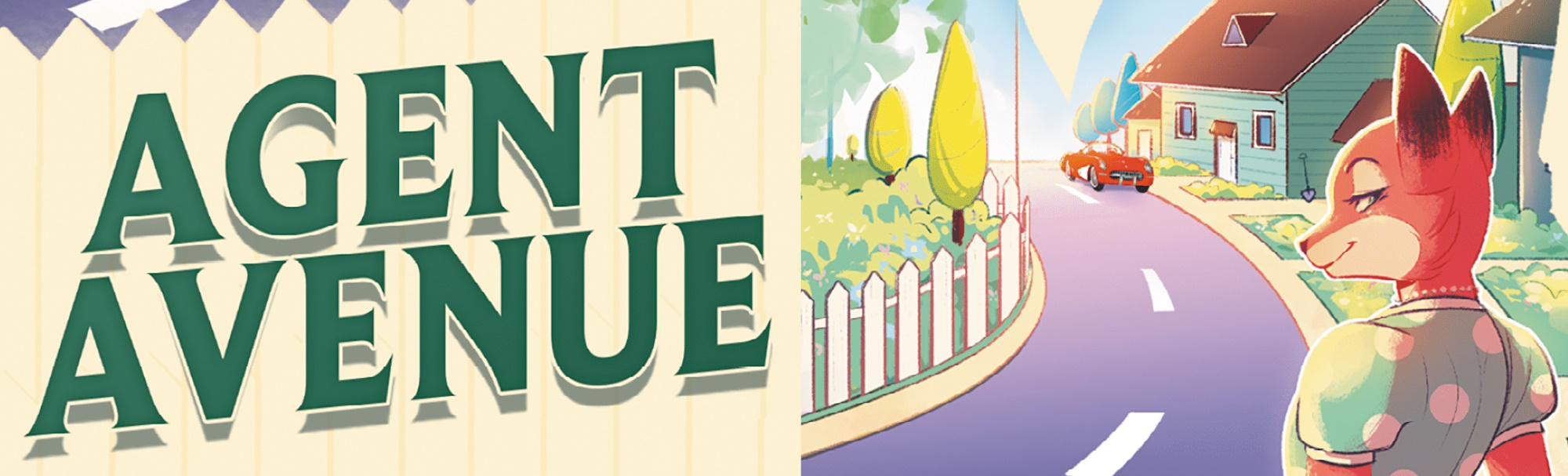
It’s incredible how the smallest change — like, say, player count — can transform a game from a perfectly fine experience into a cerebral tango. That’s a dance with brains, m’dear.
Agent Avenue, designed by Christian and Laura Kudahl, is one such title. Two secret agents have gone undercover in the same suburban neighborhood. Now they’re recruiting their neighbors in a race to out their rival before they get similarly de-closeted.
Two Minds in the Wild

Brock: What’s that noise from the woods? Is it the call of a rare bird?
“Coo. Coo.”
No, that’s not quite what I’m hearing…
“Two. Two.” Yes, that’s it! “Two… Minds!” Once again, I have lured Dan into the mountains to talk about a board game.
Dan: I can’t believe I agreed to let you write the intro.
Sharkboy vs. Octoboss

Carl Robinson is onto something with Kelp: Shark vs. Octopus. Hidden movement games have always been asymmetrical; there’s no hide-and-seek without both hiders and seekers. But in Kelp, that asymmetry is pushed in exciting new directions.
The concept will make sense to anybody who’s so much as glimpsed a nature documentary. One player becomes the Shark, a sleek killing machine running on pure reflex. The other is the Octopus, doing its darnedest to rustle up some snacks without becoming one. It’s a battle of muscle versus wits, one evolutionary path pitted against another to determine which is the more viable.

 SPACE-BIFF!