Introducing DT²
Just the other morning, something in my ear rattled. So I did what any red-blooded human person would do: stuck my pinkie finger in there and tried to repair the problem through brute force.
Long story short, I now require a tympanoplasty. But this expensive medical procedure has afforded me the opportunity to broaden the horizons of my little website. As of today, I’m proud to announce that I will finally be able to acronymize my name without confusing everybody. That’s because I, Dan Thurot, am now a proud member of the Dice Tower Network. We’re calling it DT².
Fire Hazards

Alley Cat Games recently sent me three board games that have one thing in common: each one of them is about a different fire hazard. That’s right, kids. Only you can prevent forest fires.
I guess there are some other commonalities. Like the fact that each of these games is packaged in a mint tin, costs fifteen bucks at most, and knows exactly how to make a tiny board game look amazing. Take my hand as we kindle each fire one at a time — or douse them. It’s safety time!
A Desire for More Cows

Something is in the air. Unseen. Vibrating. Friscalating. Between A Message from the Stars, City of Six Moons, and Out of Sorts, it almost seems like we’re being prepared for some grand task, an entire species press-ganged into the labor of translating alien missives.
Or maybe I just really like first contact stories.
Signal, created by the design collective Jasper Beatrix, bears a singular honor. This is the best of the recent spate of games about communicating with aliens. But more than that, it’s a game I’ve delayed writing about so I could play it over and over again, reveling in its unparalleled sense of experimentation and discovery.
Space-Cast! #45. Kelly House
Molly House! There’s a good chance you’ve heard of this recent release about queer joy in 18th-century London. Today we’re joined by Jo Kelly to discuss the origins, development, and challenges of creating such a game, including the perils of “emotional hit points,” the difficulties of representing queer joy, and why it’s so important that betrayal was included as an in-game option.
Listen here or download here. Timestamps can be found after the jump.
Gleaning Aidalon

I suspect there’s some wordplay behind Hubworld: Aidalon, the forthcoming card game by Michael Boggs and Cory DeVore. In ancient Greek literature, an eidolon is an image-spirit, a sort of displaced hologram that allows a character to be present without actually, you know, being present. In his drama Helen, for example, the Athenian tragedian Euripides contends that Helen of Troy had been whisked away to Egypt prior to the great war. There she languished, replaced by a phantom who launched a thousand ships in her name.
As references go, it’s a subtle but fitting nod. Hubworld: Aidalon is itself an eidolon, an image-spirit of Android: Netrunner that may perhaps launch a thousand icebreaker runs in that game’s absence. Certainly it’s already launched a couple dozen such runs on my table. Coming soon to Gamefound, Earthborne Games is offering two decks for the cost of shipping while supplies last. And I’m pleased to report that this early peek is as promising as they come, not only burning the afterimage of Netrunner into our retinas, but in some ways offering a fuller and more exciting take on the concept.
Cul-de-Sac Caper
It’s incredible how the smallest change — like, say, player count — can transform a game from a perfectly fine experience into a cerebral tango. That’s a dance with brains, m’dear.
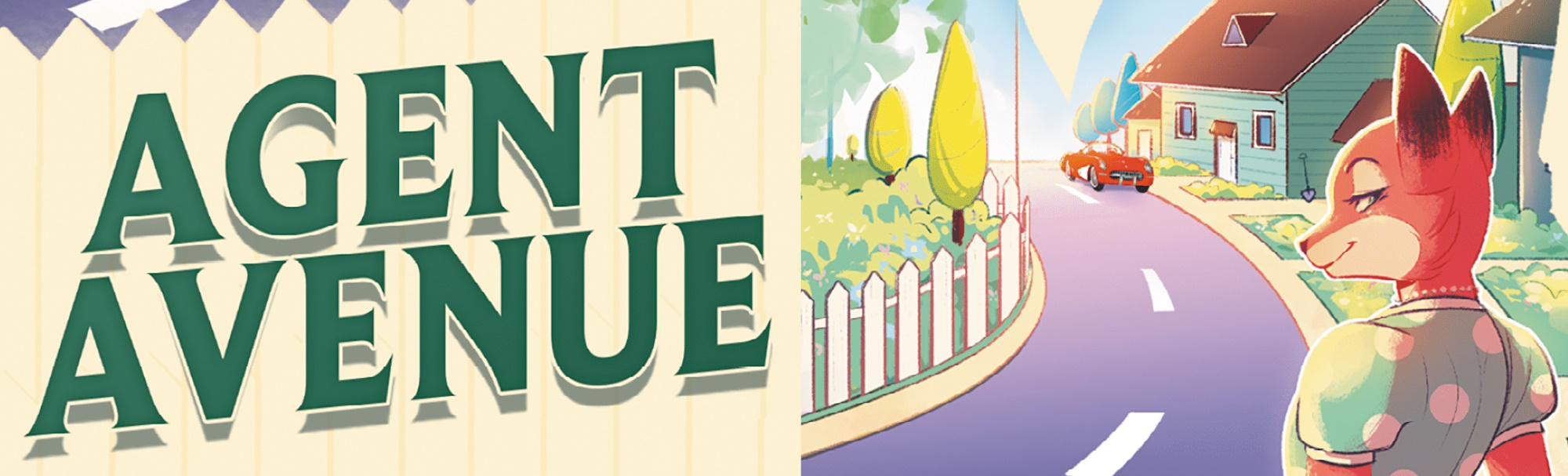
Agent Avenue, designed by Christian and Laura Kudahl, is one such title. Two secret agents have gone undercover in the same suburban neighborhood. Now they’re recruiting their neighbors in a race to out their rival before they get similarly de-closeted.
Two Minds in the Wild

Brock: What’s that noise from the woods? Is it the call of a rare bird?
“Coo. Coo.”
No, that’s not quite what I’m hearing…
“Two. Two.” Yes, that’s it! “Two… Minds!” Once again, I have lured Dan into the mountains to talk about a board game.
Dan: I can’t believe I agreed to let you write the intro.
Sharkboy vs. Octoboss

Carl Robinson is onto something with Kelp: Shark vs. Octopus. Hidden movement games have always been asymmetrical; there’s no hide-and-seek without both hiders and seekers. But in Kelp, that asymmetry is pushed in exciting new directions.
The concept will make sense to anybody who’s so much as glimpsed a nature documentary. One player becomes the Shark, a sleek killing machine running on pure reflex. The other is the Octopus, doing its darnedest to rustle up some snacks without becoming one. It’s a battle of muscle versus wits, one evolutionary path pitted against another to determine which is the more viable.
Strategic Prayer

Faith. On a few occasions, I’ve written about the prospect of board games as expressions of belief. More than one designer has made the attempt, usually by offering some perspective on history, as in The Acts of the Evangelists, The Mission, and Nicaea, but not so often by reflecting on individual devotion. I suppose Ierusalem: Anno Domini is the closest I’ve seen, with its sacramental closeness, but that one was so burdened by its gamier elements that any deeper relationship was washed out with the flotsam.
Imagine my surprise when such a game appeared on my table, not born of my native Judeo-Christian education or background, but courtesy of the third branch of our shared family tree. Designed by Ahmad Salahuddin, Usolli is about performing salah, the five daily prayers of Islam, amid the hustle and bustle of modern life. It’s lighthearted but earnest, sweet and funny and focused wholly on personal action. And although I have a few hangups about Usolli as a game, I appreciate what Salahuddin is trying to do here.
Kinfire. That One.

Here’s a funny thing: playing Kinfire Delve, the three small boxes spun off of Kevin Wilson’s much grander Kinfire Chronicles: Night’s Fall, I figured they must be runty versions of the larger thing. Those side quests feature the same cast of heroes as Chronicles, albeit parceled out two per box, with a card system that sees them either using cards for their principal effects or to boost their fellow heroes. Surely, I assumed, the massive slab that was Kinfire Chronicles would be deeper, smarter, more compelling?
If anything, it’s the other way around. I’ve been playing Kinfire Chronicles: Night’s Fall for some months now, picking through its storybook, slaying its monsters, and scouring the lighthouse-protected city of Din’Lux for its coziest inn. And I have to say — I prefer the little ones. By a lot.

 SPACE-BIFF!